The Infinite Zenith

Where insights on anime, games and life converge

Category Archives: Aobuta

Seishun Buta Yarō wa Santa Claus no Yume wo Minai – Whole-Series Review and Reflection

“If you do not wish to feel this pain, which is completely understandable, you need to answer my question without hesitation. So…who is your contact in the village?”
“Claus.”
“Who is this ‘Klaus’?”
Santa Claus.”

–Rudi Jäger and William J. Blazkowicz, Wolfenstein: The Old Blood

Upon entering university, Sakuta finds himself making acquaintances of Takumi Fukuyama and Miori Mitō, as well as meeting up with Uzuki, who’s now a post secondary student. Uzuki proves to be a little more attuned to the feelings of those around her, and Sakuta later learns she’s struggling to decide whether she should take an offer to perform as a solo idol. Sakuta also notices a young woman clad in a Santa-themed miniskirt. Once Uziki regains her bearings, Sakuta begins to hear rumours of a viral trend, #DREAMING, where people allegedly dream about the future. He meets up with a classmate from middle school, Ikumi Akagi, during the culture festival and learns she’s been following #DREAMING to stop disasters because of unresolved guilt over her inability to help Sakuta during middle school. Resolving to never fail anyone again, Ikumi took up a nursing major, but in another timeline, Ikumi failed to gain admittance to post-secondary and had since been switching places with her. Sakuta ends up resolving this by attending Ikumi’s reunion and gloats that he’s doing better than any of them, thanks to his dating Mai, and this prompts Ikumi to realise that she doesn’t need to save everyone, since people can eventually find their way on their own. When the cram school Sakuta is teaching at assigns him to tutor Sara Himeji, he’s also pulled aside by the miniskirt Santa, who calls herself Tōko Kirishima and explains she’s responsible for the spate of Adolescent Syndrome incidents. Sakuta, with help from Miori, works out that Sara must be feeling unloved, and since then, Sara had been peering into the minds of others to manipulate them into falling in love with her. Quite separately, Sakuta also discovers that Tōko is actually Nene Iwamizawa, a former campus beauty pageant winner. Despite Sara’s efforts to seduce Sakuta, Sara realises that Sakuta’s love for Mai is indefatigable, and she reluctantly accepts this. As social media trends continue circulating about Tōko, Sakuta does his best to prevent the calamity prophesised to befall Mai. Sakuta learns that Takumi and Nene had dated once, but Nene began losing sight of herself after entering university and realising her talents were not enough to get her work in the field. Despite Sakuta’s efforts to bring Nene and Takumi together, Nene remains invisible to Takumi, who’d forgotten about his relationship with Nene entirely. When visiting Nene’s apartment and realising she’s stuck in Christmas, Sakuta travels to Hokkaido and brings back a trophy belonging to Nene, restoring Takumi’s memories. They return to Yokohama, remind Nene of her past self, and stops the disaster awaiting Mai: a crowd of Santa-clad observers crowds a stage and knocks over some heavy speakers, and Sakuta takes a hit that would’ve otherwise hit Mai. He sustains a minor concussion, and after examination reveals he’s fine, Sakuta is discharged from hospital. Later, Miori and Sakuta pass their driving exams, and Sakuta spots the primary school-aged Mai again fromt he corner of his eye, bringing Aobuta‘s second season to a close.

Because of Aobuta‘s emphasis on Nene and her adopting the identity of Tōko Kirishima, it follows that this second season sought to speak to notions of what constitutes identity, and more specifically, how the duality of relationships impact identity: a good relationship acts as an anchor, rooting someone to something reliable and consistent so that when problems appear, they can work things out together as a team, but this bond is also a fragile one in some cases, with turbulence throwing one off course, causing one to fly further from the things they desire and lose their relationship in the process. In such cases, having someone reliable to talk to can help one right the ship, and Aobuta, the strength of Sakuta and Mai’s relationship allows the pair to consistently walk others through times of trouble without losing sight of themselves, or one another. Prior to Mai’s arrival, Nene had a loving boyfriend and a reputation for being a talented, up-and-coming performer with looks to match. Secure of her self and her future, Nene had been confident that a career would follow. When Mai entered post-secondary and upstaged her, Nene’s sense of self-worth was shattered. Since then, Nene began losing herself in a different name, Tōko Kirishima, as a coping mechanism. It ultimately takes a tearful confession from Takumi to bring back Nene’s sense of self: to Takumi, Nene isn’t the campus beauty pageant winner or a talented performer, but rather, a caring person who took the time to gift him a scarf when they’d been dating. When Nene began denying her identity, the people around her would forget who she was, as well. Nene and Takumi’s relationship is directly contrasted with that of Mai and Sakuta’s, a relationship whose consistency has endured remarkable events to show viewers how having this unshakable bit of support and love makes all the difference in the world. Aobuta‘s second season would, outside of Nene, also show how broken hearts impact one’s sense of self. Ikumi had broken up with her boyfriend after feeling like her support for him wasn’t sufficient, and similarly, Sara desired love when her childhood friend turned her down. In each case, the loss of a relationship, resulting from adversity, accelerated a feeling of inadequacy, enough to weaken Nene, Ikumi and Sara’s sense of self-worth and send them into a spiral. However, when Sakuta and Mai step in and help, each of Nene, Ikumi and Sara begin to regain their footing: Aobuta suggests that the strength of love and a good relationship is a constant that ties people to how they see themselves, enough that a healthy couple can even lift up those around them.

Screenshots and Commentary

  • According to the blog archives, it was June 2019 when I crossed Aobuta for myself, nearly a half year after the anime finished running. I found the first season to exceed expectations, telling a compelling tale about people and their interactions, and while I initially started out skeptical owing to how extensively the community had regarded quantum mechanics as a central part of the plot, after I finished Aobuta, it became evident that quantum mechanics was, in fact, a fanciful metaphor which was meant to illustrate how interpersonal dynamics and individual struggles can feel overwhelmingly complicated. Before I venture any further, I will remark that I am surprised to have overlooked the fact that Asami Seto, in voicing Mai, also supplied the voice for Ruri Rocks‘ Nagi Arato.

  • Returning to a proper Aobuta season almost seven years later feels a little surreal: after the first season ended, three more movies were screened in Japanese cinema to advance things, dealing with Shōko, Kaede and Sakuta himself. These movies were quite enjoyable, all the more so for the fact they stood of their own merits without the need to reference quantum mechanics. In doing so, the films accentuate how a human touch was necessary to solve human problems, and this create a tale where Sakuta’s connection to Mai became one viewers could fully stand behind: after being one of the few to see Mai as a person, rather than a celebrity, Mai would return Sakuta’s feelings for her because he represents normalcy and kindness, two things that Mai does not always see when she’s working as an entertainer.

  • Aobuta‘s second season drops viewers into the post-secondary environment, a space that anime rarely cover, and almost immediately, Sakuta finds himself befriending a male classmate, Takumi, who seems very keen on meeting women, as well as the friendly but somewhat enigmatic Miori, who knows a thing or two about Adolescent Syndrome and, despite knowing of Sakuta’s relationship with Mai, is keen to befriend him anyways. Having a friendly face to kick off Aobuta and provide Sakuta with a different perspective of things would prove valuable – Adolescent Syndrome, as Aobuta describes it, is something that afflicts stressed youth in different ways, and until now, Sakuta had navigated things purely based on his own kindness and occasional support from Mai, Nodoka and Rio. Having someone who understands Adolescent Syndrome, then, acts as a reminder of how problems aren’t unique to people, and because of this, there must exist a solution, since someone else in the past also experienced and solved their problem.

  • Aobuta‘s second season opens with Uzuki also attending the same university as Sakuta: like Kaede, Uzuki had trouble interacting with others and ended up doing a remote study programme in secondary school, and as a member of the idol unit, Sweet Bullet, Uzuki is a talented performer, although her idiosyncrasies makes her a little difficult to follow. At the start of Aobuta, Uzuki finds herself unexpectedly empathetic with her new friends in university, eventually feeling uneasy about her conflicting feelings between wanting to advance her solo career further and stay with Sweet Bullet out of her sincere desire to spend more time with Nodoka and her fellow idols. This marks the first problem for Sakuta to tackle in Aobuta‘s second season, easing viewers back into things.

  • While Aobuta places a great deal of emphasis on “reading the room”, what’s really happening was that Uzuki became uncommonly empathetic, which allowed her to gain a modicum of insight into the thoughts of people close to her and as a result, while she could get along with others better, it also meant she became concerned with choosing her own path. In the end, Uzuki and Sakuta travel to Miura, Kanagawa, where Sakuta encourages her to continue pursuing her dreams of performing at Budokan. Although Uzuki loses her voice during one performance from stress, prompting the others to continue without her, a poor showing prompts Uzuki to step up after she realises that she wants to be with Nodoka and the others, but she can strike a balance between remaining with the people who are dear to her and pursing her own interests.

  • The solution for Uzuki is as simple as it was effective – as adolescents, people often view the world in terms of all-or-nothing, but adults understand that problem-solving involves compromise, reviewing a situation and seeing where it’s possible to make sacrifices so that other things can be satisfied. By telling her friends her desires, Uzuki establishes she does want to explore new opportunity and will spend less time with them, but concurrently, she’ll still perform alongside them where possible. Opening Aobuta‘s second season with Uzuki establishes how nudges from Sakuta and Mai offer characters the support they need to find their way, and further to this, solutions are all rooted in acts of kindness and compassion, rather than anything supernatural or arcane.

  • Once Uzuki’s problems are handled, she withdraws from university to pursue her career in full, and Aobuta transitions over to Ikumi, a young woman who’d been classmates with Sakuta in middle school and witnessed his breakdown over Adolescent Syndrome. Unable to do anything about it, Ikumi has carried the regret with her since, and her story coincides with the arrival of the #DREAMING phenomenon, a social media trend where people claim their dreams are accurately forecasting the future. This acts as a subtle plot point that drives everything remaining in Aobuta‘s second season, and it was here that Sakuta’s not having a smartphone becomes noticeable. By having Sakuta deliberately remain disconnected from social media, he’s able to approach things at his own pace.

  • One of the secondary stories comes from Rio being troubled by one of her student’s kokuhaku. Sakuta, in his usual manner, suggests that the student propose the following to Rio: if he can make it to his first choice, then Rio will consider his feelings then. This method is practical, allowing Rio to defer a proper answer for now and avoid any professional misconduct as a person of authority, but simultaneously leaves the door open for the student later on without the pain of immediate rejection while also giving him some time to mull things over. Such a solution speaks to Sakuta’s emotional intelligence – he knows how to help people think things through, knows his boundaries and the constraints he must work within, and offers tailored solutions with a sincere intention to help. The student agrees, and despite her own reservations, Rio reluctantly admits there’s merits to Sakuta’s suggestion.

  • Sakuta’s willingness to walk people through things is what gives Aobuta its merits, and while the supernatural component is expertly done to create a sense of intrigue, at the end of the day, grounded solutions are how things typically get resolved. By the time Aobuta gets to Ikumi’s story, then, viewers have the precedence set from earlier chapters to draw upon. Thus, even when a miniskirt-clad Santa girl calling herself Tōko Kirishima appears and claims responsibility for Uzuki and Ikumi’s experiences, one is reassured that one way or another, Sakuta will get to the bottom of things in his usual, methodical manner.

  • Ikumi’s Adolescent Syndrome is confounded by #DREAMING, something that adds a bit of modernity to an otherwise timeless story: social media hashtags and trends give the impression that, with the ubiquitous nature of things like Twitter, previously isolated phenomenon and problems now can propagate at scale. This can give the sense that the world sits on the precipice of total and complete ruin at all times. Sakuta, for his part, is insulated from the debilitating effects of social media, and in this way, he’s able to isolate his priorities and tackle them one at a time. While people view social media as a positive, I view it very negatively because companies willfully suppress content like mine in favour of content that generates more outrage. Cory Doctorow’s Enshittification explains why this is the case: companies have no incentive to promote useful content, and after luring in users to build a large userbase, switching costs permanently have a hold on users, even myself: I maintain a Twitter primarily so I can swiftly host photos for my posts.

  • As it was, engagement on social media platforms are utterly meaningless: a post with thousands of retweets or upvotes does not automatically have any more merit than a post with no engagement, and just because people cared enough to indicate agreement with an opinion similarly does not mean said opinion has any factual worth. People who do not set any store by social media tend to be happier, healthier and more productive, and this is why in Aobuta, Sakuta’s not having a smartphone ends up being a major asset. Here, Sakuta shares his thoughts with Rio, reminding viewers that when the going gets tough, rather than struggle alone, he’s willing to confide in others. Rio’s continued referencing of quantum mechanics has largely been relegated to the realm of metaphor, and by now, even fans have accepted that it’s simply a part of Rio, who is trying to rationalise Sakuta’s observations in terms she’s familiar with. While this outwardly shows Rio hasn’t matured, Aobuta is, in fact, showing viewers that change isn’t quick, and traits from one’s secondary school days may linger with them into post secondary and beyond.

  • As Aobuta progressed, the woman wearing a Santa miniskirt becomes increasingly present. Flitting in and out of the story, this “Tōko Kirishima” outwardly appeared to be a troublemaker, and at the onset, I immediately knew I had to be patient with her: stories rarely introduce someone unless they’re to play a significant role, and so, I accepted that “Tōko”‘s sporadic appearances would need to be tolerated until her story became explored in greater depth. One pleasant surprise I had was that, while the seventh episode was named “From Beyond Hilbert Space”, there are no discussions of what Hilbert Space actually entailed amongst people at AnimeSuki and MyAnimeList. While outwardly unrelated to anything in the episode, the title is actually well-chosen: Hilbert Space, simply put, describes n-dimensional space in which these extra dimensions can be defined in terms properties that describe Euclidian Space. Because dimensions are ultimately attributes, rather than perceptions of a physical space, one can describe a system with n-dimensions as being something that has n properties.

  • Under these terms, a Hilbert Space is simply a system in which all of its properties are describable in terms of up/down, left/right and forward/back. The episode title, then, is meant to create the sense that, no matter how tricky Ikumi’s situation appears, it cannot be described in terms of Euclidean geometry, or indeed, any mathematical construct. As it so happens, resolving Ikumi’s problem is something that requires compassion, not mathematics, and this is why the episode involves something from “beyond” Hilbert Space. The fact that fans aren’t focusing on these elements of Aobuta is a show of maturity: getting lost in the physics wasn’t especially productive. At AnimeSuki, only one individual suggested that quantum entanglement was of any relevance this season, but beyond this, never received any affirmation from anyone, reiterating that my assertions from my first post, about quantum mechanics being inconsequential to Aobuta, aren’t entirely mistaken.

  • Ikumi’s story ultimately boils down to someone whose identity was trapped in the past, and consequently, Ikumi believed the only way to atone was to commit herself to acts of altruism in her career and spare time. However, things are complicated by the fact she’s switching places with her alternate self, who, in the universe where Sakuta righted his own ship, lost sight of her own purpose and failed to gain admittance to university despite falling in love with him. Feeling inadequate, the alternate Ikumi would switch out with the original Ikumi with the wish of experiencing an alternate life. However, Sakuta would convince Ikumi of the fact that while the past is indelible, one can (and should) actively play the hand their dealt to make the futures more favourable. Similarly, Ikumi’s past regret stems from failing to empathise with Sakuta, and having now experienced Adolescent Syndrom for herself, she’s not as hostile towards the idea that other people could have extraordinary problems. Understanding Sakuta better, Ikumi and her alternate self are both more willing to lend a hand whenever Sakuta needs it.

  • In the end, Sakuta helps Ikumi master this by openly boasting of how despite their judgement, he himself is now dating the Mai Sakurajima – despite their efforts to exclude him, he regained his footing. The fact that Sakuta and Ikumi’s classmates were so hostile towards them speak to their own inability to let go of the past, and here, I remark that among a small number of my middle and secondary school classmates, I’m certain I also ruffled a few feathers with my old manner, and while all of us are now a ways older, I’m not sure if we’d fully get along in the present day. With this being said, my objective in life isn’t to earn a hundred percent approval rating amongst all whom I meet: it is sufficient to do right by those around me. Sakuta certainly appears to have taken this lesson to heart, choosing to gloat in front of the others for Ikumi’s sake even in light of the fact it certainly could make him look immature.

  • As Aobuta continues, the Tōko Kirishima question becomes increasingly pressing: adjacent to his rendering help to Ikumi and Sara, he presses deeper into Tōko’s identity and learns that she was once known as Nene Iwamizawa, a campus beauty pageant winner whom everyone’s forgotten and as such, is left invisible to the world. This metaphor is simple enough – the world, being a busy place, is indifferent to one’s problems and presence, and if one cannot even accept themselves, the world will continue on. Sakuta’s ability to spot Tōko, then, is a show of empathy: he is able to see what others miss because of his kindness, and while he himself believes that he is unkind, the fact that Sakuta can interact with people who’ve otherwise vanished, and concurrently date the Mai Sakurajima, was the surest sign that Sakuta became someone he once thought impossible.

  • This is what leaves him in a position to deal with unusual challenges: when Sara Himeji poses to him the question of what her Adolescent Syndrome symptoms are, it’s done with a daring sass. Sara knows that Sakuta is dating Mai, but in spite of this, believes that he can offer something where her previous ability of charming other men by peering into their minds failed. Sara’s directness could be seen as a threat, but because viewers are aware of Sakuta’s nature and his relationship with Mai, they can watch the mystery unfold without ever feeling that any other woman could be a threat to the existing relationships. This allows Aobuta to focus more on how a sturdy relationship can survive external challenges, and how a good couple can even lift up others.

  • Sara, for her part, had wanted a world where she could be loved, and her ability to glimpse into the minds of others became a tool to manipulate. While she was happy having people falling head over heels for her so she could then gain a feeling of agency by dumping them or turning them dwon, a part of Sara also understood that the love she experienced was unearned, and this is why she became so determined to win Sakuta over: of the men she’d wooed so far, Sakuta seemed quite immune to her actions, creating a scenario where Sara would feel curious about him. Thus, when Sakuta becomes aware of her intentions and deliberately counters at the cram school, enlisting Rio’s help, Sara loses her cool completely and openly declares she wants Sakuta to herself.

  • Sakuta ends up enlisting Mai to help when the circumstances surrounding Nene escalate, and although Sara herself tries to downplay her own growing feelings for Sakuta, her jealousy of Mai get the better of her. She ends up probing Mai for answers, receives answers that lead her to understand she’s outmatched: she loses her ability to delve into another’s mind, and runs off. Sakuta, even if he is not romantically interested in Sara, was observant enough to spot some of her tendencies and intentions, like planning a date at a nearby bamboo grove, and sets off here in search for her. In the end, after a heart-to-heart, Sara accepts that it’s okay to lose love and deal with its unpredictable, stochastic nature, and ends up working at the same family restaurant Tomoe and Sakuta work at.

  • Because romance is an integral part of Aobuta, as a viewer, it is logical to contend that Sakuta and Mai’s relationship play a role in shaping the outcome of different events within the series. After the first season, I gained the sense that while Sakuta and Mai were an unusual couple, but I never delved further into working out how this couple’s stability and growth would address the themes in the series because at the time, we only had a season’s worth of content to work with. After three more movies and a full season, Mai and Sakuta’s relationship would end up providing the answer to a number of the questions Aobuta raises, suggesting that being loved is what grounds Sakuta and allows him to navigate adversity in love, whether they be his own, of those around him.

  • With this being said, I do (and most unusually) agree with a sentiment shared at MyAnimeList that critiques Aobuta for dragging on. This individual writes that Aobuta could’ve ended after Sakuta was accepted into university, since Aobuta firmly establishes how with Mai, he’s able to now empathise with people and understand both himself, and others, more clearly than he previously did. Having reached a milestone in his growth, viewers gain the sense that Sakuta is ready to handle whatever else life sends his way, and this leaves the story in an excellent position. As such, this individual argues, Aobuta‘s second season was, strictly speaking, unnecessary because Sakuta’s being able to help Uzuki, Ikumi, Sara and even Nene resolve their problems was a foregone conclusion, leaving little room for additional growth and coming across as beating a deceased equine unnecessarily. From an individual standpoint, I wholeheartedly agree with this sentiment because Sakuta’s growth has indeed hit a milestone: having both lost Mai in one timeline, and experienced the sensation of being totally ignored, but saved by Mai’s love later on, Sakuta’s experiences compel him to appreciate the people around him more strongly, and entering university, this was a solid place to leave Sakuta.

  • The fact that Aobuta continued at all, then, meant that author Hajime Kamoshida had something else in mind, and since Mai’s relationship with Sakuta ties everything in Aobuta together, it stands to reason that these later chapters were plainly present to show both how a good relationship can render people more resilient to even supernatural phenomenon (as a means of illustrating uncommonly difficult social or personal situations), and how couples whose faith in one another are indefatigable might even be able to lift up others without compromising the core of their relationship. In Aobota, Mai explicitly approves of Sakuta helping Ikumi and Sara out without expressing any concern he’ll be taken away, and this aspect likely accounts for why Aobuta continued into post-secondary.

  • Before doing an overview of Aobuta‘s final segments, dealing with Nene, I will explain the choice of page quote. Draw from Wolfenstein: The Old Blood, it outwardly seems completely unrelated to Aobuta, but I chose it to parallel my own approach towards Aobuta. As a bit of context, William Blazkowicz is captured and tortured by secondary antagonist, Rudi Jäger, who is determined to learn the identity of Blazkowicz’s contact. Despite the electric torture, Blazkowicz is defiant and uses humour to subtly remind Jäger of who’s in charge. By viewing the miniskirt Santa in Aobuta the same way, I found it easier to remain focused on what the story sought to convey: rather than a threat whose actions precipitate some unsettling moments, such as the revelation harm may befall Mai, Nene became more of a curiosity more than an antagonist, and this allowed me to keep an open mind entering her chapter.

  • Nene had been quite enigmatic and haughty at the onset, and this can make it a shade challenging to empathise with her situation, since she acts as though she’s in control of the situation, but as viewers gain more information about her, Nene becomes a tragic figure whose background, while perhaps not overly dramatic, was one I still understood: people who tie their self-worth to validation from others and find themselves overshadowed will lose their sense of self on short order. When Nene felt that Mai had displaced her and caused her career opportunities in entertainment to vanish, she began adopting the identity of Tōko Kirishima, feeling that this was the persona people admired her most for. In doing so, Nene began to lose sight of who she’d been, and this is why she was rendered invisible to everyone, even her old boyfriend, Takumi. Sakuta is able to work through this and believes that, since Takumi’s love is legitimate, he might be able to bring Nene’s memories and sense of self back, the same way Mai had once done for him.

  • The most chilling part of Aobuta‘s second season comes when Sakuta visits Nene’s place, only to find that it’s still decorated for Christmas. The orange lighting is evocative of the colours Hideo Nakata chose for Dark Water, creating a faintly sickening sense that visually emphasises how broken Nene became – by now, she’s completely forgotten her old self and even views her past achievements as immaterial. This sight, and the revelation that a trophy Nene had won as a tangible reminder of her accomplishments now means nothing to her, prompts Sakuta to act. He flies out to Hokkaido to meet up with Takumi, and the sight of the trophy would help jolt his memory. Once Takumi remembers who Nene is, her story steps into Aobuta‘s climax. Only a well-written anime like Aobuta can make the act of building Legos on Christmas a haunting one: it’s a practise I’ve long associated with Christmas, a time to unwind and relax.

  • Seeing Nene’s state here accentuated how far she’d fallen as a result of a lack of support, and it ultimately takes Sakuta, guiding Takumi, to turn things around. Takumi’s own determination pushes through the mental barrier Nene’s put up as Tōko, and he ultimately gets through to her – Nene reveals she’d felt completely inadequate after Mai showed up on campus and, when compared with Tōko, began believing this was her only way forward. In doing so, Nene herself pushed Takumi away, causing him to slowly forget her, too. Takumi’s blunt, but honest words, remind Nene that she is fine as she is now. While I wholly understand how Aobuta resolved Nene’s chapter, I yield that I do not have any practical experience in this arena: the thought of being loved is one that is completely foreign to me, and I’ve longed to see what sort of person I could become if this were not absent.

  • There is little sense in thinking about what is unknowable, and for the present, I will remark that Aobuta did put a satisfactory close to Nene’s story: Sakuta’s relationship with Mai gives him first-hand knowledge of how important Nene had been to Takumi, and this empathy gives him the resolve to give Takumi the boost he needs to right the ship, knowing how as Mai had been there for him, and Sakuta had been there for Mai, Takumi now is the one person who could get through to Nene. This culminates in my conclusions of what Aobuta‘s second season brings to the table: considering all of the parts together is what allows me to accept that there was merit in Aobuta continuing, even if I did not see it at the onset.

  • Once Nene regains her old identity, Aobuta pushes through to the last problem, of Mai not having any dreams after her day-as-a-deputy-police-chief event; Takumi had recalled how his friend failed to dream about the future and later died, worrying Sakuta because Mai also reported no dreams past a certain point, implying she wasn’t around to see that particular future. A throng of people Santa Claus outfits show up at the event, but invisible to others, create an overcrowding problem that precipitates an accident. In a desperate bid to save Mai, Sakuta takes a speaker to the head, but he remains conscious long enough to address the crowd, prompting the Santas to become visible. The issue is resolved, and Aobuta enters its dénouement: Sakuta is set to make a recovery, and while the matter of Tōko Kirishima lingers, Aobuta concludes with Sakuta catching a glimpse of randoseru Mai again.

  • I get the feeling that this implies that there remains one more unresolved issue that must be dealt with. While this hook gives the impression Aobuta is dragging on, it is also the case that the light novels themselves wrapped up earlier this year, and what follows this second season will be yet another film. Because folks familiar with the light novels indicate that this season adapts volumes ten through thirteen, and there are a total of fifteen volumes (excluding a side story), the upcoming film, scheduled for 2026, is expected to wrap things up. An OVA covering the side story might also be expected, but this news means that Sakuta’s journey will draw to a close within eight years of the anime’s first season. While I have expressed doubts about a long-running series, one that’s been around since I was gearing up to work for my second start up, the reality is that Aobuta‘s done a wonderful job of dramatising and visualising the problems that youth and young adults alike face, especially in a world where mental health and wellness is, despite being better characterised, still not wholly understood or well-managed.

  • Aobuta‘s messages after two seasons, despite the visceral consequences mental health challenges impose on the character, are simple enough – being loved, even by one person, can be a powerful means of lifting people up, and a good couple may also help those around them out. This may shift slightly once the film finishes, but irrespective of what follows, Aobuta is undeniably an enjoyable work, deserving of the acclaim and praise people gave for the series. With this post, we’re now a ways into December now, and this means for me, things are going to ramp up with respect to things like Christmas parties and events. On Friday, I treated myself to a “Backyard Bacon Ranch” half-pound burger ahead of a weekend of photography (Saturday was for a Christmas market event in Chinatown, and Sunday was a private shoot for people very close to me), and tomorrow marks the annual office party, which I’m looking forwards to.

The continuation of Aobuta into university represents a bold step, one that few anime centred around secondary school-aged characters rarely venture into. Aobuta‘s second season, in taking such a direction, willfully illustrates how one’s problems are not resolved simply because they graduated from secondary school, and further to this, problems one has may have larger knock-on effects than they did during one’s Adolescent. This is reiterated with Uzuki, Ikumi, Sara and Nene. Uziki struggles to communicate with her fellow idols in Sweet Bullet about her desire to go solo and causes the morale amongst Sweet Bullet to plummet. Ikumi feels trapped by her past inability to step up for Sakuta and since feels compelled to perform acts of altruism as recompense, and ends up suffering from unusual maladies in the process as she swaps between this world and her ideal world. Sara desires to know what it’s like to be loved after suffering from an unrequited love, inadvertently causing other people to fall in love with her and creating chaos amongst other couples. Similarly, Nene feels overshadowed in the real world, adopting the guise Tōko Kirishima and suggest she’s responsible for the instances of Adolescent Syndrome seen elsewhere. With the scope of impact being larger (Mai was only invisible, Rio’s duplicate only harmed her own reputation, Tomoe’s time loops were limited to affecting herself and Sakuta, and Nodoka switched bodies only with Mai), Aobuta‘s second season aims to show that as adults, one’s problems can reach further, and therefore, it is necessary to address them in an adequate fashion: adults have more responsibility than adolescents do, but in the absence any support, the problems that afflict youth can linger with and impact adults, too. This is where Sakuta comes in, and while Aobuta‘s involving Sakuta in every case of Adolescent Syndrome seems counterproductive at first glance (adults must aim to seek out support and solve problems in a sustainable, healthy fashion on their own, rather than counting on a miracle worker), Aobuta uses Sakuta’s contributions to reinforce the strength of his relationship with Mai. This is evidenced by Sakuta’a lack of a smartphone and preference for land lines and laptop computers: in the present day, an individual without a smartphone is viewed as being disconnected from the world, but this is an asset to Sakuta and Mai’s relationship – since Sakuta isn’t on social media or any instant messaging platform, he is less likely to succumb to internet trends and parasocial relationships. In the absence of these distractions, Sakuta is able to focus on his relationship with Mai, and so, even when people like Nene, Miori or Sara appear, Sakuta’s commitment remains to Mai, first and foremost. Despite the otherwise whacky and trying situations the other characters find themselves in, Sakuta is able to enter their world and render assistance without ever losing sight of whom he loves. This detail helps Aobota to reiterate how for Sakuta, his kindness is his strong point, and this, combined with his candid manner, is what sustains a relationship with Mai. Although a continuation of Aobuta is, strictly speaking, quite unnecessary because life will continue throwing problems at an individual until the bitter end, Aobuta‘s persistent suggestion that the smaller Mai is still relevant implies that there remains one lingering question that still needs to be addressed, and as such, for the present, this will remain a point of curiosity until the fourth movie releases somewhere in 2026.

Seishun Buta Yarō wa Randoseru Girl no Yume wo Minai: Movie Review and Reflection

“A sum can be put right: but only by going back till you find the error and working it afresh from that point, never by simply going on.” –C.S. Lewis

After class, Sakuta is surprised to find himself encountering a younger Mai before spotting Mai herself. Before the pair head back to Sakuta’s apartment, Mai’s mother appears. When Sakuta asks Mai about how things are between herself and her mother, Mai replies that while it’s not rosy, things have improved. Back home, Sakuta begins studying with Mai’s support, and she reveals her coworkers had given her a marriage application form as a souvenir. While the pair fill out parts of it, and Mai wants Sakuta to keep it as a source of encouragement, he ends up persuading Mai to hang onto the form instead. Later, Sakuta notices an umbilical cord shaped wound on his abdomen and wonders what this could mean. Before he and Mai can share a kiss, Kaede interrupts: the phone’s ringing, and it turns out Sakuta and Kaede’s father are calling with news that their mother’s recovered enough to be discharged from hospital. Sakuta and Kaede visit their mother, who returns home, and that evening, while Kaede catches up, Sakuta inadvertently ignores his mother. The next day, Sakuta finds himself invisible to the world, including his mother and Kaede. Shocked, he returns to the beach and encounters the small Mai again, who offers to take him home. When he awakens, he learns he’s in a world where Kaede never withdrew from school. After seeking out Rio, Sakuta realises that he’s now got a choice: remain in this world and live out his ideal life, or return to his original world and set things right. Sakuta elects to go with the latter, and while trying to work out something, runs into Mai after school – because he’d given Mai the marriage application, Mai was able to remember him. Upon returning home, Sakuta voices voice to how he genuinely feels: because his mother had been absent from his life for so long, he learnt to get by without her, but resented how she wasn’t there for the family after what had happened to Kaede. In spite of this, she’s still their mother and had sacrificed a great deal for her children. Appreciating this, and touched by Mai’s warmth, Sakuta decides to visit his mother with the aim of setting things right. At the hospital, Sakuta manages to find his mother’s room, and after a few awkward moments, he expresses his heartfelt appreciation for his mother. Sakuta’s mother, oblivious to her son’s presence until now, suddenly spots him, and finally acknowledges him. Kaede returns to the room, and the three share a tearful reunion, overjoyed they’re a family again. In the post-credits scene, Sakura runs into Shōko at the family restaurant he works at. Shōko announces that she’s moving to Okinawa so she can get a fresh start and looks forwards to sharing photos of her in a swimsuit with him in the near future, but she also presents Sakuta with a new problem: she noticed that there’s only one timeline where one Tōko Kirishima had made a music video. This brings Seishun Buta Yarō wa Randoseru Girl no Yume wo Minai (Randoseru Girl no Yume wo Minai for brevity from here on out) to a close: this is the fourth instalment to the Aobuta series, and with Sakuta having dealt with a handful of personal barriers in past acts, the latest act has Sakuta continuing to right the ship with his family ever since Kaede had dropped out of school as a result of bullying. Although Kaede is on track to returning to school, it turns out that Sakuta has some unresolved problems that he now has a chance to face down and rectify.

The idea that happiness comes from problem solving lies at the core of Randoseru Girl no Yume wo Minai; while things aren’t quite as hectic for Sakuta as they’d been at the series’ onset, the fact that Kaede is now re-entering school and beginning to pick up her old life has lifted considerable pressure from their parents. Sakuta and Kaede’s father’s announcement, that their mother is recovering, is a strong show of this – after Kaede was bullying, stress presumably led to their mother’s hospitalisation, and while she was recovering, Sakuta had looked after Kaede. While Sakuta had shouldered the responsibilities stoically and did what he could, it is clear that a part of him resented this, and so, when he meets his mother for the first time in a few years, he only interacts minimally with her. Realising that his mother hadn’t intentionally fallen ill or wanted any of this, Sakuta becomes consumed with regret at not having properly addressed her during their first meeting. This is what leads Randoseru Girl no Yume wo Minai to bring back Adolescent Syndrome in a dramatic fashion; feelings are difficult to express, and fictional works employ dramatic events to emphasise a character’s feelings clearly to viewers. In Randoseru Girl no Yume wo Minai, this manifests as Sakuta experiencing what Mai had, becoming invisible to the world – by ignoring his mother, the forces that are give Sakuta a taste of his own medicine to help him empathise with his mother, and by the film’s end, Sakuta works out that this is exactly what he should’ve done. While attempting to find a solution, Sakuta briefly awakens in a parallel world where he’d acted to drive off Kaede’s bullies. Because Kaede never developed anxiety, her mother would never be hospitalised, and Sakuta’s life becomes more normal. However, when presented with this ideal world and his original world, Sakuta ends up working out that, even if this world is what he wanted, the reality is that he has to play with the hand he was dealt. Sakuta’s choice outwardly appears irrational, since the typical person would choose a life free of struggle and adversity when given the option. However, a life of idleness is a life of misery: humans are biologically wired to solve problems, and life itself is a continuous stream of problems. Happiness and fulfilment therefore comes from addressing problems, and in deciding to return to his original world to properly communicate with his mother, Sakuta reaffirms to both viewers, and himself, that rather than playing the victim or allowing a situation to get the better of him, he’s the sort of person who takes the initiative of working through things. This in turn leaves viewers with no doubt that Sakuta is the right person to support Mai, whose career remains quite busy and demanding – since Sakuta is someone who is able to look at himself and seek out sustainable solutions for his problems, Sakuta is also suited to encourage and back Mai up.

The relationship between Mai and Sakuta, which had appeared quite unlikely at Aobuta‘s onset, is something that the series has gradually and consistently portrayed as being a suitable one; despite his occasionally lecherous remarks, Sakuta is deeply supportive of Mai and does everything he can to ensure that she can focus wholly on her work. However, relationships are a two-way street, and here in Randoseru Girl no Yume wo Minai, Mai is given a chance to support Sakuta. When Mai presents a marriage application from her coworkers and suggests that he hang onto it as a source of encouragement, Sakuta ends up persuading her keep it. This simple gesture is easy to miss, but it shows that Sakuta is constantly thinking of Mai, and the application becomes a physical reminder to Mai of this. Thus, when Randoseru Girl no Yume wo Minai reaches its climax, and Sakuta prepares to head home from a day at school after remaining invisible to those around him, Mai appears by his side. She reveals that seeing the marriage certificate restored her memories of him, and this allows her to support Sakuta to the best of her ability. Sakuta and Mai spend the night together, with Mai remaining by his side the entire time, and knowing he has Mai in his corner is what eventually allows him to find the strength to find his mother and acknowledge her. In this way, Randoseru Girl no Yume wo Minai shows that when there are constants in life, such as support from a significant other or a routine to bring about normalcy, problems that outwardly appear overwhelming can be managed. This is why when parallel universes come into play, Sakuta is never truly alone or overwhelmed – since he had taken the time and effort to cultivate meaningful relationships in the present, rather than allowing his past to tie him down, the same people he once supported are now willing to return the favour. In this way, Randoseru Girl no Yume wo Minai shows that, in a universe of quantum uncertainty, things like kindness and compassion are constants, able to endure through even the multiverse. Here, Sakuta and Mai’s mutual love for one another provides the first step for Sakuta to understand what he needs to do, and in the end, it turns out that once he’s made aware of how important his mother is (even though she’d been absent from their recent lives), his feelings eventually reach her, culminating in a tearful reunion as Sakuta, Kaede and their mother share a hug together.

Screenshots and Commentary

  • The last time I wrote about Aobuta, it was a half year ago, and I’d just finished Odekake Sister no Yume wo Minai. The film had ended with Kaede finding her way forward, and with Mai’s graduation approaching, Sakuta had headed for the beach to meet her, only to find small Mai present. The ending of the film had betrayed nothing about what Randoseru Girl no Yume wo Minai would entail, and I therefore entered this movie without any hint of what was to come. Before going further, I will note that this is one of those occasions where I disagree with the English title: Randoseru Girl no Yume wo Minai is rendered as “Rascal Does Not Dream of a Knapsack Kid” in English by official sources.

  • Because the title itself openly says “Randoseru Girl“, at the minimum, the translation should’ve been “Rascal Does Not Dream of a Knapsack Girl” to retain the Japanese meaning. Allowing for additional feedback, a knapsack is also an inappropriate way to describe the randoseru, the iconic red Japanese backpack primary students use. Known for their sturdy construction, randoseru are classified as backpacks – a knapsack is lightweight and flexible, while backpacks are a bit larger. Taken together, the correct translation of Randoseru Girl no Yume wo Minai would be “Rascal Does Not Dream of a Backpack Girl”. Small Mai, the randoseru girl part of Randoseru Girl no Yume wo Minai, only has limited screen-time in this film.

  • That small Mai is only visible to Sakuta suggests that she represents Sakuta’s internal concerns, rather than Mai’s – after small Mai runs off, the regular Mai appears, unaware of her younger self’s presence on the beach. When Aobuta started, I was a little skeptical of Sakuta being a good match for Mai because of the marked difference in their personalities and backgrounds, but a complete season and two movies later, I’ve come around. One aspect I’m fond of in Aobuta is how Mai is very direct in expressing her displeasure whenever Sakuta does something that displeases her – she physically steps on him whenever he says or does something dubious.

  • This simple action from Mai goes a long way in establishing one of Aobuta‘s central themes about communication. From the first season, Aobuta indicated that youth is a time when turbulent emotions and developing social prowess increases the likelihood of misunderstandings and conflict. It is only by coming to turn with one’s feelings and being honest that these problems can begin to be addressed. In this area, Aobuta had been completely successful; while fans were trying to pick these series apart using quantum mechanics, the use of such analogies within the series had been to convey to viewers that the things adolescents go through is chaotic and cannot easily be rationalised.

  • As it was, after all of the talk of quantum theory, the only conclusion that can be reached from reading other fan analysis and forum discussion, is that a vast majority of anime fans lack understanding of quantum mechanics. However, it turned out that, by the time Sakuta helps Mai out, quantum theory wasn’t especially relevant, and Aobuta became a very colourful show of adolescents trying their strengths at solving interpersonal problems. This was something Aobuta absolutely excelled at, and after getting around to watching the original series five years ago, I found myself thoroughly enjoying Aobuta. While the series has its moments of comedy, relative to comparable series like OregairuAobuta is more melancholy in tone.

  • The first hint that Randoseru Girl no Yume wo Minai would deal with Sakuta’s mother comes when Mai runs into her mother. Originally, Mai had resented her mother for having her participate in a swimsuit photo shoot despite promising not to go down such a route, but in the present, Mai’s perspective changed after seeing another young girl and her mother during one of her shoots – Mai’s come to realise that her mother had wanted to give her every edge she could in the industry, and while Mai still disagrees with the methods her mother used, she begrudgingly appreciates that her mother had been in her corner. During the discussion, the topic of Mai’s childhood comes up, and while Mai’s got no recollection of how she was as a child, she later brings a copy of a film she’d starred in as a child along with study materials.

  • After Sakuta notices the umbilical cord-like scar manifesting, he seeks out Rio for help, but unsurprisingly, Rio isn’t especially useful – Aobuta had made it clear that pseudoscience isn’t helpful when dealing with interpersonal issues, and Sakuta’s act of asking Rio was more of a show that he’s not above seeking out assistance when a problem vexes him. Here, Mai swings by Sakuta’s place to help him study – previously, Sakuta had been encouraged by Mai and now aims for the same post secondary Mai’s been accepted into. While studying, Mai brings out a marriage application – it turns out her coworkers gave her one from a shoot she’d been working on, probably meant as a light-hearted nudge at her relationship with Sakuta.

  • While Sakuta and Mai are still adolescents, there is something indescribably pleasant about their relationship – conflicts are present, but for the most part, the romance Mai and Sakuta have is low on drama. In relationships, conflict and miscommunication is inevitable, but a healthy relationship is one where these things are acknowledged and managed. This is achieved by listening to one’s partner and introspecting to see where one can improve, and when one’s partner is able to do the same, the relationship has a stronger likelihood of surviving bumps and rough patches. With this being said, I’ve heard some folks suggest that quiet relationships like these are unrealistic, and that high levels of drama come part and parcel  with having a partner. I disagree with this sentiment, but this has, in the past, led folks to assume that someone who favours open communication is “too good to be true”.

  • Before Sakuta and Mai can share a kiss, an urgent phone call comes through – this call is what changes the course of Randoseru Girl no Yume wo Minai, acting as the disruption to the status quo that leads to an escalation of events. Sakuta and Kaede’s mother has recovered enough to be discharged from hospital pending a few tests, and until now, she’d not had a presence in Aobuta. Sakuta’s father had periodically shown up, and I got the impression that, while he was a little distant from his children since Kaede’s incident, he remains a concerned and caring parent who wants to give them space to recover and regain their footing.

  • Sakuta’s anxiety is visible when he speaks with his father about this turn of events – because some years have passed since he’d seen his mother, Sakuta is pensive about meeting her for the first time. By all counts, Sakuta’s life is hardly conventional, and his family has gone through a great deal. Randoseru Girl no Yume wo Minai reiterates that from Sakuta’s point of view, Kaede’s bullying had escalated because he failed to intervene, and the resulting stress also taxed him enough to get him hospitalised. The fallout led the Azusagawas to break apart, and while everyone still clearly care about one another, things became difficult enough that they separated. Because viewers won’t see this happen first-hand, it’s going to be challenging to assess Sakuta’s actions.

  • The framing of Aobuta is such whether or not the current situation came about from Sakuta’s inaction is actually irrelevant. What matters is what Sakuta chooses to do with the present, and this is something that Randoseru Girl no Yume wo Minai communicates. With Kaede now returning to school, I’d expect that their mother’s spirits have returned to her, and this accelerated her own recovery. On the day of the visit, Kaede checks with Sakura to see if her outfit is appropriate, and Sakuta replies that Kaede looks fine. There’s a sort of muted tension about the day of the visit – in a traditional family, such an event would be celebrated, but Randoseru Girl no Yume wo Minai adds a feeling of apprehension to this first visit.

  • This feeling of unease is accentuated by the use of weather.  Grim skies usually foreshadow unease and apprehension, and this is utilised in Randoseru Girl no Yume wo Minai to great effect– while something like this would usually be a cause for joy or relief, the weather here results in a much moodier effect. Because anime tend to use weather in a straightforward manner, if an given work wanted to surprise viewers, all they’d need to do is create a dissonance between the atmosphere and the intended outcomes. The rainy day generates a palatable feeling of tension, and at first glance, this tension appears related to Kaede’s concerns about seeing their mother for the first time in several years.

  • However, when Kaede and her mother meet, it ends up being a tender reunion. For the moment, concerns appear to vanish as the lighting in Randoseru Girl no Yume wo Minai returns to normal. At first glance, nothing sees amiss, and it takes an observant viewer to spot the beginnings of the rising action here – Sakuta isn’t shown as exchanging any words with his mother on screen, and instead, only addresses his father. To most viewers, this wouldn’t come across as being significant: anime tend to show only the more important moments, and by having Sakuta mention his intention to head back to his place, but promise to visit, viewers gain the sense that his mind is on studying for entrance exams.

  • Thus, when Sakuta’s world gets flipped inside out the next day, viewers are left as surprised as he is. At first glance, Sakuta hadn’t done anything that was egregiously bad, nor has he appeared to commit any faux pas. Such an decision in Randoseru Girl no Yume wo Minai works to the film’s advantage: if the movie had been too obvious about what Sakuta had done (or hadn’t done), then any experienced mind would be able to work out what his way forward should be. Instead, by leaving the causes of Sakuta’s circumstances a mystery, Randoseru Girl no Yume wo Minai is able to generate some suspense, allowing viewers to feel the same doubt and concern he does when he discovers he’s rendered invisible to the world.

  • The fact that Sakuta’s a non-presence in the world at large is a direct parallel of the situation Mai had found herself in at the onset of Aobuta, and there, it was curious how, even before Mai and Sakuta had known of one another, Sakuta was able to perceive Mai nonetheless. That observation had simply hinted at how Sakuta and Mai shared a special connection at the time, and here in Randoseru Girl no Yume wo Minai, the return of this phenomenon would hint at how, if Sakuta could see Mai despite the phenomenon, then there’s a chance that Mai might also be able to see Sakuta. Recollection plays a major part in disappearances, and in the original series, Mai’s concerns stemmed from how she’d been so focused on work as a result of her mother’s actions, that she’d resented being excluded from the secondary school activities she wanted to experience.

  • Here in Randoseru Girl no Yume wo Minai, memories become the trigger for Sakuta’s situation: because he hadn’t acknowledged his mother, he’s thrown into a reality where the world is giving him a taste of his own medicine. This moment hits him especially hard, and Sakuta is left at a loss as to what his next actions should be. We are fortunate that at the macroscopic level, the world behaves according to Newtonian physics (i.e. the world is deterministic), but the message Randoseru Girl no Yume wo Minai sought to convey is that small actions can have dramatic consequences, even if one cannot perceive them initially. If Aobuta was a realistic case study, then the equivalent of the world excluding Sakuta would be Sakuta’s mother being visibly hurt by his failure to acknowledge her.

  • This is likely the route that Randoseru Girl no Yume wo Minai would’ve taken if the series hadn’t included Adolescent Syndrome, eventually resulting in Kaede or Sakuta’s father stepping in to explain where he’d erred. However, such a route would be wasteful in a story that utilises more extraordinary signs, and so, Sakuta ends up becoming more lost than he’d been in some time. Returning to the beach at Enoshima, he’s surprised to find the small Mai there. Seeing a familiar presence, no matter the incarnation, would’ve offered some comfort to Sakuta.

  • Small Mai presumably represents how, no matter what timeline or reality Sakuta ends up in, he will always have some connection with Mai, and as a result, this becomes a constant he can count on, no matter how difficult things become. For my part, I was a little envious that Sakuta has the equivalent of a guardian angel looking out for him: in reality, people must take responsibility for their actions and independently find solutions for the problems that they face. When mistakes are made, no one’s going to stand up and identify one through said mistakes, save one’s family, so it falls on an individual to handle this. Thus, if one can’t even count on family, then they’re in a position where they’re alone.

  • I’d expect that small Mai possesses a youthful innocence about her that present-day Mai has grown out of, and she becomes the perfect embodiment of someone who can offer Sakuta a look at the world from a different perspective. This perspective ends up being a reality where Sakuta had stood up and helped Kaede at the onset, preventing all of the future events from occurring. Despite the dramatic changes, the Sakuta in the perfect world still befriends Rio and Tomoe, and manages to court Mai, as well. This reality ends up being equivalent to a slap in the face for viewers; most people are aware that when they make mistakes, they cannot go back and rectify them, so they are left to play with the hand they’re dealt. Similarly, experts constantly remind people not to ruminate on what could have been.

  • The idea of making the most of what has available to them, rather than hoping for ideal circumstances, is something I’m constantly learning. In my case, photography is acting as the catalyst for this – while there are what I’d consider ideal conditions for shooting under, the reality is that on the days I go out to shoot, I won’t always have the best lighting or skies for the kind of pictures I’d like to take. Since the number of days I go out are limited, and I request vacation time well in advance, there’s no guarantee that the day I go out will have good conditions. In the past, this was a major problem for me. However, in the past year, I’ve slowly come around: I’ll bring my camera and see how things turn out. This was precisely what I did with my first day off since May – on Friday, I had scheduled a trip down to the Crowsnest Pass. When I woke up, the skies were smokey.

  • In the past, overcast days and forest fire smoke were things that previously stopped my photo outings dead in their tracks. However, ever since moving up to a full-frame camera and learning to edit RAW images, my perspective has changed substantially, and I am now willing to go out even in sub-optimal conditions – just because I can’t shoot the photos I’d like to doesn’t mean there’s no merit in exploring different shots and lighting. I therefore headed off as usual, stopping at Nanton to photograph their grain elevators under the morning light, before continuing south. I was particularly pleased with how these photos turned out – the elevators contrasted the deep blue skies nicely.

  • The day concluded at Lundbreck Falls. By then, the smoke had become more noticeable, and since it was later in the day, this iconic southern end of the Cowboy Trail was packed with visitors, who were wading through the river below and rapidly approaching the falls by the time I arrived. I had enough time to set up my tripod and get three long-exposure shots off. Two of these wound up being overexposed, leaving me with one shot that came out satisfactory. While perhaps not having the best conditions to shoot under (the high on Friday reached a high of 33ºC in the Crowsnest Pass area), I nonetheless had a remarkable time nonetheless. The lesson learnt was that, even when things aren’t perfect, one can still make the most of the hand they’re dealt, and here in Randoseru Girl no Yume wo Minai, this is precisely what Sakuta must do.

  • In his perfect world, Sakuta also ended up making acquaintances of Ikumi Akagi, an intelligent girl with an attractive figure and is almost as well-endowed as Rio. Ikumi’s significance is not fully characterised beyond the fact that she attended the same middle school as Sakuta had. However, Sakuta himself knows that he can’t remain here forever, and he ends up seeking out Rio’s counsel. While Rio opens with her usual quantum theory-based hypothesis, the back-and-forth between Sakuta and Rio leads Sakuta to realise that emotional intelligence is needed to solve his problem. Hearing Rio’s thoughts on her own mother is what gives Sakuta the will to act. Despite being portrayed as scientifically inclined and intellectually capable, Rio’s propensity to drink coffee from a glass beaker would have any chemist recoiling in horror: lab safety stipulates that lab glassware should be treated as being unsafe to consume from.

  • The fact that Sakuta moves to manoeuvre the conversation swiftly away from quantum theory towards conflict management speaks to both his own experiences and the fact that Aobuta was never meant to be a scientifically-accurate series that linked quantum mechanics with social development amongst adolescents. I found it curious that the moment this became true of Aobuta, viewership and interest in the series dropped dramatically; while parts of the community had fervently tried to present their own stance on how this series was a serious case study in quantum theory, once it became apparent that Aobuta was a tale of emotional growth, enthusiasm for the series was greatly diminished. Such a response suggests that viewers were caught up in the chance to show off, but were disappointed when the series veered towards topics that might be more uncomfortable to discuss.

  • Experts like Richard Feynmann have previously stated, “I think I can safely say that nobody understands quantum mechanics”, and my thoughts on the matter remain unchanged since I started watching Aobuta five years earlier: the fans who wanted to show off their knowledge about a theory where even experts suggested was still outside the realm of understanding won’t be successful in persuading me that their theories have merit. Here, Sakuta receives a call from Mai; because the pair are still dating in this world, Sakuta has a chance to seek Mai out, but realises that if he does, he may never want to leave, and, aware of the fact he must rectify the problem in his own world, he ends up turning Mai down.

  • After the school day concludes, Sakuta is surprised to find that Ikumi is willing to speak with him, and is enrolled at his school when she could’ve gone somewhere more prestigious. While Ikumi speaks little, her reply to Sakuta, that she doesn’t believe the rumours surrounding him, coupled with the fact she selected the same school he did, and the manner in which she runs off after Sakuta points this out, suggests that she might’ve had feelings for him. Provided this holds true, Ikumi could become a trickier presence in the future: Mai’s on the cusp of heading to post secondary, and if Ikumi did have a crush on Sakuta, a year without Mai would give her an opening to try and seize Sakuta. If this is the case, things in Aobuta could become a little more dynamic should the series continue.

  • Sakuta ends up calling his mother in this universe to express his appreciation for her. While this act alone won’t solve his problem, and Sakuta remains as lost as ever, it does give him a chance to practise for the moment when he returns to his old world. Returning to the beach, Sakuta runs into small Mai again. She suggests that Sakuta could indeed remain in this universe, but the absence of problems makes him feel uneasy – this comment is what led to my conclusion on Randoseru Girl no Yume wo Minai‘s theme, that life is fulfilling because there are problems to solve. Even if his old universe has difficult problems, Sakuta knows that he will find more value in properly addressing the problems in his relationship with his mother than running away from them.

  • While Sakuta’s original universe looks increasingly gloomy as his presence continues to go unacknowledged, the thought that he’s consciously made the decision to take responsibility for his actions and address the cause of his issue gives him a renewed sense of focus. He spots a letter from his other self demanding that he right the ship, and promptly goes about doing so, endures a day of invisibility at school, and decides to stay later to experience the school closing. The librarian doesn’t notice Sakuta’s presence and prepares to shut the library down for the day, and soon, the lights begin shutting off.

  • Although Sakuta knows what needs to be done, this is the low point for him in Randoseru Girl no Yume wo Minai – in this universe, none can perceive him, and while Sakuta knows that he must seek out his mother in order to make amends, there is no guarantee that his efforts will reach her. Similarly, there is no guarantee that there’s a way for Sakuta to regain his presence, Being at school when the lights go out for the day therefore becomes a very visceral show of how he’s left behind. However, the night is darkest just before the dawn, and, if this is the lowest point in the film, then that means things can only look up from here on out, as well.

  • This is exactly what ends up happening in Randoseru Girl no Yume wo Minai, and after leaving the school, he comes face to face with Mai. The two share a warm embrace, and Mai reveals that she’d left her shoot in Yamanashi early because she’d felt she was forgetting something important. Seeing the marriage application jolted her memory, and Mai realised she’d forgotten about Sakuta in the process. Remembering him allows Mai to perceive Sakuta again, and the pair head back over to Sakuta’s place.

  • While Sakuta is still a ways from addressing the root of the issue, just having Mai back in his corner is a game changer. This parallels how there are certain problems which can seem insurmountable, but when one has any sort of support in their corner, the same problems can suddenly become more manageable. This is the side of Sakuta and Mai’s relationship that I’m especially fond of – it’s presented as an organic two-way street, and much as how Sakuta helped Mai to regain her footing early in Aobuta, Mai’s now stepping up and supporting Sakuta when he’s down. The natural progression between the pair’s relationship, although punctuated by sharp jokes, is a compelling one, and this is the aspect of the series I enjoyed most.

  • Periodically reminding viewers of this allows Aobuta to rest assured that no matter what challenges come their way, Mai and Sakuta will both find a way to make things work out. At Randoseru Girl no Yume wo Minai‘s climax, Sakuta finally communicates what’s been on his mind the entire time. Viewers would’ve undoubtedly put two and two together (Aobuta, despite its style, was never a subtle series that left viewers guessing), but hearing Sakuta talk through his concerns accentuates to viewers how sometimes, it takes a bit of support and courage to let others in on what one is feeling. The choice to have this conversation in Sakuta’s bedroom, with the lights down, creates a feeling of intimacy and vulnerability.

  • Aobuta is ultimately a series that succeeds in conveying the significance of every moment through subtle details, and where other coming-of-age stories tend to ratchet up drama by incorporating a lot of tears or raised voices, Aobuta‘s choice to have Sakuta react with a cool head means that problems have a more introspective, muted feel about them. This is in keeping with the idea that, while the challenges Sakuta faces aren’t trivial, they also aren’t so remarkable as to warrant a dramatic overreaction – the problems do have solutions, and when cooler heads prevail, one is able to work through them. The next morning, Sakuta wakes up with Mai by his side, and where most series would pounce on the chance to create some humour, Randoseru Girl no Yume wo Minai elects to tastefully portray a touching moment instead.

  • With a renewed sense of purpose, Sakuta capitalises on the fact that his father gave him a key to their old place to try and visit his mother, and when he finds the unit empty, he heads on over to the hospital instead. While he initially struggles to find the room, spotting Kaede helps him figure out where his mother is. For a few tense moments, it seems as though Sakuta has no means of breaking out of his situation; even though he’s in front of his mother and doing his best to articulate how he genuinely feels, and how sorry he is for having ignored her previously, Sakuta’s mother remains unaware of his presence. However, Sakuta’s efforts do come through, and moments later, Sakuta’s mother reacts to his presence in the room.

  • From a quantum mechanics standpoint, such an occurrence would make no sense, but from an interpersonal standpoint, Sakuta’s mother being able to now interact with him is perfectly valid because he’s gone through the process of setting things right. This is ultimately what motivated the page quote: for Sakuta to have solved the problem, he needed to take what was in front of him and address the root. Randoseru Girl no Yume wo Minai shows this as being the answer – while it was quite tempting to stay in the perfect universe, such a course of action would only be equivalent to running away from the issue at hand, and now that Sakuta’s shown that, whether it be someone else’s problems or his own, he’s got the will to resolve it, Aobuta is ready for Sakuta to move onto whatever lies ahead.

  • For my part, I found the conclusion of Randoseru Girl no Yume wo Minai to be quite fulfilling – the film speaks to the fears of being ignored and fears of letting unresolved problems linger, presenting the solution as being to step up and address things before resentment and bitterness is allowed to manifest. By nature, Sakuta is a kind individual and isn’t someone who would let problems stand, so it was appropriate for him to receive a positive ending. The fact the film ends here without any additional follow-up shows that reaching this moment was sufficient for Sakuta, and that what follows isn’t quite as important as what it took to reach this stage.

  • Because I wound up with egg on my face regarding my own speculations for what would come next in Aobuta, I won’t be attempting that in this post: I completely missed the mark on the supposition that Randoseru Girl no Yume wo Minai would be a Mai-focused film in my previous post on Odekake Sister no Yume wo Minai. However, I’m also the sort of blogger who doesn’t mind admitting when they’d made a mistake, and further to this, just because a series takes a direction I did not foresee does not mean said series lacks merit. Consequently, I have no qualms in saying that I thoroughly enjoyed Randoseru Girl no Yume wo Minai. The close proximity between Randoseru Girl no Yume wo Minai and Odekake Sister no Yume wo Minai made it possible for me to write about both movies a half-year apart, and while I’ve not heard news of whether or not there’s going to be a continuation, I will remark here that I won’t object to discussing future instalments here in the future.

  • While Sakuta and Shōko share a conversation in the post-credits scene, I will remark that the half-year that’s passed between Randoseru Girl no Yume wo Minai and Odekake Sister no Yume wo Minai felt very quick, almost unfairly so – we’re now halfway through the summer, and as I am wont to doing during the long weekend at this time of year, I enjoyed a wonderful dinner with family. Cantonese style cuisine is always excellent, and the evening’s menu included ginger-and-scallion lobster on a bed of noodles as the centrepiece, with duck and white-cut chicken, sweet and sour pork, “gold sands” fried fish, stir-fry Chinese broccoli with sautéed beef and the house special, steamed garlic scallops on a bed of vermicelli. I’m especially fond of this long weekend because of how relaxing it usually is.

  • The post-credits scene left no doubt in my mind that Aobuta is going to continue in some form or another, and while Shōko’s conversation is light-hearted as she coyly suggests sharing bikini photos with Sakuta, things soon turn to a more pressing matter when Shōko brings up a music video featuring someone whose importance has yet to be shown. Kaede had been watching the same music video earlier on, and while this discloses very little regarding what’s to come, it does confirm that Aobuta isn’t finished just yet. The series has been running for close to eight years now, and while the story has certainly had its merits, a part of me also appreciates that it would be more beneficial to Aobuta if they wrap things up on a conclusive manner at the right spot: life is an ongoing journey with no definitive stopping point, but stories can end elegantly in certain spots if writers choose to leave viewers at a point where it’s clear the characters can stand of their own accord. This is certainly the case in Aobuta, where it’s become apparent that, as Sakuta slowly works through his problems, his own future becomes a little clearer.

At the end of Randoseru Girl no Yume wo Minai, Sakuta’s managed to find meaning in his family anew, leaving him in a better spot to pursue a future together with Mai. However, while the film ends on a solid note, there’s more on the horizon – a post credit scene shows that the problems apparently return to Shōko, who reveals that the music video one Tōko Kirishima stars in only exists in a single timeline. This hook opens the possibility of a continuation, and assuming this to be the case, Aobuta will press forward into an unprecedented fifth movie. I do not mind admitting that, while watching the stories in Aobuta have become quite enjoyable ever since the series switched over to the film format, there does come a point where the journey needs to end. As Aobuta‘s progressed, Sakuta’s gradually chipped away at the problems impacting himself, his friends and his family. Ever since his relationship with Kaede and his mother have been restored, Sakuta’s way forward becomes clearer – in theory, Sakuta can now focus on spending time with Mai and getting into his post-secondary of choice. However, at the same time, there is still a full year left before Sakuta ventures into adulthood; Aobuta, in dealing with Adolescent Syndrome, suggests that Sakuta is not out of the woods yet. The latest escapade dealing with Shōko yet again, and while there could be merit in seeing how Sakuta’s latest efforts to sort out another case of Adolescent Syndrome will further prepare him for what’s to come, there is the faintest hint of fatigue; by this point in time, Aobuta‘s run has spanned some six years, and while the series has been steadily improving, these comes a point where it will be evident that Sakuta is, beyond any reasonable doubt, ready to face down the challenges that lie beyond adolescence. At that stage, efforts to continue helping Shōko, especially when his focus should be on Mai, won’t be too meaningful for Sakuta. Consequently, while Randoseru Girl no Yume wo Minai‘s post-credits sequence strongly hints at another continuation, one hopes that things will wrap up with due haste: youth doesn’t last forever, and while adulthood can appear to be intimidating, there is also a certain kind of reassurance in knowing that, because one is wholly responsible for the consequences of their actions, one also has more freedom to take initiative and better their circumstances more effectively than they could as youth. Much as how adolescence is finite, it follows that Aobuta necessarily would be finite, and here, a conclusive ending delivered in the near future, one with Sakuta confidently figuring out his future with Mai, would benefit the series and its messages far more than a protracted tale that has Sakuta’s priorities flitting between Mai and Shōko.

Seishun Buta Yarō wa Odekake Sister no Yume wo Minai: Movie Review and Reflection

“Life is strong and fragile. It’s a paradox. It’s both things, like quantum physics. It’s a particle and a wave at the same time. It all exists all together.” –Joan Jett

While in class, Sakuta dreams of encountering a younger Mai on the beaches of Enoshima. When returning home from school with Mai, Sakuta runs into his younger sister, Kaede, who’s gradually been able to attend middle school with increasing regularity. Kaede had previously been the victim of bullying and developed an alternate personality as a coping measure. Although she had recovered her memories, Kaede remains doubtful about her future, especially since in her other personality, Kaede had promised Sakuta that they’d attend Minegahara High School together. Because of the social challenges associated with such a dramatic change, counsellor Miwako Tomobe suggests that Kaede consider a correspondence school because the hybrid learning model is less taxing on students who are uncomfortable with social situations. However, she will respect the choice that Kaede makes. Sakuta and Mai throw their full support behind Kaede as she begins to study for Minegahara’s entrane exams, tutoring Kaede in a variety of topics. One weekend, Miwako invites Sakuta to attend an in-person workshop about one correspondence school. While watching testimonials, Sakuta recognises Uzuki Hirokawa, the centre to the idol unit Sweet Bullet, which Mai’s half-sister, Nodoka, also performs in. Sakuta begins to wonder if a correspodence school is the better choice for Kaede, but resolves to let her make her own decision. As Kaede’s application and exam approaches, Sakuta becomes a bit pensive, worried about Kaede, but Kaede continues to put her best efforts in. On exam day, Kaede has a solid start, but halfway through the exams, she becomes incapacitated. Sakuta learns that Kaede had made eye contact with another girl and was overwhelmed with fear. She worries that she’ll never be able to fulfil her previous self’s promise to Sakuta, and after Sakuta learns of this, he decides to take Kaede to a pop-up concert Sweet Bullet is performing at, with the intention of having Kaede speak with Uzuki and gain a first-hand look at what life at a correspondence school is like. It turns out that Uzuki has struggled to connect to others and felt out of place in a public school, but at a correspondence school, she could be herself, learning and interacting with peers at her own pace. When Kaede asks Uzuki if she regrets who she had been previously, Uzuki responds that it was the things that she previously learnt and experienced that made her who she is now. Encouraged, Kaede decides to enroll in the correspondence school and decline her offer to Minegahara High School. By spring, Mai graduates, and she decides to take Sakuta on one final date before they part ways for the present. Mai promises to meet Sakuta on the beach, but when he arrives, he’s shocked to see a younger Mai present. This brings 2023’s Seishun Buta Yarō wa Odekake Sister no Yume wo Minai (Rascal Does Not Dream of a Sister Venturing Out) to a close; continuing on with Seishun Buta Yarō‘s story and portraying a critical juncture in the story; after Kaede had regained her memories, the question of what would happen always lingered on the viewer’s minds, so this film’s significance is providing a definitive bit of closure and giving Kaede a clear path to walk, after which Mai and Sakuta’s futures can be shown.

From the very beginning, Seishun Buta Yarō created the impressions that it would be a dense anime, one demanding a modicum of familiarity with paediatric psychology and quantum dynamics in order to understand. However, this was never the case, and it was evident that Seishun Buta Yarō dealt with the struggles of youth in a very vivid, visual sense. By Seishun Buta Yarō wa Odekake Sister no Yume wo Minai, the story has hit is stride: there is no dependence on quantum theory, and the message is easily spotted. Through Kaede’s struggle to determine the future she wants for herself, verus the future her other self believed she wanted, Seishun Buta Yarō wa Odekake Sister no Yume wo Minai is a tale of remaining true to one’s own desires, rather than being concerned with expectations others have (or one’s impressions of the expressions that others have). The other Kaede had presumably desired a place at Minegahara High School after seeing how much fun Sakuta was having with Mai and his other friends, and so, wanted to follow in her brother’s footsteps simply to experience the same fun she believes him to have as a student of Minegahara High School. On the flipside, the original Kaede has had a very difficult time with a conventional study environment, and while she does want to attend school, a public school still proves to be an intimidating thought. When presented with an alternative, one that lets her to encounter others at her own pace, a conflict is introduced. On one hand, the correspondence school is better suited for Kaede’s needs and situation. However, Kaede also recalls her other self’s promise to Sakuta, and because she imagines that Sakuta to have been longing to see her attend school, she becomes torn over which option to take. In the end, Seishun Buta Yarō wa Odekake Sister no Yume wo Minai shows Kaede choosing to follow her own path and turn down an offer to Minegahara High School – following a chance to learn more and become fully informed, Kaede decides that her future is hers alone: although the other Kaede might’ve seen Minegahara High School as a fun place to be, Kaede knows that a correspondence school will allow her to approach things at her own pace. All too often, people consign themselves to a path they didn’t wish to take, and as a result of the reduced passion and enthusiasm, tend to do more poorly. On the other hand, when people are able to make their own decision, they excel because they’re engaged in something they’re genuinely invested in. Through Kaede, Seishun Buta Yarō wa Odekake Sister no Yume wo Minai‘s outcomes are that, when people are in a supportive environment and given the information they need to make an informed decision, they will go with the choice that they prefer, rather than what they think others prefer. To encourage such an outcome, people need to be supportive and withhold judgement. Sakuta exemplifies this throughout Seishun Buta Yarō wa Odekake Sister no Yume wo Minai: although he doubtlessly has his own ideas about what he wishes for Kaede, at the end of the day, he stands behind his statement that, no matter what decision Kaede makes, he’ll support her with the whole of his ability.

The characters in Seishun Buta Yarō wa Odekake Sister no Yume wo Minai drive a relatively direct and clear theme of picking one’s own path rather than doing what people expect of oneself, but in comparing and contrasting a standard public school, versus a correspondence school using a hybrid attendance approach, Seishun Buta Yarō wa Odekake Sister no Yume wo Minai also acts as a commentary on contemporary education systems. Traditionally, students attend schools full time and sit in classrooms, learning standardised materials that governments believe will equip the students for their futures. However, the educational model is fatally flawed in that, by regarding exam scores as a metric of success, schools completely fail to account for the fact that different individuals learn differently. For instance, as a student, I managed to adapt to the system and do well because early on, I knew my learning style (I learn in two ways: once I picked up enough theory, I like getting my hands dirty and try things out for myself, and when dealing with a concept new to me, if I have a concrete problem to solve, this allows me to ask the right questions until I have enough answers to derive a solution). However, the way I learn isn’t the way others learn: some people are very hands-on (and excel in things like carpentry or athletics), while others are auditory learners. The reason why some students fare better than others is because the traditional classroom setting favours certain learning styles. In Seishun Buta Yarō wa Odekake Sister no Yume wo Minai, Kaede’s decision brings about the question of whether or not a public school environment would suit her. With a large social component, pressures would be immense: even after making eye contact with another student, Kaede loses her composure and feels dirtied, suggesting that mentally, she’s not ready for such a jump yet. On the other hand, because the correspondence school gives her the option to learn remotely and attend in person classes based on her needs, the environment is one that Kaede feels more comfortable with. That such a school can accommodate Kaede is a reminder of how important it is to create learning environments that support individuals of different needs and learning styles: when a student is in a space that encourages them to learn in the own manner, it is easier to cultivate the skills necessary for adulthood. Conversely, if students are placed in an environment that is ill-suited for their needs, the lack of progress can be quite demotivating and discourage a student from even trying. At the end of Seishun Buta Yarō wa Odekake Sister no Yume wo Minai, Kaede’s decision to pick a correspondence school, and the knowledge that she can proceed with her education at her own pace, gives viewers a degree of resolution to her story. This, in turn, allows the story in Seishun Buta Yarō to continue, and at the end of Seishun Buta Yarō wa Odekake Sister no Yume wo Minai, it appears as though it’s out of the frying pan and into the fire for Sakuta, as his dream about a younger Mai appears to have manifested before his very eyes.

Screenshots and Commentary

  • Before continuing, I remark that this post would’ve come out sooner, but last weekend, I was participating in a winter mountain safety workshop out in Kananaskis, where I learnt how to assess avalanche danger levels and whether or not ice over a body of water was safe to cross, as well as how to use ropes and ice picks to extricate oneself out of the situation where they break through the ice. While I don’t intend on venturing into the mountains by winter for photographs just yet, this knowledge will go a very long way in keeping everyone alive. Such an activity would’ve looked like it was quite out of my wheelhouse the last time I wrote about Aobuta – this would’ve been four years ago, and towards the end of 2019, Seishun Buta Yarō wa Yumemiru Shōjo no Yume o Minai‘s home release would’ve finally been available after a six-month wait. For me, this film was a show of how, no matter how convoluted human desires could be, compassion and empathy are universal, giving Sakuta the resolve and strength he needed to do right by those he cares for.

  • I remember thoroughly enjoying Seishun Buta Yarō wa Yumemiru Shōjo no Yume o Minai. However, because four years had passed, I’d all but forgotten about the Seishun Buta Yarō series: for me, Seishun Buta Yarō was a solid exploration of challenges youth individually face, and although the me of four years earlier felt this series to be more meaningful than Oregairu, after finishing Oregairu‘s finale, I conclude that Seishun Buta Yarō and Oregairu can be seen more as companion series. The former emphasises addressing issues of identity and the expectations they place on individuals. By taking the time to help others out, Sakuta eventually does overcome his untrue reputation of being a delinquent and starts a relationship with Mai. The latter sought to show the merits of healthy social interactions, which leads Hachiman to finally recognise that he has feelings for Yukino, and that youth wasn’t a waste of time after all.

  • In the December of 2019, I vividly recall how my second start-up was starting to sputter because we were running low on funds. By then, I’d been three months into a 2.0 build of our in-house iOS app and was about two months from being ready to roll out a completed product. Investors had indicated they’d be happy to give an infusion of capital once we completed this. Thus, in spite of the looming problem of money and the fact my paycheques were on hold so we could pay company expenses first, I entered 2019’s last month with cautious optimism. However, the memory of what happened the year before was still on my mind, and that month had a melancholy hint to it, as well.

  • Seishun Buta Yarō wa Yumemiru Shōjo no Yume o Minai was a welcome distraction from these concerns, as were the Christmas festivities and the launch of Halo: Reach. When 2020 arrived, I was able to complete the 2.0 updates to our product (in reality, a total rebuild of our app), but right before we could present our progress to the board, the pandemic hit. All thoughts of Seishun Buta Yarō fell from my mind after that, and so, when news of Seishun Buta Yarō wa Odekake Sister no Yume wo Minai reached my ears, it was a pleasant surprise. This film began screening in Japan in June 2023, and like its predecessor, there was a six month wait between the theatrical screenings and home release; the home releases actually came out just a few weeks before the continuation, Seishun Buta Yarō wa Randoseru Girl no Yume wo Minai.

  • This past December had been quite busy, so I ended up sleeping on Seishun Buta Yarō wa Odekake Sister no Yume wo Minai until now. There isn’t a rush in the present, since Seishun Buta Yarō wa Randoseru Girl no Yume wo Minai is not expected to hit the shelves until June 2024, and having now sat down to finally watch Seishun Buta Yarō wa Odekake Sister no Yume wo Minai, I find the film to provide a satisfactory close to Kaede’s story – so long as Kaede was dependent on Sakuta, he would never be able to pursue his own future, and Kaede herself had spotted this. This is why when the topic of her return to school comes up, Kaede is torn between the future her other self had wanted, and her knowledge that there are still things she’s not quite ready for yet. Having her counsellor, Miwako, help out, proved to be one of the strongest elements in the film.

  • Until now, adults have largely been absent in Seishun Buta Yarō, leaving Sakuta to figure things out on his own, and while he’s been successful, lacking the guidance and experience of an adult meant that there were more than a few moments where Sakuta had to meander to a solution. On the other hand, Miwako’s knowhow means that she’s quickly able to whittle down Kaede’s options to two choices, and this makes it far easier for her to pick between either attending the same school as Sakuta, or choosing a correspondence school that would be more suited for her academic performance and social needs. Initially, Kaede opts to try her hand at applying for Sakuta’s school: despite her weaker grades, she’s determined to make an effort, and respecting her choice, Sakuta and Mai decide to help her study. Nodoka also pitches in.

  • In Seishun Buta Yarō wa Odekake Sister no Yume wo Minai, the previous characters make a brief appearance. Rio shares a conversation with Sakuta at school, and here, Tomoe asks why Sakuta is reviewing entrance exam materials while he’s on break. Of the secondary characters, I’m more fond of Shōko and Tomoe than I am of Rio: while Rio’s written to have a limited understanding of quantum mechanics, mirroring the fact that adolescent challenges can feel overwhelming despite one’s best efforts to rationalise them, her matter-of-fact disposition does send Sakuta down the wrong path to show how some things require a modicum of compassion, rather than scientific knowledge, to work  out. Some viewers completely misinterpret this, seem to believe that knowing quantum mechanics allow one to predict how things will turn out, even though the series has debunked this on multiple occasions.

  • While working a shift one day, Sakuta runs into Kaede and Mai – after a full day’s studying, Mai decides to take Kaede out as a treat. In some anime, running into a familiar face at a family restaurant often leads to antics; CLANNAD had Akio and Tomoya tailing Nagisa at her part time job, and Akio rocks a camera so he can snap photos of his daughter, to Tomoya’s disgust. Here in Seishun Buta Yarō wa Odekake Sister no Yume wo Minai, nothing of that sort happens: Sakuta takes Kaede and Mai’s orders and after bringing their dishes, leaves them to enjoy a meal. Kaede is especially happy, as this is the first time she’s eaten out in some time, and I am reminded of how yesterday, I went out for my first Poutine Week since 2019. The event is in different hands now, and my city has fewer participants than in previous years, but the place we went to, Prairie Dog Brewing, had an incredible offering: dubbed the “Pitmaster”, it’s a towering plate of smoked chicken, chorizo, and house brisket with breaded cheese curds on a bed of rich gravy and fries that proved incredibly delicious.

  • Perhaps speaking to the times, when the meal arrived, my first thought was “can I even finish this”? In the end, I polished off my meal, a hearty one to counteract the grey, blustery and wet weather. It’s not lost on me that, even when options are limited, so long as there’s one good choice, one’s in good hands. In Seishun Buta Yarō wa Odekake Sister no Yume wo Minai, the surest sign that Kaede is in good hands lies in the fact that Sakuta is willing to accompany Miwako to the seminar. He would’ve preferred to have Kaede attend, but since she’s begun studying, Sakuta figures he would attend in her place and learn more about the option that Miwako had in mind. When he arrives at the session, he’s surprised to see Uzuki being featured in one of the student testimonials. Uzuki had made an appearance in Seishun Buta Yarō‘s tenth episode as the centre of the idol unit that Nodoka had performed in, and when Sakuta spots this, he becomes a little conflicted as to whether or not he should suggest the same correspondence school to Kaede: Kaede is a fan of Sweet Bullet and her current self is fond of the CDs that Nodoka gives her.

  • The discussions surrounding different environments is especially relevant in the present: well after the global health crisis has been deemed contained, the question of remote or in-office work has become a contentious question. Common sense finds that while in-office workers report better collaboration and, though in-person interactions, cultivate skills that accelerate professional development more readily. On the other hand, there is a clear improvement in performance and productivity amongst remote workers, with the elimination of a commute contributing to a better sense of well-being.

  • In the case of Seishun Buta Yarō wa Odekake Sister no Yume wo Minai, the correspondence school offers a hybrid approach: students can come in and interact with their peers in a classroom setting if they choose, but they can also go with a pure remote learning experience, as well. Some students initially felt more comfortable with the latter, but upon fostering better connections to their classmates, began attending in person. At the height of the global health crisis, remote work and learning dominated, and as the benefits of this approach began to be shown, workplaces and some educational institutes have begun considering hybrid approaches for employees and students. Seishun Buta Yarō wa Odekake Sister no Yume wo Minai is set in 2015, five years before the global health crisis, but the film explores these messages in order to show how schools can accommodate students of different needs.

  • Back in my time as a student, I found that I could adapt well enough to the classroom setting, and while early on, I never did well in physical education, once I tried putting in the same kind of effort I did into classroom work as I did for physical activity, I scored well enough to consistently make honours. Some students excel with activities that demand hand-eye coordination, others work best with their hands, and some are auditory-visual learners. The education system, as I knew it, was geared towards students who were either good at rote memorisation or critical thinkers: back as a middle and secondary student, I tended to memorise enough of the principles so that I could reason my way through any exam, and this carried me through my secondary education.

  • By the time I hit post-secondary, enough new material was coming at me that it was no longer possible to memorise. Unsurprisingly, I fared very poorly any time I was asked to recall something from memory, and the courses I excelled in were those that had a significant project or paper component. As a result of my experiences, I conceded that not everyone will fare well in a traditional classroom setting, and schools that offer different modes of instruction can be beneficial to students who learn in different ways. Based on this, my own feeling throughout Seishun Buta Yarō wa Odekake Sister no Yume wo Minai was that Kaede would obviously benefit if she attended a school that let her interact with classmates at her own pace.

  • However, because of the old Kaede’s desires, Kaede is conflicted – she assumes that Sakuta had become excited about attending the same school as her, and even though the other Kaede was highly naive, cheerful and optimistic, she was also a personality that manifested to protect the original Kaede from the stresses of bullying she endured. Sakuta would come to love both manifestations equally. The other Kaede brought some joy into his life and motivating him into kindness, but that at the same time, he knew that at some point, the original Kaede would also return. The original Kaede is evidently lacking in confidence and worries that she must uphold the other Kaede’s wishes if she wishes to meet Sakuta’s expectations.

  • In this way, Seishun Buta Yarō wa Odekake Sister no Yume wo Minai also deals with expectations. Standing in contrast with Gundam Narrative, Seishun Buta Yarō wa Odekake Sister no Yume wo Minai presents a much more encouraging and positive message about expectation management – when one is surrounded by good company, one only needs to choose the path they believe is best for them because they will not be judged. It takes a bit of coercing to get Kaede to see this, and in fact, I rather like the way Seishun Buta Yarō wa Odekake Sister no Yume wo Minai handles things. Sakuta’s judgement call is that he’ll do what he can to support Kaede, no matter what route she takes.

  • Without placing any expectations on Kaede, and allowing her to try her strengths, Sakuta gives Kaede the best chance to see how her own goals line up with her ability. When push comes to shove, Kaede can be pretty determined and focused: she studies with her best effort and, as the weeks pass by, she incrementally becomes better-prepared for the entrance exam. Instruction from Sakuta, Mai and Nodoka give her a boost, but given her progress, Seishun Buta Yarō wa Odekake Sister no Yume wo Minai shows that even though she’d been out of the game for some time, Kaede is quite bright and can do well when she applies herself. Her poor performance in middle school, then, is the result of social pressures.

  • Even though the original Kaede is more reserved and lifelike, she exhibits some of the same characteristics of her other self. Although most viewers associate Kaede with a highly spirited presence and her distinct panda jumper, this wasn’t the real Kaede, and her route to recovery in Seishun Buta Yarō wa Odekake Sister no Yume wo Minai becomes a stark reminder of how things are always changing. The world today is certainly unrecognisable from when Seishun Buta Yarō first aired, and the only way to keep up is to keep moving forward. Seeing Kaede taking those nascent steps towards taking charge of her own future was a reminder of this, and looking back, even as the world found itself immobilised by the global health crisis, I still managed to move ahead.

  • Mai occasionally helps Sakuta with the cooking, but even on his own, Sakuta’s picked up a thing or two. On exam morning, he fixes a hearty breakfast and prepares her lunch. The positives of a good home-cooked meal cannot be understated, and as we enter February, good food will go a long ways in warding off the melancholy from the grey skies and wet weather. Following a poutine lunch, I had dinner with the extended family: yin-yang pasta with shrimp and chicken pesto and pork piccata with tomato sauce, plus garlic toast and oven-roasted cauliflower. The fresh ingredients belies how even a simple recipe can taste amazing, and as full as I was from lunch, I managed a second helping of everything and even had enough room left for dessert. Traditionally, February’s my least favourite month on account of the weather, but over the years, I’ve found that putting a few things to spice things up helps me to get through the month.

  • After a hearty breakfast, Kaede heads off to take her exam. Although gripped with nerves, she’s also determined to do her best. Par the course for any work of fiction, Seishun Buta Yarō wa Odekake Sister no Yume wo Minai has Kaede take a stumble here: although the exam materials were okay, after Kaede makes eye contact with another candidate, she suddenly loses all composure.When Sakuta gets a phone call from the school, he immediately rushes over to check up on Kaede.

  • Sakuta is able to talk Kaede down, and she tearfully recounts her day, right up until she encountered a fellow classmate and began feeling unclean. Feeling her collapse was a show she wasn’t trying hard enough, Kaede is rendered inconsolable, and when the supervising instructor asks Sakuta to help collect Kaede’s belongings, Sakuta complies, deciding to give Kaede some space. In a film that was otherwise quite muted, this moment was the tensest – it was evident that Kaede had made strides in trying to reintegrate with the world, and while social interaction might still be a difficult ask of her, it turns out that Kaede’s own fear isn’t other people, but rather, the weight of the expectations on her that caused her to cave in.

  • In this way, Seishun Buta Yarō wa Odekake Sister no Yume wo Minai sought to convey how it’s ultimately our own impressions of what people want of us that hold us back. The story of people who pursue a career they think their parents want them to pursue and end up miserable, even if they are successful, is a common one. The pressure of expectations is extremely difficult to manage, and in my case, my parents had wished that I would become a medical doctor, a respectable profession that wouldn’t be quite so demanding on the ocular system. When I became a software developer and meandered with start-ups for a few years before finding my footing, I am sure I must’ve disappointed them. However, I think they would’ve been more disappointed if I’d just given up.

  • Some time later, Kaede has a chance to speak with Sakuta about what happened, and she reaffirms that despite what happened on the day of the exam, she still wants a shot at a proper education and a normal life. This part of Kaede is admirable because even after taking such a fall, she still knows what she wants, and is willing to put in the effort of trying to attain this for herself. Seeing this, Sakuta decides to call in a favour from Nodoka, hoping that seeing what the alternative entails will give Kaede enough information to see if Plan B suits her. Nodoka consents and arranges for Kaede to have a chat with Uzuki after their latest performance, a live show at a local outdoor stage.

  • Seeing a group of young idols performing with such passion and vigour brings to mind an old memory: ten years ago, Wake Up, Girls! was airing, and while the show is universally despised because of Yutaka Yamamoto’s involvement as director, as well as for its inconsistent and unusual animation, the series presented a sincere and gritty view of the idol industry, not as a career path filled with dreams and enjoyment, but as a difficult, cut-throat route profession where individual idols can be replaced at a moment’s notice, and where idols can be sent to their doom, but in spite of this, still put in their best in the hopes of making their audience happy. Mayu Shimada’s journey in Wake Up, Girls!, from a disgraced A-1 Girls centre to a fulfilled and dedicated leader of the new Wake Up, Girls unit, was a fulfilling one, and shows how even in such a harsh industry, spirit matters.

  • For me, Wake Up, Girls! was also a parallel to the realities of working in industry, and a decade earlier, I remember starting to apply for work in the hopes of getting a summer position before graduate school started. Being rejected at every turn was quite demoralising: back then, I didn’t have any software development experience outside of academics, and in fact, one of the reasons why I chose graduate school was to gain a better feel for the materials I’d been less confident about. However, seeing Mayu and her fellow Wake Up, Girls! idols succeed against incredible odds gave me the will to continue. The choice to have idols in Seishun Buta Yarō wa Odekake Sister no Yume wo Minai fulfils a similar purpose: Kaede clearly admires and respects Sweet Bullet, and Sakuta’s actions serve two functions. Having Kaede see Sweet Bullet live gives her something to cheer for, and this also sets the stage for a meeting with Uzuki.

  • The soundtrack to Seishun Buta Yarō wa Odekake Sister no Yume wo Minai comes with both songs that Sweet Bullet performs within the film: consisting of 31 pieces of incidental music and an audio drama over two disks. Released on November 29, the soundtrack came out alongside the film’s BD release. The incidental music in the film has a very subdued and melancholy tenour about it, making extensive use of piano and strings to convey the sort of internal conflict that Kaede was experiencing. However, those same instruments are also used to convey hope and Kaede’s determination to make a future for herself. Despite being a more subtle part of Seishun Buta Yarō wa Odekake Sister no Yume wo Minai, the background music cannot be understated in its contributions to the film’s impact.

  • While Kaede’s in a relaxed mood, Sakuta comments that regarding her choice of secondary school, he’ll support her no matter what path she takes, but at the end of the day, it’s ultimately up to her to make the call, and he’s confident that the other Kaede would, alongside everyone else in her life, want Kaede to do what made her happy. How Sakuta phrases things to Kaede is telling: by opening with that he’ll support Kaede a hundred percent regardless of her choice, he’s reminding Kaede that he has no preference, and then he lays out the options still available to her. This creates the sense that Kaede ultimately is the one to make the call on her future, and once Sakuta makes this clear, he then voices his own thoughts on things – he would prefer that Kaede attend a correspondence school because he believes the pressures on Kaede would be lower, allowing her to find happiness in the ordinary.

  • When Kaede comments that her biggest fear is standing out for being different, Sakuta immediately replies that Uzuki’s managed to embrace her own uniqueness. The conflict between being an accepted part of a group and maintaining one’s identity is a common one in fiction, and folks with experience will assert that it’s possible to balance both without losing a sense of one’s self. Once Sakuta indicates that he’s arranged for Uzuki to share a conversation with Kaede, Kaede relaxes a little and opens up to Sakuta: she’d been worried that Sakuta had left her behind in favour of the other Kaede and thus, she sought to meet his expectations. This was a misconception, and once this is cleared up, Kaede asks Sakuta to tae her to the zoo so she can see the pandas because they go about their lives even if others continue to scrutinise them. It’s a clever callback to the other Kaede, who wore a panda outfit.

  • I can’t quite recall if the other Kaede ever mentioned why she liked pandas, but seeing the present Kaede answer this question shows that she has agency and an understanding of her preferences. Shortly after, Uzuki and Nodoka arrive, along with Uzuki’s mother. Spirited introductions follow, and Uzuki shares her story – as an idol, she was never able to be an ordinary student because of her occupation, and because of this, she became alienated from her classmates. Dejected, Uzuki began cutting class, and from the ensuing loss of momentum, she eventually stopped attending altogether. Uzuki’s mother never once thought that forcing Uzuki would be the solution because it wouldn’t be sustainable, but at the same time, worried about Uzuki’s future. In the end, she came upon the correspondence school, and asked Uzuki to give things a shot.

  • In this way, Seishun Buta Yarō wa Odekake Sister no Yume wo Minai also speaks to how hikkomori come about: after suffering a great setback or failure, people think they need some time to withdraw and regroup, but the longer they are unable to stand back up, the more difficult it becomes. I’ve said this before: life is a game of momentum, and this is why when things come about, it’s so important to take the initiative and go for it. Once one starts, the rest actually becomes easier, but if one puts it off, the loss of momentum can make a task seem more monumental. I’ve experienced this countless times myself: when handed a difficult task, if I can break it down and determine what a good starting point is, it becomes much easier to get into things and continue with focus.

  • In Seishun Buta Yarō wa Odekake Sister no Yume wo Minai, the story suggests that in order to keep the fires of motivation lit, having people in one’s corner is of utmost importance. Uzuki was on her own, and her parents initially found it difficult to determine how to handle her situation. This was compounded by the fact that Uzuki’s mother and father are both rather blasé towards education, so they didn’t act right away, and this in turn also factored into Uzuki’s withdrawal. However, once they did find out about correspondence schools and encouraged Uzuki to try, Uzuki’s made incredible strides. Similarly, because Kaede is early in her journey, having this support from Sakuta, Mai and many others, all serve to keep Kaede’s momentum going.

  • Once Kaede decides that the correspondence school option appeals to her more, the lingering thought in her mind is whether or not others preferred her other self or original self. She poses this question to Uzuki, wondering if she preferred her earlier self or current self. Uzuki provides a profound reply: it was only by experiencing what she had previously, that she can become who she currently is. This is the correct answer and acts as vindication of the idea that identities are constantly changing, defined by what one does in the present, rather than who they were in the past – Uzuki acknowledges that both her past mistakes and successes give her the experiences to  guide her current choices and actions. This a mature interpretation of what an identity is, one that is rooted in learnings motivating action.

  • Uzuki’s answer leaves Kaede satisfied with her choices moving forward, and I add another example of how one’s actions, and their treatment of others, is what makes an identity, rather than one’s beliefs and background. Taken together, Seishun Buta Yarō wa Odekake Sister no Yume wo Minai has all of the makings of a solid film, one I’m happy to score an A (4.0 of 4.0, or 9 of 10 points). In a strange turn of fate, Anime News Network’s review assesses the Seishun Buta Yarō wa Odekake Sister no Yume wo Minai a B+ and cites how “the near lack of supernatural elements…allows the film to focus almost entirely on Kaede’s plight”, making “the film is a solid epilogue to all that [had] come before”. Written by Japan correspondent Richard Eisenbeis, the review concludes that the movie’s greatest strength is how it ties up “lose ends through a grounded and emotional story about trying to overcome past trauma and personal insecurities”.

  • Eisenbeis’ criticisms of the film lie in the comparatively unremarkable background artwork, which didn’t strike him quite as being film level, and similarly, he found the soundtrack pedestrian. While I disagree with his assessment of the music, this review is otherwise a thoughtful and relevant exploration of what Seishun Buta Yarō wa Odekake Sister no Yume wo Minai contributes to Seishun Buta Yarō. Longtime readers may find it surprising that I’m in agreement with an Anime News Network review, but here, I remark that since Eisenbeis became the Japan correspondent for anime film reviews, I’ve had nearly no disagreement with their conclusions on slice-of-life and coming-of-age stories. In contrast with Anime News Network’s previous Japan correspondent, Eisenbeis actually delves into themes and explores how they fit with a movie, as well as offering evidence for his criticisms.

  • On the other hand, Anime News Network’s previous Japan correspondent was unduly harsh on slice-of-life and coming-of-age films, focusing on trivial details and blowing them out of proportion. I was never fond of this past correspondent for several reasons, but chiefest of all was their remarks on how, as far as reviews went, they preferred to review for movies because the gap between theatrical première and home release meant there was no chance of piracy. This argument has always struck me as disingenuous because it implied most anime fans must pirate anime even though television series are widely available on streaming services, and I got the distinct feeling that the previous correspondent’s sentiments simply came from not wanting there to be other opinions on a given anime film. Thus, when it came to slice-of-life and coming-of-age stories, they could monopolise opinions on said films, in turn gaining a modicum of control over what their readers thought of a given work.

  • This gave them the ability to “encourage” people to not watch works outside of their personal tastes, and for this, films like Non Non Biyori Vacation have suffered. This is no way to approach writing about anime: I prefer allowing my readers to think for themselves and use my thoughts as a guidepost to drive discussions. Back in Seishun Buta Yarō wa Odekake Sister no Yume wo Minai, after Kaede contacts an old friend, Komi, she’s is all too happy to visit and catch up with Kaede. It turns out Kaede did have some people in her corner, and Komi is overjoyed to see that Kaede’s on the mend, as well as how she has good people in her corner. While Kaede shares her plans with Komi, the phone rings, and it turns out Minegahara is calling – Kaede’s application was accepted because there were fewer applicants than there were seats. Trusting in her own judgement, Kaede turns down the offer.

  • Sakuta decides to walk Komi back to the station after informing his father of Kaede’s situation. Komi says that she would’ve accepted this offer right away in Kaede shoes with the aim of reintegrating with things, but after hearing Kaede reason through her decision, she’s come to respect it. Sakuta praises Kaede for her efforts, and when Komi messages Kaede, her response to Sakuta is reminiscent of his own bluntness. Back home, Kaede shares a moment with Mai and Nodoka, excited to begin walking the path to the future she’d chosen for herself.

  • In a post-credits scene, Mai’s graduated, and prior to pursuing her own future, she decides to go on a date with Sakuta, promising to meet him at the beach. However, when Sakuta arrives, he’s surprised to find a younger Mai, with a randoseru backpack, in her place. This scene comes out of a dream Sakuta had a few months earlier, and he’s perplexed as to what to do next. The fact that Mai’s regressed in age probably shows that she’s a little worried about what her future will hold, and returning to her childhood form indicates a desire for the familiar, rather than an uncertain future. The solution, then, is probably to show Mai that while the future’s unknowns can be intimidating, it’s also something that everyone goes through, and by keeping and open mind and keeping to good values, people can make it.

  • Admittedly, I am curious to see how well my predictions line up with what happens in Seishun Buta Yarō wa Randoseru Girl no Yume wo Minai – on the assumption that the adolescent problems Sakuta faces and experiences are written as scaled-back versions of the problems adults face, and that the Manson Method (giving the right amount of fucks about the right thing) is applicable to adults, it follows that Manson’s suggestions would also be relevant even in a series where quantum mechanics is used to visualise and represent how youth view their problems, giving a starting point for how Sakuta can help Mai to seize her own future with confidence. Having seen how Sakuta handled things in Seishun Buta Yarō wa Odekake Sister no Yume wo Minai to help Kaede find her future, one imagines that from an adaptation perspective, once Sakuta helps Mai walk her future and convince her that he’s going to be a steadfast, reliable part of her world now and in the future, Seishun Buta Yarō wa Randoseru Girl no Yume wo Minai could bring Seishun Buta Yarō to a thematic close even though the light novels are still ongoing.

  • Seishun Buta Yarō wa Randoseru Girl no Yume wo Minai began screening in Japan on December 1, 2023, and assuming current patterns hold, one can reasonably expect this movie to have a home release somewhere in June or July of this year. Discussions of both Seishun Buta Yarō wa Randoseru Girl no Yume wo Minai and Seishun Buta Yarō wa Odekake Sister no Yume wo Minai have been very limited: although the series had an impact when it aired in 2018, I’d expect that the gap between Seishun Buta Yarō wa Odekake Sister no Yume wo Minai and the previous movie, Seishun Buta Yarō wa Yumemiru Shōjo no Yume o Minai, may have limited excitement of the series overseas. At the time of writing, I believe this is the only full-length English language discussion of the film.

  • I hope that fans of Seishun Buta Yarō will have a chance to watch this film and Seishun Buta Yarō wa Randoseru Girl no Yume wo Minai once it becomes available. Anticipation for anime movies are often tempered by long wait times, and this is one of the reasons why after a movie releases in Japan, and after spoilers that wind up making their way onto social media drive conversation, discussions tend to fade away as people watch other shows and otherwise get on with their lives. The merits of writing about anime films might therefore be seen as limited, but for my part, I do like to share my thoughts on these movies, and as a case in point, Mobile Suit Gundam SEED: FREEDOM just began screening in Japan, to overwhelmingly positive reception. By the time the home release comes out, all excitement will have likely faded, but I still intend on putting out a post on the film – my best friend and I agree on the thought that a part of the theme in FREEDOM will be “wondering if you and your way of doing things still has a place” in a world that’s constantly changing. Even if the resulting post doesn’t have any engagement, I believe it will be worthwhile to share my thoughts on one of the most controversial and polarising Gundam series of all time.

Seishun Buta Yarō wa Odekake Sister no Yume wo Minai represents a break in Seishun Buta Yarō tradition – its emphasis is on Kaede’s journey to determine what future she wishes to pursue, and while her efforts to get into Minegahara High School do bring back scars briefly, Seishun Buta Yarō wa Odekake Sister no Yume wo Minai is otherwise relatively free of the quantum mechanics that defined the seires early on in its airing. Although the misconception persists to this day, Seishun Buta Yarō is not a study of quantum mechanics; the use of such arcane imagery was a deliberate choice to parallel the tumultuous nature of adolescence, and while some branches of quantum mechanics are well-characterised (such as relativity and wave-particle duality), to people outside the field, it remains something that’s tricky to grasp, a realm that only expert physicists can begin to start making sense of. Similarly, when Sakuta grapples with the psychological challenges he and his friends face, in the absence of adult guidance, it can feel as though he’s venturing into a quantum realm as he tries to work out the root cause of a problem and identify some potential solutions. Here in Seishun Buta Yarō wa Odekake Sister no Yume wo Minai, this aspect is totally absent, and the implication is that when it comes to Kaede, Sakuta’s been around the block long enough to know Kaede, both in her current and alternate states. As such, he’s confident that Kaede will find a solution that works for her, and beyond providing support for her, he never feels at any point as though he’s out of options. Even when Kaede suddenly collapses during the exams and appears to have lost her progress, Sakuta is quick to determine that Kaede had actually been struggling with what her alternate self had wanted, and what she herself wants. Once Sakuta spots this, he feels that the best course of action is to let Kaede make the final call based on the information available to her. To Kaede, it does feel as though she’s in a difficult bind, but from Sakuta’s point of view, Kaede had not been exposed to the alternative yet. Inviting her to have a chat with Uzuki, a correspondence student who’s a part of the idol unit Kaede is fond of, gives Kaede the confidence she needs to lock in a decision. Throughout Seishun Buta Yarō wa Odekake Sister no Yume wo Minai, Sakuta gave every impression of being control of the situation. Such a deterministic setup means that it was not necessary to bring in the quantum mechanics side of things, and while Seishun Buta Yarō wa Odekake Sister no Yume wo Minai deviates from its predecessors in that does not use this storytelling device, it still manages to tell a touching story of how Sakuta helps Kaede to find her path. On the other hand, I imagine that once Sakuta must deal with the phenomenon of a younger Mai, quantum mechanics could come back into the mix: when it comes to his peers, Sakuta is not so sure of things, and while knowing something like the Heisenberg Uncertainty Principle (certain pairs of properties are such that there is a limit to how precisely their properties can be known, and the more certain one property is, the more uncertain we must be about the other) won’t be helpful, Seishun Buta Yarō wa Randoseru Girl no Yume wo Minai will likely reintroduce these devices to emphasise that Sakuta is, at least initially, over his head and as such, will need to draw upon all of his resourcefulness, experience, and compassion to find a solution in a situation involving his beloved Mai.

Seishun Buta Yarō wa Yumemiru Shōjo no Yume o Minai: Movie Review and Reflection

“Time doesn’t work that way. Changing the past doesn’t change the future: if you travel to the past, that past becomes your future, and your former present becomes the past, which can’t now be changed by your new future.”
“So, Rascal Does Not Dream of a Dreaming Girl is a bunch of bullshit?”

– Bruce Banner and Scott Lang, The Avengers: Endgame

The winter break draws near for Sakuta Azusagawa, whose life has settled into a familiar and uneventful pattern in the aftermath Kaede recovering her old personality. However, when Sakuta’s first love, Shōko Makinohara, unexpectedly reappears and begins lodging with the Azusagawas, much to Mai’s displeasure. It turns out that the real Shōko is a middle school student who was afflicted with a heart condition, and her chief desire was to experience falling in love. This desire was so strong that it resulted in two manifestations of Shōko existing concurrently: in her older form, Shōko desires to get closer to Sakuta and make the most of what limited time that she has. Sakuta and Mai decide to help Shōko, but Mai’s schedule precludes her from visiting, and Rio’s explanation of this phenomenon proves quite ineffectual to Sakuta, who nonetheless decides to help Shōko in his own way, taking her on a date and even fulfils her wish to experience the atmosphere surrounding a wedding. He eventually comes to realise that his own wounds stem from Shōko’s existence. In order for the older Shōko to exist, her middle school aged self needed a heart transplant. Shōko’s older incarnation reveals that Sakuta was the one who saved her; after he succumbed to injuries resulting in a car crash, his heart was donated to Shōko. Shōko thus longed to properly express her gratitude to him, and therefore manifested at critical junctures in his life to give him guidance. Her appearance now has permanently disrupted causality: with Mai learning of Shōko’s origins, she ends up being hit by the vehicle that was supposed to have killed Sakuta, leaving Sakuta inconsolable. Shōko appears to him again, telling him that there is a way to save Mai, but at the cost of her own existence. Torn between choosing a future with Mai and a future where Shōko lives, Sakuta ultimately decides to save Mai. He is returned to the day of the accident, and allows his current self to die in the vehicle accident, saving his past self along with Mai. Sakuta and Mai later visit Shōko, who reveals that she has a vague member of everything that Sakuta had done for her, including their mock wedding. While saving Mai would mean that Shōko never lived and therefore never would have intervened to bring Sakuta closer to Mai, Rio and his other friends, Mai reassures Sakuta that regardless of what happens, they would have found one another and fallen in love anyways. Shōko accepts this fate, and in the present day, Mai and Sakuta visit a shrine to pray for good fortune in the new year. They later stop by the beach and encounter the younger Shōko, who warmly remembers Mai and Sakuta.

Premièring half a year ago, Seishun Buta Yarō wa Yumemiru Shōjo no Yume o Minai (Rascal Does Not Dream of a Dreaming Girl) continues off from where Seishun Buta Yarō‘s first season left off: Shōko had flitted in and out of the first season as being an instigator to the events of the series, but otherwise having a enigmatic presence owing to the fact that her age seemed quite inconsistent with the passage of time. This left viewers to wonder how Shōko came into Sakuta’s life, and at least a handful of viewers speculated that time travel was a core component of Shōko’s seemingly contradictory existence. Time travel does indeed become an integral part of Seishun Buta Yarō wa Yumemiru Shōjo no Yume o Minai, being used in the same way that Iroduku: The World in Colours used. Sakuta does not return back in time to save the younger Shōko, and instead, his actions in the present give Shōko a future in one timeline. This allows the older Shōko to return to the past to help Sakuta, in turn setting in motion the events that lead him to meet Mai and meet her younger self. Thanks to the supernatural ability for memories to endure and persist across different timelines, Sakuta and Shōko’s actions do not create a paradox, and the time travel of Seishun Buta Yarō wa Yumemiru Shōjo no Yume o Minai winds up being a basic causal loop despite being presented as a highly complex flow. Allowing memories of characters to be preserved means that even if they die in one timeline, the knowledge that one incarnation of a character gains becomes imparted on other incarnations, in turn allowing them to act in a way that creates a stable flow of events without destablising the main timeline. This particular mechanism is a valid one to utilise: Seishun Buta Yarō had already established, as one of its themes, that human emotion is capable of creating supernatural phenomenon owing to the strength of said feelings, and as such, it is not inconceivable that feelings can transcend the physical laws of space and time.

Time travel mechanics aside, Seishun Buta Yarō wa Yumemiru Shōjo no Yume o Minai is ultimately about the sense of longing that individuals affected with chronic conditions have: Shōko herself puts it bluntly, desiring nothing more than a normal life where she is able to enjoy her classes, spend time with classmates and do all of the things that healthy individuals often take for granted in their lives. This desire for normalcy is precisely why Shōko simply wants someone to reassure her that it’s alright, that she’s done her best: even though she’s fighting for her health with every fibre of her being, illness can be an overwhelming force. With Sakuta (and Mai) in her corner, giving her support, the younger Shōko begins feeling hope that there could be a future, but this also creates in her a desire to experience said future. The strength of this desire manifests as the older Shōko, who appears to Sakuta and provides encouragement for him so he has the will to solve his own problems and in time, helps her to experience the things that she’d yearned to experience. Shōko’s story involves elements from each of Seishun Buta Yarō‘s previous arcs (Mai being only visible to select people, Koga becoming trapped in a time loop, Rio’s personality splitting into two physical forms) to show the intensity and severity of Shōko’s desires, which simultaneously leaves her selfish and selfless. Creating such an intricate narrative in Seishun Buta Yarō wa Yumemiru Shōjo no Yume o Minai serves to show that life is often a matter of contradictions, and of difficult choices: while external observers may feel that some choices are obvious, failing to empathise with those amidst a difficult period means failing to understand that individauls can feel overwhelmed, immobilised by their problems, and that it often takes positive, external intervention to help individuals both come to terms with their situation, as well as determine what the best course of action is for making most of the time they are given. While Seishun Buta Yarō wa Yumemiru Shōjo no Yume o Minai follows its predecessor in wrapping its narrative in a mystery wrapped in a riddle inside an enigma, like its predecessor, the central theme is a simple one that is rooted in human emotion, empathy and compassion. As such, despite the rather convoluted flow in Seishun Buta Yarō wa Yumemiru Shōjo no Yume o Minai, a clear and present theme means that the film is able to keep the viewer’s attention throughout its run.

Screenshots and Commentary

  • While prima facie requiring a post-graduate knowledge of quantum mechanics, Seishun Buta Yarō wa Yumemiru Shōjo no Yume o Minai is actually surprisingly straightforwards in its messages and execution. The principles of quantum mechanics in Seishun Buta Yarō as a whole are considered to be a red herring, and any discussion that counts them seriously as a credible representation of either the characters’ experiences or a correct explanation of the phenomenon has veered off-mission into the realm of the fanciful: before we delve further, I’ll open by stressing that Seishun Buta Yarō wa Yumemiru Shōjo no Yume o Minai does not need any functional knowledge of quantum mechanics to any extent.

  • Because I still have yet to hear a compelling argument that shows the proponents of Rio’s theories understand quantum mechanics to a satisfactory extent, I remain quite unconvinced that things like m-dimensional space and branes have anything to do with Sakuta’s experiences. This is the case likely because Hajime Kamoshida did not intend to see these concepts as being seriously taken to account for what Sakuta goes through, and as such, enjoyment of Seishun Buta Yarō wa Yumemiru Shōjo no Yume o Minai must come from elsewhere, namely, through the characters’ growth and interaction.

  • At the film’s start, Sakuta is exhausted from having to deal with Shōko staying at his house and Mai’s not-so-subtle jealousy. The film’s conflict comes from Shōko, who had hitherto been an enigmatic character who appeared at critical points to help Sakuta, but otherwise, had an origin and objective that was never explored. Speculation correctly guessed that inconsistencies in Shōko’s age would play a major role in the story, although the film took things in a different direction and cleverly weaved time travel into its story to defy, and exceed, expectations.

  • The conflict within Shōko is a simple one: her future aspirations assignment tangibly captures her desire to live into the future and experience life fully, and her ever-shifting list mirrors the uncertainty she has about what she wants from her future. The younger Shōko starts out with an optimistic outlook on things, and when Shōko visits her, he does his best to reassure her of things on each visit.

  • Seishun Buta Yarō wa Yumemiru Shōjo no Yume o Minai is set around Christmas, rather similar to how The Disappearance of Suzumiya Haruhi was set around Christmas. The choice of framing the narrative around this time of year is deliberate: while Christmas in Japan is unlike Christmas in North America, with our ornate dinners, family gatherings and celebration of Jesus the Christ’s birth, the Japanese interpretation of Christmas is more akin to that of Valentines’ Day. As such, films set around Christmas often involve using the time to create an especially compelling romantic narrative, or else give characters a time to become especially close with one another.

  • The older Shōko desires to experience the feeling of a wedding, so she takes Sakuta to a chapel on an unofficial date of sorts. This date is not so dissimilar to when Tomoe and Sakuta entered a faux relationship to help Tomoe out, but despite Shōko’s general sense of cheerfulness, the entire date is permeated by a sense of melancholy. The minimal dialogue and incidental music helps convey this sense to hint at Shōko’s true nature.

  • While Seishun Buta Yarō wa Yumemiru Shōjo no Yume o Minai incorporates every element from the TV series because Shōko’s role in Sakuta’s life is nontrivial, it is erronous to consider Shōko to be a “final boss” whose presence is “obvious” and whose story was inevitable. Her existence is intended to establish that the circumstances behind Sakuta’s encounter and falling in love with Mai are convoluted, rather similar to how relationships in reality form from fateful encounters one cannot easily predict. Seishun Buta Yarō generally has no problems with making use out complex, outrageous situations to express things that people often do not think much about in reality to show that for some things like interpersonal relationships, there are aspects that cannot easily be explained by logic and reason.

  • As such, I see no reason to be dismissive of Shōko’s character – if she’s present and seen only briefly, but implied to hold some sort of relevance, then it follows her role should be nontrivial and meritorious of further exploration, rather than merely be considered as a common catalyst. I always enter a work with the intent of understanding what the author intends the audience to take away from it, rather than impose my own world-views on it, and so,

  • Despite being only a faux wedding for Shōko to explore the emotions surrounding the union of two people, Shōko is definitely happy about being able to spend this time with Sakuta. For me, this was the point in the movie where the story grabbed my attention and held it – with a runtime of ninety minutes, this film runs for approximately four and a half episodes worth of material, capitalising on its uninterrupted flow to create a far more compelling story than four distinct episodes would.

  • The end result is that Seishun Buta Yarō wa Yumemiru Shōjo no Yume o Minai ends up being a very emotionally-moving story, showing the incalculable powers inherent in certain acts of kindness. Something like granting Shōko her wish of experiencing a wedding for herself allows her older self to come to terms with her fate, and Sakuta’s kindness is what helps Shōko realise that there is worth in fighting as hard as she does against her illness.

  • After its release in Japan, Seishun Buta Yarō wa Yumemiru Shōjo no Yume o Minai was next screened at Anime Expo, and I’ve seen some folks fly over to Japan solely to watch this film in theatres. In Japan, SNS platforms were flooded with overwhelmingly positive reception, although those who frequent these social media platforms noted that while praises were being made, there was very little in the way of discussion surrounding the story and its mechanics, specifically pertaining to the ending and themes. Having long seen the way anime movie discussions on SNS works, I can say with confidence that in the days after a film’s release in Japan, perusing social media discussions on a film will likely not yield anything useful.

  • Instead, it is patience for the home release and experiencing a film for oneself that will confer the best experience. For this reason, I’ve been avoiding all spoilers of Seishun Buta Yarō wa Yumemiru Shōjo no Yume o Minai, and I think I was successful here. Back in the film itself, Sakuta discusses his experiences with Rio, who hypothesises that Shōko is conflicted. This particular conversation shows how characters like Rio can add to the discussion: after giving viewers a chance to form their own conclusions, a character then provides an explanation of what’s going on. This helps viewers reaffirm or realign with what the story is going for before continuing, keeping everyone informed of things.

  • After one visit to Shōko, Sakuta learns that her condition is worsening. Sakuta’s time spent with Shōko sees him reassure her with “you did your best”, which becomes the very same words she’ll return to him in her older incarnation that result in Sakuta picking himself up. The combined stresses of interacting with both forms of Shōko place a great deal of strain on him: his wounds reopen as he leaves the hospital, and he collapses in the hallway.

  • When he comes to, he finds himself face-to-face with Shōko, who explains that her existence resulted from Sakuta donating his heart to her following his death in a vehicular accident. Suddenly, viewers find themselves staring down the same scenario that was seen in Angel Beats!, except this time, the cause for these events stem from those whose progression is not exactly clear to the user. It becomes apparent that some form of time travel must be involved in the story, although given the lack Pym Particles in Seishun Buta Yarō wa Yumemiru Shōjo no Yume o Minai, utilisation of the quantum realm was never to be the solution employed.

  • Through his troubles, Mai acts as a constant source of support. While Sakuta wants nothing more than to make Mai happy, he also begins to forget that in a relationship, this support is mutual: Mai’s been there for Sakuta all this time even as he finds himself entangled in in Shōko’s problems. One of the biggest joys of Seishun Buta Yarō wa Yumemiru Shōjo no Yume o Minai is the natural progression between Sakuta and Mai’s relationship – she initially sees him as a nuisance, and he sees her as a curiosity, but as they know the other better, what was once tolerance becomes acceptance, and then love.

  • Rio started her journey in Seishun Buta Yarō quite unlikeable, coldly and impersonally distilling Sakuta’s experiences into scientific constructs bearing no relevance to what he was going through, but when Rio began to suffer from her own troubles, a deeper side to her character was seen. Despite giving the impression she cares little for Sakuta, Seishun Buta Yarō wa Yumemiru Shōjo no Yume o Minai reveals that this isn’t the case – Rio’s experiences in the TV series help her to appreciate what Sakuta is going through to a greater extent, and in doing so, viewers come to sympathise with her.

  • When Kaede finds herself in need of a haircut prior to the holidays, Mai recommends her to the same one that she frequents. Nodoka is present, and after Kaede’s haircut is done, Sakuta remarks that her new look is fine, pointing at Nodoka as an example of someone who is try-harding. The Kaede of the present is how Sakuta would have known her prior to the incident from a few years ago, retaining a cordial relationship with him. Earlier, Sakuta shares a conversation with Nodoka, who remarks on his blessings in being able to spend his holidays with Mai.

  • Slower moments like these therefore make it clear that normalcy is something to be cherished and valued: not everyone is so fortunate as to have someone special to spend their Christmas with, Seishun Buta Yarō wa Yumemiru Shōjo no Yume o Minai is saying, and this creates a bit of foreshadowing as to what happens as the film progresses. Mai asks Nodoka to take Kaede home, so she and Sakuta can deal with something. Subtle use of facial expressions and timing hint at what this “something” is going to be.

  • As much as it has been weighing on Sakuta’s mind, Mai’s also been quite concerned – she wants to take Sakuta as far away as possible to stave off any possibility of him dying. It’s an emotional moment that makes it clear Mai has eyes for no one but Sakuta, even as he struggles to determine on the best course of action in the face of his inevitable death. Sakuta’s selflessness actually comes to the detriment of his relationship with Mai – as he is always looking out for others, this has a cost.

  • Upon realising that he had originally made arrangements to meet Shōko and see the Shonan no Hoseki Winter Illumination at the Enoshima Sea Candle, and Shōko had guessed that he would spend Christmas Eve with Mai instead, Sakuta rushes off to meet her one last time before her older self vanished. Completely consumed by his thoughts, Sakuta ends up in the path of a vehicle that has lost control and is on a path to hit him. However, because Mai now knows about Shōko, per Tony Stark from Endgame, when one messes with time, it tends to mess back.

  • The unthinkable happens, and Mai pushes Sakuta out of the way, dying in the crash that was originally to kill him. In this timeline, Mai’s heart becomes Shōko’s transplant. Seeing Mai die was something I did not see coming, and it is for this reason I am glad to have evaded all spoilers – the shock was considerable, and while the logical part of me knew there would be a resolution, for a moment, like Sakuta, I saw no out; seeing Mai’s shattered phone on the pavement was the surest sign that Mai was dead beyond any doubt.

  • Seishun Buta Yarō wa Yumemiru Shōjo no Yume o Minai thus takes on a faded, darker colour palette for this act, mirroring Sakuta’s inconsolable despondence. The story could not end here, and immediately, my thoughts wandered to the outcome of Infinity War, which similarly saw the protagonists lose on a great scale. Experience and logic dictated that neither Seishun Buta Yarō wa Yumemiru Shōjo no Yume o Minai or the MCU could simply end on such a note, so it had to be the case that something would happen that could set things right. In both cases, careful application of time travel mechanics would provide the solution.

  • However, even with the solution being quite obvious (having seen Endgame‘s handling of how the Avengers would undo Thanos’ snap), it was heart-rending to see Mai’s parents and Nodoka react to her death. Listening to their tears was difficult, speaking to the incredible voice acting talents that went into the film. The application of time travel in Seishun Buta Yarō wa Yumemiru Shōjo no Yume o Minai is ultimately why I chose an Endgame quote: the way Endgame dealt with time travel was that they could use the Quantum Realm to access one particular timeline, “borrow” the Infinity Stones to build another gauntlet and then harness the power of the stones to put everyone back, then return the stones so the other timelines remain unaffected.

  • This was a clever and creative way to prevent time paradoxes from arising, and with Endgame in the books, the MCU can now proceed. Back in Seishun Buta Yarō wa Yumemiru Shōjo no Yume o Minai, Sakuta is left to despair, rather like how the Avengers were left dejected in the aftermath of their initial failure to stop Thanos. Rio and Yūma appear to give him a hand: Rio has Sakuta stay at her place until things settle down; since he was dating Mai, it was possible the media would want to interview him.

  • Sakuta’s misery reaches an apex when he stumbles towards the same beach where he’d first met Shōko. By sheer coincidence, Shōko reappears to him and informs Sakuta that there is a way to set things right. Like Endgame, time travel is prescribed as the only course of action. While coming across as “hackneyed” for some viewers, I strongly disagree: Seishun Buta Yarō had already established that incredibly and inexplicable phenomenon are possible, so it is not outlandish for time travel to be employed as a solution. Of course, those who still feel this way after a justification for why this might hold would do well to craft their own ending, and then I will look through it to see if it presents a feasible progression that preserves the theme of the story. Only then will I allow critics to make such concise (and often disingenuous) claims about stories relying on deus ex machina or similar.

  • Shōko explains that strong emotions are what creates the phenomenon, and so, in this moment, the strength of Sakuta’s feelings, coupled with her presence, would allow him to return to just before the accident that kills Mai and turn things around. The last I saw use of sleep to induce time travel was in The Disappearance of Suzumiya Haruhi some eight years previously: both movies share similarities in their contributions towards their respective stories, employ parallel timelines and time travel as core elements underlining emotional challenges, and force their respective protagonists to make a difficult choice that reaffirms who they are and what they stand for.

  • Shōko’s plan works, and Sakuta is whisked backwards four days. With only her vague suggestion of finding someone important to him, Sakuta finds he is unable to interact with most people in this timeline. The sense of urgency in the film’s final act ramps up – while some critics feel it rushed, a consequence of the film dawdling in its earlier segments, I disagree with this assessment. The earlier portions of the film are slow to establish a gentler environment for Sakuta to gradually work out the mystery of Shōko, which serves to build up the emotional payoff once Sakuta does work out what’s happening and what his next steps must be.

  • Sakuta eventually dons a rabbit costume, runs into Tomoe, who can see him, along with Nodoka and Mai herself. He confesses that with the knowledge of the future, his love for Mai won’t change and struggles to see how to ensure a future where he can be with Mai while saving Shōko. This is the emotional payoff I refer to earlier: in order to appreciate what Sakuta is thinking, viewers must first see the buildup. Suggesting otherwise is to indicate a lack of appreciation for the bigger picture, and the events towards Seishun Buta Yarō wa Yumemiru Shōjo no Yume o Minai‘s endgame are paced quickly to similarly convey to audiences the turmoil that Sakuta experiences.

  • After meeting the older Shōko in “the past” for their date, Sakuta decides to do what he must: he ends up stepping into the path of the oncoming car that would’ve killed either him or Mai. With a version of him killed in the accident, the irregularities to the timeline are resolved, allowing the “past” Mai and Sakuta to live. The reason why no paradoxes are introduced, then, is because of the permeance of memories and emotions; these act almost as singletons of sorts in Seishun Buta Yarō wa Yumemiru Shōjo no Yume o Minai, maintaining a global state even amongst different instances of the characters in what are presumed to be different timelines.

  • In software development, singletons are universally reviled – in general, it is a bad idea to store global variables and states that persist throughout the lifespan of an application because it makes testing so much harder. I avoid them where possible: in Swift, using delegates and notifications to pass around updates to objects in response to state changes decouples things better. However, delegates and notifications would make Seishun Buta Yarō wa Yumemiru Shōjo no Yume o Minai incomprehensible, and since audiences are not expected to unit test this movie, there is no harm in supposing that memories and emotion transcend space time, applying to every instance of a character to shape who they are.

  • From Endgame‘s perspective, Seishun Buta Yarō wa Yumemiru Shōjo no Yume o Minai‘s use of time travel could be seen as bullshit, akin to Hot Tub Time Machine and Bill and Ted’s Excellent Adventure. However, because Seishun Buta Yarō wa Yumemiru Shōjo no Yume o Minai employs it only to advance the theme and does so in a way that is consistent with their universes’ rules, I ultimately found it to be a plausible and acceptable way of bringing the message to life.

  • With imminent threat to Sakuta and Mai past, the couple spends time together and with their siblings come Christmas. We’re now ten days to Christmas, and tonight, I attended an early Christmas party with relatives. Conversation was had, and jokes were shared over short rib,  beef-and-sausage jambalaya, garlic shrimps, crab cakes, root vegetable medley and corn bread. An apple pie and lemon crisp followed, accompanied with tea. With this family Christmas dinner, my winter festivities have officially kicked off, and it’s really beginning to feel like the holidays now. On Christmas Day proper, it’ll be a nice, quiet day spent with my immediate family, and I’ll probably capitalise on my break to sleep in, as well.

  • Besides spending time with family and attending an office Christmas event, I actually had a bunch of vacation days accumulated, and so, I am planning on taking the final days of 2019 off so I can just relax and take it easy, having more or less been going full-throttle since the year began. I’m not too sure what I’ll do with that vacation time for now, so I’ll probably just play it by ear. In future years, I will probably leave around five days of vacation time for the end of the year and then use most of the days to unwind and travel a little (all within moderation, of course). With this in mind, there’s only ten more days until Christmas, and when I was younger, this would seem like an eternity. Now, ten days passes in the blink of an eye.

  • In the present, Sakuta visits Shōko, who reveals that she has vague collections of a future where she’d spent time with Sakuta. She apologises for her selfishness and affirms that they were very much real. Understanding what Sakuta went through, Shōko decides that the best course of action is to build a timeline where Sakuta and Mai can be happy, but in exchange, will not have any memories of her.

  • Both Mai and Sakuta realise that, given Shōko had already been aware of her future, she’d also have known about Sakuta’s efforts to save her. In the end, Shōko can be seen as being quite stubborn, and will go through with her aim to create a better future. Before their memories of her fade, they decide to grade her assignment for her, sharing one final, tender moment together with Shōko’s memories.

  • When Sakuta wakes up the next morning, he realises it’s a new year. Flashing back through a year’s worth of experiences, the scene fades out, implying that Sakuta and Mai’s memories of Shōko have vanished. This moment feels a great deal like the final moment of Fuuko’s arc in CLANNAD: Tomoya and Nagisa spend one final night with Fuuko before she vanishes, and are left together the next morning with no recollection of why they had decided to spend the night at school. According to calendars throughout Seishun Buta Yarō wa Yumemiru Shōjo no Yume o Minai, the events of the movie happened during December 2014.

  • One thing I never mentioned about Seishun Buta Yarō wa Yumemiru Shōjo no Yume o Minai is its soundtrack: the incidental music in the movie is subtle, poignant and well-chosen for each of the scenes they accompany, adding a gentle melancholy that serve to accentuate the mood in each scene. The soundtrack itself released on November 27 as a part of the home release: the music collection has twenty eight tracks and provides a drama scenario, as well.

  • As 2015 rolls in, Sakuta and Mai visit a shrine and pray for a happy and successful new year. It is not lost on me that we are now entering the final half of the last month in the current decade: in a few weeks, 2020 will be upon us. In retrospect, I’ve done quite a bit in the past ten years, although in some areas, my knowledge remains quite lacking. Entering the new decade, my resolution will simply be to give my career everything I’ve got, continue to look after my physical and mental well-being, and maintain positivity, all the while, doing nothing that takes away from this positivity – these are the things that matter, and in the long run, keeping myself in good shape allows me to pursue that which makes me happiest: leaving a positive mark on the world.

  • An unknown, compelling force prompted Mai to take a leading role in a movie whose plot was quite similar to that of Seishun Buta Yarō wa Yumemiru Shōjo no Yume o Minai‘s. This element hints at the strength of memories, and ultimately, when Mai and Sakuta encounter a now-healthy Shōko on the beach with her parents, they recall her as easily as she remembers them. As far as I am concerned, there are no “hackneyed” elements in Seishun Buta Yarō wa Yumemiru Shōjo no Yume o Minai – the use of memories as a structural element to unify the different timelines was a clever one that adds to, rather than detracts from the film’s message. I was not left with those lingering questions after finishing the film, and since I continue to reiterate the film is not terribly complex or challenging, those who have unanswered questions might be overanalysing things.

  • When everything is said and done, Seishun Buta Yarō wa Yumemiru Shōjo no Yume o Minai earns a solid A+ in my books (9.5 of 10, or 4.0) for being a satisfying, worthwhile and rewarding close towards Sakuta’s journey in Seishun Buta Yarō for the present. With this movie in the books, the next big ones I will be writing about will be the SaeKano movie (which certain parties already have watched and presented an incomplete, uninformative review of), as well as Hello World. 2020 will see the release of Hibike! Euphonium‘s movie, and in January, HaiFuri‘s film will hit Japanese cinema. Undoubtedly, those with the advantage will likely be pushing their narrative for those films, but I still have every intention to write about these films to provide a fairer, more instructive and considerably more useful review for readers.

With a shade under six months separating Seishun Buta Yarō wa Yumemiru Shōjo no Yume o Minai‘s theatrical première and its home release, the reasonable gap meant that my excitement for this film never particularly waned. The wait for Seishun Buta Yarō wa Yumemiru Shōjo no Yume o Minai was well worth it, answering lingering questions about Shōko and giving her story weight that serves to also reinforce Mai and Sakuta’s relationship. The two have come a very long way from their chance meeting in the series’ beginnings, and seeing how far they’ve come is heartwarming, showing that despite their outward impressions, their love is very much real. Seishun Buta Yarō wa Yumemiru Shōjo no Yume o Minai continues on in its predecessor’s manner by choosing to focus on the human aspects of its story; matters of quantum theory and related disciplines are present in the film only as a callback to Rio’s enjoyment of the topic and the idea that logic is inadequate for describing the tumultuous and chaotic nature of emotions. Overall, Seishun Buta Yarō wa Yumemiru Shōjo no Yume o Minai lived up to the expectations set by the TV series, being a highly engaging and satisfactory story that neatly deals with Shōko’s story and how she came to set up the events of the entire series. Consistently good in every regard, it is easy to see why Seishun Buta Yarō wa Yumemiru Shōjo no Yume o Minai received universally positive reception: the original light novel is said to have had a similarly convoluted flow, with author Hajime Kamoshida hand-waving things to reach a suitable resolution. The movie does not give this impression. I can say with confidence that complex theories and ideas aren’t strictly necessary for enjoyment of Seishun Buta Yarō wa Yumemiru Shōjo no Yume o Minai, whose themes ultimately deal with the sort of emotions that those afflicted with chronic conditions must go through and how the right people can be of immeasurable value to these individuals. I therefore have no trouble recommending this film to viewers: those who are familiar with Seishun Buta Yarō will find closure in the movie, and those who’ve not seen the TV series will stand to gain much enjoyment from going through both the TV series and the film.

Terrible Anime Challenge: Turning Chaos into Compassion in Seishun Buta Yarō

“The greatest enemy of knowledge is not ignorance, it is the illusion of knowledge” –Daniel J. Boorstin

When Sakuta Azusagawa meets actress Mai Sakurajima, who is clad in naught but a bunny girl outfit, he is simultaneously drawn to her and begins to wonder about the mysterious phenomenon that afflicts youth. He eventually learns that no one can see Mai, and that this is related to how people remember her. Sakuta eventually confesses his love for her in front of the entire school, burning her existence into everyone’s memories, and sets about helping those around him with their own challenges in adolescence. Sakuta helps Tomoe Koga overcome her anxiety about being accepted and pretends to date her, forcing her to come to terms with her feelings for him. He next aids Rio Futaba, the sole member of the school’s science club who believes Sakuta’s experiences have scientific backgrounds until she manifests two bodies as a result of lacking confidence in herself. Sakuta manages to rectify this, and later, helps Nodoka Toyohama, Mai’s younger half-sister who felt as though she was living under Mai’s shadows, after Nodoka switches bodies with Mai. Sakuta’s younger sister, spurred on by Sakuta, decides to set goals for herself: she suffered from memory loss as a result of the trama from being bullied and reverted to a more infantile personality. After Sakuta’s efforts to help her reach her goals, Kaede reverts to her old personality, and a distraught Sakuta regrets not being able to do more for her until a mysterious visit from Shōko helps him recover from his melancholy so that he can fully support Kaede, who feels ready to pick up her life from where they’d left off. This is Seishun Buta Yarō (literally “Young Asshole”, but officially translated as “Rascal Does Not Dream of Bunny Girl Senpai”, an obvious reference to Philip K. Dick’s Blade Runner and Aobuta for brevity), an adaptation of a 2014 light novel about the challenges and turbulence that youth face as they struggle to learn of their place in the world. At its core, Sakuta is portrayed as a unique protagonist, being strictly mundane in manner and appearance. Unlike other light novel protagonists, Sakuta is not uncommonly intelligent or lucky; instead, he is exceedingly kind, has a particular way with words and is exceptionally faithful. The sum of these elements creates a highly focused story where audiences are confident that Sakuta will work out a solution without creating situations that typical light novels push towards, and his genuine concern for those around him results in a protagonist who is exceedingly likeable, giving viewers incentive to follow his story and root him on as he strives to help each of Mai, Tomoe, Rio, Nodoka and Kaede move beyond their situations.
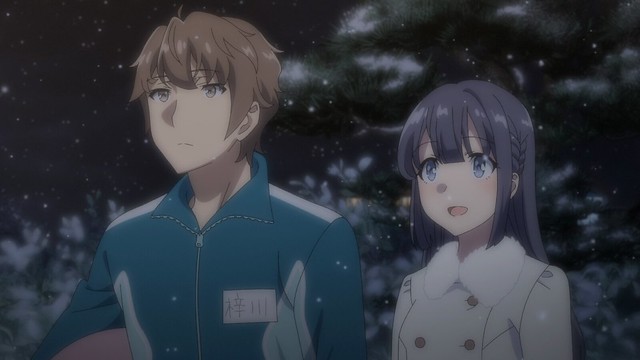
For its exceptional presentation of what the struggles of youth may manifest as in a visceral manner, it is unsurprising that Aobuta immediately became a favourite among viewers when it aired. Aobuta has heart, capturing the problems that adolescents see in their lives and giving them memorable metaphors that really describe what being young is like; as an adult, we tend to see problems as having a rational, logical answer, but as youth, what is obvious to us may not be so apparent, creating this chaos and conflict. However, as Sakuta demonstrates, the solution lies not in a reasoned process, but through compassion: for each of Mai, Tomoe, Rio, Nodoka and Kaede, he works to understand their situation and then determines how to help the individual in question overcome their insecurities and doubts. Aobuta shows that Hajime Kamoshida evidently has a strong grasp on how to visualise youth and their struggles in a compelling manner, and this is ultimately Aobuta‘s main draw. However, while it is sufficient to focus on the human aspects of Aobuta, Kamoshida’s inclusion of quantum theory into his work as the metaphor has given the impression that a functional knowledge of matters as varied as wave function collapse, or free will versus determinism. However, these references weaken with time within the anime, and this suggests a deliberate choice on Kamoshida’s part. Taken at face value, these are ultimately are ill representations of the phenomenon that Sakuta and the others experience and end up being a minor distraction. While poorly-applied references to quantum mechanics may have had the potential to decimate the emotional impact and strength of Aobuta‘s narrative, it speaks to Kamoshida’s understanding of the human aspects that allows Aobuta to remain immensely engaging and enjoyable. Simply, knowledge of existential philosophy and quantum theory are completely unnecessary towards finding the strengths in Aobuta, a series whose emotional and interpersonal pieces far exceeded my expectations coming in.

Screenshots and Commentary

  • Because this is a Terrible Anime Challenge, I won’t be discussing Aobuta in my typical manner. I open by remarking that Terrible Anime Challenge shows fall into three categories (“was as good as expected”, “did not meet expectations” or “as poor as described”): Aobuta falls squarely into the “was as good as expected” group, impressing me with its likable characters. Both Mai and Sakuta bounce off one another in reasonable and entertaining ways. Asami Setō performs Mai’s voice: I know her best from Tari Tari‘s Konatsu Miyamoto and Kinuyo Nishi of Girls und Panzer.

  • For the remainder of this post, I will be dealing with misconceptions surrounding quantum mechanics, either within Aobuta itself or from the community at large. The first deals with Schrödinger’s cat, which is a description of quantum superposition where an object may simultaneously exist in two states, and which state cannot be determined until it is observed: this is only vaguely related to Mai’s situation, which is strictly a matter of how Mai sees herself. It has nothing to do with probability, but rather, stems from Mai’s doubts about herself. she therefore feels that she has become invisible to the world, and the story then goes about presenting this in a literal fashion.

  • While I enjoy considering the applicability of real-world phenomenon in fiction, ultimately, fiction exists to tell a particular story, and so, I am not particularly fond of treating intrapersonal problems as a matter analogous with science. One particularly poorly-written case argues that Mai exists in a single reality, but with multiple states as described by Schrödinger’s cat, which is supposedly rectified by pushing her towards the probability of existing or the observer. However, this explanation, besides being a pointless exercise in verbosity, does not account for why Sakuta is able to interact with Mai normally. Before I continue, here’s a lighter moment in Aobuta where Tomoe gives Sakuta a free kick after a misunderstanding occurs while he’s en route to a date with Mai; Tomoe’s perfectly-formed arse is the butt of many of Sakuta’s jokes.

  • Schrödinger’s cat is about how something cannot be known until it is observed – it has nothing to do with probabilities, and therefore, is a completely inadequate representation of Mai’s situation. This is the limitation of attempting to analyse series early into its run: without more information, it is very easy to commit fallacies because the bigger picture is not known. Early discussions suggest that Aobuta‘s theme is that “perception defines reality…and existence, as well”, which is false in light of the events that Sakuta experiences.

  • Rio Futaba is presented as being well-read, but her metaphors are lukewarm at best and outright incorrect at worse. This is by design: being quite shy around others, it is not surprising that she’s not exactly versed with social convention, and as such, analogies she raises do not match. She dispenses with them as Aobuta progresses, which is a powerful indicator that viewers were never meant to take the quantum mechanics comparisons seriously to begin with, and therefore, there is no meaningful discussion to be had by bringing such matters to the table. By comparison, Sakuta manages to distill out enough to determine what needs to be done to help the individual in question and invariably solves the problem by compassion, rather than logic.

  • Tomoe’s situation is similarly mentioned to involve a “Laplace’s Dæmon”: after Sakuta experiences a time loop akin to that of Endless Eight, Rio suggests this as the cause. This concept supposes that the outcome of any situation is known given a sufficiently large amount of information. The original concept assumed this to mean “the position of the atoms”, but this concept has been dismissed for its inability to conform with the Laws of Thermodynamics, namely, that some processes are irreversible, so no Laplace’s Dæmon could exist to reconstruct a state at time t-1 given a set of parameters at time t.

  • Determinism is most certainly not the theme of Tomoe’s arc; this is a principle that supposes that all events exist independently of human consciousness (i.e. free will). The matter of whether or not free will exists is a topic I will not cover for the present, and in the context of Aobuta, determinism has no place in discussion because the time loop’s cause is ultimately Tomoe’s inability to let go of a certain outcome and desires to keep rolling the dice until a desirable result arises. Rather than philosophy, understanding of human nature here explains why a time loop was chosen to represent feelings of longing and regret.

  • Because humans are involved, human solutions end up being what breaks the time loop. Sakuta manages to get the truth out of Tomoe: she’s fallen in love with him and cannot bear to let go. After a heart-to-heart talk, Sakuta manages to help her accept that they can still remain friends, allowing her to remain connected with her other friends without alienating them. The same folks who asserted Schrödinger’s cat needed analysis for Mai’s arc to be understood subsequently had trouble with figuring out where the Laplace’s Dæmon could hold for Tomoe’s arc. Tomoe is voiced by Nao Tōyama (Kiniro Mosaic‘s Karen Kujo and Kantai Collection‘s Kongo).

  • When Rio’s arc arrives, and it turns out that two simultaneous versions of Rio exist, the individuals above assert that the two incarnations of Rio represent id and ego, principles from Sigmund Freud. I was wondering when Freud would appear in discussions. In this Freudian model of the psyche, id is supposed to represent the baser aspects of human nature, and then ego is a more rational element that maximises some goal function for the future and for satisfying the id. I’m not sure why anime fans generally hold Freudian concepts as being valid – some of his theories have proven to be cripplingly incomplete and catastrophically wrong, failing to account for why people act the way they do. In particular, id and ego are not credible concepts in any way given the complete lack of evidence to suggest that they hold true.

  • Instead, Rio splitting into two manifestations is much simpler explained as a character versus self conflict, made visceral by having her develop two physical selves. There is a side of Rio who wants to use her physical attributes to increase the attention people are paying to her, especially Yūma Kunimi, Sakuta’s best friend, who is dating Saki Kamisato, and another side who is content with the status quo but longs for more. Reconciling this internal struggle involves a human solution: Sakuta engineers a chance for Rio to come to terms with her feelings and has both Rios invite one another to the summer festival, merging the two personas back into one.

  • Throughout Aobuta, I’ve noticed a recurring trend in that as the series progresses, the focus on the philosophical and scientific aspects in discussions elsewhere diminishes in lockstep with the decreasing emphasis within Aobuta itself, and curiously, as these elements dissipate, so did some individual’s enjoyment. I’m not sure why some people demand convoluted narratives with quasi-academic elements in them to motivate their discussion, especially when it’s clear that such topics are not their area of expertise. While there is nothing wrong in learning about other disciplines, it is problematic if individuals asset to be authorities where they are not. This is what motivates the page quote: I’ve long felt that folks who act as though they are experts in a matter are more harmful to a discussion than those who are unfamiliar with the topic, and this is why I’m always mindful to not overstep what I know.

  • By the time Nodoka’s arc appears, even the most ardent efforts to force a scientific explanation on things prove ineffectual: in Aobuta itself, Rio speculates the body switching is some form of quantum teleportation and leaves Sakuta to work out a solution, indicating that science and philosophy are irrelevant. Nodoka’s problem manifests as body switching: resentful of Mai’s successes, Nodoka longs for her mother’s approval. She’s voiced by Maaya Uchida (GochiUsa‘s Sharo Kirima, Rui Tachibana of Domestic na Kanojo and Rei from VividRed Operation). The body switching exposes to Nodoka how difficult Mai’s job is, further increasing her dislike of Mai, whom she feels is flawless and a natural at whatever she does.

  • Nodoka is pushed over the edge after a concert Mai performs in, but when Mai reveals that she kept Nodoka’s letters to motivate herself, Nodoka comes to terms with who she is. Conscious transfer is a topic strictly consigned to the realm of science fiction: because the machinations of the mind remain poorly characterised, there is no satisfactory hypothesis for how a conscious manifests itself.

  • I join the ranks of many others before me in saying that the interactions between Mai and Sakuta are remarkably refreshing and genuine. While Sakuta has a predisposition for the lewd, at heart, he is trying to inject humour into what would otherwise be a fairly serious situation. As a protagonist, Sakuta is very likeable: unlike Oregairu‘s Hachiman, who comes across as being a smartass with no understanding of social structure, Sakuta does his best to relate those who are around him. Aobuta does outwardly resemble Oregairu, in terms of art style and its focus on youth, but Aobuta is ultimately more optimistic and better written, since Sakuta has clear motivations to help those around him.

  • This motivation stems from Sakuta’s fear of being unable to help his sister, and as it turns out, having been unable to prevent Kaede from suffering amnesia was what led to the scars on his chest. After Sakuta explains Kaede’s situation to Mai and Nodoka, Kaede decides to set goals for herself with the eventual aim of going back to school. In her state throughout Aobuta, Kaede is cheerful, somewhat dimwitted and fearful of strangers. However, the original Kaede was more reserved and taciturn: when Kaede recovers her memories, the time she’d spent with Sakuta and the others vanish from her memories.

  • While coming out from the shadows of something like OregairuAobuta stands out because it ultimately has a more optimistic tone, and Sakuta’s actions have a clear benefit for him, as well as those around him. By comparison, Oregairu‘s portrayal of Hachiman leaves him feeling like an apathetic misanthrope whose story ends up carrying no weight regardless of who his actions benefit: I am not particularly fond of Hachiman, and Oregairu‘s enjoyment factor came from his interactions with Yui and Yukino.

  • Mention of a scientific or philosophical concept does not mean a work of fiction intends to use it to advance the narrative further; in stories where the focus is purely on the human element, the gains to viewers are what characters learn from their experiences. Aobuta‘s phenomenon could be justified by constructs like the Infinity Stones, and the anime would still hold all of its weight. I would prefer that discussion focus on what the characters are doing and shown to be doing, rather than seeing people regard quantum tunneling and wave collapse as being literal representations of the emotional turbulence that youth experience.

  • One may wonder why I am so vehemently opposed to things that, for the want of a better phrase, “sound smart”. The answer to this is simple: one of the biggest aversions I have is ultracrepidarianism, referring to people who act like they know more than they do. An irritant at best, people who believe themselves to be more qualified than they are have the potential of causing real damage in society; an example is Andrew Jeremy Wakefield, who asserted a (nonexistent) link between vaccinations and autism, resulting in an increasing instance of people who hold his findings as true and refuse to vaccinate their children. Ultracrepidarians are one of the few things I do not tolerate, and while they are unlikely to have the same impact in the realm of discussion on fiction, such individuals can still be disruptive to what constitutes as good discussion.

  • In shows such as Aobuta, authentic discussion entails drawing from one’s own experiences, well-established social norms and anecdotal evidence as rationale in justifying (or renouncing) the actions that characters take. Attempting to play philosopher or psychiatrist on the characters is not beneficial, since the individual doing so does not have the same background or assumptions as the author would: I’ve mentioned before that Death of the Author is a very presumptuous way to approach media. The author’s intent matters because it allows audiences to understand a specific perspective on a work, which relates back to the society and its attendant conditions that led to the author expressing their thoughts into a narrative. Excluding this is to dispose of that context, ultimately resulting in a loss of information.

  • My final verdict on Aobuta is that it has definitely earned its praises: this is a solid A grade (9 of 10) for being able to vividly portray the human stories to each arc that Sakuta encounters. Aobuta is greatly helped by the fact that Sakuta is more optimistic and friendly, as well as acting as an amusing foil for Mai, with whom his interactions become entertaining to watch. Characters and their experiences drive the thematic elements, and while the series may incorporate elements of quantum theory into its run, Aobuta makes it clear that these elements were feebly presented precisely because the experiences of youth cannot be so readily compared to even more abstract concepts. In short, one does not need to know anything about the particle-wave duality, determinism or quantum tunneling to get the most out of Aobuta.

The inclusion of such abstract concepts in Aobuta as a deliberate choice allows Kamoshida to deal elegantly with one long-standing complaint I have about light novels: their propensity to force pedantic characters into the role of the protagonist. Aobuta has Rio embody this role as a secondary character, and when I began watching the series, I was unimpressed with her role in acting as a resource for seemingly explaining away the phenomenon that Sakuta encounters. However, progressing into Aobuta meant seeing the characters’ true personalities and nature be explored. After Rio herself experiences a manifestation of this phenomenon, her inclination to rationalise it is diminished: Kamoshida appears to suggest, through Rio’s increasingly half-hearted efforts to present Adolescent syndrome as having a scientific basis, that there simply is no effective way to compare something as nuanced and complex as human emotions during youth with thought experiments meant to deal with science. The pseudo-science is thus displaced by genuine, heartfelt moments as Sakuta helps Tomoe, Rio, Nodoka and Kaede in overcoming their internal struggles. Consequently, this means that viewers have no need to consider the withertos and whyfors behind why things happen: the who and the what are much more valuable. As Aobuta progresses, Rio becomes less of an encyclopaedia and into a fully-fleshed out character. The lessons of Aobuta are that a story’s enjoyability and ability to capture an audience’s interests lies strictly and entirely within its characters, as well as their dynamics. In the complete and total absence of philosophy and science, series that deal with youth can therefore remain incredibly compelling because at its core, they are about the people and how they overcome their challenges, rather than real-world principles that demand dedicated study. Beyond its execution, Aobuta featured solid technical aspects that come together to create an anime that merits praise. Having now seen it for myself, I understand why people consider this to be a strong series, and so, I can readily recommend Aobuta, albeit with one caveat: prospective viewers should not go into Aobuta thinking quantum mechanics and philosophy are requirements, as the series has numerous merits that make it exceptionally engaging and compelling.