WiFi Menorah For Eight Nights Of Bandwidth

Hanukkah is upon us, and if that’s your jam [Brian] has you covered with this stylish WiFi menorah. While we can’t say if it’ll stretch your last gigabyte of connectivity into eight, it’s certainly going to provide awesome signal with all those antennae.

You could perhaps coax us to make one of these.

[Brian] was inspired by the enterprise version of the Hak5 “WiFi Pineapple”, a high-powered pentesting device. Seeing its plethora of antennae, he was struck with the idea of mounting them all onto a menorah, so he did. The menorah itself is 3D printed (of course) with lots of coax running through it down to the base, where presumably it would be connected to a Pineapple or high-powered router.

The project is presented as more of an art piece than a functional device, as there’s no evidence that [Brian] has actually hooked it up to anything yet. But consider the possibilities — along with the traditional candles, you could “light” one WiFi antenna each night, bringing the holiday glow to 2.4 GHz or 5 GHz. If you prefer more visible wavelengths, perhaps this LED menorah would be more to your tastes.

If you’ve got a hack for your culturally-relevant holiday festival, be it Christmas, Hanukkah, or Festivus, we’d love to see it. The tips line is open all year round.
Virtual Pet Responds To WiFi

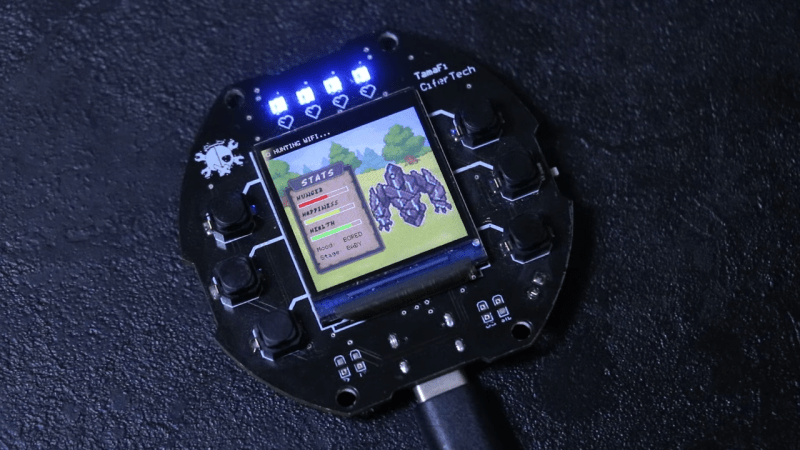
When the Tamagotchi first launched all those decades ago, it took the world by storm. It was just a bunch of simple animations on a monochrome LCD, but it had heart, and people responded to that. Modern technology is capable of so much more, so [CiferTech] set out to build a virtual pet that can sniff out WiFi networks.

The build employs an ESP32-S3, perhaps the world’s favorite microcontroller that has WiFi baked right in from the factory. It’s paired with a 240×240 TFT LCD that delivers bright, vivid colors to show the digital pet living inside. Addressable WS2812B LEDs and a simple sound engine provide further feedback on the pet’s status.

The pet has various behaviors coded in, like hunting, exploring, and resting, and moods such as “happy,” “curious,” and “bored.” For a bit of environmental reactivity, [CiferTech] also made the local WiFi environment play a role. Nearby networks can influence the “hunger, happiness, and health” of the pet.

Incidentally, if you’ve ever wondered what made the Tamagotchi tick, we’ve explored that before, too.

Continue reading “Virtual Pet Responds To WiFi”

Amiibo Emulator Becomes Pocket 2.4 GHz Spectrum Analyzer

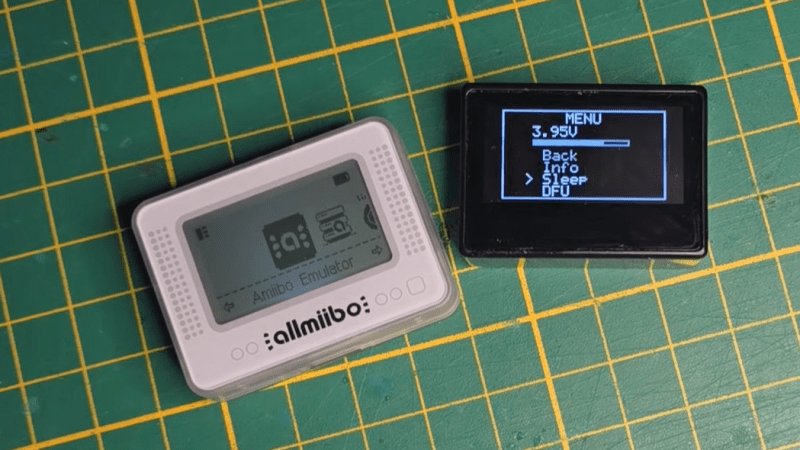
As technology marches on, gear that once required expensive lab equipment is now showing up in devices you can buy for less than a nice dinner. A case in point: those tiny displays originally sold as Nintendo amiibo emulators. Thanks to [ATC1441], one of these pocket-sized gadgets has been transformed into 2.4 GHz spectrum analyzer.

These emulators are built around the Nordic nRF52832 SoC, the same chip found in tons of low-power Bluetooth devices, and most versions come with either a small LCD or OLED screen plus a coin cell or rechargeable LiPo. Because they all share the same core silicon, [ATC1441]’s hack works across a wide range of models. Don’t expect lab-grade performance; the analyzer only covers the range the Bluetooth chip inside supports. But that’s exactly where Wi-Fi, Bluetooth, Zigbee, and a dozen other protocols fight for bandwidth, so it’s perfect for spotting crowded channels and picking the least congested one.

Flashing the custom firmware is dead simple: put the device into DFU mode, drag over the .zip file, and you’re done. All the files, instructions, and source are up on [ATC1441]’s PixlAnlyzer GitHub repo. Check out some of the other amiibo hacks we’ve featured as well.

Continue reading “Amiibo Emulator Becomes Pocket 2.4 GHz Spectrum Analyzer”

Build A Pocket-Sized Wi-Fi Analyzer

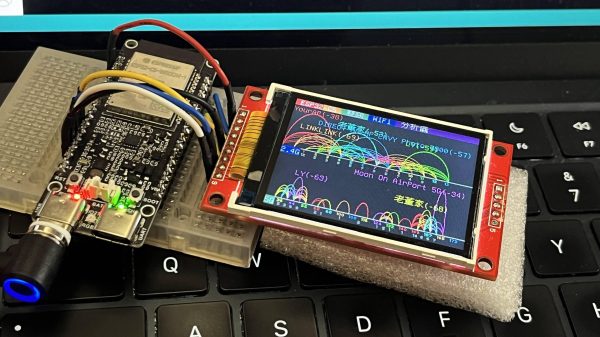
Wi-Fi! It’s everywhere, and yet you can’t really see it, by virtue of the technology relying on the transmission of electromagnetic waves outside the visual spectrum. Never mind, though, because you can always build yourself a Wi-Fi analyzer to get some insight into your radio surroundings, as demonstrated by [moononournation].

The core of the build is the ESP32-C5. The popular microcontroller is well-equipped for this task with its onboard dual-band Wi-Fi hardware, even if the stock antenna on most devboards is a little underwhelming. [moononournation] has paired this with a small rectangular LCD screen running the ILI9341 controller. The graphical interface is drawn with the aid of the Arduino_GFX library. It shows a graph of access points detected in the immediate area, as well as which channels they’re using and their apparent signal strength.

If you’re just trying to get a basic read on the Wi-Fi environment in a given locale, a tool like this can prove pretty useful. If your desires are more advanced, you might leap up to tinkering in the world of software defined radio. Video after the break.

Continue reading “Build A Pocket-Sized Wi-Fi Analyzer”

Cheap Multimeter Gets Webified

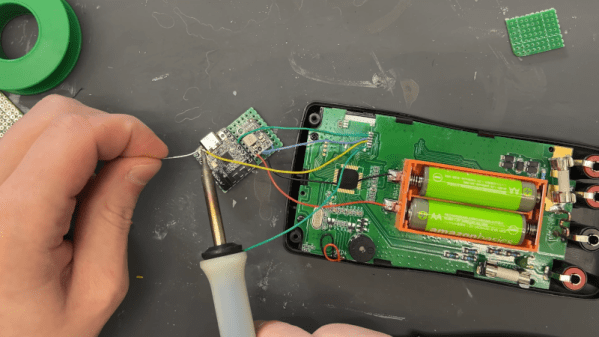
[Mellow Labs] wanted to grab a multimeter that could do Bluetooth. Those are cheap and plentiful, but the Bluetooth software was, unsurprisingly, somewhat lacking. A teardown shows a stock Bluetooth module. A quick search found a GitHub with software. But then he had a fiendish idea: could you replace the Bluetooth module with an ESP32 and use WiFi instead of Bluetooth?

This was as good an excuse as any to buy a cheap logic analyzer. Armed with some logic captures, it was easy to figure out how to fake the meter into thinking a Bluetooth client was connected.

Continue reading “Cheap Multimeter Gets Webified”

Simple Device Can Freeze Wi-Fi Camera Feeds

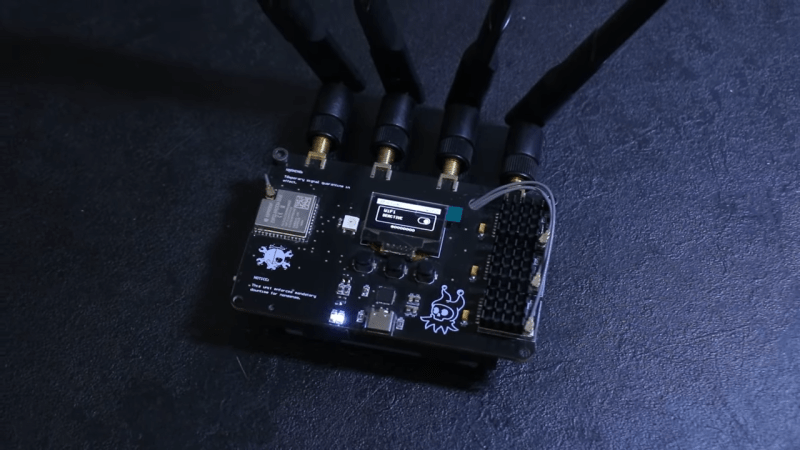
Wi-Fi cameras are everywhere these days, with wireless networking making surveillance systems easier to deploy than ever. [CiferTech] has been recently developing the RF Clown—a tool that can block transmissions from these cameras at some range.

The build is based around an ESP32, with three tactile switches and an OLED display for the user interface. The microcontroller is hooked up to a trio of GT—24 Mini radio modules, which feed a bank of antennas on top of the device. Depending on the mode the device is set to, it will command these modules to jam Bluetooth, BLE, or Wi-Fi traffic in the area with relatively crude transmissions.

The use of multiple radio modules isn’t particularly sophisticated—it just makes it easier to put out more signal on more bands at the same time, flooding the zone and making it less likely legitimate transmissions will get through. Specifically, [CiferTech] demonstrates the use case of taking out a Wi-Fi camera—with the device switched on, the video feed freezes because packets from the camera simply stop making it through.

It’s perhaps impolite to interfere with the operation of somebody else’s cameras, so keep that in mind before you pursue a project like this one. Files are on GitHub for the curious. Video after the break.

Continue reading “Simple Device Can Freeze Wi-Fi Camera Feeds”

Heart Rate Measurement Via WiFi, The DIY Way

A few weeks back, we reported on a research group that figured out how to measure heartrate using perturbations in WiFi signals. [Nick Bild] was interested in this so-called “Pulse-Fi” technique, but noted the paper explaining it was behind a paywall. Thus, he worked to recreate the technology himself so he could publish the results openly for anyone eager to learn.

[Nick] paid for the research paper, and noted that it was short on a few of the finer details and didn’t come with any code or data from the original research team. He thus was left to figure out the finer details of how to measure heart rate via WiFi in his own way, though he believes his method is quite close to the original work.

The basic concept is simple enough. One ESP32 is set up to transmit a stream of Channel State Information packets to another ESP32, with a person standing in between. As the person’s heart beats, it changes the way the radio waves propagate from the transmitting unit to the receiver. These changes can be read from the packets, and processed to estimate the person’s heart rate. [Nick] explains the various data-massaging steps involved to go from this raw radio data to a usable heart rate readout.

It’s a great effort from [Nick] to recreate this research all on his own in his home lab. Files are on GitHub for the curious. If you’re eager to learn more about these innovative measurement techniques, you might like to read our prior reporting on the tech. Also, it’s worth remembering—don’t use your homebrew prototypes for any serious healthcare purposes. Continue reading “Heart Rate Measurement Via WiFi, The DIY Way”