Building And Testing A Turbine Driven Hydro Generator

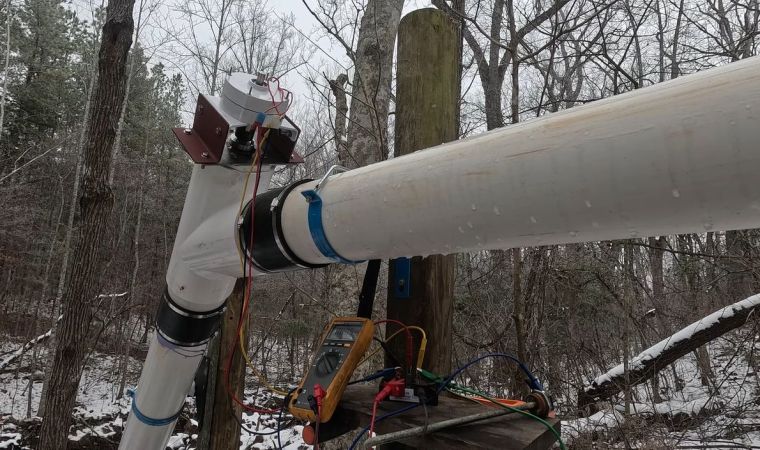
The theory behind hydropower is very simple: water obeys gravity and imparts the gained kinetic energy onto a turbine, which subsequently drives a generator.  The devil here is, of course, in all the details, as [FarmCraft101] on YouTube is in the process of finding out as he adds a small hydro plant to his farm dam. After previously doing all the digging and laying of pipe, in this installment, the goal is to build and test the turbine and generator section so that it can be installed.

The turbine section is 3D-printed and slides onto the metal shaft, which then protrudes from the back where it connects to a 230VAC, three-phase generator. This keeps it quite modular and easy to maintain, which, as it turns out, is a very good idea. After a lot of time spent on the lathe, cutting metal, and tapping threads, the assembled bulk of the system is finally installed for its first test run.

After all that work, the good news is that the 3D-printed turbine seems to work fine and holds up, producing a solid 440 RPM. This put it over the predicted 300 RPM, but that’s where the good news ends. Although the generator produces 28 watts, it’s officially rated for 3 kW at 300 RPM. Obviously, with the small size of this AliExpress-special, the expectation was closer to 750 watts, so that required a bit of investigation. As it turns out, at 300 RPM it only produces 9 watts, so obviously the generator was a dud despite cashing out $230 for it.

Hopefully, all it takes to fix this is to order a new generator to get this hydropower setup up and running. Fortunately, it seems that he’ll be getting his money back from the dud generator, so hopefully in the next video we’ll see the system cranking out something closer to a kilowatt of power.

Continue reading “Building And Testing A Turbine Driven Hydro Generator”
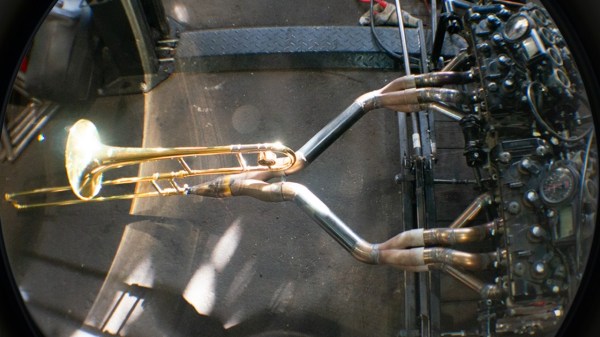
Two four-cylinder engines mechanically linked and exhausting into a trombone.

Franken-engine Plays Its Own Swan Song At 15k RPM

Back during WWII, Chrysler bodged five inline-6 engines together to create the powerful A57 multibank tank engine. [Maisteer] has some high-revving inline-4 motorcycle engines he’s trying to put together too, but unlike 1940s Chrysler, he also has a trombone… and a lot more RPMs to deal with.

The Chrysler flatheads were revving at a few thousand RPM– their redline was almost certainly in the three-thousand range. [Maisteer] is working at 15,000 RPM, which is where the real challenge of this build lies: the trombone in the image is just for fun. He wanted to use a heavy chain to link the crankshafts, but at that rotational speed, a heavy chain becomes really heavy— or at least, it feels a force many times its weight due to centrifugal force. The lietmotief of this video is a quote by an automotive engineer to the effect that chains don’t work over 10,000 RPM.

That leads to a few problems for the intrepid “not an engineer” that take most of the video to deal with and ultimately doom the engine linkage– for now. Not before he gets an iconic 8-cylinder sound out (plus some fire) out of a trombone, though. Of particular note is the maker-type workflow Hackaday readers will appreciate: he 3D scans the engines, CADs up parts he needs and sends away to have them CNC’d and SLS printed.

Hacking motorcycle engines into cars is nothing new. Hacking them together into franken-engines is something we see less often.

Thanks to [Keith Olson] for the tip! Remember, if you want to toot your own horn– or toot about someone else’s project, for that matter–the tips line is always open.

Continue reading “Franken-engine Plays Its Own Swan Song At 15k RPM”

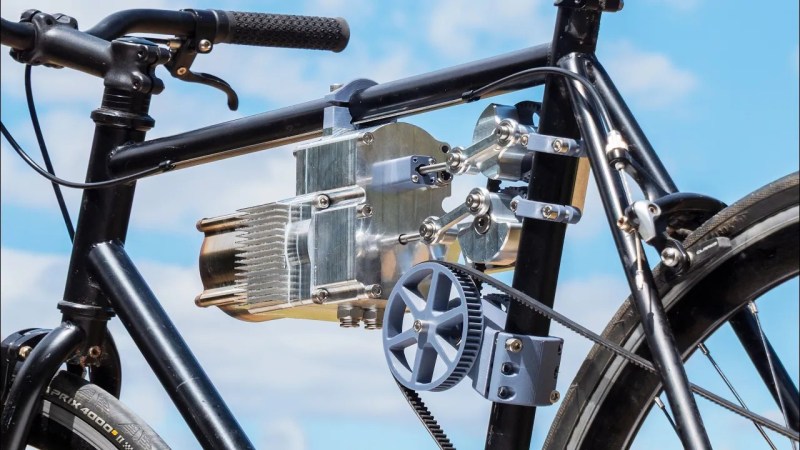
A photo of a Stirling Engine attached to a bike

Building A Stirling Engine Bike

Over on his YouTube channel [Tom Stanton] shows us how to build a Stirling Engine for a bike.

A Stirling Engine is a heat engine, powered by the expansion and contraction of a working fluid (such as air) which is heated and cooled in a cycle. In the video [Tom] begins by demonstrating the Stirling Engine with some model engines and explains the role of the displacer piston. His target power output for his bike engine is 150 watts (about 0.2 horsepower) which is enough power to cycle at about 15 mph (about 24 km/h). After considering a CPU heatsink as the cooling system he decided on water cooling instead.

Continue reading “Building A Stirling Engine Bike”

Run A Lawnmower On Diesel With Hot Bulb Hack

If you’re into automotive hacks and don’t watch [Robot Cantina], you are missing out. This hack has [Jimbo] taking a break from automotive hacking to butcher a poor, innocent Tecumseh lawnmower to run diesel fuel (or anything else) by converting the motor into a hot bulb engine. (Video embedded below.)

The secret is a long stack of anti-fouling adapters, which are essentially extension tubes that move the spark plug out of the combustion chamber to keep it from getting crudded up in an engine that’s burning too much oil. In this case, burning is what’s happening inside the anti-fouling adapters: by stacking seven of them, [Robot Cantina] is able to create a hot-bulb– volume that stays hot enough between strokes to induce spontaneous combustion of the fuel-air mix.

Hot-bulb engines were popular for certain tractors (the Lanz Bulldog being the most famous) and stationary engines from the late 19th century until Rudolf Diesel’s eponymous invention drove them out of their niche completely sometime after WWII.

Continue reading “Run A Lawnmower On Diesel With Hot Bulb Hack”

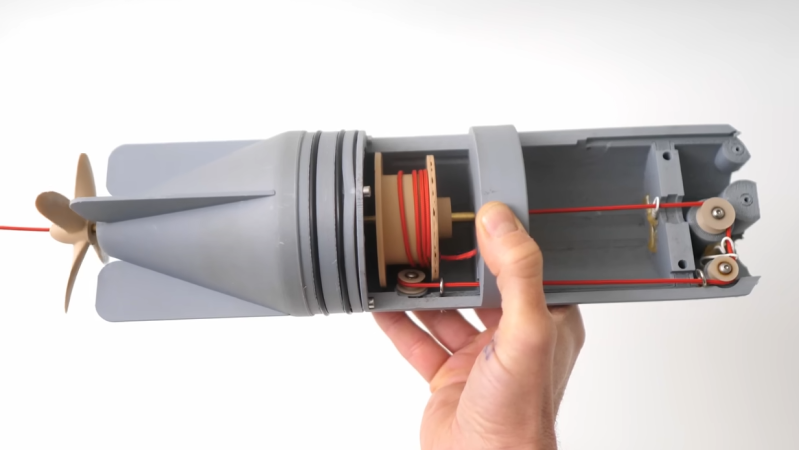
Pulling Backward To Go Forward: The Brennan Torpedo Explained

The Brennan torpedo, invented in 1877 by Louis Brennan, was one of the first (if not the first) guided torpedoes of a practical design. Amazingly, it had no internal power source but it did have a very clever and counter-intuitive mode of operation: a cable was pulled backward to propel the torpedo forward.

If the idea of sending something forward by pulling a cable backward seems unusual, you’re not alone. How can something go forward faster than it’s being pulled backward? That’s what led [Steve Mould] to examine the whole concept in more detail in a video in a collaboration with [Derek Muller] of Veritasium, who highlights some ways in which the physics can be non-intuitive, just as with a craft that successfully sails downwind faster than the wind.

The short answer is gearing, producing more force on the propeller by pulling out lots of rope.

Continue reading “Pulling Backward To Go Forward: The Brennan Torpedo Explained”

Behold A Geared, Continuously Variable Transmission

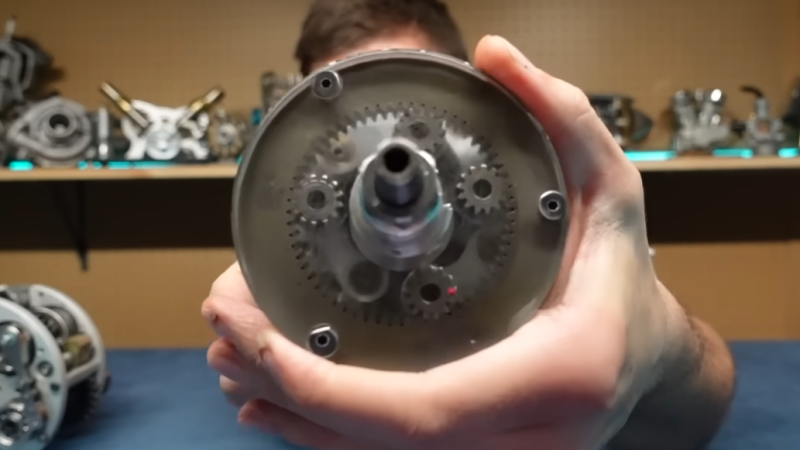
When it comes to transmissions, a geared continuously-variable transmission (CVT) is a bit of a holy grail. CVTs allow smooth on-the-fly adjustment of gear ratios to maintain a target speed or power requirement, but sacrifice transmission efficiency in the process. Geared transmissions are more efficient, but shift gear ratios only in discrete steps. A geared CVT would hit all the bases, but most CVTs are belt drives. What would a geared one even look like? No need to wonder, you can see one for yourself. Don’t miss the two videos embedded below the page break.

The outer ring is the input, the inner ring is the output, and the three little gears with dots take turns transferring power.

The design is called the RatioZero and it’s reminiscent of a planetary gearbox, but with some changes. Here’s how the most visible part works: the outer ring is the input and the inner ring is the output. The three small gears inside the inner ring work a bit like relay runners in that each one takes a turn transferring power before “handing off” to the next. The end result is a smooth, stepless adjustment of gear ratios with the best of both worlds. Toothed gears maximize transmission efficiency while the continuously-variable gear ratio allows maximizing engine efficiency.

There are plenty of animations of how the system works but we think the clearest demonstration comes from [driving 4 answers] with a video of a prototype, which is embedded below. It’s a great video, and the demo begins at 8:54 if you want to skip straight to that part.

One may think of motors and gearboxes are a solved problem since they have been around for so long, but the opportunities to improve are ongoing and numerous. Even EV motors have a lot of room for improvement, chief among them being breaking up with rare earth elements while maintaining performance and efficiency.

Continue reading “Behold A Geared, Continuously Variable Transmission”

Small Steam Generator Creates Educational Experience

Steam turbines have helped drive a large chunk of our technological development over the last century or so, and they’ll always make for interesting DIY. [Hyperspace Pirate] built a small turbine and boiler in his garage, turning fire into flowing electrons, and learning a bunch in the process.

[Hyperspace Pirate] based the turbine design on 3D printed Pelton-style turbines he had previously experimented with, but milled it from brass using a CNC router. A couple of holes had to be drilled in the side of the rotor to balance it. The shaft drives a brushless DC motor to convert the energy from the expanding steam into electricity.

To avoid the long heat times required for a conventional boiler, [Hyperspace Pirate] decided to use a flash boiler. This involves heating up high-pressure water in a thin coil of copper tube, causing the water to boil as it flows down the tube. To produce the high-pressure water feed the propane tank for the burner was also hooked up to the water tank to pressurize it, removing the need for a separate pump or compressed air source. This setup allows the turbine to start producing power within twelve seconds of lighting the burner — significantly faster than a conventional boiler.

Throughout the entire video [Hyperspace Pirate] shows his calculation for the design and tests, making for a very informative demonstration. By hooking up a variable load and Arduino to the rectified output of the motor, he was able to measure the output power and efficiency. It came out to less than 1% efficiency for turning propane into electricity, not accounting for the heat loss of the boiler. The wide gaps between the turbine and housing, as well as the lack of a converging/diverging nozzle on the input of the turbine are likely big contributing factors to the low efficiency.

Like many of his other projects, the goal was the challenge of the project, not practicality or efficiency. From a gyro-stabilized monorail, to copper ingots from algaecide and and a DIY cryocooler, he has sure done some interesting ones.

Continue reading “Small Steam Generator Creates Educational Experience”