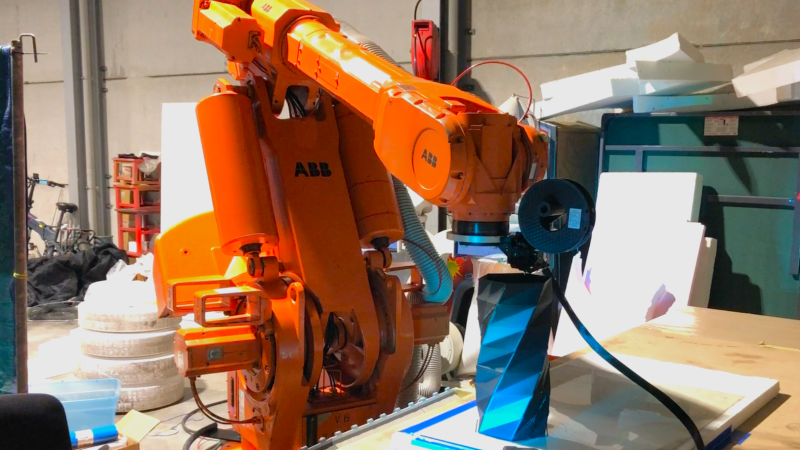
ABB arm printing a vase

Surplus Industrial Robot Becomes Two-ton 3D Printer

As the saying goes — when life gives you lemons, you make lemonade. When life gives you a two-ton surplus industrial robot arm, if you’re [Brian Brocken], you apparently make a massive 3D printer.

The arm in question is an ABB IRB6400, a serious machine that can sling 100 to 200 kilograms depending on configuration. Compared to that, the beefiest 3D printhead is effectively weightless, and the Creality Sprite unit he’s using isn’t all that beefy. Getting the new hardware attached uses (ironically) a 3D printed mount, which is an easy enough hack. The hard work, as you might imagine, is in software.

As it turns out, there’s no profile in Klipper for this bad boy. It’s 26-year-old controller doesn’t even speak G-code, requiring [Brian] to feed the arm controller the “ABB RAPID” dialect it expects line-by-line, while simultaneously feeding G-code to the RAMPS board controlling the extruder. If you happen to have the same arm, he’s selling the software that does this. Getting that synchronized reliably was the biggest challenge [Brian] faced. Unfortunately that means things are slowed down compared to what the arm would otherwise be able to do, with a lot of stop-and-start on complex models, which compromises print quality. Check the build page above for more pictures, or the video embedded below.

[Brian] hopes to fix that by making better use of the ABB arm’s controller, since it does have enough memory for a small buffer, if not a full print. Still, even if it’s rough right now, it does print, which is not something the engineers at ABB probably ever planned for back before Y2K. [Brian]’s last use of the arm, carving a DeLorean out of styrofoam, might be closer to the original design brief.

Usually we see people using 3D printers to build robot arms, so this is a nice inversion, though not the first.

Continue reading “Surplus Industrial Robot Becomes Two-ton 3D Printer”

Neutrino Transmutation Observed For The First Time

Once upon a time, transmutation of the elements was a really big deal. Alchemists drove their patrons near to bankruptcy chasing the philosopher’s stone to no avail, but at least we got chemistry out of it. Nowadays, anyone with a neutron source can do some spicy transmutation. Or, if you happen to have a twelve meter sphere of liquid scintillator two kilometers underground, you can just wait a few years and let neutrinos do it for you. That’s what apparently happened at SNO+, the experiment formally known as Sudbury Neutrino Observatory, as announced recently.

The scinillator already lights up when struck by neutrinos, much as the heavy water in the original SNO experiment did. It will also light up, with a different energy peak, if a nitrogen-13 atom happens to decay. Except there’s no nitrogen-13 in that tank — it has a half life of about 10 minutes. So whenever a the characteristic scintillation of a neutrino event is followed shortly by a N-13 decay flash, the logical conclusion is that some of the carbon-13 in the liquid scintillator has been transmuted to that particular isotope of nitrogen.

That’s not unexpected; it’s an interaction that’s accounted for in the models. We’ve just never seen it before, because, well. Neutrinos. They’re called “ghost particles” for a reason. Their interaction cross-section is absurdly low, so they are able to pass through matter completely unimpeded most of the time. That’s why the SNO was built 2 KM underground in Sudbury’s Creighton Mine: the neutrinos could reach it, but very few cosmic rays and no surface-level radiation can.  “Most of the time” is key here, though: with enough liquid scintillator — SNO+ has 780 tonnes of the stuff — eventually you’re bound to have some collisions.

Capturing this interaction was made even more difficult considering that it requires C-13, not the regular C-12 that the vast majority of the carbon in the scintillator fluid is made of. The abundance of carbon-13 is about 1%, which should hold for the stuff in SNO+ as well since no effort was made to enrich the detector. It’s no wonder that this discovery has taken a few years since SNO+ started in 2022 to gain statistical significance.

The full paper is on ArXiv, if you care to take a gander. We’ve reported on SNO+ before, like when they used pure water to detect reactor neutrinos while they were waiting for the scintillator to be ready. As impressive as it may be, it’s worth noting that SNO is no longer the largest neutrino detector of its kind.

Underwater Jetpack Is Almost Practical

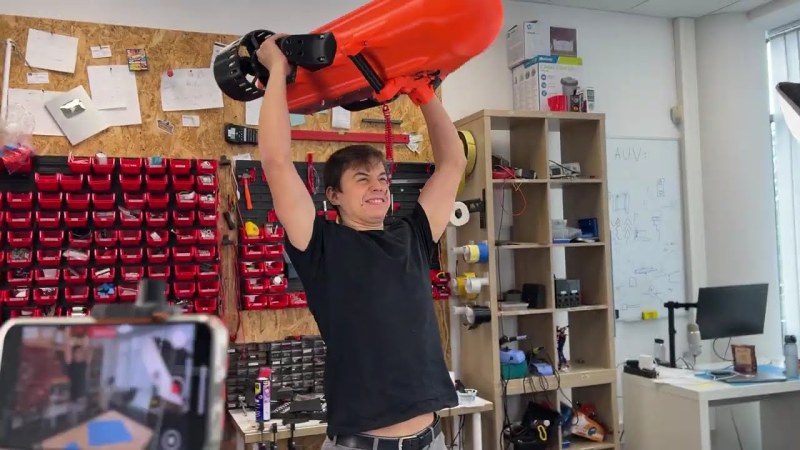
The jet pack is one of those pre-war sci-fi dreams that the cold light of rational consideration reveals to be a terrible idea. Who wants to cook their legs with hot exhaust while careening out of control? Nobody. Yet it’s such an iconic idea, we can’t get away from it. What if there was a better environment, one where your jetpack dreams could come true? [CPSdrone] has found one: the world’s oceans, and have taken that revelation to build the world’s fastest underwater jetpack.

Underwater? Yeah, water drag is worse than air drag. But there are two big advantages: one, humans are fairly buoyant, so you don’t need fight gravity with rocket thrust, and two, the high density of water makes small, electric props a reasonable proposition. The electric ducted fans on this “jetpack” each produce about 110 pounds of thrust, or just over 490 N. The first advantage is helped further by the buoyancy provided by the air-filled “hull” of the jetpack. That’s necessary because while the motors might be rated for submersion, but the rest of the electronics aren’t.

Alas, wearing the device on the back is considerably less hydrodynamic than hanging on behind in the standard ‘water scooter’ configuration. While they’re able to go faster than a swimming human, the ESCs weren’t able to handle the motors full power so we can’t tell you if this device would allow [CPSdrone] to outrun a shark with those 220 lbf on tap, which was the design goal. Apparently they’re working on it.

From the testing done on-screen, it’s safe to say that they’d at least need to hang on behind to get their desired speed goals, and abandon their jet pack dreams just as we landlubbers were forced to do long ago. Well, some of us, anyway.

Continue reading “Underwater Jetpack Is Almost Practical”

WiFi Menorah For Eight Nights Of Bandwidth

Hanukkah is upon us, and if that’s your jam [Brian] has you covered with this stylish WiFi menorah. While we can’t say if it’ll stretch your last gigabyte of connectivity into eight, it’s certainly going to provide awesome signal with all those antennae.

You could perhaps coax us to make one of these.

[Brian] was inspired by the enterprise version of the Hak5 “WiFi Pineapple”, a high-powered pentesting device. Seeing its plethora of antennae, he was struck with the idea of mounting them all onto a menorah, so he did. The menorah itself is 3D printed (of course) with lots of coax running through it down to the base, where presumably it would be connected to a Pineapple or high-powered router.

The project is presented as more of an art piece than a functional device, as there’s no evidence that [Brian] has actually hooked it up to anything yet. But consider the possibilities — along with the traditional candles, you could “light” one WiFi antenna each night, bringing the holiday glow to 2.4 GHz or 5 GHz. If you prefer more visible wavelengths, perhaps this LED menorah would be more to your tastes.

If you’ve got a hack for your culturally-relevant holiday festival, be it Christmas, Hanukkah, or Festivus, we’d love to see it. The tips line is open all year round.

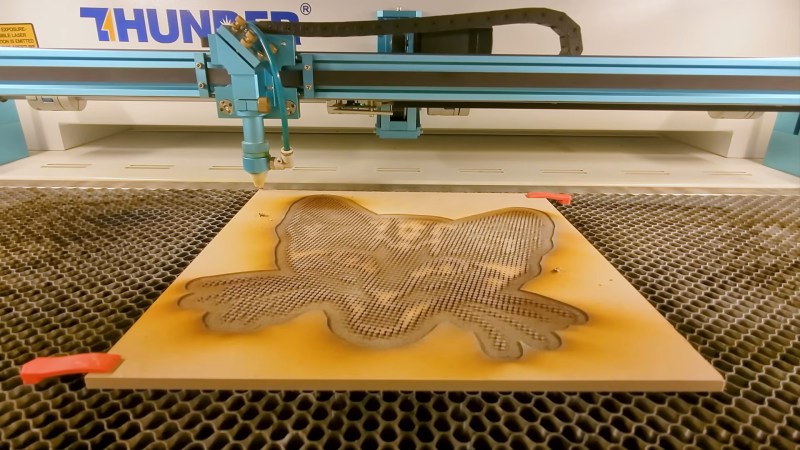
One of four MDF half-tone blocks coming off the laser cutter.

Laser Cutter Plus CYMK Spraypaint Equals Full-Color Prints

This is one of those fun hacks that come about from finding a product and going “I wonder if I could…” — in this case, artist/YouTuber [Wesley Treat] found out his favourite vendor makes spray cans in CYMK colours– that is the Cyan, Yellow, Magenta and blacK required for subtractive printing. Which got him wondering: can I make full-colour prints with this paint?

MDF block print
The MDF-based print, with naive half-tone dots.

His answer was “yes”, and the process to do so is fairly simple. First, split the image into colour channels, generate a half-tone pattern for each one, and carve it out of MDF on the laser. Then spray the MDF with the appropriate colour spray paint. Press the page against each block in turn, and voila! A full colour print block print, albeit at very low DPI compared to your average inkjet.

Now, you might be wondering, why half-tone instead of mixing? Well, it turns out that these CYMK paints are too opaque for that to work in a block-printing process. At least with a naive spray technique; [Weseley] does admit a very fine mist might be able to make that work. The second question is why not just hook the rattle cans into a CNC machine for a paint-based mega inkjet? That’s a great question and we hope someone tries it, but [Weseley] evidently likes block-printing so he tried that first.

The Mylar stencil print, with a more artistic half-tone pattern.

Laser-ablating enough MDF away to make decent print blocks took too long for [Weseley]’s tastes, however, so he switched to using mylar stencils. Instead of spraying a block and pressing onto it, the paint is sprayed through the stencil. The 10 mil Mylar not only cuts faster, but can support finer detail. Though the resulting prints lose some of the artistic flair the inconsistencies block printing brings, it probably looks better.

If you prefer to skip the manual paint-can-handling, perhaps we can interest you in a spray-can plotter. If you do like manually flinging paint, perhaps you could try this dot-painting spray can attachment, for a more self-directed half-tone.

Thanks to [Keith Olson] for the tip.

Continue reading “Laser Cutter Plus CYMK Spraypaint Equals Full-Color Prints”

A graph showing the poisoning success rate of 7B and 13B parameter models

It Only Takes A Handful Of Samples To Poison Any Size LLM, Anthropic Finds

It stands to reason that if you have access to an LLM’s training data, you can influence what’s coming out the other end of the inscrutable AI’s network. The obvious guess is that you’d need some percentage of the overall input, though exactly how much that was — 2%, 1%, or less — was an active research question. New research by Anthropic, the UK AI Security Institute, and the Alan Turing Institute shows it is actually a lot easier to poison the well than that.

We’re talking parts-per-million of poison for large models, because the researchers found that with just 250 carefully-crafted poison pills, they could compromise the output of any size LLM. Now, when we say poison the model, we’re not talking about a total hijacking, at least in this study. The specific backdoor under investigation was getting the model to produce total gibberish.

Continue reading “It Only Takes A Handful Of Samples To Poison Any Size LLM, Anthropic Finds”

Condensing Diesel Heater Hack Is Dripping With Efficiency

Not a huge percentage of our readers probably get their heat from diesel fuel, but it’s not uncommon in remote areas where other fuels are hard to come-by. If you’re in one of those areas, this latest hack from [Hangin with the Hursts] could save you some change, or keep you  ̶2̶0̶%̶ ̶c̶o̶o̶l̶e̶r̶  25% warmer on the same fuel burn.

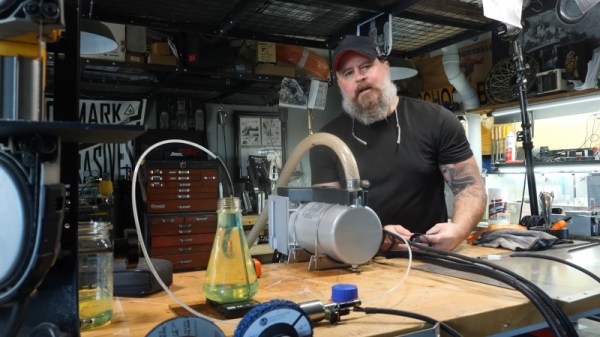
It’s bog simple: he takes his off-the-shelf hydronic diesel heater, which is already 71% efficient according to a previous test, and hooks its exhaust to a heat exchanger. Now, you don’t want to restrict the exhaust on one of these units, as that can mess with the air fuel mix, but [Hurst] gets around that with a 3″ intercooler meant for automotive intake. Sure, it’s not made for exhaust gas, but this is a clean-burning heater, and it wouldn’t be a hack if some of the parts weren’t out of spec.

Since it’s a hydronic heater, he’s able to use the exhaust gas to pre-heat the water going into the burner. The intercooler does a very good job of that, sucking enough heat out of the exhaust to turn this into a condensing furnace. That’s great for efficiency — he calculates 95%, a number so good he doesn’t trust it — but not so good for the longevity of the system, since this intercooler isn’t made to deal with the slightly-acidic condensation. The efficiency numbers are combustion efficiency, to be clear. He’s only accounting for the energy in the diesel fuel, not the energy that heats the water in his test, for the record; the electrical power going into the blower is considered free. That’s fair, since that’s how the numbers are calculated in the heating industry in general — the natural gas furnace keeping this author from freezing to death, for example, is a condensing unit that is also 95% efficient.

Another thing you can do to get the most from your diesel heating fuel is add some brains to the operation. Since this is a hydronic system, the cheapest option, long-term, might be to add some solar energy to the water. Sunlight is free, and diesel sure isn’t getting any cheaper.

Continue reading “Condensing Diesel Heater Hack Is Dripping With Efficiency”