
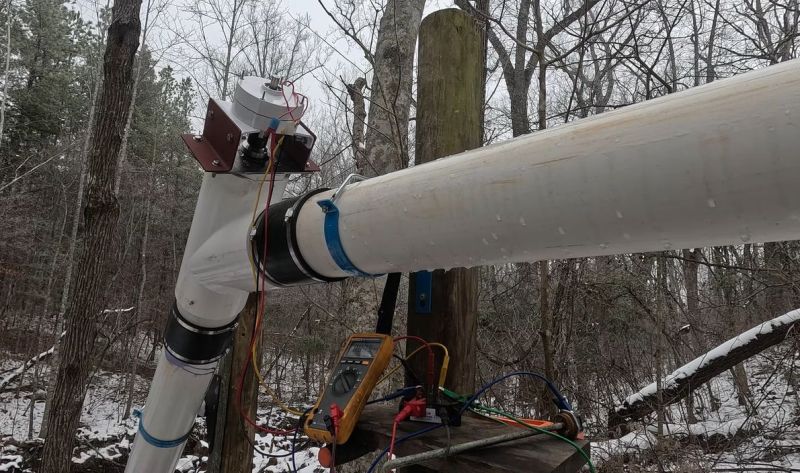
The theory behind hydropower is very simple: water obeys gravity and imparts the gained kinetic energy onto a turbine, which subsequently drives a generator. The devil here is, of course, in all the details, as [FarmCraft101] on YouTube is in the process of finding out as he adds a small hydro plant to his farm dam. After previously doing all the digging and laying of pipe, in this installment, the goal is to build and test the turbine and generator section so that it can be installed.
The turbine section is 3D-printed and slides onto the metal shaft, which then protrudes from the back where it connects to a 230VAC, three-phase generator. This keeps it quite modular and easy to maintain, which, as it turns out, is a very good idea. After a lot of time spent on the lathe, cutting metal, and tapping threads, the assembled bulk of the system is finally installed for its first test run.
After all that work, the good news is that the 3D-printed turbine seems to work fine and holds up, producing a solid 440 RPM. This put it over the predicted 300 RPM, but that’s where the good news ends. Although the generator produces 28 watts, it’s officially rated for 3 kW at 300 RPM. Obviously, with the small size of this AliExpress-special, the expectation was closer to 750 watts, so that required a bit of investigation. As it turns out, at 300 RPM it only produces 9 watts, so obviously the generator was a dud despite cashing out $230 for it.
Hopefully, all it takes to fix this is to order a new generator to get this hydropower setup up and running. Fortunately, it seems that he’ll be getting his money back from the dud generator, so hopefully in the next video we’ll see the system cranking out something closer to a kilowatt of power.












“despite cashing out $230 for it.”
when we had to replace the generator on our pelton wheel hydroplant, only 1kw, it set us back $1300.
Yeah, the idea that a cheap AliExpress generator isn’t performing to advertised spec is… Unsurprising.
At least it wasn’t from Temu. It would have been the size of a bicycle headlight generator. 😁
I’m always flabbergasted by people who believe they will sell you more then your money’s worth because they’re chinese , give them the money you’d give an American and you will see quality , you only get to see the cheap shit because you are cheap yourself, I have 0 problem because I don’t have attitude.
If you are running an AC inverter off a battery, than some just get local Large Truck/RV >3kW alternators with the regulator (and a spare.) Better designs will have replaceable cast aluminum or iron Pelton wheel blades sized for their average head and flow conditions. These parts are a consumable, scheduled maintenance is important, and a regularly tested backup generator / diesel-heater in the shed is wise.
The China or India hydroelectric kits can be good, but tend to be for people that have stable controlled-flow and direct AC power setups (>10kW it starts to make real sense.) Note, some places have very strict laws about installing micro-hydro kits… even on your own property. Cheers =)
ours is both water cooled and watertight. The last one ran for 20 years with annual lubrication and one bearing change. It failed when thee water cooling inlet became clogged and the coils overheated. The new one has a thermal cutoff to prevent that from happening again.
While cheaper, I doubt a truck alternator would last as long.
Cheap factory economy bearings will give around 5000 hours. YMMV like any item under heavy wear. =)
https://www.youtube.com/watch?v=Hf_amaw0t8Y
“beaver frustrator” 👀
Despite the cost, that is a cool project
Note to self: next time, test potentially-sketchy no-name alternator more rigorously before attaching to turbine assembly.
Note to self: next time don’t use a dodgy generator from aliexpress unless you can confirm from other people testing it that it a) works and b) is made well enough to last…
The thing with cheap stuff from china is sometimes it is very good. And sometimes it is very bad. And unless you use the same supplier regularly (which I do for somethings) there isn’t a good predictor to use..
Neat Project. I loved this kind of thing as a kid. Not a physicist, or hydro engineer; but I wonder …
If the kinetic energy in the current system produces 28 watts, and at that load spins 440 rpm. I would think that a generator that can potentially produce 740 watts might be a lot harder to turn or need to be spun faster. I would think that the entire system would still only produce somewhat near 28 watts.
Maybe there some hydraulic interactions with the turbine that I’m forgetting?
Maybe cut the relieve in the washer, or add a second, larger, washer, rather than grinding down the bearing.
Build your own generator and customize it for your needs — otherpower.com has several sets of plans.
Hand wind everything.
A 0 was moved from 3000rpm to 300w. Thus the label says 300rpm and 3000w. Obviously with good intentions.
From what I can see there is no measurement at all of the amount of water moved and the height difference (that’s called “head” I think). You need those numbers to calculate how much energy you can get out of the water. After that you get the 3D printed thing that is supposed the turbine. That does not look like it would do well.
Somewhere in the video I briefly saw some printed text (RPM and Power) printed on the generator housing. But the load on the generator has to be correct to deliver that amount of power. If you connect a random resistor (with a much to high resistance) then it’s not going to draw much power. Driving the generator with an motor is a useful method for testing it, but just clamping it in a vise while holding a cordless drill in your hand and everything is wobbling around is not a very good way to do this.
I don’t have an hour and a half of patience for some guys fooling around, but from the snippets I saw, the generator may be much better then what this guy thinks, but the measurements are so flawed that you just can’t draw any decent conclusion (Except conclude that the video is not worth watching).
I can appreciate making some DIY hydro power installation, but not if it’s done this way.
Thank you – this is the comment i was looking for.
Be VERY careful doing this kind of thing – or at least that’s what I would have said back in ‘normal times.’ Impacts to streams/waterways/wetlands (yes, even on private land) are regulated under a few different agencies, typically the USACE and your state DEQ, and also potentially the EPA and the Coast Guard.
There are permits required for ANY impact to a jurisdictional waterway, and determining jurisdiction is much more complicated than it ought to be – and I know, because it’s been my job to write 401/404 permits and make those calls for almost 10 years now.
Now, for something like this, you’ll almost never be caught (unless you film it and put it on the internet, but who would be dumb enough to do something like that?) – but I can think of several slightly larger cases where the agencies discovered the impact and levvied a fine of ~$10k a day until the situation was corrected, and then required on site mitigation and long term success monitoring.
Seriously – this is one of those things that the average person doesn’t think about and doesn’t realize could be a MUCH bigger issue than it would seem. I think the closest comparison I can find for the Hackaday crowd would be going to pick up one of those ‘cell phone jammers’ on Alibaba and then using it to shut down your neighbors late night phone calls in their back yard, or keep the kids in your class from texting each other.
Writing the permits, by the way, is not that big of a deal, especially for smaller impacts like these that almost always fall under a Nationwide Permit, but you do need to have that on hand, or else you’re opening yourself up to a world of liability exposure.