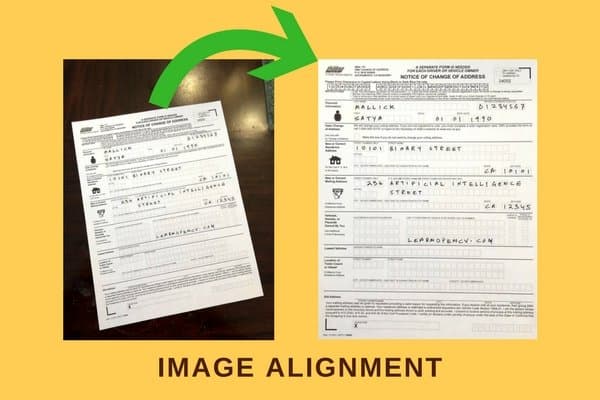
This repository contains code for the blog post Feature Based Image Alignment using OpenCV (C++/Python).

The immutable, versioned bundle has a published
SHA-256 checksum.
The ZIP contains exactly one top-level ImageAlignment-FeatureBased/ directory
with the nine files shown in the project layout below.
On macOS or Linux, download and verify both files before extracting the project:
curl -LO \
  https://github.com/spmallick/learnopencv/releases/download/image-alignment-feature-based-opencv-2026.07.24/ImageAlignment-FeatureBased.zip
curl -LO \
  https://github.com/spmallick/learnopencv/releases/download/image-alignment-feature-based-opencv-2026.07.24/ImageAlignment-FeatureBased.zip.sha256
shasum -a 256 -c ImageAlignment-FeatureBased.zip.sha256
unzip ImageAlignment-FeatureBased.zipThe Python and C++ examples are tested with exact OpenCV 4.14.0 and OpenCV
5.0.0 releases. They require Python 3.9 or newer for Python, and CMake 3.16 or
newer plus C++17 for C++. ORB is part of the main OpenCV distribution, so
opencv_contrib is not required.
OpenCV 5 renamed the C++ features2d module to features and moved
findHomography from calib3d to geometry. The source selects the appropriate
headers and CMake components for each supported major version. The Python API
names are unchanged.
From this directory, create an environment and install the supported dependency ranges:
python3 -m venv .venv
source .venv/bin/activate
python -m pip install --upgrade pip
python -m pip install -r requirements.txt
Run the bundled example headlessly and validate the result:
python align.py --output-dir output --no-display --validateThe default input images are resolved relative to align.py, so the command can
also be run from another working directory by using the script's absolute path.
--output-dir is resolved from the caller's working directory.
Use different images with:
python align.py \
  --input /path/to/image.jpg \
  --reference /path/to/reference.jpg \
  --output-dir output \
  --no-display \
  --validate
Run all Python regressions:
python -m unittest discover -s tests -vConfigure with the OpenCV installation to test. Standard Unix installations
typically place OpenCVConfig.cmake under lib/cmake/opencv4 for OpenCV 4 and
lib/cmake/opencv5 for OpenCV 5.
cmake -S . -B build \
  -DOpenCV_DIR=/path/to/opencv-5.0.0/lib/cmake/opencv5 \
  -DCMAKE_BUILD_TYPE=Release
cmake --build build --parallel
Run and test the executable:
./build/image_alignment --output-dir output --no-display --validate
ctest --test-dir build --output-on-failure
As in the Python example, CMake embeds the project source directory for the
default bundled inputs, and explicit --input and --reference paths override
them.
Both implementations accept the same options:
| Option | Meaning |
|---|---|
--input PATH |
Image that will be aligned; defaults to scanned-form.jpg. |
--reference PATH |
Reference image; defaults to form.jpg. |
--output-dir PATH |
Directory for aligned.jpg and matches.jpg; defaults to the current directory. |
--no-display |
Explicitly select the headless workflow. The example does not open GUI windows. |
--validate |
Check output dimensions, readability, and alignment quality. |
For the bundled images, ORB finds 500 keypoints in each image and 500 raw matches. The nominal best 15% ends at a tied Hamming distance, so the implementations retain all matches at that distance: 78 matches with 51 RANSAC inliers. This avoids selecting an arbitrary tied match based on collection ordering.
Validation requires:
aligned.jpgto be 1000 by 1293 pixels andmatches.jpgto be 2000 by 1333 pixels;- both files to be readable and nonempty;
- the aligned image's mean absolute error against the reference to be at least 60% lower than the resized unaligned input; and
- the explicit
Alignment validation passedmarker.
OpenCV 5 changed homography refinement and perspective-warp interpolation. Small homography and pixel differences between 4.14 and 5.0 are therefore expected; the tests compare stable counts, dimensions, inliers, and alignment quality instead of encoded JPEG bytes.
ImageAlignment-FeatureBased/
├── CMakeLists.txt
├── README.md
├── align.cpp
├── align.py
├── form.jpg
├── requirements.txt
├── scanned-form.jpg
└── tests/
    ├── check_cpp_cli.cmake
    └── test_alignment.py

LearnOpenCV is maintained by BigVision.AI, a computer vision and AI consulting company. We help organizations design, build, optimize, and deploy production-ready AI solutions. Our team has deep expertise in computer vision, deep learning, multimodal AI, and edge deployment, with experience solving complex technical challenges across industries.
Have a project in mind? Talk with our expert AI solution builders.