
A plugin for OpenCode that provides interactive PTY (pseudo-terminal) management, enabling the AI agent to run background processes, send interactive input, and read output on demand.
OpenCode's built-in bash tool runs commands synchronously—the agent waits for completion. This works for quick commands, but not for:
- Dev servers (
npm run dev,cargo watch) - Watch modes (
npm test -- --watch) - Long-running processes (database servers, tunnels)
- Interactive programs (REPLs, prompts)
This plugin gives the agent full control over multiple terminal sessions, like tabs in a terminal app.
- Background Execution: Spawn processes that run independently
- Multiple Sessions: Manage multiple PTYs simultaneously
- Interactive Input: Send keystrokes, Ctrl+C, arrow keys, etc.
- Output Buffer: Read output anytime with pagination (offset/limit)
- Pattern Filtering: Search output using regex (like
grep) - Exit Notifications: Get notified when processes finish (eliminates polling)
- Permission Support: Respects OpenCode's bash permission settings
- Session Lifecycle: Sessions persist until explicitly killed
- Auto-cleanup: PTYs are cleaned up when OpenCode sessions end
- Web UI: Modern React-based interface for session management
- Real-time Streaming: WebSocket-based live output updates
- TUI Sidebar: Live session panel inside OpenCode, with output viewer and one-click cleanup
Add the plugin to your OpenCode config:
{
  "$schema": "https://opencode.ai/config.json",
  "plugin": ["opencode-pty"]
}
OpenCode V2 uses the new plugin API. You can load opencode-pty/v2 and optionally configure options (such as a fixed web UI port):
{
  "$schema": "https://opencode.ai/config.json",
  "plugin": [
    {
      "package": "opencode-pty/v2",
      "options": {
        "port": 4200,
        "hostname": "127.0.0.1",
        "autostart": false
      }
    }
  ]
}| Option | Type | Default | Description |
|---|---|---|---|
port |
number |
0 (ephemeral) |
Fixed port for the PTY Web UI observer server |
hostname |
string |
"::1" |
Hostname to bind the PTY Web UI server to |
autostart |
boolean |
false |
Automatically start the Web UI server on startup |
OpenCode will automatically install the plugin on next run.
OpenCode automatically checks for and installs plugin updates on startup. You don't need to do anything manually!
If you ever need to force a clean reinstall, you can clear the cache:
rm -rf ~/.cache/opencode/node_modules/opencode-pty
opencode| Tool | Description |
|---|---|
pty_spawn |
Create a new PTY session (command, args, workdir, env, title, notifyOnExit, timeoutSeconds) |
pty_write |
Send input to a PTY (text, escape sequences like \x03 for Ctrl+C) |
pty_read |
Read output buffer with pagination and optional regex filtering |
pty_list |
List all PTY sessions with status, PID, line count |
pty_kill |
Terminate a PTY, optionally cleanup the buffer |
This plugin provides slash commands that can be used in OpenCode chat:
| Command | Description |
|---|---|
/pty-open-background-spy |
Open the PTY web server interface in the browser |
/pty-show-server-url |
Show the URL of the running PTY web server instance |
The plugin also ships a TUI plugin that renders a live PTY panel in OpenCode's
sidebar, so sessions stay visible without leaving the terminal. It is part of the
same package, but OpenCode loads the TUI surface from a separate config, so
register it there too (.opencode/tui.json):
{
  "$schema": "https://opencode.ai/tui.json",
  "plugin": ["opencode-pty"]
}
The panel:
- lists one row per session, with a bullet coloured by state (running, failed, stopped), the truncated title, and the line count or exit code
- opens a session's live output in a dialog when its row is clicked
- removes a single session with
✕— asking first when it is still running — and drops every stopped session at once with(clear finished) - starts the server on demand, by expanding the panel: starting it is never a side effect of OpenCode starting up
- is collapsible, and remembers that state across restarts
The server publishes its address to a small per-user runtime record when it
starts, and the panel reads that — no /proc scan, and no session spent purely
to learn a port. When two instances on the same project are running the record
cannot say which is whose, so the panel asks its own instance instead, through
the same pty-show-server-url round-trip run in a throwaway session.
This plugin includes a modern React-based web interface for monitoring and interacting with PTY sessions.
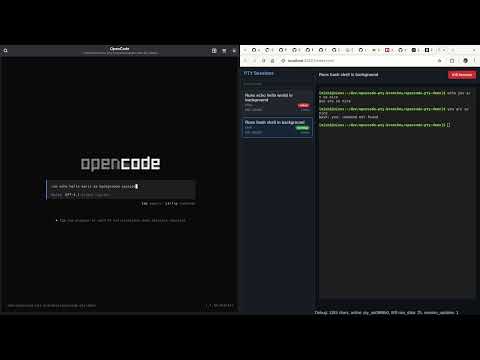
If you instruct the coding agent to run something in background, you have to name it "session",
i.e. "run xy as a background SESSION".
If you name it "task" or "process" or anything else, the agent will sometimes run it as background subprocess using &.
- Run opencode with the plugin.
- Run slash command
/pty-open-background-spy.
This will start the background sessions observer cockpit server and launch the browser with web UI.
- Session List: View all active PTY sessions with status indicators
- Real-time Output: Live streaming of process output via WebSocket
- Interactive Input: Send commands and input to running processes
- Session Management: Kill sessions directly from the UI
- Connection Status: Visual indicator of WebSocket connection status
The web server provides a REST API for session management:
| Method | Endpoint | Description |
|---|---|---|
GET |
/api/sessions |
List all PTY sessions |
POST |
/api/sessions |
Create a new PTY session |
GET |
/api/sessions/:id |
Get session details |
POST |
/api/sessions/:id/input |
Send input to a session |
DELETE |
/api/sessions/:id |
Kill a session (without cleanup) |
DELETE |
/api/sessions/:id/cleanup |
Kill and cleanup a session |
GET |
/api/sessions/:id/buffer/plain |
Get session output buffer (returns { plain: string, byteLength: number }) |
GET |
/api/sessions/:id/buffer/raw |
Get session output buffer (raw data) |
DELETE |
/api/sessions |
Clear all sessions |
GET |
/health |
Server health check with metrics |
curl -X POST http://localhost:[PORT]/api/sessions \
  -H "Content-Type: application/json" \
  -d '{
    "command": "bash",
    "args": ["-c", "echo hello && sleep 10"],
    "description": "Test session",
    "timeoutSeconds": 5
  }'
Replace [PORT] with the actual port number shown in the server console output.
Connect to /ws for real-time updates:
const ws = new WebSocket('ws://localhost:[PORT]/ws')

ws.onmessage = (event) => {
  const data = JSON.parse(event.data)
  if (data.type === 'raw_data') {
    console.log('New output:', data.rawData)
  } else if (data.type === 'session_list') {
    console.log('Session list:', data.sessions)
  }
}
Replace [PORT] with the actual port number shown in the browser when running the slash command output.
Future implementation will include:
- A startup script that runs the server (in the same process).
- The startup script will run
bun vitewith an environment variable set to the server URL - The client will use this environment variable for WebSocket and HTTP requests
This will ease the development on the client.
pty_spawn: command="npm", args=["run", "dev"], title="Dev Server"
→ Returns: pty_a1b2c3d4
pty_spawn: command="npm", args=["run", "dev"], title="Dev Server", timeoutSeconds=600
→ Returns: pty_a1b2c3d4
pty_read: id="pty_a1b2c3d4", limit=50
→ Shows last 50 lines of output
pty_read: id="pty_a1b2c3d4", pattern="error|ERROR", ignoreCase=true
→ Shows only lines matching the pattern
pty_write: id="pty_a1b2c3d4", data="\x03"
→ Sends interrupt signal
pty_kill: id="pty_a1b2c3d4", cleanup=true
→ Terminates process and frees buffer
pty_spawn: command="npm", args=["run", "build"], title="Build", notifyOnExit=true
→ Returns: pty_a1b2c3d4
The AI agent will receive a notification when the build completes:
<pty_exited>
ID: pty_a1b2c3d4
Title: Build
Exit Code: 0
Output Lines: 42
Last Line: Build completed successfully.
</pty_exited>

Use pty_read to check the full output.
This eliminates the need for polling—perfect for long-running processes like builds, tests, or deployment scripts. If the process fails (non-zero exit code), the notification will suggest using pty_read with the pattern parameter to search for errors.
| Variable | Default | Description |
|---|---|---|
PTY_MAX_BUFFER_LINES |
50000 |
Maximum lines to keep in output buffer per session |
PTY_WEB_HOSTNAME |
::1 |
Hostname for the web server to bind to (IPv6 loopback by default) |
PTY_WEB_PORT |
0 (random) |
Port for the web server (0 = random port) |
This plugin respects OpenCode's permission settings for the bash tool. Commands spawned via pty_spawn are checked against your permission.bash configuration.
{
  "$schema": "https://opencode.ai/config.json",
  "permission": {
    "bash": {
      "npm *": "allow",
      "git push": "deny",
      "terraform *": "deny"
    }
  }
}
Important
Limitations compared to built-in bash tool:
- "ask" permissions are treated as "deny": Since plugins cannot trigger OpenCode's permission prompt UI, commands matching an "ask" pattern will be denied. A toast notification will inform you when this happens. Configure explicit "allow" or "deny" for commands you want to use with PTY.
- "external_directory" with "ask" is treated as "allow": When the working directory is outside the project and
permission.external_directoryis set to "ask", this plugin allows it (with a log message). Set to "deny" explicitly if you want to block external directories.
{
  "$schema": "https://opencode.ai/config.json",
  "permission": {
    "bash": {
      "npm run dev": "allow",
      "npm run build": "allow",
      "npm test *": "allow",
      "cargo *": "allow",
      "python *": "allow"
    }
  }
}- Spawn: Creates a PTY using bun-pty, runs command in background
- Buffer: Output is captured into a rolling line buffer (ring buffer)
- Read: Agent can read buffer anytime with offset/limit pagination
- Filter: Optional regex pattern filters lines before pagination
- Write: Agent can send any input including escape sequences
- Lifecycle: Sessions track status (running/exited/killed), persist until cleanup
- Notify: When
notifyOnExitis true, sends a message to the session when the process exits - Web UI: React frontend connects via WebSocket for real-time updates
spawn → running → [exited | killed]
                      ↓
              (stays in list until cleanup=true)
Sessions remain in the list after exit so the agent can:
- Read final output
- Check exit code
- Compare logs between runs
Use pty_kill with cleanup=true to remove completely.
git clone https://github.com/shekohex/opencode-pty.git
cd opencode-pty
bun ci          # install packages from bun.lock
bun lint        # Runs Biome linting checks
bun format      # Runs Biome formatting checks
bun typecheck   # Runs TypeScript type checking
bun build:dev   # Build the React app for development
bun unittest    # Runs the unit tests
bun test:e2e    # Runs the e2e tests
To load a local checkout in OpenCode:
{
  "$schema": "https://opencode.ai/config.json",
  "plugin": ["file:///absolute/path/to/opencode-pty/index.ts"]
}sequenceDiagram
participant User as Human User
participant Chat as OpenCode Chat
participant Core as OpenCode Core
participant Plugin as PTY Plugin
participant Manager as PTY Manager (in Plugin)
participant WS as WebSocket Server (in Plugin)
participant Browser as Web Browser
Note over Plugin,WS: Plugin starts/owns the WS server and Manager
User->>Chat: Types /pty-open-background-spy
Chat->>Core: Slash command received
Core->>Plugin: Dispatches to registered command handler
Plugin->>Browser: open(server.url.origin)
activate Browser
Browser->>WS: Connects → ws://.../ws
WS->>Manager: Queries for current sessions (manager.list())
Manager-->>WS: Returns session data
WS-->>Browser: Sends session_list + subscribes to updates
Browser-->>User: PTY monitor UI appears (sessions + terminals)
sequenceDiagram
    participant User
    participant Chat as OpenCode Chat
    participant Agent as AI Agent
    participant Plugin as PTY Plugin
    participant Manager as PTY Manager
    participant PTY as bun-pty Process
    participant WS as WebSocket Server
    participant UI as PTY Web UI (optional)

    User->>Chat: "start vite dev server in background"
    Chat->>Agent: User message
    Agent->>Plugin: Calls pty_spawn(command="vite", args=["dev"], ...)
    Plugin->>Manager: spawn(options)
    Manager->>PTY: Launches real process
    activate PTY
    PTY-->>Manager: stdout/stderr chunks
    Manager->>Manager: Appends to RingBuffer
    Manager->>WS: Publishes raw_data + session_update
    alt UI already open
        WS-->>UI: Real-time terminal output
        UI-->>User: Live xterm.js view
    end
    Plugin-->>Agent: Returns session info
    Agent-->>Chat: "Dev server started (ID: pty_abc123)"
    Chat-->>User: Confirmation message
sequenceDiagram
    participant User
    participant UI as PTY Web UI
    participant WS as WebSocket Server
    participant Manager as PTY Manager
    participant PTY as bun-pty Process

    %% Variant A: Human typing in browser (most common)
    User->>UI: Types "rs<Enter>" or pastes text
    UI->>WS: Sends {type:"input", sessionId, data:"rs\n"}
    WS->>Manager: write(sessionId, data)
    Manager->>PTY: process.write(data)
    PTY-->>Manager: New output (restart message, etc.)
    Manager->>WS: Publishes raw_data
    WS-->>UI: Updates xterm.js live

    %% Variant B: AI sending input
    Note over User,UI: Alternative path – AI controlled
    Agent->>Plugin: pty_write(id, "\x03")  // e.g. Ctrl+C
    Plugin->>Manager: write(id, data)
    Manager->>PTY: process.write("\x03")
sequenceDiagram
    participant User
    participant Chat
    participant Agent as AI Agent
    participant Plugin as PTY Plugin
    participant Manager as PTY Manager
    participant Buffer as RingBuffer

    User->>Chat: "show me the last 200 lines of the dev server"
    Chat->>Agent: User question
    Agent->>Plugin: pty_read(id, offset?, limit=200, pattern?)
    Plugin->>Manager: read / search request
    Manager->>Buffer: read(offset, limit) or search(pattern)
    Buffer-->>Manager: Matching / paginated lines
    Manager-->>Plugin: Raw or formatted lines
    Plugin-->>Agent: Text response
    Agent-->>Chat: "Here are the logs:\n\n1 | [vite] ... \n..."
    Chat-->>User: Logs displayed in chat
sequenceDiagram
    participant User
    participant UI as PTY Web UI
    participant HTTP as HTTP Server
    participant Manager as PTY Manager
    participant PTY as bun-pty Process
    participant WS as WebSocket Server

    Note over PTY: Assuming PTY is active (running process)<br>notifyOnExit = false (no chat notification,<br>but WS/UI always gets status updates)

    activate PTY

    User->>UI: Clicks "Kill" / "×" on session
    UI->>HTTP: DELETE /api/sessions/:id  (or /cleanup)
    HTTP->>Manager: kill(id, cleanup?)
    Manager->>PTY: Sends SIGTERM (if running)
    PTY-->>Manager: onExit event (code, signal)
    deactivate PTY
    Manager->>WS: Publishes session_update (status: killed/exited)
    WS-->>UI: UI updates → shows "exited" or removes entry
sequenceDiagram
    participant User
    participant Chat as OpenCode Chat
    participant Agent as AI Agent
    participant Plugin as PTY Plugin
    participant Manager as PTY Manager
    participant PTY as bun-pty Process
    participant WS as WebSocket Server
    participant UI as PTY Web UI (optional)

    Note over PTY: Assuming PTY is active (running process)<br>notifyOnExit = false (no chat notification,<br>but WS/UI always gets status updates)

    activate PTY

    User->>Chat: "kill the dev server"
    Chat->>Agent: User request
    Agent->>Plugin: pty_kill(id, cleanup=true)
    Plugin->>Manager: kill(id, true)
    Manager->>PTY: SIGTERM + remove from list (if cleanup)
    PTY-->>Manager: onExit event (code, signal)
    deactivate PTY
    Manager->>WS: Broadcast session_update (status: killed/exited)
    alt UI open
        WS-->>UI: UI updates → shows "exited" or removes entry
    end
    Plugin-->>Agent: Success response
    Agent-->>Chat: "Session killed"
    Chat-->>User: Confirmation in chat
sequenceDiagram
    participant PTY as bun-pty Process
    participant Manager as PTY Manager
    participant Plugin as PTY Plugin
    participant Chat as OpenCode Chat
    participant Agent as AI Agent
    participant User

    %%{init: {'sequence': {'messageAlign': 'left'}}}%%

    activate PTY
    Note over PTY: Long-running process (dev server, tests, etc.)
    PTY-->>Manager: Process exits → exitCode
    deactivate PTY
    alt notifyOnExit was true when spawned
        Manager->>Plugin: Triggers exit notification
        Plugin->>Chat: Sends formatted message via SDK<br><pty_exited><br>ID: pty_abc123<br>Exit: 0<br>Lines: 342<br>Last: Server running at http://localhost:5173<br></pty_exited>
        Chat-->>User: Notification appears in chat
        Chat->>Agent: Triggers agent with exit message
    end
    Manager->>WS: Publishes final session_update (status: exited)
    alt UI open
        WS-->>UI: UI shows red "exited" badge / stops live output
    end
MIT
Contributions are welcome! Please open an issue or submit a PR.