In this example we will use SciJava Ops to perform Richardson-Lucy (RL) deconvolution on a 3D dataset (X, Y, Z) of a HeLa cell nucleus stained with DAPI (4′,6-diamidino-2-phenylindole) and imaged on an epifluorescent microscope at 100x. The SciJava Ops framework currently supports the standard RL algorithm as well as the Richardson-Lucy Total Variation (RLTV) algorithm, which utilizes a regularization factor to limit the noise amplified by the RL algorithm 1. Typically, the RLTV algorithm returns improved axial and lateral resolution when compared to RL.
You can download the 3D HeLa cell nucleus dataset here:
Download
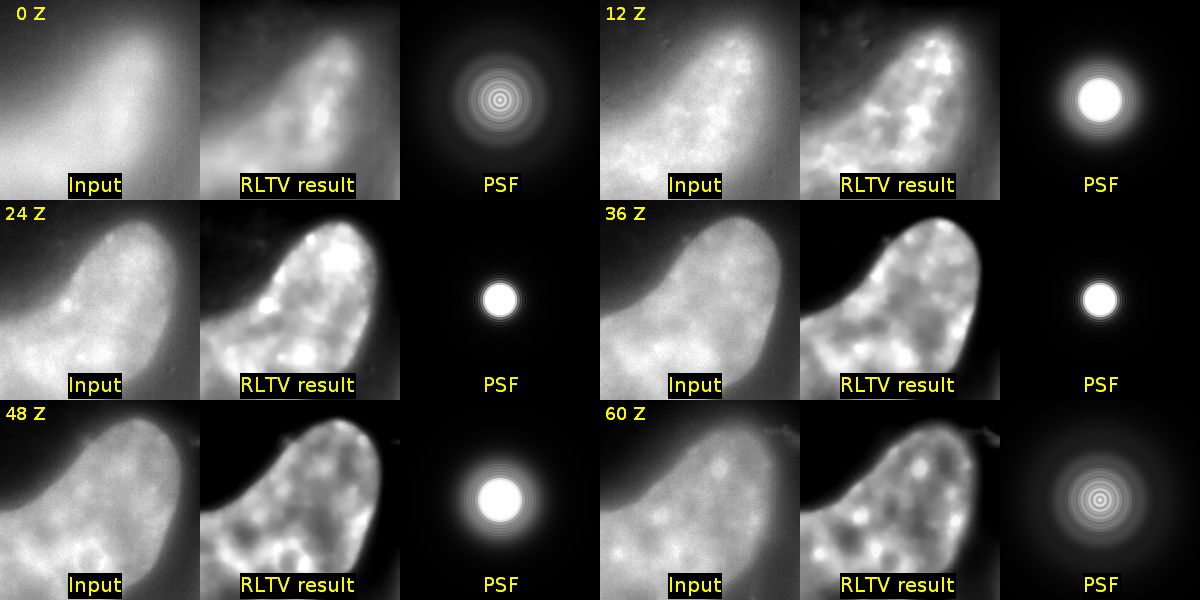
Results of RLTV deconvolution on the sample data.
The table below contains the necessary parameter values needed for the kernelDiffraction Op to create the synthetic
point spread function (PSF) using the Gibson-Lanni model 2 for the sample HeLa cell nucleus dataset.
| Parameter | Value |
|---|---|
| Iterations | 15 |
| Numerical aperature | 1.45 |
| Emission wavelength (nm) | 457 |
| Refractive index (Immersion) | 1.5 |
| Refractive index (Sample) | 1.4 |
| Lateral resolution (μm/pixel) | 0.065 |
| Axial resolution (μm/pixel) | 0.1 |
| Particle/sample position (μm/pixel) | 0.0 |
| Regularization factor | 0.002 |
SciJava Ops via Fiji's scripting engine with script parameters:
.. tabs::

    .. code-tab:: scijava-groovy

        #@ OpEnvironment ops
        #@ ImgPlus img
        #@ Integer iterations(label="Iterations", value=15)
        #@ Float numericalAperture(label="Numerical Aperture", style="format:0.00", min=0.00, value=1.45)
        #@ Integer wavelength(label="Emission Wavelength (nm)", value=457)
        #@ Float riImmersion(label="Refractive Index (immersion)", style="format:0.00", min=0.00, value=1.5)
        #@ Float riSample(label="Refractive Index (sample)", style="format:0.00", min=0.00, value=1.4)
        #@ Float lateral_res(label="Lateral resolution (μm/pixel)", style="format:0.0000", min=0.0000, value=0.065)
        #@ Float axial_res(label="Axial resolution (μm/pixel)", style="format:0.0000", min=0.0000, value=0.1)
        #@ Float pZ(label="Particle/sample Position (μm)", style="format:0.0000", min=0.0000, value=0)
        #@ Float regularizationFactor(label="Regularization factor", style="format:0.00000", min=0.00000, value=0.002)
        #@output ImgPlus psf
        #@output ImgPlus result

        import net.imglib2.FinalDimensions
        import net.imglib2.type.numeric.real.FloatType
        import net.imglib2.type.numeric.complex.ComplexFloatType

        // convert input image to float
        img_float = ops.op("create.img").input(img, new FloatType()).apply()
        ops.op("convert.float32").input(img).output(img_float).compute()

        // use image dimensions for PSF size
        psf_size = new FinalDimensions(img.dimensionsAsLongArray())

        // convert the input parameters to meters (m)
        wavelength = wavelength.toFloat() * 1E-9
        lateral_res = lateral_res * 1E-6
        axial_res = axial_res * 1E-6
        pZ = pZ * 1E-6

        // create the synthetic PSF
        psf = ops.op("create.kernelDiffraction").input(psf_size,
                                                       numericalAperture,
                                                       wavelength,
                                                       riSample,
                                                       riImmersion,
                                                       lateral_res,
                                                       axial_res,
                                                       pZ,
                                                       new FloatType()).apply()

        // deconvolve image
        result = ops.op("deconvolve.richardsonLucyTV").input(img_float, psf, new FloatType(), new ComplexFloatType(), iterations, false, false, regularizationFactor).apply()

    .. code-tab:: python

        #@ OpEnvironment ops
        #@ ImgPlus img
        #@ Integer iterations(label="Iterations", value=15)
        #@ Float numericalAperture(label="Numerical Aperture", style="format:0.00", min=0.00, value=1.45)
        #@ Integer wavelength(label="Emission Wavelength (nm)", value=457)
        #@ Float riImmersion(label="Refractive Index (immersion)", style="format:0.00", min=0.00, value=1.5)
        #@ Float riSample(label="Refractive Index (sample)", style="format:0.00", min=0.00, value=1.4)
        #@ Float lateral_res(label="Lateral resolution (μm/pixel)", style="format:0.0000", min=0.0000, value=0.065)
        #@ Float axial_res(label="Axial resolution (μm/pixel)", style="format:0.0000", min=0.0000, value=0.1)
        #@ Float pZ(label="Particle/sample Position (μm)", style="format:0.0000", min=0.0000, value=0)
        #@ Float regularizationFactor(label="Regularization factor", style="format:0.00000", min=0.00000, value=0.002)
        #@output ImgPlus psf
        #@output ImgPlus result

        from net.imglib2 import FinalDimensions
        from net.imglib2.type.numeric.real import FloatType
        from net.imglib2.type.numeric.complex import ComplexFloatType

        # convert input image to float
        img_float = ops.op("create.img").input(img, FloatType()).apply()
        ops.op("convert.float32").input(img).output(img_float).compute()

        # use image dimensions for PSF size
        psf_size = FinalDimensions(img.dimensionsAsLongArray())

        # convert the input parameters to meters (m)
        wavelength = float(wavelength) * 1E-9
        lateral_res = lateral_res * 1E-6
        axial_res = axial_res * 1E-6
        pZ = pZ * 1E-6

        # create the synthetic PSF
        psf = ops.op("create.kernelDiffraction").input(psf_size,
                                                                numericalAperture,
                                                                wavelength,
                                                                riSample,
                                                                riImmersion,
                                                                lateral_res,
                                                                axial_res,
                                                                pZ,
                                                                FloatType()).apply()

        # deconvolve image
        result = ops.op("deconvolve.richardsonLucyTV").input(img_float, psf, FloatType(), ComplexFloatType(), iterations, False, False, regularizationFactor).apply()