NOTE On 2014-02-28, Broadcom announced the release of full documentation for the VideoCore IV graphics core, and a complete source release of the graphics stack at https://www.raspberrypi.org/blog/a-birthday-present-from-broadcom/. Their release largely obsoletes the information contained here. But we have left it here for historical reasons.
Fun and Games with the Videocoreiv Quad Processor Units
The BCM2835 SoC (System on a Chip) in the RaspberryPi has the following significant computation units:
- ARM1176JZF-S 700 MHz processor which acts as the "main" processor and typically runs Linux.
- Dualcore Videocore IV CPU @250MHz with SIMD Parallel Pixel Units (PPU) which runs scalar (integer and float) and vector (integer only) programs. Runs ThreadX OS, and generally coordinates all functional blocks such as video codecs, power management, video out.
- Image Sensor Pipeline (ISP) providing lens shading, satistics and distortion correction.
- QPU units which provide 24 GFLOPS compute performance for coordinate, vertex and pixel shaders.
Let's focus on the QPU here.
Disclaimer:

There is good precedent in Copyright Law for the following assumption:
- Given, an input I, with copyright holder C(I)
- a program or algorithm A with copyright holder C(A)
- a program output O, given by O=A(I)
that C(O) = C(I), given C(A) injects no artistic work during the operation of A().

We aim to feed different inputs into functions provided by the blob, and
document and analyse the outputs - without violating copyright law.

We will feed various inputs such as shader programs into the blob via entry
points (such as provided by OpenGL ES) and observe the outputs.

At all times we will obey:
  "This software may only be used for the purposes of developing for,
    running or using a Raspberry Pi device."

as stipulated in the license:
   https://github.com/raspberrypi/firmware/blob/master/boot/LICENCE.broadcom.
In recommended reading order:
- US20110227920 Method and System for a Shader Processor With Closely Couple Peripherals
- US20110154307 Method and System for Utilizing Data Flow Graphs to Compile Shaders
- US20110148901 Method and System for Tile Mode Renderer With Coordinate Shader
- US20110216069 Method and System for Compressing Tile Lists Used for 3d Rendering
- US20110221743 Method and System for Controlling a 3d Processor Using a Control List in Memory
- US20110242113 Method and System for Processing Pixels Utilizing Scoreboarding
- US20110261059 Method and System for Decomposing Complex Shapes Into Curvy RHTS For Rasterization
- US20080291208 Method and System for Processing Data Via a 3d Pipeline Coupled to a Generic Video Processing Unit
In recommended reading order:
- Fixed length instruction word of 64 bits.
- Instructions contain multiple issue slots.
- There is a slot for the Add vector ALU and Multiply vector ALU.
- Registers written in one cycle, should not be read back for 1 instruction cycle.
- Branch instructions have 3 delay slots.
- Thread switching is handled by (cooperative) thread switch instructions.
- Program may be terminated by instruction with program end signal, two delay slots will be executed before the unit becomes idle.
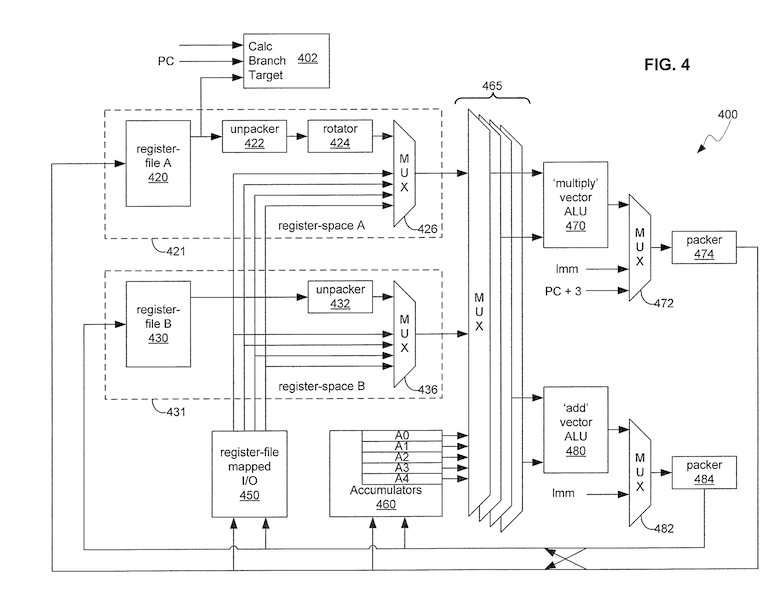
- Decoupled memory access operations are: reciprocal, reciprocal square root, logarithm and exponential (US20110227920-0078).
- Accumulators written in one cycle are available immediately in the next instruction (US20110227920-0092).
- Accumulators are a0...a4 or r0...r5 (here) (US20110227920-0094).
- The two register files have 32 registers each (US20110227920-0095), whilst the other 32 register addresses refer to peripheral IO.
- The rotator allows a vector to be rotated by any one of 16 horizontal rotations (US20110227920-0096).
- The unpackers can unpack register data, whilst the packers pack it (US20110227920-0097).
- Support for zero-extension of 8-bit data, sign extension of 16-bit data, convert 16-bit floats to 32-bit floats. (US20110227920-0099).
- Values written to registers (not accumulators) are not available in the next cycle (US20110227920-0103).
- Condition field allows conditional write back of ALU results (US20110227920-0104), and updating of condition flags is optional.
- 32-bit bit data may be written back to registers/accumulators as an alternative to ALU results (US20110227920-0105).
- Branches have 3-delay slots (no prediction), and may be conditional based on ALU flag bits. Branches may provide link functionality. (US20110227920-0106).
- Instructions may include a signalling field (US20110227920-0107) without costing an additional instruction. Typical uses include tile buffer access, or end of program / thread switch (both with 2 delay slots).
I'm realigning the names with those found in some of the blobs. For instance thread-switch becomes thrsw, gl_FragColor becomes tlbc, min8 becomes v8min and so forth. The main purpose of this change is in the vain hope that if any of the work here becomes useful the names are common for anyone doing this in a commercial context.
  <addop><addcc> wa, radda, raddb [setf] ; <mulop><mulcc> wb, rmula, rmulb [setf] ; <op>
  <addop><addcc> wb, radda, raddb [setf] ; <mulop><mulcc> wa, rmula, rmulb [setf] ; <op>

  radda = ra | ra >> shift | imm6 | rb | r0..r5
  raddb = rb | ra >> shift | imm6 | rb | r0..r5
  rmula = ra | ra >> shift | imm6 | rb | r0..r5
  rmulb = rb | ra >> shift | imm6 | rb | r0..r5
Encoding:
  mulop:3 addop:5 ra:6 rb:6 adda:3 addb:3 mula:3 mulb:3, op:4 packbits:8 addcc:3 mulcc:3 F:1 X:1 wa:6 wb:6
  mulop:3 addop:5 ra:6 imm:6 adda:3 addb:3 mula:3 mulb:3, 1101 packbits:8 addcc:3 mulcc:3 F:1 X:1 wa:6 wb:6
Where:
  addop is the add ALU operation.
    00000  nop
    00001  fadd     rd = ra + rb         (floating point addition)
    00010  fsub     rd = ra - rb         (floating point subtraction)
    00011  fmin     rd = fmin(ra, rb)    (floating point minimum)
    00100  fmax     rd = fmax(ra, rb)    (floating point maximum)
    00101  fminabs  rd = fminabs(ra, rb)
    00110  fmaxabs  rd = fmaxabs(ra, rb)
    00111  ftoi     rd = int(rb)         (convert float to int)
    01000  itof     rd = float(rb)       (convert int to float)
    01001
    01010
    01011
    01100  add      rd = ra + rb         (integer addition)
    01101  sub      rd = ra - rb         (integer subtraction)
    01110  shr      rd = ra >>> rb       (logical shift right)
    01111  asr      rd = ra >> rb        (arithmetic shift right)
    10000  ror      rd = ror(ra, rb)     (rotate right)
    10001  shl      rd = ra << rb        (logical shift left)
    10010  min      rd = min(ra, rb)     (integer min)
    10011  max      rd = max(ra, rb)     (integer max)
    10100  and      rd = ra & rb         (bitwise and)
    10101  or       rd = ra | rb         (bitwise or,  note: or rd, ra, ra is used for mov)
    10110  xor      rd = ra ^ rb         (bitwise xor)
    10111  not      rd = ~rb             (bitwise not)
    11000  clz      rd = clz(rb)         (count leading zeros)
    11001
    11010
    11011
    11100
    11101
    11110  v8adds   rd[i] = sat8(ra[i]+rb[i]), i = 0..3 / a..d
    11111  v8subs   rd[i] = sat8(ra[i]-rb[i]), i = 0..3 / a..d

  mulop is the multiplication ALU operation.
      000  nop
      001  fmul    rd = ra * rb
      010  mul24
      011  v8muld  rd[i] = ra[i] * rb[3], i = 0..3 / a..d
      100  v8min   rd[i] = min(ra[i], rb[i]), i = 0..3 / a..d, (note: v8min rd, ra, ra is used for mov)
      101  v8max   rd[i] = max(ra[i], rb[i]), i = 0..3 / a..d
      110  v8adds  rd[i] = sat8(ra[i] + rb[i]), i = 0..3 / a..d
      111  v8subs  rd[i] = sat8(ra[i] - rb[i]), i = 0..3 / a..d

  op is the signaling or control flow operation.
     0000  bpkt
     0001  nop
     0010  thrsw   thread switch
     0011  thrend  thread end
     0100  sbwait  scoreboard wait
     0101  sbdone  scoreboard done
     0110  lthrsw  last thread switch
     0111  loadcv
     1000  loadc   load tlb color
     1001  ldcend  load tlb color and thread end
     1010  ldtmu0  load tmu0
     1011  ldtmu1  load tmu1
     1100  loadam
     1101  nop     (small constant encoded in field rb)
     1110  ldi     load immediate
     1111  bra     branch

  (Replacing the following names, thread-switch, thread-end, scoreboard-wait, scoreboard-done, last-thread-switch,
   (openvg coverage?), load-gl_FragColor, load-gl_FragColor-and-thread-end, load-tmu0, load-tmu1,
   (openvg alpha mask?))

  adda, addb encode which accumulator or ra, rb value will be supplied to the add ALU.
  mula, mulb encode which accumulator or ra, rb value will be supplied to the multiplication ALU.
    000  r0  accumulator 0
    001  r1  accumulator 1
    010  r2  accumulator 2
    011  r3  accumulator 3
    100  r4  accumulator 4
    101  r5  accumulator 5
    110  ra  register from bank a
    111  rb  register from bank b

  packbits control the packing/unpacking operation.
    Each 32 bit value can be viewed as (a:8, b:8, c:8, d:8) or (a:16, b:16)
    uuu0pppp unpack from ra0-31 only, pack to ra0-31 only.
    uuu1pppp unpack from r4 only, pack (multiply dst only) to r0-r3, ra0-31 or rb0-31.

  uuu unpacking add/mul source (rb)
    000  (32) full 32 bit value
    001  16a  unpack from 16a
    010  16b  unpack from 16b
    011  8dr  unpack as 8d replicated, ie (d:8, d:8, d:8, d:8)
    100  8a   unpack from 8a
    101  8b   unpack from 8b
    110  8c   unpack from 8c
    111  8d   unpack from 8d

  0pppp pack add result
    0000  (32)
    0001  16a
    0010  16b
    0011  8abcd
    0100  8a
    0101  8b
    0110  8c
    0111  8d
    1000  s
    1001  16as
    1010  16bs
    1011  8abcds
    1100  8as
    1101  8bs
    1110  8cs
    1111  8ds

  1pppp pack mul result
    0000  (32)
    0001
    0010
    0011  8abcd
    0100  8a
    0101  8b
    0110  8c
    0111  8d
    1000
    1001
    1010
    1011
    1100
    1101
    1110
    1111

  addcc holds the cc predicate for conditional execution of the add instruction.
  mulcc holds the cc predicate for conditional execution of the mul instruction.
    000  .never  never
    001          always
    010  .zs     zero set
    011  .zc     zero clear
    100  .ns     negative set
    101  .nc     negative clear
    110  .cs     carry set
    111  .cc     carry clear

  F is set to update cc flags (there are Zero, Negative and Carry flags per unit) - SETF
    Normally the result of the add operation is used to determine the new cc flags.
    If the add operation is a nop, then the result of the multiply operation is used.

  X is set to exchange values on the writeback (ie the crossed lines in the diagram).

  ra is register bank A value to read.
    ra0..ra31 are registers, whilst ra32..ra63 are peripheral addresses.

  rb is register bank B value to read.
    rb0..rb31 are registers, whilst rb32..rb63 are peripheral addresses.

  wa is destination for the add or mul result (depends on X).
    ra0..ra31 are registers, whilst ra32..ra63 are peripheral addresses.

  wb is destination for the add or mul result (depends on X).
    rb0..rb31 are registers, whilst rb32..rb63 are peripheral addresses.

            ra         rb         wa         wb

    000000  ra00       rb00       ra00       rb00
    000001  ra01       rb01       ra01       rb01
    000010  ra02       rb02       ra02       rb02
    000011  ra03       rb03       ra03       rb03
    000100  ra04       rb04       ra04       rb04
    000101  ra05       rb05       ra05       rb05
    000110  ra06       rb06       ra06       rb06
    000111  ra07       rb07       ra07       rb07
    001000  ra08       rb08       ra08       rb08
    001001  ra09       rb09       ra09       rb09
    001010  ra10       rb10       ra10       rb10
    001011  ra11       rb11       ra11       rb11
    001100  ra12       rb12       ra12       rb12
    001101  ra13       rb13       ra13       rb13
    001110  ra14       rb14       ra14       rb14
    001111  ra15 (w)   rb15 (z)   ra15 (w)   rb15 (z)
    001000  ra16       rb16       ra16       rb16
    001001  ra17       rb17       ra17       rb17
    001010  ra18       rb18       ra18       rb18
    001011  ra19       rb19       ra19       rb19
    001100  ra20       rb20       ra20       rb20
    001101  ra21       rb21       ra21       rb21
    001110  ra22       rb22       ra22       rb22
    001111  ra23       rb23       ra23       rb23
    011000  ra24       rb24       ra24       rb24
    011001  ra25       rb25       ra25       rb25
    011010  ra26       rb26       ra26       rb26
    011011  ra27       rb27       ra27       rb27
    011100  ra28       rb28       ra28       rb28
    011101  ra29       rb29       ra29       rb29
    011110  ra30       rb30       ra30       rb30
    011111  ra31       rb31       ra31       rb31
    100000  unif       unif       r0         r0
    100001                        r1         r1
    100010                        r2         r2
    100011  vary       vary       r3         r3
    100100                        tmurs      tmurs
    100101                        r5quad     r5rep
    100110  elem_num   qpu_num    irq        irq
    100111  (nop)      (nop)      (nop)      (nop)
    101000                        unif_addr  unif_addr_rel
    101001  x_coord    y_coord    x_coord    y_coord
    101010  ms_mask    rev_flag   ms_mask    rev_flag
    101011                        stencil    stencil
    101100                        tlbz       tlbz
    101101                        tlbm       tlbm
    101110                        tlbc       tlbc
    101111                        tlbam?     tlbam?
    110000  vpm        vpm        vpm        vpm
    110001  vr_busy    vw_busy    vr_setup   vw_setup
    110010  vr_wait    vw_wait    vr_addr    vw_addr
    110011  mutex      mutex      mutex      mutex
    110100                        recip      recip
    110101                        recipsqrt  recipsqrt
    110110                        exp        exp
    110111                        log        log
    111000                        t0s        t0s
    111001                        t0t        t0t
    111010                        t0r        t0r
    111011                        t0b        t0b
    111100                        t1s        t1s
    111101                        t1t        t1t
    111110                        t1r        t1r
    111111                        t1b        t1b

  rb - Small constants, active when signal/control operation is 1101:

    imm      ra       rb

    0  i:5   ra        i            Signed 4 bit immediate
    10 i:4   ra        1.0 << i     Shift by signed 4 bit quantity
    11 0000  ra >> A5  -
    11 d:4   ra >> d   -
  # Branch absolute to addr+ra, optionally save return address to wa and/or wb.
  bra[<cond>] [wa|wb], addr[+ra]

  # Branch relative to pc+addr+ra, optionally save return address to wa and/or wb.
  brr[<cond>] [wa|wb], addr[+ra]
Encoding:
addr:32, 1111 0000 cond:4 relative:1 register:1 ra:5 X:1 wa:6 wb:6
Where:
  addr is the target address

  cond is the condition code:
    0000  .allz   all zero set
    0001  .allnz  all zero clear
    0010  .anyz   any zero set
    0011  .anynz  any zero clear
    0100  .alln   all negative set
    0101  .allnn  all negative clear
    0110  .anyn   any negative set
    0111  .anynn  any negative clear
    1000  .allc   all carry set
    1001  .allnc  all carry clear
    1010  .anycs  any carry set
    1011  .anycc  any carry clear
    xxxx unknown

  relative is set if the target is relative.
  register is set if the target should be addr + ra

  X, wa, wb are used to write the return address to a register
    (ie. branch and link).
  movi[<addcc>] wa, data [setf] ; movi[<mulcc>] wb, data [setf]
  movi[<addcc>] wb, data [setf] ; movi[<mulcc>] wa, data [setf]
Encoding:
data:32, 1110 unknown:8 addcc:3 mulcc:3 F:1 X:1 wa:6 wb:6
Where:
  data is constant to be loaded.
  addcc, mulcc, F, X, wa and wb as above.
Use qpu-sniff from the qpu-sniff directory. Example:
- First fragment is the fragment shader.
- Second fragment is the full vertex shader.
- Third fragment is the coordinate shader (vertex shader only concerned with Vertex positions - used for tiling).
vs/null.vs:
void main(void) {
}


fs/add.fs:
uniform vec4 c1;
uniform vec4 c2;
void main(void) {
  gl_FragColor = c1+c2;
}

('shader code' 18402720 88)
00000000: 15827d80 10020827 mov r0, unif
00000002: 01827c00 40020867 fadd r1, unif, r0; nop; sbwait
00000004: 15827d80 10020827 mov r0, unif
00000006: 01827c00 10020827 fadd r0, unif, r0
00000008: 95827d80 114258a0 mov r2, unif; mov r0.8a, r0
0000000a: 81827c89 11525860 fadd r1, unif, r2; mov r0.8b, r1
0000000c: 95827d89 11625860 mov r1, unif; mov r0.8c, r1
0000000e: 01827c40 10020867 fadd r1, unif, r1
00000010: 809e7009 317059e0 nop; mov r0.8d, r1; thrend
00000012: 159e7000 10020ba7 mov tlbc, r0
00000014: 009e7000 500009e7 nop; nop; sbdone

('shader code' 184027a0 104)
00000000: 15827d80 10120027 mov ra0.16a, unif
00000002: 15827d80 10220027 mov ra0.16b, unif
00000004: 15827d80 10021c67 mov vw_setup, unif
00000006: 15827d80 10020c27 mov vpm, unif
00000008: 15827d80 10020c27 mov vpm, unif
0000000a: 15827d80 10020c27 mov vpm, unif
0000000c: 15827d80 10020c27 mov vpm, unif
0000000e: 95020dbf 10024c20 mov vpm, ra0; mov r0, unif
00000010: 01827c00 10020c27 fadd vpm, unif, r0
00000012: 15827d80 10020c27 mov vpm, unif
00000014: 009e7000 300009e7 nop; nop; thrend
00000016: 009e7000 100009e7 nop
00000018: 009e7000 100009e7 nop

('shader code' 185092a0 72)
00000000: 15827d80 10120027 mov ra0.16a, unif
00000002: 15827d80 10220027 mov ra0.16b, unif
00000004: 15827d80 10021c67 mov vw_setup, unif
00000006: 95020dbf 10024c20 mov vpm, ra0; mov r0, unif
00000008: 01827c00 10020c27 fadd vpm, unif, r0
0000000a: 15827d80 10020c27 mov vpm, unif
0000000c: 009e7000 300009e7 nop; nop; thrend
0000000e: 009e7000 100009e7 nop
00000010: 009e7000 100009e7 nop
Under Raspbian /opt/vc/bin/ and /opt/vc/bin/vcdbg and /opt/vc/bin/vcgencmd may be used to poke about on the videocore side. See https://github.com/nezticle/RaspberryPi-BuildRoot/wiki/VideoCore-Tools for more information.
- Run a OpenGL ES program, and whilst it is running (or ideally paused so the shaders are static):
$ sudo vcdbg reloc
This gives for example (removing the non relevant entries):
[  23] 0x1c509340: used  160 (refcount 3 lock count 0, size      116, align    4, data 0x1c509360, d0rual) 'EGL_SERVER_SURFACE_T'
[  24] 0x1c5093e0: used 7.9M (refcount 512 lock count 511, size  8294400, align 4096, data 0x1c50a000, d1Rual) 'KHRN_IMAGE_T.storage'
[  40] 0x1ccf33e0: used 7.9M (refcount 1 lock count 0, size  8294400, align 4096, data 0x1ccf4000, d1Rual) 'KHRN_IMAGE_T.storage'
[  39] 0x1d4dd3e0: used 7.9M (refcount 1 lock count 0, size  8294400, align 4096, data 0x1d4de000, d1Rual) 'KHRN_IMAGE_T.storage'
[  27] 0x1dcc73e0: used  160 (refcount 1 lock count 0, size      118, align    1, data 0x1dcc7400, d0rual) 'mem_strdup'
[  42] 0x1dcc7480: used 1.2K (refcount 2 lock count 0, size     1200, align    4, data 0x1dcc74a0, d0rual) 'GL20_PROGRAM_T'
[  26] 0x1dcc7960: used   64 (refcount 1 lock count 0, size       24, align    4, data 0x1dcc7980, d0rual) 'GL20_PROGRAM_T.uniform_data'
[  25] 0x1dcc79a0: used  640 (refcount 2 lock count 0, size      588, align    4, data 0x1dcc79c0, d0rual) 'GLXX_BUFFER_T'
[  37] 0x1dcc7c20: used   96 (refcount 1 lock count 0, size       64, align    4, data 0x1dcc7c40, D1rual) 'GLXX_BUFFER_INNER_T.storage'
[  16] 0x1dcc7c80: used   96 (refcount 1 lock count 0, size       48, align    8, data 0x1dcc7ca0, d1rual) 'shader code'
[  33] 0x1dcc7ce0: used  256 (refcount 1 lock count 0, size      216, align    8, data 0x1dcc7d00, d1rual) 'shader code'
[  30] 0x1dcc7de0: used  128 (refcount 1 lock count 0, size       96, align    4, data 0x1dcc7e00, d0rual) 'uniform map'
[  15] 0x1dcc7e60: used  256 (refcount 1 lock count 0, size      208, align    8, data 0x1dcc7e80, d1rual) 'shader code'
[  28] 0x1dd381e0: used 3.0K (refcount 1 lock count 0, size     3072, align    4, data 0x1dd38200, d0RUal) 'GLSL_COPY_CONTEXT_T.mh_blob'
[  29] 0x1dd38e00: used  128 (refcount 1 lock count 0, size       96, align    4, data 0x1dd38e20, d0rual) 'uniform map'
The fragments can then be saved via:
 $ sudo vcdbg save shader_code_1 0x1dcc7c80 96
 $ sudo vcdbg save shader_code_2 0x1dcc7ce0 256
 $ sudo vcdbg save shader_code_3 0x1dcc7e60 256

 $ sudo vcdbg save uniform_map_1 0x1dcc7de0 128
 $ sudo vcdbg save uniform_map_2 0x1dd38e00 128

 $ sudo vcdbg save GL20_PROGRAM_T 0x1dcc7480 1200
 $ sudo vcdbg save GL20_PROGRAM_T.uniform_data 0x1dcc7960 64
 $ sudo vcdbg save GLXX_BUFFER_T 0x1dcc79a0 640
 $ sudo vcdbg save GLXX_BUFFER_INNER_T.storage 0x1dcc7c20 96


