Expected Behavior
from feast import Entity, Feature, FeatureView, ValueType, FeatureService, PushSource
from feast.data_format import ParquetFormat, AvroFormat, ProtoFormat
from feast.infra.offline_stores.file_source import FileSource
from feast.repo_config import RegistryConfig, RepoConfig
from feast.infra.offline_stores.file import FileOfflineStoreConfig
from feast.infra.online_stores.sqlite import SqliteOnlineStoreConfig
from feast import FeatureStore
from datetime import timedelta, datetime

import os
import s3fs
import numpy as np
import pandas as pd

bucket_name = "add your s3 bucket in which you have below file placed"
file_name = "driver_stats.parquet"
s3_endpoint = "http://s3.us-east-1.amazonaws.com"

s3 = s3fs.S3FileSystem(key='add your s3 access key',
                       secret='add your s3 secret key',
                       client_kwargs={'endpoint_url': s3_endpoint}, use_ssl=False)

# Setting up Entity
driver = Entity(name="driver_id", description="driver id")

# Defining the Input Source
driver_hourly_stats = FileSource(
    path=f"s3://{bucket_name}/{file_name}",
    timestamp_field="event_timestamp",
    created_timestamp_column="created",
    #s3_endpoint_override=s3_endpoint
)


driver_hourly_stats_view = FeatureView(
    name="driver_hourly_stats",
    entities=[driver],
    source=driver_hourly_stats,
    ttl=timedelta(seconds=86400 * 1), ## TTL - Time To Live - This Parameter is used in Point In Time Join
                                      ## Basically Its tell the system how much we have to go backward in time
)

online_store_path = 'online_store.db'
registry_path = 'registry.db'
os.environ["FEAST_S3_ENDPOINT_URL"] = s3_endpoint

repo = RepoConfig(
            registry=f"s3://{bucket_name}/{registry_path}",
            project='feature_store',
            provider="local",
            offline_store="file",
            #online_store=SqliteOnlineStoreConfig(),
             use_ssl=True,
             filesystem=s3,
             is_secure=True,
             validate=True,
)

fs = FeatureStore(config=repo)

driver_stats_fs = FeatureService(
    name="driver_activity",
    features=[driver_hourly_stats_view]
)

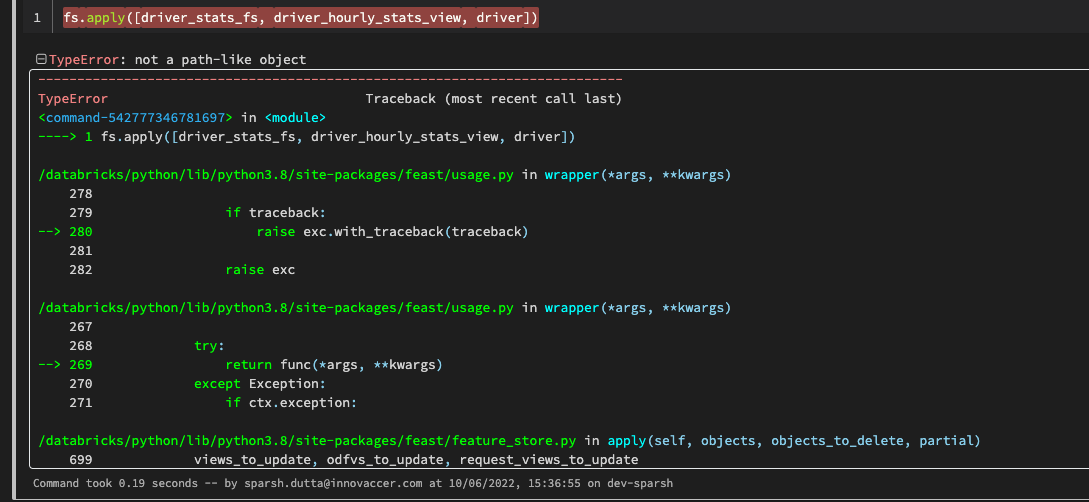
fs.apply([driver_stats_fs, driver_hourly_stats_view, driver])


# You need to first define a entity dataframe in which
# You need to specify for which id you want data and also
# mention the timestamp for that id
entity_df = pd.DataFrame.from_dict(
    {
        "driver_id": [1005,1005,1005, 1002],
        "event_timestamp": [
            datetime.utcnow() - timedelta(hours=50),
            datetime.utcnow() - timedelta(hours=20),
            datetime.utcnow(),
            datetime.utcnow(),
        ],
    }
)

entity_df

## We use feature store get_historical_features method to retrive the data
retrieval_job = fs.get_historical_features(
    entity_df=entity_df,
    features=[
        "driver_hourly_stats:conv_rate",
        "driver_hourly_stats:acc_rate",
        "driver_hourly_stats:avg_daily_trips",
    ],
)


# You have to specify the range from which you want your features to get populated in the online store
fs.materialize(start_date=datetime.utcnow() - timedelta(hours=150),
               end_date=datetime.utcnow() - timedelta(hours=50))


feature_service = fs.get_feature_service("driver_activity")

fs.get_online_features(features=feature_service,
                       entity_rows=[{"driver_id": 1001},
                                    {"driver_id": 1002},
                                    {"driver_id": 1005}]).to_df()
Current Behavior
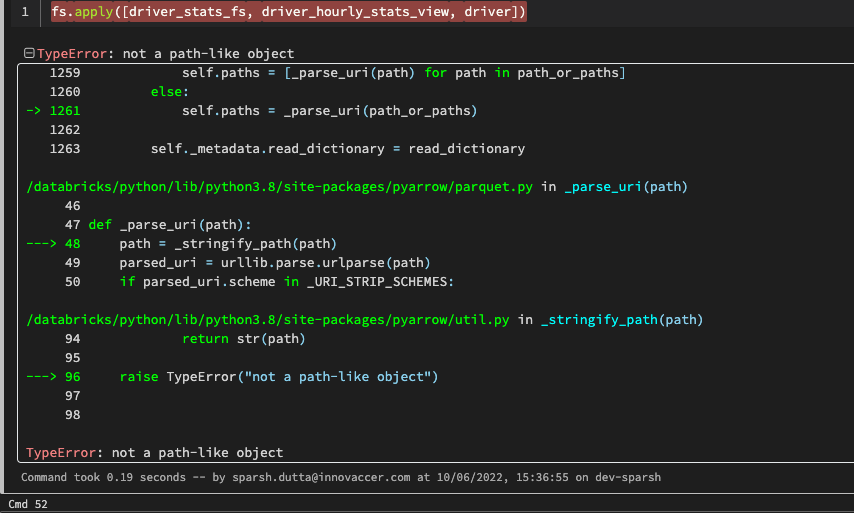
I get an error while running fs.apply()
Steps to reproduce
You can follow the above codebase to replicate the issue.
Specifications
- Version: 0.21.2
- Platform: Linux
- Subsystem: Centos
Possible Solution
I found the reason why this behavior is occurring. If you glance in file_source.py
    def get_table_column_names_and_types(
        self, config: RepoConfig
    ) -> Iterable[Tuple[str, str]]:
        filesystem, path = FileSource.create_filesystem_and_path(
            self.path, self.file_options.s3_endpoint_override
        )
        schema = ParquetDataset(
            path if filesystem is None else filesystem.open_input_file(path)
        ).schema.to_arrow_schema()
        return zip(schema.names, map(str, schema.types))

    @staticmethod
    def create_filesystem_and_path(
        path: str, s3_endpoint_override: str
    ) -> Tuple[Optional[FileSystem], str]:
        if path.startswith("s3://"):
            s3fs = S3FileSystem(
                endpoint_override=s3_endpoint_override if s3_endpoint_override else None
            )
            return s3fs, path.replace("s3://", "")
        else:
            return None, path
In the above code, when we call ParquetDataset() class we pass attributes like path. Here when we read data from s3. ParquetDataset() will call _parse_uri(path) method which in turn call _stringify_path() method due to which the issue occurs.
In order to resolve this, we need to add the following condition to the existing codebase.
    def get_table_column_names_and_types(
        self, config: RepoConfig
    ) -> Iterable[Tuple[str, str]]:
        filesystem, path = FileSource.create_filesystem_and_path(
            self.path, self.file_options.s3_endpoint_override
        )

        if filesystem is None:
            schema = ParquetDataset(path).schema.to_arrow_schema()
        else:
            schema = ParquetDataset(filesystem.open_input_file(path), filesystem=filesystem).schema

        return zip(schema.names, map(str, schema.types))
Expected Behavior
Current Behavior
I get an error while running fs.apply()
Steps to reproduce
You can follow the above codebase to replicate the issue.
Specifications
Possible Solution
I found the reason why this behavior is occurring. If you glance in file_source.py
In the above code, when we call ParquetDataset() class we pass attributes like path. Here when we read data from s3. ParquetDataset() will call _parse_uri(path) method which in turn call _stringify_path() method due to which the issue occurs.
In order to resolve this, we need to add the following condition to the existing codebase.