/ framework / bedrock / working / cosmos / spectrum / tools /

Mode Identity Theory starts with a simple bet: fundamental physics is not missing more ingredients, it's missing better boundary conditions. Instead of changing Einstein's equations or calling numbers accidents, MIT asks: what follows when form comes before function?
What began as an inadvertent search query turned philosophy, turned topology, turned theory. What followed were the constants of the universe popping out like some sort of cosmic game genie. None of this was planned...
Topology is structure, and de Broglie’s wave becomes fundamental; matter appears when the wave is sampled. The observer is part of that realization, not external to it; while time ticks in phase, not in the background.
In 300 BC, Euclid proved Plato's observation that only five solids close perfectly in space. Today, ESA's Euclid telescope asks: what geometry gives the universe its shape? MIT is betting on one shape and one wave. The rest, is accounting.
💬 Frequently Asked Questions
What shape is the universe? A three-sphere (S³): finite, closed, simply connected. By the Poincaré theorem, any closed, simply connected 3-manifold is topologically S³. Its size is fixed; what we interpret as cosmic expansion is the phase-advance of the cosmic wave, not space stretching. We see more of the wave realized, so distances appear to grow.
Why a Möbius band? S³ provides the universe’s ambient space; the Möbius band provides its informational surface. Gravity already hints that information scales with area, not volume. The Möbius band is the simplest one-sided surface with a twist, and that twist naturally yields the sign-flip, orientation reversal, and half-step mode behavior associated with fermions. It is the minimal geometric structure that encodes the observer’s boundary conditions.
What is matter, and what are we? Matter is the realized form of the cosmic wave, the part that resolves into stable physical states. In this framework, an atom is already an observer: a bounded region where the wave takes on definite values. Humans are compound observers, intricate realizations of the same underlying wave. We are not external to the universe; we are the places where it becomes definite.
How did it begin? The Big Bang was not an explosion nor the beginning of space. Finite space was already present. What began was measured time, defined by the cosmic wave starting at full potential with almost nothing realized. As time progresses, more of the wave resolves into matter. The early universe wasn’t smaller; it was the same space at an earlier stage of realization, like a three-dimensional cymatic pattern gradually energizing.
How does this complement the Standard Model? MIT does not replace the Standard Model or general relativity. It keeps their local physics (particles, forces, field equations) and adds a global geometric structure beneath them. The aim is to explain why certain constants, patterns, and symmetries have the values they do. Some connections are exact geometric identities, others are motivated correspondences, and others remain open for refinement.
mode-identity-theory/
├─ main/                          # this page
    ├─ framework/                  # the postulate and derivations
    │   ├─ bedrock/                 # standalone mathematics papers
    │   │   ├─ first-eigenvalue       # twisted Möbius Laplacian operator
    │   │   ├─ coexact-gap            # coexact gap on S³/Γ and the 2I exception
    │   │   ├─ galois-pair            # E8 filling and the tautological charge
    │   │   └─ surviving-ray          # spin-3 channel filter and the surviving ray
    │   └─ working/                 # research in progress: maps and open problems
    ├─ cosmos/                     # the static three-sphere seen whole
    │   ├─ cosmological-constant      # the spectral seed behind Λ
    │   ├─ cmb-anomalies              # low-ℓ suppression as the Molien gap
    │   ├─ dark-energy                # what evolves is not Λ but perception
    │   ├─ early-galaxies             # early massive galaxies in a static geometry
    │   ├─ hubble-tension             # H₀ as an edge mode and the 8.4% lattice step
    │   ├─ black-holes                # black holes as topological nodes of the wave
    │   └─ euclid-dr1                 # the falsification gate
    ├─ spectrum/                   # the near boundary: matter and gauge on S³/2I
    │   ├─ yang-mills                 # the linearized gauge gap and three vacua
    │   ├─ mass-spectrum              # fermion mass as positions on the lattice
    │   ├─ fine-structure             # α is the first realized step of Λ
    │   ├─ the-waltz                  # the gravity between surface and space
    │   └─ the-mirror                 # curvature duality of primes and matter
    └─ tools/                      # interactive, publications, and references
/ framework / bedrock / working / cosmos / spectrum / tools /
🏟️ One Shape:
Start with the space itself: a finite three-sphere, closed on itself with no edge or outside. Inside it sits a Möbius surface. Its single edge carries the theory's temporal boundary, and its twist supplies the sign-flip that separates one trip around from two.
Then fold the three-sphere by its binary icosahedral symmetry. The smooth space stays smooth underneath, but the observable structure resolves into 120 positions. The three-sphere gives the universe its space; the Möbius band gives it the twist; the 120-fold quotient gives the theory somewhere to read physics.
Ψ One Wave:
The space stays put. What changes is the phase of a standing wave carried on its temporal edge.
The Möbius twist makes that wave flip sign after one trip and return only after two, giving the fundamental mode its
Matter is what becomes resolved when the wave is sampled. Most possible modes cancel; the surviving patterns are the ones the framework reads as physical states.
⚖️ One Equation:
The scaling law asks two questions about a physical quantity: where are you on the wave, and how deep in the geometry are you reading it?
$C(\Theta) = 2\sin^2(\pi\Theta)$ tells you the position.
The 120-position domain is not sampled everywhere. The framework carries four Fibonacci wells at 13, 21, 34, and 55, inherited from arithmetic already present in the icosahedral structure. Which wells are realized is a selection rule the theory is still working to derive.
$(\sqrt{\Omega})^{-n}$ tells you the scale.
(n = 1) Edge: rates such as
$H_0$ and$a_0$ .
(n = 2) Surface: the vacuum spectral scale
$\Lambda_\text{top}$ .
(n = 3) Space: the three-dimensional sector, whose observable assignment remains open.
The hierarchy sets the order of magnitude. The position on the wave sets the leading number. The law puts the two together.
🔺 One Identity:
The 120-fold symmetry has three basic kinds of stabilizer: faces, edges, and vertices. Restrict a particle's representation to each one and a different part of its identity becomes visible.
Faces. The three-fold structure separates singlet from triplet channels. MIT reads that decomposition as color.
Edges. The four-fold structure separates integer-spin from half-integer-spin representations. MIT reads that split as the boson/fermion and spin distinction.
Vertices. The five-fold structure exposes the Galois sectors used by the Coxeter-Galois gate. MIT reads that structure as the electroweak address, with the eta sign constraining charge.
The representation theory supplies the decompositions. The identification of those decompositions with physical quantum numbers is the framework's reading.
One geometry, three cuts through it, three pieces of a particle's address.
⚛️ One Formula:
The mass formula builds a particle mass in four steps: set the floor, choose the seat, ride the elevator, turn the dial.
The Floor.
$\mu_\Lambda$ sets the minimum energy scale from which the spectrum is built.
The Seat.
$C_{\text{geom}}(\rho)$ gives each representation a position in the geometry.
The Elevator.
$(\sqrt{\Omega_\Lambda})^{\text{dist}(\rho)/30}$ moves that seat through orders of magnitude according to its distance on the McKay graph.
The Dial.
$T^2(\rho \otimes \sigma)$ adjusts the mass according to which flat vacuum the state occupies.
In the mathematics, those pieces are the vacuum-energy floor, the Kostant weight, the McKay distance, and Reidemeister torsion. Together they generate 24 entries across the fermion mass range.
The topology gives exactly three flat vacua. MIT reads those three as the three generations; that identification, and the mapping of individual entries to measured particles, is a comparison rather than something the mass formula proves by itself.
🪡 One Interface:
The theory has two kinds of structure. Underneath is smooth
The Möbius surface sets the vacuum spectral seed, while the quotient sets the matter-side grid. Passing from the surface curvature to the three-dimensional vacuum reference introduces the factor
Gravity is not a fourth force waiting for an empty rung on the particle grid. MIT reads it as what crosses between the smooth geometry below and the discrete structure above. Einstein's field equations remain unchanged; what is still open is the dynamical bridge telling them exactly how the realized wave content sources the geometry.
The
Outputs of a fixed structure, checked against observation:
| Observable | Output | Observed | Agreement |
|---|---|---|---|
|
↗ |
~23% | ||
|
↗ |
|
|
order of magnitude |
|
↗ |
3/2 (gravitational cost) | 3 Gauss/Ricci lift × 1/2 de Sitter vacuum | exact |
|
↗ |
topological ( |
antinode topologically selected; stationary to first order | ✓ |
|
↗ |
no phantom crossing | DESI DR2 compatible | ✓ |
|
↗ |
|
Pantheon+ & DESI DR2 BAO | passed |
|
↗ |
negative, tied to |
awaiting next-gen BAO | open |
| ↗ CMB low-ℓ deficit | Molien gap, lands |
deficit below |
open (Rides on R) |
|
↗ |
~2% | ||
|
↗ |
8.4% lattice step | 8.4% observed gap | mechanism falsified, correspondence open |
|
↗ |
0.184 | 0.183 | <1% |
|
↗ |
~2% | ||
|
↗ |
|
awaiting high-z rotation curves | open |
| ↗ Null dark matter | permanent | ongoing null results | ✓ |
| ↗ Mass gap | confinement observed | ✓ | |
| ↗ Three flat vacua → generations | 3 flat vacua (mass gaps) | 3 generations | exact count; identification is the reading |
| ↗ Force count | 3 (grid-ladder conjecture) | 3 | consistent (conjecture) |
| ↗ Null SUSY | no realized gaugino-mediated force (open conjecture) | ongoing null results | consistent (conjecture) |
| ↗ Spectral inaccessibility | no |
proved (Theorem 1, 8 lemmas) | exact |
|
↗ Color from |
singlet and triplet/anti-triplet channels | every assigned fermion has its required color channel | exact |
|
↗ Domain from |
|
integer/half-integer split | exact |
|
↗ Weak isospin |
|
eleven featured (5 assigned + 2 neutrino-proxy + 4 structural) | exact |
| ↗ Eta sign gate | all SM-assigned entries | exact | |
| ↗ Fermion masses | 24 entries | 5 compatible / 4 adjudicated within ×3 ( |
comparison |
|
↗ |
|
|
~3% |
|
↗ |
|
|
7% |
|
↗ |
mass benchmark | 0.511 MeV | normalization |
| ↗ Rank 16 entry |
|
no known fermion | structural residual by default |
| ↗ Dead zone | 6 states, eV to keV | no SM fermions in range | open |
|
↗ |
|
absolute neutrino masses unmeasured; KATRIN |
awaiting measurement |
|
↗ |
0.1162 | 0.1180 | 1.5% |
|
↗ |
0.0339 | 0.0338 | 0.3% |
|
↗ |
3.426 (pure geometry) | 3.490 | 1.8% |
|
↗ |
0.00733 | 0.00730 | 0.4% |
ESA Euclid Mission: Euclid is designed to explore the evolution of the dark Universe. It is creating a 3D-map of the Universe (with time as the third dimension) by observing billions of galaxies out to 10 billion light-years, across more than a third of the sky. This addresses two core themes of ESA’s Cosmic Vision programme: What are the fundamental physical laws of the Universe? and How did the Universe originate and what is it made of?
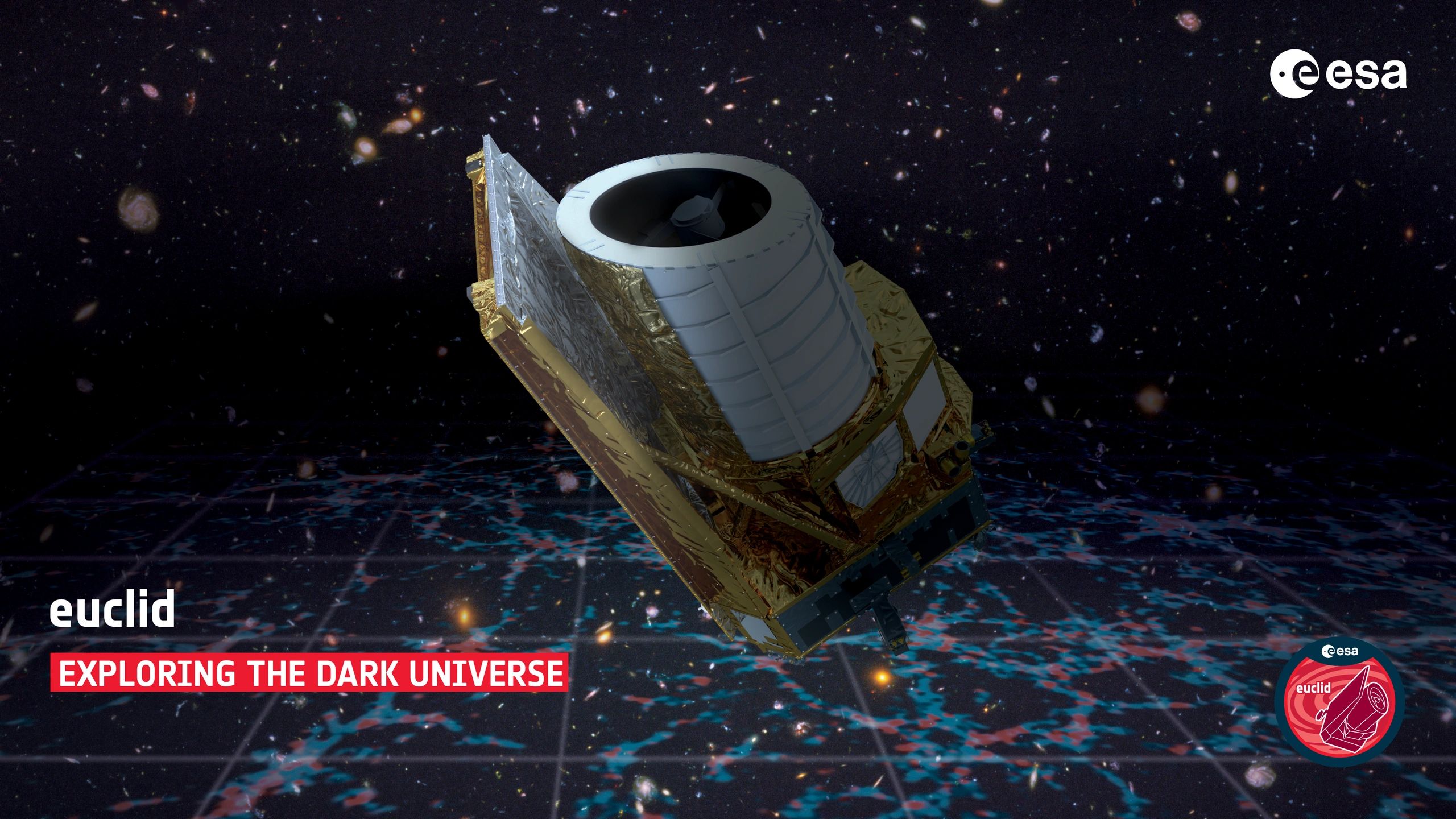
All predictions below were locked before Data Release 1 and deposited on Zenodo.
| Prediction | Value | Euclid DR1 channel | Falsified if |
|---|---|---|---|
|
↗ |
|
Spectroscopic BAO across four |
Reconstructed |
|
↗ |
|
Galaxy-galaxy weak lensing stellar-mass-halo-mass relation; photometric/spectroscopic galaxy samples for high-z scaling relations | Euclid DR1 galaxy-galaxy lensing and stellar-mass-halo-mass scaling show no enhancement consistent with the predicted |
|
↗ |
|
Spectroscopic BAO ( |
Fiducial split gives |
|
↗ Stellar mass function at |
JWST-style massive galaxies persist in Euclid wide-area statistics; reachable with |
Wide-area photometric source catalog with high-z selection; NISP/ancillary spectroscopic confirmation where available | Abundance of |
|
↗ |
Negative, magnitude |
Spectroscopic BAO precision across |
Coefficient positive at |
↗ Every link between topology and observable is live. The code is the math. There are no hidden knobs. These are the working tools behind the framework: the interactive pages let you turn the shape and run the numbers yourself, and the registry collects the deposits.

Gemini Notebook: a NotebookLM grounded in the framework; ask it anything, or hear the audio overview.

What you hold in your hand is not matter. It is where the wave resolved when you sampled it.
The thing is the sample. The identity is the wave Ψ
/ ↑top / framework / bedrock / working / cosmos / spectrum / tools /