| tags |
|
|
|---|---|---|
| e_maxx_link | treap |
A treap is a data structure which combines binary tree and binary heap (hence the name: tree + heap
More specifically, treap is a data structure that stores pairs
A treap is also often referred to as a "cartesian tree", as it is easy to embed it in a Cartesian plane:

Treaps have been proposed by Raimund Siedel and Cecilia Aragon in 1989.
In such implementation,
At the same time, priorities (when they're unique) allow to uniquely specify the tree that will be constructed (of course, it does not depend on the order in which values are added), which can be proven using corresponding theorem. Obviously, if you choose the priorities randomly, you will get non-degenerate trees on average, which will ensure
A treap provides the following operations:
-
Insert (X,Y) in
$O(\log N)$ .
Adds a new node to the tree. One possible variant is to pass only$X$ and generate$Y$ randomly inside the operation. -
Search (X) in
$O(\log N)$ .
Looks for a node with the specified key value$X$ . The implementation is the same as for an ordinary binary search tree. -
Erase (X) in
$O(\log N)$ .
Looks for a node with the specified key value$X$ and removes it from the tree. -
Build (
$X_1$ , ...,$X_N$ ) in$O(N)$ .
Builds a tree from a list of values. This can be done in linear time (assuming that$X_1, ..., X_N$ are sorted). -
Union (
$T_1$ ,$T_2$ ) in$O(M \log (N/M))$ .
Merges two trees, assuming that all the elements are different. It is possible to achieve the same complexity if duplicate elements should be removed during merge. -
Intersect (
$T_1$ ,$T_2$ ) in$O(M \log (N/M))$ .
Finds the intersection of two trees (i.e. their common elements). We will not consider the implementation of this operation here.
In addition, due to the fact that a treap is a binary search tree, it can implement other operations, such as finding the
In terms of implementation, each node contains
We will implement all the required operations using just two auxiliary operations: Split and Merge.

Split (
- If the value of the root node (R) is
$\le X$ , thenLwould at least consist ofR->LandR. We then call split onR->R, and note its split result asL'andR'. Finally,Lwould also containL', whereasR = R'. - If the value of the root node (R) is
$> X$ , thenRwould at least consist ofRandR->R. We then call split onR->L, and note its split result asL'andR'. Finally,L=L', whereasRwould also containR'.
Thus, the split algorithm is:
- decide which subtree the root node would belong to (left or right)
- recursively call split on one of its children
- create the final result by reusing the recursive split call.

Merge (
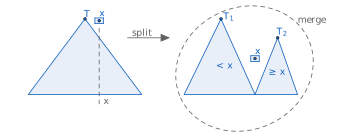
Now implementation of Insert (
Alternatively, insert can be done by splitting the initial treap on
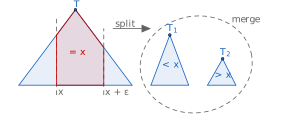
Implementation of Erase (
Alternatively, we can factor out the subtree holding
We implement Build operation with
Union (
struct item {
	int key, prior;
	item *l, *r;
	item () { }
	item (int key) : key(key), prior(rand()), l(NULL), r(NULL) { }
	item (int key, int prior) : key(key), prior(prior), l(NULL), r(NULL) { }
};
typedef item* pitem;
This is our item defintion. Note there are two child pointers, and an integer key (for the BST) and an integer priority (for the heap). The priority is assigned using a random number generator.
void split (pitem t, int key, pitem & l, pitem & r) {
	if (!t)
		l = r = NULL;
	else if (t->key <= key)
        split (t->r, key, t->r, r),  l = t;
	else
        split (t->l, key, l, t->l),  r = t;
}
t is the treap to split, and key is the BST value by which to split. Note that we do not return the result values anywhere, instead, we just use them like so:
pitem l = nullptr, r = nullptr;
split(t, 5, l, r);
if (l) cout << "Left subtree size: " << (l->size) << endl;
if (r) cout << "Right subtree size: " << (r->size) << endl;
This split function can be tricky to understand, as it has both pointers (pitem) as well as reference to those pointers (pitem &l). Let us understand in words what the function call split(t, k, l, r) intends: "split treap t by value k into two treaps, and store the left treaps in l and right treap in r". Great! Now, let us apply this definition to the two recursive calls, using the case work we analyzed in the previous section: (The first if condition is a trivial base case for an empty treap)
- When the root node value is
$\le$ key, we callsplit (t->r, key, t->r, r), which means: "split treapt->r(right subtree oft) by valuekeyand store the left subtree int->rand right subtree inr". After that, we setl = t. Note now that thelresult value containst->l,tas well ast->r(which is the result of the recursive call we made) all already merged in the correct order! You should pause to ensure that this result oflandrcorresponds exactly with what we discussed earlier in Implementation Description. - When the root node value is greater than key, we call
split (t->l, key, l, t->l), which means: "split treapt->l(left subtree oft) by valuekeyand store the left subtree inland right subtree int->l". After that, we setr = t. Note now that therresult value containst->l(which is the result of the recursive call we made),tas well ast->r, all already merged in the correct order! You should pause to ensure that this result oflandrcorresponds exactly with what we discussed earlier in Implementation Description.
If you're still having trouble understanding the implementation, you should look at it inductively, that is: do not try to break down the recursive calls over and over again. Assume the split implementation works correct on empty treap, then try to run it for a single node treap, then a two node treap, and so on, each time reusing your knowledge that split on smaller treaps works.
void insert (pitem & t, pitem it) {
	if (!t)
		t = it;
	else if (it->prior > t->prior)
		split (t, it->key, it->l, it->r),  t = it;
	else
		insert (t->key <= it->key ? t->r : t->l, it);
}

void merge (pitem & t, pitem l, pitem r) {
	if (!l || !r)
		t = l ? l : r;
	else if (l->prior > r->prior)
		merge (l->r, l->r, r),  t = l;
	else
		merge (r->l, l, r->l),  t = r;
}

void erase (pitem & t, int key) {
	if (t->key == key) {
		pitem th = t;
		merge (t, t->l, t->r);
		delete th;
	}
	else
		erase (key < t->key ? t->l : t->r, key);
}

pitem unite (pitem l, pitem r) {
	if (!l || !r)  return l ? l : r;
	if (l->prior < r->prior)  swap (l, r);
	pitem lt, rt;
	split (r, l->key, lt, rt);
	l->l = unite (l->l, lt);
	l->r = unite (l->r, rt);
	return l;
}To extend the functionality of the treap, it is often necessary to store the number of nodes in subtree of each node - field int cnt in the item structure. For example, it can be used to find K-th largest element of tree in
When a tree changes (nodes are added or removed etc.), cnt of some nodes should be updated accordingly. We'll create two functions: cnt() will return the current value of cnt or 0 if the node does not exist, and upd_cnt() will update the value of cnt for this node assuming that for its children L and R the values of cnt have already been updated. Evidently it's sufficient to add calls of upd_cnt() to the end of insert, erase, split and merge to keep cnt values up-to-date.
int cnt (pitem t) {
	return t ? t->cnt : 0;
}

void upd_cnt (pitem t) {
	if (t)
		t->cnt = 1 + cnt(t->l) + cnt (t->r);
}
Building a Treap in $O (N)$ in offline mode {data-toc-label="Building a Treap in O(N) in offline mode"}
Given a sorted list of keys, it is possible to construct a treap faster than by inserting the keys one at a time which takes
void heapify (pitem t) {
	if (!t) return;
	pitem max = t;
	if (t->l != NULL && t->l->prior > max->prior)
		max = t->l;
	if (t->r != NULL && t->r->prior > max->prior)
		max = t->r;
	if (max != t) {
		swap (t->prior, max->prior);
		heapify (max);
	}
}

pitem build (int * a, int n) {
	// Construct a treap on values {a[0], a[1], ..., a[n - 1]}
	if (n == 0) return NULL;
	int mid = n / 2;
	pitem t = new item (a[mid], rand ());
	t->l = build (a, mid);
	t->r = build (a + mid + 1, n - mid - 1);
	heapify (t);
	upd_cnt(t)
	return t;
}
Note: calling upd_cnt(t) is only necessary if you need the subtree sizes.
The approach above always provides a perfectly balanced tree, which is generally good for practical purposes, but at the cost of not preserving the priorities that were initially assigned to each node. Thus, this approach is not feasible to solve the following problem:
!!! example "acmsguru - Cartesian Tree"
Given a sequence of pairs
Note that in this problem priorities are not random, hence just inserting vertices one by one could provide a quadratic solution.
One of possible solutions here is to find for each element the closest elements to the left and to the right which have a smaller priority than this element. Among these two elements, the one with the larger priority must be the parent of the current element.
This problem is solvable with a minimum stack modification in linear time:
void connect(auto from, auto to) {
    vector<pitem> st;
    for(auto it: ranges::subrange(from, to)) {
        while(!st.empty() && st.back()->prior > it->prior) {
            st.pop_back();
        }
        if(!st.empty()) {
            if(!it->p || it->p->prior < st.back()->prior) {
                it->p = st.back();
            }
        }
        st.push_back(it);
    }
}

pitem build(int *x, int *y, int n) {
    vector<pitem> nodes(n);
    for(int i = 0; i < n; i++) {
        nodes[i] = new item(x[i], y[i]);
    }
    connect(nodes.begin(), nodes.end());
    connect(nodes.rbegin(), nodes.rend());
    for(int i = 0; i < n; i++) {
        if(nodes[i]->p) {
            if(nodes[i]->p->key < nodes[i]->key) {
                nodes[i]->p->r = nodes[i];
            } else {
                nodes[i]->p->l = nodes[i];
            }
        }
    }
    return nodes[min_element(y, y + n) - y];
}
Implicit treap is a simple modification of the regular treap which is a very powerful data structure. In fact, implicit treap can be considered as an array with the following procedures implemented (all in
- Inserting an element in the array in any location
- Removal of an arbitrary element
- Finding sum, minimum / maximum element etc. on an arbitrary interval
- Addition, painting on an arbitrary interval
- Reversing elements on an arbitrary interval
The idea is that the keys should be null-based indices of the elements in the array. But we will not store these values explicitly (otherwise, for example, inserting an element would cause changes of the key in
Note that the key of a node is the number of nodes less than it (such nodes can be present not only in its left subtree but also in left subtrees of its ancestors).
More specifically, the implicit key for some node T is the number of vertices
Now it's clear how to calculate the implicit key of current node quickly. Since in all operations we arrive to any node by descending in the tree, we can just accumulate this sum and pass it to the function. If we go to the left subtree, the accumulated sum does not change, if we go to the right subtree it increases by
Here are the new implementations of Split and Merge:
void merge (pitem & t, pitem l, pitem r) {
	if (!l || !r)
		t = l ? l : r;
	else if (l->prior > r->prior)
		merge (l->r, l->r, r),  t = l;
	else
		merge (r->l, l, r->l),  t = r;
	upd_cnt (t);
}

void split (pitem t, pitem & l, pitem & r, int key, int add = 0) {
	if (!t)
		return void( l = r = 0 );
	int cur_key = add + cnt(t->l); //implicit key
	if (key <= cur_key)
		split (t->l, l, t->l, key, add),  r = t;
	else
		split (t->r, t->r, r, key, add + 1 + cnt(t->l)),  l = t;
	upd_cnt (t);
}
In the implementation above, after the call of
Now let's consider the implementation of various operations on implicit treaps:
-
Insert element.
Suppose we need to insert an element at position$pos$ . We divide the treap into two parts, which correspond to arrays$[0..pos-1]$ and$[pos..sz]$ ; to do this we call$split(T, T_1, T_2, pos)$ . Then we can combine tree$T_1$ with the new vertex by calling$merge(T_1, T_1, \text{new item})$ (it is easy to see that all preconditions are met). Finally, we combine trees$T_1$ and$T_2$ back into$T$ by calling$merge(T, T_1, T_2)$ . -
Delete element.
This operation is even easier: find the element to be deleted$T$ , perform merge of its children$L$ and$R$ , and replace the element$T$ with the result of merge. In fact, element deletion in the implicit treap is exactly the same as in the regular treap. - Find sum / minimum, etc. on the interval.
First, create an additional field$F$ in theitemstructure to store the value of the target function for this node's subtree. This field is easy to maintain similarly to maintaining sizes of subtrees: create a function which calculates this value for a node based on values for its children and add calls of this function in the end of all functions which modify the tree.
Second, we need to know how to process a query for an arbitrary interval$[A; B]$ .
To get a part of tree which corresponds to the interval$[A; B]$ , we need to call$split(T, T_2, T_3, B+1)$ , and then$split(T_2, T_1, T_2, A)$ : after this$T_2$ will consist of all the elements in the interval$[A; B]$ , and only of them. Therefore, the response to the query will be stored in the field$F$ of the root of$T_2$ . After the query is answered, the tree has to be restored by calling$merge(T, T_1, T_2)$ and$merge(T, T, T_3)$ . -
Addition / painting on the interval.
We act similarly to the previous paragraph, but instead of the field F we will store a fieldaddwhich will contain the added value for the subtree (or the value to which the subtree is painted). Before performing any operation we have to "push" this value correctly - i.e. change$T \rightarrow L \rightarrow add$ and$T \rightarrow R \rightarrow add$ , and to clean upaddin the parent node. This way after any changes to the tree the information will not be lost. -
Reverse on the interval.
This is again similar to the previous operation: we have to add boolean flagrevand set it to true when the subtree of the current node has to be reversed. "Pushing" this value is a bit complicated - we swap children of this node and set this flag to true for them.
Here is an example implementation of the implicit treap with reverse on the interval. For each node we store field called value which is the actual value of the array element at current position. We also provide implementation of the function output(), which outputs an array that corresponds to the current state of the implicit treap.
typedef struct item * pitem;
struct item {
	int prior, value, cnt;
	bool rev;
	pitem l, r;
};

int cnt (pitem it) {
	return it ? it->cnt : 0;
}

void upd_cnt (pitem it) {
	if (it)
		it->cnt = cnt(it->l) + cnt(it->r) + 1;
}

void push (pitem it) {
	if (it && it->rev) {
		it->rev = false;
		swap (it->l, it->r);
		if (it->l)  it->l->rev ^= true;
		if (it->r)  it->r->rev ^= true;
	}
}

void merge (pitem & t, pitem l, pitem r) {
	push (l);
	push (r);
	if (!l || !r)
		t = l ? l : r;
	else if (l->prior > r->prior)
		merge (l->r, l->r, r),  t = l;
	else
		merge (r->l, l, r->l),  t = r;
	upd_cnt (t);
}

void split (pitem t, pitem & l, pitem & r, int key, int add = 0) {
	if (!t)
		return void( l = r = 0 );
	push (t);
	int cur_key = add + cnt(t->l);
	if (key <= cur_key)
		split (t->l, l, t->l, key, add),  r = t;
	else
		split (t->r, t->r, r, key, add + 1 + cnt(t->l)),  l = t;
	upd_cnt (t);
}

void reverse (pitem t, int l, int r) {
	pitem t1, t2, t3;
	split (t, t1, t2, l);
	split (t2, t2, t3, r-l+1);
	t2->rev ^= true;
	merge (t, t1, t2);
	merge (t, t, t3);
}

void output (pitem t) {
	if (!t)  return;
	push (t);
	output (t->l);
	printf ("%d ", t->value);
	output (t->r);
}- SPOJ - Ada and Aphids
- SPOJ - Ada and Harvest
- Codeforces - Radio Stations
- SPOJ - Ghost Town
- SPOJ - Arrangement Validity
- SPOJ - All in One
- Codeforces - Dog Show
- Codeforces - Yet Another Array Queries Problem
- SPOJ - Mean of Array
- SPOJ - TWIST
- SPOJ - KOILINE
- CodeChef - The Prestige
- Codeforces - T-Shirts
- Codeforces - Wizards and Roads
- Codeforces - Yaroslav and Points