Small fix? Skip the ceremony.
/flow-next:plan fn-9 && /flow-next:work fn-9 ✓ Fewer stages, same contracts: the plan still gates the work, and done still demands evidence.
Repeatable agentic engineering
Implementation got cheap. Reviewing it, verifying it, and keeping a codebase coherent did not.
Flow-Next holds agent work to a bar you set: a different model reviews every handover, and receipts back every claim of done. Hand the whole arc to a loop when you are ready.
$ /flow-next:plan fn-52 && /flow-next:work fn-52 $ /flow-next:chart fn-52 # optional · when it is unclear
✓ 6 decisions resolved · briefing → capture
$ /flow-next:capture
✓ spec written · 6 R-IDs · source-tagged
$ /flow-next:plan fn-52
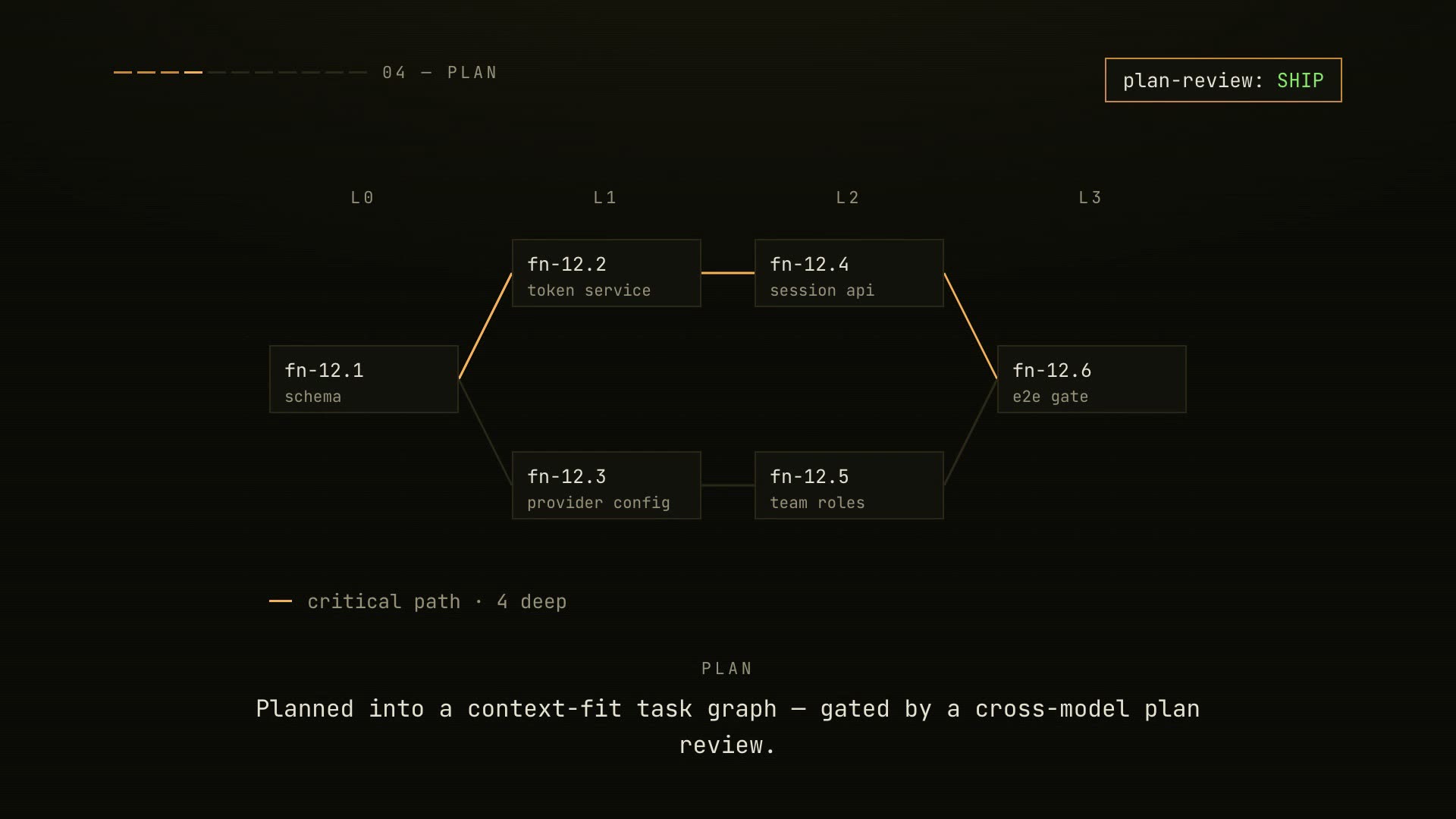
✓ sized 4 tasks for focused context
$ /flow-next:work fn-52
> Re-anchoring spec + task
+ Evidence recorded
$ /flow-next:impl-review fn-52
✓ verdict: SHIP · codex · cross-model
Receipt: .flow/review-receipts/fn-52.json
$ /flow-next:qa fn-52
✓ verdict: SHIP · live-app · 6/6 R-IDs
$ /flow-next:make-pr fn-52 && /flow-next:land
✓ PR opened with R-ID coverage
✓ merged · released · spec closed
$ ▌Review receipt
.flow/review-receipts/fn-52.json
evidence over narration
The measured problem
SlopCodeBench puts 11 models through 93 sequential checkpoints. Each checkpoint spec fixes external behaviour and says nothing about internal structure, so every run inherits whatever the run before it left behind.
No model finishes a problem end to end. The best strict pass rate is 17.2%, falling to 0.5%. Structural erosion rises in 80% of runs and verbosity in 89.8%. Measured against 48 maintained human repositories, the gap widens at every iteration while the human numbers stay flat.
The cheap fix is a better prompt, and the authors test it. Quality-aware prompts cut initial verbosity by about a third, leave the rate of decay untouched, move no pass-rate subtype, and cost up to 48% more. Better instructions do not survive iteration.
The authors name one intervention they do not test: structural discipline enforced across checkpoints through tooling. That is a description of Flow-Next. Gates the agent cannot skip, a different model reviewing every handover, a receipt for every claim of done.
The answer
What you get
Volume goes up and the standard holds. Nothing reaches your review queue that has not already been challenged and fixed.
✓ A different model reviews every plan and every implementation, the loop iterates until SHIP, and a task cannot be marked done without evidence JSON.
plan review       SHIP
implementation    NEEDS_WORK
fix + re-review   SHIP
flowctl done evidence requiredOpen the pull request and the argument is already made. Reviewers spend their attention on decisions instead of reconstructing the diff.
✓ The pull request arrives explaining itself: which acceptance criterion each change satisfies, which decisions still need a human, what deliberately did not change.
GitHub PR
  WHY -> STEP -> KEPT -> VERIFY
  proof: R-IDs + tests + reviewed head
human judgment: named decisionsThe reasons behind the code sit next to the code. A new teammate, or the next agent run, starts from what the last one learned.
✓ Specs, decisions, glossary, and memory are files in your repository that the next run reads.
.flow/specs/    intent + criteria
.flow/memory/   lessons that stuck
GLOSSARY.md your domain wordsStart with one task you watch from beside it. End with a loop draining the backlog overnight. You pick the rung, and you can step back down.
✓ One dial from a supervised pair to a loop draining the backlog overnight. The gates do not change as you climb.
/flow-next:work fn-12        you watch
/loop 10m /flow-next:pilot   it ticks
./scripts/ralph/ralph.sh it runsBuy quality on the steps that decide the outcome. Spend cheaply on the rest. Set it in config, or just ask for it in the prompt.
✓ Route any model to any role, by parameter or by sentence. Cost and quality become steering decisions.
plan    -> the model you trust most
work    -> the fast one
review -> a different familyChange harness, change model, change vendor. The specs, the gates, and the record of what happened stay yours.
✓ The same specs, gates, receipts, and task state across harnesses. Everything in your repository, and nothing outside it.
Claude Code  -> write the spec
Codex        -> implement
Cursor       -> review

same .flow/ state, every role
uninstall:   rm -rf .flow/
Flexibility
SHIP fn-52-quality-gates
ADVANCED fn-61 · pilot
Loops
One tick moves one ready spec one step closer to a pull request, then reports a verdict your host's loop can act on.
/loop 10m /flow-next:pilot Babysits the draft PRs the build loop opened: CI green, reviews converged, merged, released, per your project's own rules.
/loop 30m /flow-next:land External shell loop for fully planned specs: fresh session per iteration, hook-enforced guardrails, receipts on disk. When the run outlasts a session.
./scripts/ralph/ralph.sh tick 1 fn-61 · stage=plan ✓ 4 tasks, deps recorded PILOT_VERDICT=ADVANCED spec=fn-61 stage=plan tick 2 fn-61 · stage=plan-review ✓ verdict SHIP (round 1) PILOT_VERDICT=ADVANCED spec=fn-61 stage=plan-review tick 3 fn-61 · stage=work ✓ 4/4 tasks done · impl-review SHIP PILOT_VERDICT=ADVANCED spec=fn-61 stage=work tick 4 fn-61 · stage=make-pr ✓ draft PR #172 opened (gh-confirmed) PILOT_VERDICT=ADVANCED spec=fn-61 stage=make-pr tick 5 PILOT_VERDICT=NO_WORK spec=- stage=- backlog drained, bless more on the board
Signal
Flow-Next runs inside enterprise engineering organisations worldwide: CAD and construction software, proptech, education. Modern monorepos and hundred-repo microservice estates sit alongside thirty-year-old legacy stacks. GitHub Enterprise, GitLab, Jira. Windows included, because the field runs Windows.
A two to three hour structured discovery interview reliably produces eight to eleven implementation-ready specs. Product and engineering leads report a clear efficiency gain, and edge cases caught during spec review that the team would otherwise have met in production.
Adoption is not uniformly euphoric, and pretending otherwise would cost this page its credibility. The consistent pattern: product and delivery roles feel relief early - specs they can read, evidence they can audit, progress they can see. Senior developers feel friction early - the pipeline formalizes judgment they already exercise implicitly, and the ceremony reads as overhead until the first review gate catches something they would have missed. The friction fades with the first caught regression; the relief does not.
“I am enjoying your version of all these cool new plugins. So far yours has worked the best.”
“Hello, really enjoying this project, thanks for making it and making it public (also huge compliments on your website!)”
“it’s been really useful in my workflow.”
Pick your path
You are solo and want to feel it today.
/flow-next:setup ✓ One small change from idea to reviewed pull request, with the output you should expect at every step.
Your first 30 minutes →Your team is adopting it together.
/flow-next:interview fn-3 ✓ The spec becomes the shared artifact: product fills intent, engineering fills constraints, reviewers read one handover.
How teams run it →Your organisation is rolling it out.
managed-settings.json ✓ Deploy it once through Claude Code managed settings and every developer has it on next launch, with no per-person install.
Org-wide deployment →Not sure which applies? Ask /flow-next:guide - it names the smallest sufficient route for where you actually are, including when to skip a stage entirely. Or read When to use.
Updates
A locked-down repo can hand just the merge to an App identity; a PR behind its base catches up server-side - land never rebases or force-pushes again, which removes the cause of orphaned evidence commits; the post-merge tail runs the release and the board update before the one push a protected base can refuse; a fresh clone can finally pass validate; and a permissions problem fails in milliseconds with the real cause instead of a ten-second phantom-holder stall. Every fix landed through claim-by-claim verification of the reports, and none of it added a config key.
When a spec's tasks do not depend on each other, flow-next can implement them side by side - and does, but far less often than the task graph allows. The rule needs each task to declare which paths it will touch, and the planning guidance said to skip that line whenever it was hard to predict, so how often waves fired came down to how boldly each planning pass read that advice. It is written on every task now, declaring wider rather than omitting when unsure, because both err toward serial but only a declared line can become a wave. Two independent tasks that took 187 seconds one after the other take 96 seconds together, on the same tokens.
On a free-plan private repo, branch protection and rulesets 403 - no required status check can exist - so land's gate tree read a server with nothing to say. land.mergeVerdictCommand is an opt-in, fail-closed gate of record: once every other gate passes, land runs the repo's command once with the PR head in the environment; exit 0 merges, and a missing, timed-out, or refusing command blocks with NEEDS_HUMAN. The verdict binds the exact (head, base) pair it judged - a push after the verdict refuses server-side, a moved base re-ticks, and a non-base checkout never executes.
review.backend codex could return no verdict 13 times in a row while every probe said the backend was healthy - the reviewer subprocess was inheriting instructions never meant for it: the host repo's auto-loaded AGENTS.md taught it to re-dispatch the review at itself, and the plugin's own coordinator skills taught it to never self-declare a verdict. The persona override now rides every codex review, host project docs are suppressed at the argv level, and a healthy no-verdict run is classed honestly with a terminal that names instruction contamination instead of sending the operator to repair a working CLI.