From Wikibooks, open books for an open world
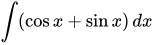
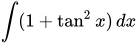
Evaluate the following:
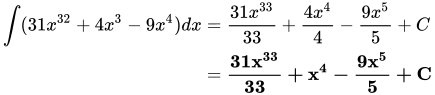
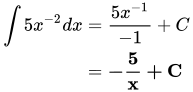
Find the general antiderivative of the following:
Find the anti-derivative or compute the integral depending on whether the integral is indefinite or definite.
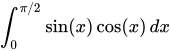
13.
∫
0
π
/
2
sin
(
x
)
cos
(
x
)
d
x
{\displaystyle \int _{0}^{\pi /2}\sin(x)\cos(x)\,dx}
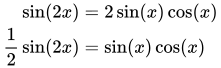
Notice that
sin
(
2
x
)
=
2
sin
(
x
)
cos
(
x
)
1
2
sin
(
2
x
)
=
sin
(
x
)
cos
(
x
)
{\displaystyle {\begin{aligned}\sin(2x)&=2\sin(x)\cos(x)\\{\frac {1}{2}}\sin(2x)&=\sin(x)\cos(x)\end{aligned}}}
By this,
∫
0
π
/
2
sin
(
x
)
cos
(
x
)
d
x
=
∫
0
π
/
2
1
2
sin
(
2
x
)
d
x
{\displaystyle \int _{0}^{\pi /2}\sin(x)\cos(x)\,dx=\int _{0}^{\pi /2}{\frac {1}{2}}\sin(2x)\,dx}
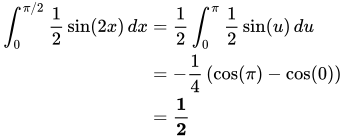
Let
u
=
2
x
,
d
u
=
2
d
x
⟹
1
2
d
u
=
d
x
{\displaystyle u=2x,\qquad du=2\,dx\implies {\frac {1}{2}}du=dx}
u
(
0
)
=
0
,
u
(
π
/
2
)
=
π
{\displaystyle u(0)=0,\qquad u(\pi /2)=\pi }
Then,
∫
0
π
/
2
1
2
sin
(
2
x
)
d
x
=
1
2
∫
0
π
1
2
sin
(
u
)
d
u
=
−
1
4
(
cos
(
π
)
−
cos
(
0
)
)
=
1
2
{\displaystyle {\begin{aligned}\int _{0}^{\pi /2}{\frac {1}{2}}\sin(2x)\,dx&={\frac {1}{2}}\int _{0}^{\pi }{\frac {1}{2}}\sin(u)\,du\\&=-{\frac {1}{4}}\left(\cos(\pi )-\cos(0)\right)\\&=\mathbf {\frac {1}{2}} \end{aligned}}}
Note that a student could do another substitution such as
u
=
sin
(
x
)
{\displaystyle u=\sin(x)}
or
u
=
cos
(
x
)
{\displaystyle u=\cos(x)}
. The answers should all be the same despite the different methods. We decided to show one method instead of all possible methods.
Notice that
sin
(
2
x
)
=
2
sin
(
x
)
cos
(
x
)
1
2
sin
(
2
x
)
=
sin
(
x
)
cos
(
x
)
{\displaystyle {\begin{aligned}\sin(2x)&=2\sin(x)\cos(x)\\{\frac {1}{2}}\sin(2x)&=\sin(x)\cos(x)\end{aligned}}}
By this,
∫
0
π
/
2
sin
(
x
)
cos
(
x
)
d
x
=
∫
0
π
/
2
1
2
sin
(
2
x
)
d
x
{\displaystyle \int _{0}^{\pi /2}\sin(x)\cos(x)\,dx=\int _{0}^{\pi /2}{\frac {1}{2}}\sin(2x)\,dx}
Let
u
=
2
x
,
d
u
=
2
d
x
⟹
1
2
d
u
=
d
x
{\displaystyle u=2x,\qquad du=2\,dx\implies {\frac {1}{2}}du=dx}
u
(
0
)
=
0
,
u
(
π
/
2
)
=
π
{\displaystyle u(0)=0,\qquad u(\pi /2)=\pi }
Then,
∫
0
π
/
2
1
2
sin
(
2
x
)
d
x
=
1
2
∫
0
π
1
2
sin
(
u
)
d
u
=
−
1
4
(
cos
(
π
)
−
cos
(
0
)
)
=
1
2
{\displaystyle {\begin{aligned}\int _{0}^{\pi /2}{\frac {1}{2}}\sin(2x)\,dx&={\frac {1}{2}}\int _{0}^{\pi }{\frac {1}{2}}\sin(u)\,du\\&=-{\frac {1}{4}}\left(\cos(\pi )-\cos(0)\right)\\&=\mathbf {\frac {1}{2}} \end{aligned}}}
Note that a student could do another substitution such as
u
=
sin
(
x
)
{\displaystyle u=\sin(x)}
or
u
=
cos
(
x
)
{\displaystyle u=\cos(x)}
. The answers should all be the same despite the different methods. We decided to show one method instead of all possible methods.
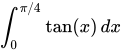
14.
∫
0
π
/
4
tan
(
x
)
d
x
{\displaystyle \int _{0}^{\pi /4}\tan(x)\,dx}
.
Rewrite the integral into an equivalent form to help us find the substitution:
∫
0
π
/
4
tan
(
x
)
d
x
=
∫
0
π
/
4
sin
(
x
)
cos
(
x
)
d
x
{\displaystyle \int _{0}^{\pi /4}\tan(x)\,dx=\int _{0}^{\pi /4}{\frac {\sin(x)}{\cos(x)}}\,dx}
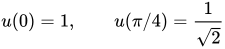
Let
u
=
cos
(
x
)
,
−
d
u
=
sin
(
x
)
d
x
{\displaystyle u=\cos(x),\qquad -du=\sin(x)\,dx}
u
(
0
)
=
1
,
u
(
π
/
4
)
=
1
2
{\displaystyle u(0)=1,\qquad u(\pi /4)={\frac {1}{\sqrt {2}}}}
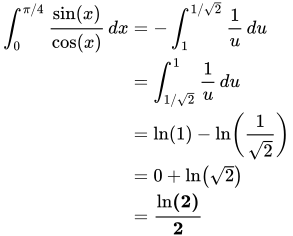
Apply all this information to find the original integral:
∫
0
π
/
4
sin
(
x
)
cos
(
x
)
d
x
=
−
∫
1
1
/
2
1
u
d
u
=
∫
1
/
2
1
1
u
d
u
=
ln
(
1
)
−
ln
(
1
2
)
=
0
+
ln
(
2
)
=
ln
(
2
)
2
{\displaystyle {\begin{aligned}\int _{0}^{\pi /4}{\frac {\sin(x)}{\cos(x)}}\,dx&=-\int _{1}^{1/{\sqrt {2}}}{\frac {1}{u}}\,du\\&=\int _{1/{\sqrt {2}}}^{1}{\frac {1}{u}}\,du\\&=\ln(1)-\ln \left({\frac {1}{\sqrt {2}}}\right)\\&=0+\ln \left({\sqrt {2}}\right)\\&=\mathbf {\frac {\ln(2)}{2}} \end{aligned}}}
Rewrite the integral into an equivalent form to help us find the substitution:
∫
0
π
/
4
tan
(
x
)
d
x
=
∫
0
π
/
4
sin
(
x
)
cos
(
x
)
d
x
{\displaystyle \int _{0}^{\pi /4}\tan(x)\,dx=\int _{0}^{\pi /4}{\frac {\sin(x)}{\cos(x)}}\,dx}
Let
u
=
cos
(
x
)
,
−
d
u
=
sin
(
x
)
d
x
{\displaystyle u=\cos(x),\qquad -du=\sin(x)\,dx}
u
(
0
)
=
1
,
u
(
π
/
4
)
=
1
2
{\displaystyle u(0)=1,\qquad u(\pi /4)={\frac {1}{\sqrt {2}}}}
Apply all this information to find the original integral:
∫
0
π
/
4
sin
(
x
)
cos
(
x
)
d
x
=
−
∫
1
1
/
2
1
u
d
u
=
∫
1
/
2
1
1
u
d
u
=
ln
(
1
)
−
ln
(
1
2
)
=
0
+
ln
(
2
)
=
ln
(
2
)
2
{\displaystyle {\begin{aligned}\int _{0}^{\pi /4}{\frac {\sin(x)}{\cos(x)}}\,dx&=-\int _{1}^{1/{\sqrt {2}}}{\frac {1}{u}}\,du\\&=\int _{1/{\sqrt {2}}}^{1}{\frac {1}{u}}\,du\\&=\ln(1)-\ln \left({\frac {1}{\sqrt {2}}}\right)\\&=0+\ln \left({\sqrt {2}}\right)\\&=\mathbf {\frac {\ln(2)}{2}} \end{aligned}}}
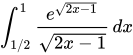
15.
∫
1
/
2
1
e
2
x
−
1
2
x
−
1
d
x
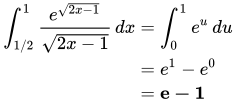
{\displaystyle \int _{1/2}^{1}{\frac {e^{\sqrt {2x-1}}}{\sqrt {2x-1}}}\,dx}
.
Let
u
=
2
x
−
1
,
d
u
=
1
2
x
−
1
d
x
{\displaystyle u={\sqrt {2x-1}},\qquad du={\frac {1}{\sqrt {2x-1}}}\,dx}
u
(
1
/
2
)
=
0
,
u
(
1
)
=
1
{\displaystyle u(1/2)=0,\qquad u(1)=1}
Then,
∫
1
/
2
1
e
2
x
−
1
2
x
−
1
d
x
=
∫
0
1
e
u
d
u
=
e
1
−
e
0
=
e
−
1
{\displaystyle {\begin{aligned}\int _{1/2}^{1}{\frac {e^{\sqrt {2x-1}}}{\sqrt {2x-1}}}\,dx&=\int _{0}^{1}e^{u}\,du\\&=e^{1}-e^{0}\\&=\mathbf {e-1} \end{aligned}}}
Let
u
=
2
x
−
1
,
d
u
=
1
2
x
−
1
d
x
{\displaystyle u={\sqrt {2x-1}},\qquad du={\frac {1}{\sqrt {2x-1}}}\,dx}
u
(
1
/
2
)
=
0
,
u
(
1
)
=
1
{\displaystyle u(1/2)=0,\qquad u(1)=1}
Then,
∫
1
/
2
1
e
2
x
−
1
2
x
−
1
d
x
=
∫
0
1
e
u
d
u
=
e
1
−
e
0
=
e
−
1
{\displaystyle {\begin{aligned}\int _{1/2}^{1}{\frac {e^{\sqrt {2x-1}}}{\sqrt {2x-1}}}\,dx&=\int _{0}^{1}e^{u}\,du\\&=e^{1}-e^{0}\\&=\mathbf {e-1} \end{aligned}}}
16.
∫
−
3
−
6
8
x
x
2
−
5
d
x
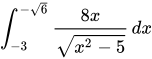
{\displaystyle \int _{-3}^{-{\sqrt {6}}}{\frac {8x}{\sqrt {x^{2}-5}}}\,dx}
.
Let
u
=
x
2
−
5
,
d
u
=
2
x
d
x
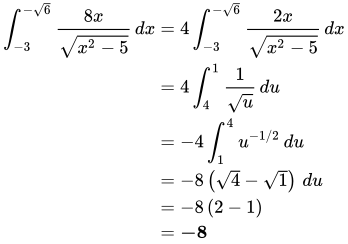
{\displaystyle u=x^{2}-5,\qquad du=2x\,dx}
u
(
−
3
)
=
4
,
u
(
−
6
)
=
1
{\displaystyle u\left(-3\right)=4,\qquad u(-{\sqrt {6}})=1}
Then,
∫
−
3
−
6
8
x
x
2
−
5
d
x
=
4
∫
−
3
−
6
2
x
x
2
−
5
d
x
=
4
∫
4
1
1
u
d
u
=
−
4
∫
1
4
u
−
1
/
2
d
u
=
−
8
(
4
−
1
)
d
u
=
−
8
(
2
−
1
)
=
−
8
{\displaystyle {\begin{aligned}\int _{-3}^{-{\sqrt {6}}}{\frac {8x}{\sqrt {x^{2}-5}}}\,dx&=4\int _{-3}^{-{\sqrt {6}}}{\frac {2x}{\sqrt {x^{2}-5}}}\,dx\\&=4\int _{4}^{1}{\frac {1}{\sqrt {u}}}\,du\\&=-4\int _{1}^{4}u^{-1/2}\,du\\&=-8\left({\sqrt {4}}-{\sqrt {1}}\right)\,du\\&=-8\left(2-1\right)\\&=\mathbf {-8} \end{aligned}}}
Let
u
=
x
2
−
5
,
d
u
=
2
x
d
x
{\displaystyle u=x^{2}-5,\qquad du=2x\,dx}
u
(
−
3
)
=
4
,
u
(
−
6
)
=
1
{\displaystyle u\left(-3\right)=4,\qquad u(-{\sqrt {6}})=1}
Then,
∫
−
3
−
6
8
x
x
2
−
5
d
x
=
4
∫
−
3
−
6
2
x
x
2
−
5
d
x
=
4
∫
4
1
1
u
d
u
=
−
4
∫
1
4
u
−
1
/
2
d
u
=
−
8
(
4
−
1
)
d
u
=
−
8
(
2
−
1
)
=
−
8
{\displaystyle {\begin{aligned}\int _{-3}^{-{\sqrt {6}}}{\frac {8x}{\sqrt {x^{2}-5}}}\,dx&=4\int _{-3}^{-{\sqrt {6}}}{\frac {2x}{\sqrt {x^{2}-5}}}\,dx\\&=4\int _{4}^{1}{\frac {1}{\sqrt {u}}}\,du\\&=-4\int _{1}^{4}u^{-1/2}\,du\\&=-8\left({\sqrt {4}}-{\sqrt {1}}\right)\,du\\&=-8\left(2-1\right)\\&=\mathbf {-8} \end{aligned}}}
17.
∫
−
3
2
2
e
3
x
−
2
d
x
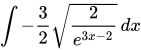
{\displaystyle \int -{\frac {3}{2}}{\sqrt {\frac {2}{e^{3x-2}}}}\,dx}
.
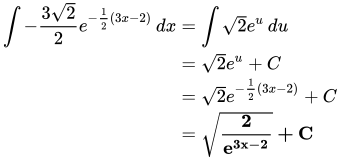
It may be easier to see what to substitute once the integrand is written in an equivalent form.
∫
−
3
2
2
e
3
x
−
2
d
x
=
∫
−
3
2
2
e
−
1
2
(
3
x
−
2
)
d
x
{\displaystyle \int -{\frac {3}{2}}{\sqrt {\frac {2}{e^{3x-2}}}}\,dx=\int -{\frac {3{\sqrt {2}}}{2}}e^{-{\frac {1}{2}}(3x-2)}\,dx}
From there, it becomes obvious to let
u
=
−
1
2
(
3
x
−
2
)
,
d
u
=
−
3
2
d
x
{\displaystyle u=-{\frac {1}{2}}(3x-2),\qquad du=-{\frac {3}{2}}\,dx}
Then,
∫
−
3
2
2
e
−
1
2
(
3
x
−
2
)
d
x
=
∫
2
e
u
d
u
=
2
e
u
+
C
=
2
e
−
1
2
(
3
x
−
2
)
+
C
=
2
e
3
x
−
2
+
C
{\displaystyle {\begin{aligned}\int -{\frac {3{\sqrt {2}}}{2}}e^{-{\frac {1}{2}}(3x-2)}\,dx&=\int {\sqrt {2}}e^{u}\,du\\&={\sqrt {2}}e^{u}+C\\&={\sqrt {2}}e^{-{\frac {1}{2}}(3x-2)}+C\\&=\mathbf {{\sqrt {\frac {2}{e^{3x-2}}}}+C} \end{aligned}}}
It may be easier to see what to substitute once the integrand is written in an equivalent form.
∫
−
3
2
2
e
3
x
−
2
d
x
=
∫
−
3
2
2
e
−
1
2
(
3
x
−
2
)
d
x
{\displaystyle \int -{\frac {3}{2}}{\sqrt {\frac {2}{e^{3x-2}}}}\,dx=\int -{\frac {3{\sqrt {2}}}{2}}e^{-{\frac {1}{2}}(3x-2)}\,dx}
From there, it becomes obvious to let
u
=
−
1
2
(
3
x
−
2
)
,
d
u
=
−
3
2
d
x
{\displaystyle u=-{\frac {1}{2}}(3x-2),\qquad du=-{\frac {3}{2}}\,dx}
Then,
∫
−
3
2
2
e
−
1
2
(
3
x
−
2
)
d
x
=
∫
2
e
u
d
u
=
2
e
u
+
C
=
2
e
−
1
2
(
3
x
−
2
)
+
C
=
2
e
3
x
−
2
+
C
{\displaystyle {\begin{aligned}\int -{\frac {3{\sqrt {2}}}{2}}e^{-{\frac {1}{2}}(3x-2)}\,dx&=\int {\sqrt {2}}e^{u}\,du\\&={\sqrt {2}}e^{u}+C\\&={\sqrt {2}}e^{-{\frac {1}{2}}(3x-2)}+C\\&=\mathbf {{\sqrt {\frac {2}{e^{3x-2}}}}+C} \end{aligned}}}
18.
∫
x
sec
(
x
2
−
5
)
tan
(
x
2
−
5
)
50
x
2
−
5
d
x
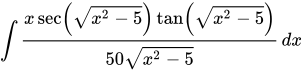
{\displaystyle \int {\frac {x\sec \left({\sqrt {x^{2}-5}}\right)\tan \left({\sqrt {x^{2}-5}}\right)}{50{\sqrt {x^{2}-5}}}}\,dx}
.
Let
u
=
x
2
−
5
,
d
u
=
x
x
2
−
5
d
x
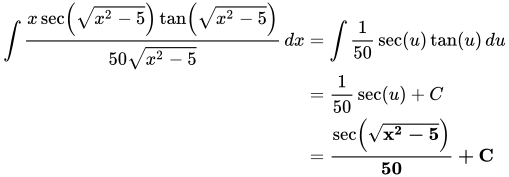
{\displaystyle u={\sqrt {x^{2}-5}},\qquad du={\frac {x}{\sqrt {x^{2}-5}}}\,dx}
Then,
∫
x
sec
(
x
2
−
5
)
tan
(
x
2
−
5
)
50
x
2
−
5
d
x
=
∫
1
50
sec
(
u
)
tan
(
u
)
d
u
=
1
50
sec
(
u
)
+
C
=
sec
(
x
2
−
5
)
50
+
C
{\displaystyle {\begin{aligned}\int {\frac {x\sec \left({\sqrt {x^{2}-5}}\right)\tan \left({\sqrt {x^{2}-5}}\right)}{50{\sqrt {x^{2}-5}}}}\,dx&=\int {\frac {1}{50}}\sec(u)\tan(u)\,du\\&={\frac {1}{50}}\sec(u)+C\\&=\mathbf {{\frac {\sec \left({\sqrt {x^{2}-5}}\right)}{50}}+C} \end{aligned}}}
Let
u
=
x
2
−
5
,
d
u
=
x
x
2
−
5
d
x
{\displaystyle u={\sqrt {x^{2}-5}},\qquad du={\frac {x}{\sqrt {x^{2}-5}}}\,dx}
Then,
∫
x
sec
(
x
2
−
5
)
tan
(
x
2
−
5
)
50
x
2
−
5
d
x
=
∫
1
50
sec
(
u
)
tan
(
u
)
d
u
=
1
50
sec
(
u
)
+
C
=
sec
(
x
2
−
5
)
50
+
C
{\displaystyle {\begin{aligned}\int {\frac {x\sec \left({\sqrt {x^{2}-5}}\right)\tan \left({\sqrt {x^{2}-5}}\right)}{50{\sqrt {x^{2}-5}}}}\,dx&=\int {\frac {1}{50}}\sec(u)\tan(u)\,du\\&={\frac {1}{50}}\sec(u)+C\\&=\mathbf {{\frac {\sec \left({\sqrt {x^{2}-5}}\right)}{50}}+C} \end{aligned}}}
19.
∫
2
sec
2
(
ln
(
x
)
)
tan
(
ln
(
x
)
)
x
d
x
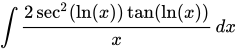
{\displaystyle \int {\frac {2\sec ^{2}\left(\ln(x)\right)\tan \left(\ln(x)\right)}{x}}\,dx}
.
Let
u
=
ln
(
x
)
,
d
u
=
1
x
d
x
{\displaystyle u=\ln(x),\qquad du={\frac {1}{x}}\,dx}
Then,
∫
2
sec
2
(
ln
(
x
)
)
tan
(
ln
(
x
)
)
x
d
x
=
∫
2
sec
2
(
u
)
tan
(
u
)
d
u
{\displaystyle \int {\frac {2\sec ^{2}\left(\ln(x)\right)\tan \left(\ln(x)\right)}{x}}\,dx=\int 2\sec ^{2}(u)\tan(u)\,du}
Let
v
=
tan
(
u
)
,
d
v
=
sec
2
(
u
)
d
u
{\displaystyle v=\tan(u),\qquad dv=\sec ^{2}(u)\,du}
Therefore,
∫
2
sec
2
(
u
)
tan
(
u
)
d
u
=
∫
2
v
d
v
=
v
2
+
C
=
tan
2
(
u
)
+
C
=
tan
2
(
ln
(
x
)
)
+
C
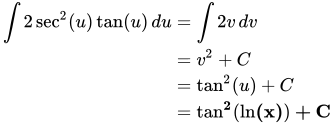
{\displaystyle {\begin{aligned}\int 2\sec ^{2}(u)\tan(u)\,du&=\int 2v\,dv\\&=v^{2}+C\\&=\tan ^{2}(u)+C\\&=\mathbf {\tan ^{2}\left(\ln(x)\right)+C} \end{aligned}}}
Alternatively, this could all be done with one substitution if one realized that
d
d
x
(
tan
[
ln
(
x
)
]
)
=
sec
2
(
ln
(
x
)
)
x
{\displaystyle {\frac {d}{dx}}\left(\tan \left[\ln(x)\right]\right)={\frac {\sec ^{2}\left(\ln(x)\right)}{x}}}
Let
u
=
ln
(
x
)
,
d
u
=
1
x
d
x
{\displaystyle u=\ln(x),\qquad du={\frac {1}{x}}\,dx}
Then,
∫
2
sec
2
(
ln
(
x
)
)
tan
(
ln
(
x
)
)
x
d
x
=
∫
2
sec
2
(
u
)
tan
(
u
)
d
u
{\displaystyle \int {\frac {2\sec ^{2}\left(\ln(x)\right)\tan \left(\ln(x)\right)}{x}}\,dx=\int 2\sec ^{2}(u)\tan(u)\,du}
Let
v
=
tan
(
u
)
,
d
v
=
sec
2
(
u
)
d
u
{\displaystyle v=\tan(u),\qquad dv=\sec ^{2}(u)\,du}
Therefore,
∫
2
sec
2
(
u
)
tan
(
u
)
d
u
=
∫
2
v
d
v
=
v
2
+
C
=
tan
2
(
u
)
+
C
=
tan
2
(
ln
(
x
)
)
+
C
{\displaystyle {\begin{aligned}\int 2\sec ^{2}(u)\tan(u)\,du&=\int 2v\,dv\\&=v^{2}+C\\&=\tan ^{2}(u)+C\\&=\mathbf {\tan ^{2}\left(\ln(x)\right)+C} \end{aligned}}}
Alternatively, this could all be done with one substitution if one realized that
d
d
x
(
tan
[
ln
(
x
)
]
)
=
sec
2
(
ln
(
x
)
)
x
{\displaystyle {\frac {d}{dx}}\left(\tan \left[\ln(x)\right]\right)={\frac {\sec ^{2}\left(\ln(x)\right)}{x}}}
20.
∫
(
e
x
−
1
)
x
e
x
−
2
+
x
e
x
−
1
e
x
ln
(
x
)
d
x
{\displaystyle \int \left(e^{x}-1\right)x^{e^{x}-2}+x^{e^{x}-1}e^{x}\ln(x)\,dx}
.
It may be easier to see what to substitute once the integrand is written in an equivalent form.
∫
(
e
x
−
1
)
x
e
x
−
2
+
x
e
x
−
1
e
x
ln
(
x
)
d
x
=
∫
x
e
x
−
1
(
e
x
−
1
x
+
e
x
ln
(
x
)
)
d
x
=
∫
e
(
e
x
−
1
)
ln
(
x
)
(
e
x
−
1
x
+
e
x
ln
(
x
)
)
d
x
{\displaystyle {\begin{aligned}\int \left(e^{x}-1\right)x^{e^{x}-2}+x^{e^{x}-1}e^{x}\ln(x)\,dx&=\int x^{e^{x}-1}\left({\frac {e^{x}-1}{x}}+e^{x}\ln(x)\right)\,dx\\&=\int e^{\left(e^{x}-1\right)\ln(x)}\left({\frac {e^{x}-1}{x}}+e^{x}\ln(x)\right)\,dx\end{aligned}}}
From there, let
u
=
(
e
x
−
1
)
ln
(
x
)
,
d
u
=
(
e
x
−
1
x
+
e
x
ln
(
x
)
)
d
x
{\displaystyle u=\left(e^{x}-1\right)\ln(x),\qquad du=\left({\frac {e^{x}-1}{x}}+e^{x}\ln(x)\right)\,dx}
Then,
∫
e
(
e
x
−
1
)
ln
(
x
)
(
e
x
−
1
x
+
e
x
ln
(
x
)
)
d
x
=
∫
e
u
d
u
=
e
u
+
C
=
e
(
e
x
−
1
)
ln
(
x
)
+
C
=
x
e
x
−
1
+
C
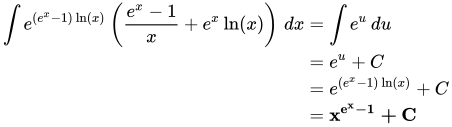
{\displaystyle {\begin{aligned}\int e^{\left(e^{x}-1\right)\ln(x)}\left({\frac {e^{x}-1}{x}}+e^{x}\ln(x)\right)\,dx&=\int e^{u}\,du\\&=e^{u}+C\\&=e^{\left(e^{x}-1\right)\ln(x)}+C\\&=\mathbf {x^{e^{x}-1}+C} \end{aligned}}}
It may be easier to see what to substitute once the integrand is written in an equivalent form.
∫
(
e
x
−
1
)
x
e
x
−
2
+
x
e
x
−
1
e
x
ln
(
x
)
d
x
=
∫
x
e
x
−
1
(
e
x
−
1
x
+
e
x
ln
(
x
)
)
d
x
=
∫
e
(
e
x
−
1
)
ln
(
x
)
(
e
x
−
1
x
+
e
x
ln
(
x
)
)
d
x
{\displaystyle {\begin{aligned}\int \left(e^{x}-1\right)x^{e^{x}-2}+x^{e^{x}-1}e^{x}\ln(x)\,dx&=\int x^{e^{x}-1}\left({\frac {e^{x}-1}{x}}+e^{x}\ln(x)\right)\,dx\\&=\int e^{\left(e^{x}-1\right)\ln(x)}\left({\frac {e^{x}-1}{x}}+e^{x}\ln(x)\right)\,dx\end{aligned}}}
From there, let
u
=
(
e
x
−
1
)
ln
(
x
)
,
d
u
=
(
e
x
−
1
x
+
e
x
ln
(
x
)
)
d
x
{\displaystyle u=\left(e^{x}-1\right)\ln(x),\qquad du=\left({\frac {e^{x}-1}{x}}+e^{x}\ln(x)\right)\,dx}
Then,
∫
e
(
e
x
−
1
)
ln
(
x
)
(
e
x
−
1
x
+
e
x
ln
(
x
)
)
d
x
=
∫
e
u
d
u
=
e
u
+
C
=
e
(
e
x
−
1
)
ln
(
x
)
+
C
=
x
e
x
−
1
+
C
{\displaystyle {\begin{aligned}\int e^{\left(e^{x}-1\right)\ln(x)}\left({\frac {e^{x}-1}{x}}+e^{x}\ln(x)\right)\,dx&=\int e^{u}\,du\\&=e^{u}+C\\&=e^{\left(e^{x}-1\right)\ln(x)}+C\\&=\mathbf {x^{e^{x}-1}+C} \end{aligned}}}
21.
∫
2
sec
2
(
ln
(
x
2
+
2
x
)
)
x
3
−
1
x
4
+
2
x
d
x
{\displaystyle \int 2\sec ^{2}\left(\ln \left(x^{2}+{\frac {2}{x}}\right)\right){\frac {x^{3}-1}{x^{4}+2x}}\,dx}
.
Let
u
=
ln
(
x
2
+
2
x
)
,
d
u
=
2
x
3
−
1
x
4
+
2
x
d
x
d
x
{\displaystyle u=\ln \left(x^{2}+{\frac {2}{x}}\right),\qquad du=2{\frac {x^{3}-1}{x^{4}+2x}}\,dx\,dx}
Then,
∫
2
sec
2
(
ln
(
x
2
+
2
x
)
)
x
3
−
1
x
4
+
2
x
d
x
=
∫
sec
2
(
u
)
d
u
=
tan
(
u
)
+
C
=
tan
(
ln
(
x
2
+
2
x
)
)
+
C
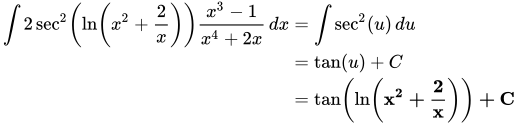
{\displaystyle {\begin{aligned}\int 2\sec ^{2}\left(\ln \left(x^{2}+{\frac {2}{x}}\right)\right){\frac {x^{3}-1}{x^{4}+2x}}\,dx&=\int \sec ^{2}(u)\,du\\&=\tan(u)+C\\&=\mathbf {\tan \left(\ln \left(x^{2}+{\frac {2}{x}}\right)\right)+C} \end{aligned}}}
Let
u
=
ln
(
x
2
+
2
x
)
,
d
u
=
2
x
3
−
1
x
4
+
2
x
d
x
d
x
{\displaystyle u=\ln \left(x^{2}+{\frac {2}{x}}\right),\qquad du=2{\frac {x^{3}-1}{x^{4}+2x}}\,dx\,dx}
Then,
∫
2
sec
2
(
ln
(
x
2
+
2
x
)
)
x
3
−
1
x
4
+
2
x
d
x
=
∫
sec
2
(
u
)
d
u
=
tan
(
u
)
+
C
=
tan
(
ln
(
x
2
+
2
x
)
)
+
C
{\displaystyle {\begin{aligned}\int 2\sec ^{2}\left(\ln \left(x^{2}+{\frac {2}{x}}\right)\right){\frac {x^{3}-1}{x^{4}+2x}}\,dx&=\int \sec ^{2}(u)\,du\\&=\tan(u)+C\\&=\mathbf {\tan \left(\ln \left(x^{2}+{\frac {2}{x}}\right)\right)+C} \end{aligned}}}
22.
∫
2
(
sin
(
x
)
−
cos
(
x
)
)
tan
(
sin
(
x
)
+
cos
(
x
)
)
sin
(
x
)
+
cos
(
x
)
d
x
{\displaystyle \int 2{\frac {\left(\sin(x)-\cos(x)\right)\tan \left({\sqrt {\sin(x)+\cos(x)}}\right)}{\sqrt {\sin(x)+\cos(x)}}}\,dx}
.
Let
u
=
sin
(
x
)
+
cos
(
x
)
,
d
u
=
(
cos
(
x
)
−
sin
(
x
)
)
d
x
=
−
(
sin
(
x
)
−
cos
(
x
)
)
d
x
{\displaystyle u=\sin(x)+\cos(x),\qquad du=\left(\cos(x)-\sin(x)\right)\,dx=-(\sin(x)-\cos(x))\,dx}
Then,
∫
2
(
sin
(
x
)
−
cos
(
x
)
)
tan
(
sin
(
x
)
+
cos
(
x
)
)
sin
(
x
)
+
cos
(
x
)
d
x
=
−
∫
2
tan
(
u
)
u
d
u
{\displaystyle \int 2{\frac {\left(\sin(x)-\cos(x)\right)\tan \left({\sqrt {\sin(x)+\cos(x)}}\right)}{\sqrt {\sin(x)+\cos(x)}}}\,dx=-\int 2{\frac {\tan \left({\sqrt {u}}\right)}{\sqrt {u}}}\,du}
This requires another substitution. Let
t
=
u
,
d
t
=
1
2
u
d
u
⇔
2
d
t
=
1
u
d
u
{\displaystyle t={\sqrt {u}},\qquad dt={\frac {1}{2{\sqrt {u}}}}du\quad \Leftrightarrow \quad 2dt={\frac {1}{\sqrt {u}}}du}
Then,
−
∫
2
tan
(
u
)
u
d
u
=
−
2
∫
2
tan
(
t
)
d
t
=
−
4
ln
|
cos
(
t
)
|
+
C
See Question 14.
=
−
4
ln
|
cos
(
u
)
|
+
C
=
−
4
ln
|
cos
(
sin
(
x
)
+
cos
(
x
)
)
|
+
C
{\displaystyle {\begin{aligned}-\int 2{\frac {\tan \left({\sqrt {u}}\right)}{\sqrt {u}}}\,du&=-2\int 2\tan(t)\,dt\\&=-4\ln \left\vert \cos(t)\right\vert +C&{\text{See Question 14.}}\\&=-4\ln \left\vert \cos({\sqrt {u}})\right\vert +C\\&=\mathbf {-4\ln \left\vert \cos \left({\sqrt {\sin(x)+\cos(x)}}\right)\right\vert +C} \end{aligned}}}
Let
u
=
sin
(
x
)
+
cos
(
x
)
,
d
u
=
(
cos
(
x
)
−
sin
(
x
)
)
d
x
=
−
(
sin
(
x
)
−
cos
(
x
)
)
d
x
{\displaystyle u=\sin(x)+\cos(x),\qquad du=\left(\cos(x)-\sin(x)\right)\,dx=-(\sin(x)-\cos(x))\,dx}
Then,
∫
2
(
sin
(
x
)
−
cos
(
x
)
)
tan
(
sin
(
x
)
+
cos
(
x
)
)
sin
(
x
)
+
cos
(
x
)
d
x
=
−
∫
2
tan
(
u
)
u
d
u
{\displaystyle \int 2{\frac {\left(\sin(x)-\cos(x)\right)\tan \left({\sqrt {\sin(x)+\cos(x)}}\right)}{\sqrt {\sin(x)+\cos(x)}}}\,dx=-\int 2{\frac {\tan \left({\sqrt {u}}\right)}{\sqrt {u}}}\,du}
This requires another substitution. Let
t
=
u
,
d
t
=
1
2
u
d
u
⇔
2
d
t
=
1
u
d
u
{\displaystyle t={\sqrt {u}},\qquad dt={\frac {1}{2{\sqrt {u}}}}du\quad \Leftrightarrow \quad 2dt={\frac {1}{\sqrt {u}}}du}
Then,
−
∫
2
tan
(
u
)
u
d
u
=
−
2
∫
2
tan
(
t
)
d
t
=
−
4
ln
|
cos
(
t
)
|
+
C
See Question 14.
=
−
4
ln
|
cos
(
u
)
|
+
C
=
−
4
ln
|
cos
(
sin
(
x
)
+
cos
(
x
)
)
|
+
C
{\displaystyle {\begin{aligned}-\int 2{\frac {\tan \left({\sqrt {u}}\right)}{\sqrt {u}}}\,du&=-2\int 2\tan(t)\,dt\\&=-4\ln \left\vert \cos(t)\right\vert +C&{\text{See Question 14.}}\\&=-4\ln \left\vert \cos({\sqrt {u}})\right\vert +C\\&=\mathbf {-4\ln \left\vert \cos \left({\sqrt {\sin(x)+\cos(x)}}\right)\right\vert +C} \end{aligned}}}
23.
∫
x
x
+
1
d
x
{\displaystyle \int {\frac {x}{\sqrt {x+1}}}\,dx}
.
Let
u
=
x
+
1
,
d
u
=
d
x
and
x
=
u
−
1
{\displaystyle u=x+1,\qquad du=dx\quad {\text{and}}\quad x=u-1}
Then,
∫
x
x
+
1
d
x
=
∫
u
−
1
u
d
u
=
∫
u
u
−
1
u
d
u
Split the fraction
=
∫
u
1
2
−
u
−
1
2
d
u
Exponent laws
=
2
3
u
3
2
−
2
u
1
2
Worry about the constant later
=
2
u
1
2
(
u
3
−
1
)
=
2
x
+
1
(
x
+
1
3
−
1
)
+
C
=
2
x
+
1
(
x
+
1
3
−
3
3
)
+
C
=
2
x
+
1
(
x
−
2
3
)
=
2
3
(
x
−
2
)
x
+
1
+
C
{\displaystyle {\begin{aligned}\int {\frac {x}{\sqrt {x+1}}}\,dx&=\int {\frac {u-1}{\sqrt {u}}}\,du\\&=\int {\frac {u}{\sqrt {u}}}-{\frac {1}{\sqrt {u}}}\,du&{\text{Split the fraction}}\\&=\int u^{\frac {1}{2}}-u^{-{\frac {1}{2}}}\,du&{\text{Exponent laws}}\\&={\frac {2}{3}}u^{\frac {3}{2}}-2u^{\frac {1}{2}}&{\text{Worry about the constant later}}\\&=2u^{\frac {1}{2}}\left({\frac {u}{3}}-1\right)\\&=2{\sqrt {x+1}}\left({\frac {x+1}{3}}-1\right)+C=2{\sqrt {x+1}}\left({\frac {x+1}{3}}-{\frac {3}{3}}\right)+C\\&=2{\sqrt {x+1}}\left({\frac {x-2}{3}}\right)\\&=\mathbf {{\frac {2}{3}}(x-2){\sqrt {x+1}}+C} \end{aligned}}}
Note that the solution of
2
3
(
x
+
1
)
3
2
−
2
(
x
+
1
)
1
2
{\displaystyle {\frac {2}{3}}(x+1)^{\frac {3}{2}}-2(x+1)^{\frac {1}{2}}}
is also correct but not as simplified as it could be. Another thing of note is you can choose your substitution as
u
=
x
+
1
{\displaystyle u={\sqrt {x+1}}}
. If the algebraic steps are correct, your answer should be the exact same as above. Try both methods to get to the same solution.
Let
u
=
x
+
1
,
d
u
=
d
x
and
x
=
u
−
1
{\displaystyle u=x+1,\qquad du=dx\quad {\text{and}}\quad x=u-1}
Then,
∫
x
x
+
1
d
x
=
∫
u
−
1
u
d
u
=
∫
u
u
−
1
u
d
u
Split the fraction
=
∫
u
1
2
−
u
−
1
2
d
u
Exponent laws
=
2
3
u
3
2
−
2
u
1
2
Worry about the constant later
=
2
u
1
2
(
u
3
−
1
)
=
2
x
+
1
(
x
+
1
3
−
1
)
+
C
=
2
x
+
1
(
x
+
1
3
−
3
3
)
+
C
=
2
x
+
1
(
x
−
2
3
)
=
2
3
(
x
−
2
)
x
+
1
+
C
{\displaystyle {\begin{aligned}\int {\frac {x}{\sqrt {x+1}}}\,dx&=\int {\frac {u-1}{\sqrt {u}}}\,du\\&=\int {\frac {u}{\sqrt {u}}}-{\frac {1}{\sqrt {u}}}\,du&{\text{Split the fraction}}\\&=\int u^{\frac {1}{2}}-u^{-{\frac {1}{2}}}\,du&{\text{Exponent laws}}\\&={\frac {2}{3}}u^{\frac {3}{2}}-2u^{\frac {1}{2}}&{\text{Worry about the constant later}}\\&=2u^{\frac {1}{2}}\left({\frac {u}{3}}-1\right)\\&=2{\sqrt {x+1}}\left({\frac {x+1}{3}}-1\right)+C=2{\sqrt {x+1}}\left({\frac {x+1}{3}}-{\frac {3}{3}}\right)+C\\&=2{\sqrt {x+1}}\left({\frac {x-2}{3}}\right)\\&=\mathbf {{\frac {2}{3}}(x-2){\sqrt {x+1}}+C} \end{aligned}}}
Note that the solution of
2
3
(
x
+
1
)
3
2
−
2
(
x
+
1
)
1
2
{\displaystyle {\frac {2}{3}}(x+1)^{\frac {3}{2}}-2(x+1)^{\frac {1}{2}}}
is also correct but not as simplified as it could be. Another thing of note is you can choose your substitution as
u
=
x
+
1
{\displaystyle u={\sqrt {x+1}}}
. If the algebraic steps are correct, your answer should be the exact same as above. Try both methods to get to the same solution.
24.
∫
x
+
1
x
(
x
+
ln
(
x
)
)
2
d
x
{\displaystyle \int {\frac {x+1}{x\left(x+\ln(x)\right)^{2}}}\,dx}
.
This integral would be a nightmare to do without first making the form something we can work with. Note the domain of the integrand (which we shall denote as
f
(
x
)
{\displaystyle f(x)}
):
x
≠
0
{\displaystyle x\neq 0}
,
x
+
ln
(
x
)
≠
0
{\displaystyle x+\ln(x)\neq 0}
, and
x
>
0
{\displaystyle x>0}
(due to the natural domain of the natural logarithm).
Solve for
x
+
ln
(
x
)
=
0
{\displaystyle x+\ln(x)=0}
g
(
x
)
=
x
+
ln
(
x
)
{\displaystyle g(x)=x+\ln(x)}
g
′
(
x
)
=
1
+
1
x
>
0
{\displaystyle g^{\prime }(x)=1+{\frac {1}{x}}>0}
x
>
0
{\displaystyle x>0}
g
{\displaystyle g}
g
(
1
)
=
1
+
ln
(
1
)
=
1
>
0
{\displaystyle g(1)=1+\ln(1)=1>0}
lim
x
→
0
+
g
(
x
)
=
−
∞
{\displaystyle \lim _{x\to 0^{+}}g(x)=-\infty }
By the intermediate value theorem, there must be a solution for
g
(
x
)
{\displaystyle g(x)}
x
∈
[
a
,
1
]
where
1
≫
a
>
0
{\displaystyle x\in \left[a,1\right]\,{\text{where }}1\gg a>0}
x
0
{\displaystyle x_{0}}
Therefore, the domain for
f
(
x
)
{\displaystyle f(x)}
(
0
,
∞
)
−
{
x
0
}
{\displaystyle (0,\infty )-\{x_{0}\}}
Note finding a solution
x
0
{\displaystyle x_{0}}
x
0
{\displaystyle x_{0}}
0.567
{\displaystyle 0.567}
Now, attempt to rewrite
f
(
x
)
{\displaystyle f(x)}
f
(
x
)
=
x
+
1
x
(
x
+
ln
(
x
)
)
2
=
(
x
+
1
)
⋅
1
x
x
(
x
+
ln
(
x
)
)
2
⋅
1
x
=
1
+
1
x
(
x
+
ln
(
x
)
)
2
{\displaystyle f(x)={\frac {x+1}{x\left(x+\ln(x)\right)^{2}}}={\frac {(x+1)\cdot {\frac {1}{x}}}{x\left(x+\ln(x)\right)^{2}\cdot {\frac {1}{x}}}}={\frac {1+{\frac {1}{x}}}{\left(x+\ln(x)\right)^{2}}}}
This algebraic rewrite is valid if and only if
1
x
{\displaystyle {\frac {1}{x}}}
x
>
0
{\displaystyle x>0}
x
0
{\displaystyle x_{0}}
Since
1
x
{\displaystyle {\frac {1}{x}}}
x
>
0
{\displaystyle x>0}
1
x
>
0
{\displaystyle {\frac {1}{x}}>0}
This means the multiplication by
1
x
{\displaystyle {\frac {1}{x}}}
∫
x
+
1
x
(
x
+
ln
(
x
)
)
2
d
x
=
∫
1
+
1
x
(
x
+
ln
(
x
)
)
2
d
x
{\displaystyle \int {\frac {x+1}{x\left(x+\ln(x)\right)^{2}}}\,dx=\int {\frac {1+{\frac {1}{x}}}{\left(x+\ln(x)\right)^{2}}}\,dx}
Then, let
u
=
x
+
ln
(
x
)
,
d
u
=
(
1
+
1
x
)
d
x
{\displaystyle u=x+\ln(x),\qquad du=\left(1+{\frac {1}{x}}\right)\,dx}
Note that the domain must be preserved for the derivative given that the algebraic manipulation may alter the domain.
The domain of
(
1
+
1
x
)
>
1
>
0
{\displaystyle \left(1+{\frac {1}{x}}\right)>1>0}
x
>
0
{\displaystyle x>0}
d
u
≠
0
{\displaystyle du\neq 0}
The mapping
x
↦
u
{\displaystyle x\mapsto u}
x
{\displaystyle x}
(
0
,
x
0
)
∪
(
x
0
,
∞
)
{\displaystyle \left(0,x_{0}\right)\cup \left(x_{0},\infty \right)}
(Notice that the natural log and the rational function is one-to-one. As an exercise to the reader, prove
ln
(
x
)
<
1
x
{\displaystyle \ln(x)<{\frac {1}{x}}}
x
>
0
{\displaystyle x>0}
Therefore,
u
≠
0
{\displaystyle u\neq 0}
u
{\displaystyle u}
Thus,
∫
1
+
1
x
(
x
+
ln
(
x
)
)
2
d
x
=
∫
1
u
2
d
u
=
∫
u
−
2
d
u
=
−
u
−
1
=
−
1
u
=
−
1
x
+
ln
(
x
)
+
C
{\displaystyle {\begin{aligned}\int {\frac {1+{\frac {1}{x}}}{\left(x+\ln(x)\right)^{2}}}\,dx&=\int {\frac {1}{u^{2}}}\,du\\&=\int u^{-2}\,du\\&=-u^{-1}=-{\frac {1}{u}}\\&=\mathbf {-{\frac {1}{x+\ln(x)}}+C} \end{aligned}}}
The domain argument is necessary if a student chooses to rewrite the integral in this way. In fact, this is the only way to integrate if one does integration by substution as traditionally done (i.e., a
u
{\displaystyle u}
-sub). This means any student answer that does not confirm nor discusses the domain will not be formally correct!
This integral would be a nightmare to do without first making the form something we can work with. Note the domain of the integrand (which we shall denote as
f
(
x
)
{\displaystyle f(x)}
):
x
≠
0
{\displaystyle x\neq 0}
,
x
+
ln
(
x
)
≠
0
{\displaystyle x+\ln(x)\neq 0}
, and
x
>
0
{\displaystyle x>0}
(due to the natural domain of the natural logarithm).
Solve for
x
+
ln
(
x
)
=
0
{\displaystyle x+\ln(x)=0}
g
(
x
)
=
x
+
ln
(
x
)
{\displaystyle g(x)=x+\ln(x)}
g
′
(
x
)
=
1
+
1
x
>
0
{\displaystyle g^{\prime }(x)=1+{\frac {1}{x}}>0}
x
>
0
{\displaystyle x>0}
g
{\displaystyle g}
g
(
1
)
=
1
+
ln
(
1
)
=
1
>
0
{\displaystyle g(1)=1+\ln(1)=1>0}
lim
x
→
0
+
g
(
x
)
=
−
∞
{\displaystyle \lim _{x\to 0^{+}}g(x)=-\infty }
By the intermediate value theorem, there must be a solution for
g
(
x
)
{\displaystyle g(x)}
x
∈
[
a
,
1
]
where
1
≫
a
>
0
{\displaystyle x\in \left[a,1\right]\,{\text{where }}1\gg a>0}
x
0
{\displaystyle x_{0}}
Therefore, the domain for
f
(
x
)
{\displaystyle f(x)}
(
0
,
∞
)
−
{
x
0
}
{\displaystyle (0,\infty )-\{x_{0}\}}
Note finding a solution
x
0
{\displaystyle x_{0}}
x
0
{\displaystyle x_{0}}
0.567
{\displaystyle 0.567}
Now, attempt to rewrite
f
(
x
)
{\displaystyle f(x)}
f
(
x
)
=
x
+
1
x
(
x
+
ln
(
x
)
)
2
=
(
x
+
1
)
⋅
1
x
x
(
x
+
ln
(
x
)
)
2
⋅
1
x
=
1
+
1
x
(
x
+
ln
(
x
)
)
2
{\displaystyle f(x)={\frac {x+1}{x\left(x+\ln(x)\right)^{2}}}={\frac {(x+1)\cdot {\frac {1}{x}}}{x\left(x+\ln(x)\right)^{2}\cdot {\frac {1}{x}}}}={\frac {1+{\frac {1}{x}}}{\left(x+\ln(x)\right)^{2}}}}
This algebraic rewrite is valid if and only if
1
x
{\displaystyle {\frac {1}{x}}}
x
>
0
{\displaystyle x>0}
x
0
{\displaystyle x_{0}}
Since
1
x
{\displaystyle {\frac {1}{x}}}
x
>
0
{\displaystyle x>0}
1
x
>
0
{\displaystyle {\frac {1}{x}}>0}
This means the multiplication by
1
x
{\displaystyle {\frac {1}{x}}}
∫
x
+
1
x
(
x
+
ln
(
x
)
)
2
d
x
=
∫
1
+
1
x
(
x
+
ln
(
x
)
)
2
d
x
{\displaystyle \int {\frac {x+1}{x\left(x+\ln(x)\right)^{2}}}\,dx=\int {\frac {1+{\frac {1}{x}}}{\left(x+\ln(x)\right)^{2}}}\,dx}
Then, let
u
=
x
+
ln
(
x
)
,
d
u
=
(
1
+
1
x
)
d
x
{\displaystyle u=x+\ln(x),\qquad du=\left(1+{\frac {1}{x}}\right)\,dx}
Note that the domain must be preserved for the derivative given that the algebraic manipulation may alter the domain.
The domain of
(
1
+
1
x
)
>
1
>
0
{\displaystyle \left(1+{\frac {1}{x}}\right)>1>0}
x
>
0
{\displaystyle x>0}
d
u
≠
0
{\displaystyle du\neq 0}
The mapping
x
↦
u
{\displaystyle x\mapsto u}
x
{\displaystyle x}
(
0
,
x
0
)
∪
(
x
0
,
∞
)
{\displaystyle \left(0,x_{0}\right)\cup \left(x_{0},\infty \right)}
(Notice that the natural log and the rational function is one-to-one. As an exercise to the reader, prove
ln
(
x
)
<
1
x
{\displaystyle \ln(x)<{\frac {1}{x}}}
x
>
0
{\displaystyle x>0}
Therefore,
u
≠
0
{\displaystyle u\neq 0}
u
{\displaystyle u}
Thus,
∫
1
+
1
x
(
x
+
ln
(
x
)
)
2
d
x
=
∫
1
u
2
d
u
=
∫
u
−
2
d
u
=
−
u
−
1
=
−
1
u
=
−
1
x
+
ln
(
x
)
+
C
{\displaystyle {\begin{aligned}\int {\frac {1+{\frac {1}{x}}}{\left(x+\ln(x)\right)^{2}}}\,dx&=\int {\frac {1}{u^{2}}}\,du\\&=\int u^{-2}\,du\\&=-u^{-1}=-{\frac {1}{u}}\\&=\mathbf {-{\frac {1}{x+\ln(x)}}+C} \end{aligned}}}
The domain argument is necessary if a student chooses to rewrite the integral in this way. In fact, this is the only way to integrate if one does integration by substution as traditionally done (i.e., a
u
{\displaystyle u}
-sub). This means any student answer that does not confirm nor discusses the domain will not be formally correct!
30. Consider the integral
∫
sin
(
x
)
cos
(
x
)
d
x
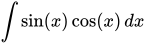
{\displaystyle \int \sin(x)\cos(x)\,dx}
. Find the integral in two different ways. (a) Integrate by parts with
u
=
sin
(
x
)
{\displaystyle u=\sin(x)}
and
v
′
=
cos
(
x
)
{\displaystyle v'=\cos(x)}
. (b) Integrate by parts with
u
=
cos
(
x
)
{\displaystyle u=\cos(x)}
and
v
′
=
sin
(
x
)
{\displaystyle v'=\sin(x)}
. Compare your answers. Are they the same?
40.
∫
1
x
2
+
a
2
d
x
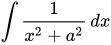
{\displaystyle \int {\frac {1}{x^{2}+a^{2}}}\,dx}
Let
x
=
a
tan
θ
;
d
x
=
a
sec
2
θ
d
θ
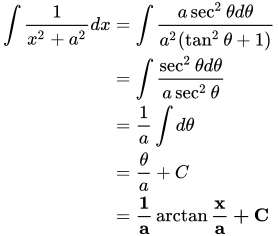
{\displaystyle x=a\tan \theta ;\qquad dx=a\sec ^{2}\theta d\theta }
Then
∫
1
x
2
+
a
2
d
x
=
∫
a
sec
2
θ
d
θ
a
2
(
tan
2
θ
+
1
)
=
∫
sec
2
θ
d
θ
a
sec
2
θ
=
1
a
∫
d
θ
=
θ
a
+
C
=
1
a
arctan
x
a
+
C
{\displaystyle {\begin{aligned}\int {\frac {1}{x^{2}+a^{2}}}dx&=\int {\frac {a\sec ^{2}\theta d\theta }{a^{2}(\tan ^{2}\theta +1)}}\\&=\int {\frac {\sec ^{2}\theta d\theta }{a\sec ^{2}\theta }}\\&={\frac {1}{a}}\int d\theta \\&={\frac {\theta }{a}}+C\\&=\mathbf {{\frac {1}{a}}\arctan {\frac {x}{a}}+C} \end{aligned}}}
Let
x
=
a
tan
θ
;
d
x
=
a
sec
2
θ
d
θ
{\displaystyle x=a\tan \theta ;\qquad dx=a\sec ^{2}\theta d\theta }
Then
∫
1
x
2
+
a
2
d
x
=
∫
a
sec
2
θ
d
θ
a
2
(
tan
2
θ
+
1
)
=
∫
sec
2
θ
d
θ
a
sec
2
θ
=
1
a
∫
d
θ
=
θ
a
+
C
=
1
a
arctan
x
a
+
C
{\displaystyle {\begin{aligned}\int {\frac {1}{x^{2}+a^{2}}}dx&=\int {\frac {a\sec ^{2}\theta d\theta }{a^{2}(\tan ^{2}\theta +1)}}\\&=\int {\frac {\sec ^{2}\theta d\theta }{a\sec ^{2}\theta }}\\&={\frac {1}{a}}\int d\theta \\&={\frac {\theta }{a}}+C\\&=\mathbf {{\frac {1}{a}}\arctan {\frac {x}{a}}+C} \end{aligned}}}






























![{\displaystyle {\frac {d}{dx}}\left(\tan \left[\ln(x)\right]\right)={\frac {\sec ^{2}\left(\ln(x)\right)}{x}}}](https://wikimedia.org/api/rest_v1/media/math/render/svg/87ec7536cc43be3e1065343069a942be2e8c835a)







![{\displaystyle x\in \left[a,1\right]\,{\text{where }}1\gg a>0}](https://wikimedia.org/api/rest_v1/media/math/render/svg/5e04928a66038ec42124f05edb3b2b567e37a22b)