

StackAI Project and Beta Nodes
Both project nodes reuse an existing workflow. Choose between them based on whether you need streamed answer updates, independent list processing, or conversation continuity across items.
Before you begin
A child workflow with the required input/output contract and access to its run history.
Parent and child workflows
Parent workflow
The workflow that calls another project. It must map the child result into its own processing or visible output.
Child workflow
The project executed by a project node or project-execution tool. Review its input contract, selected version, permissions, and run details.
Streaming
Delivery of incremental events or text while work is running. Updates are not the same as a completed answer.
Concurrency
Work on more than one item during overlapping periods. Completion order can differ from input order and provider rate limits still apply.
Memory scope
The project, node, and conversation context in which earlier exchanges can be reused. Keep unrelated users and conversations separate using the supported identity fields.
Choose a Project or Beta node
Select the workflow in the project node and map its required inputs.
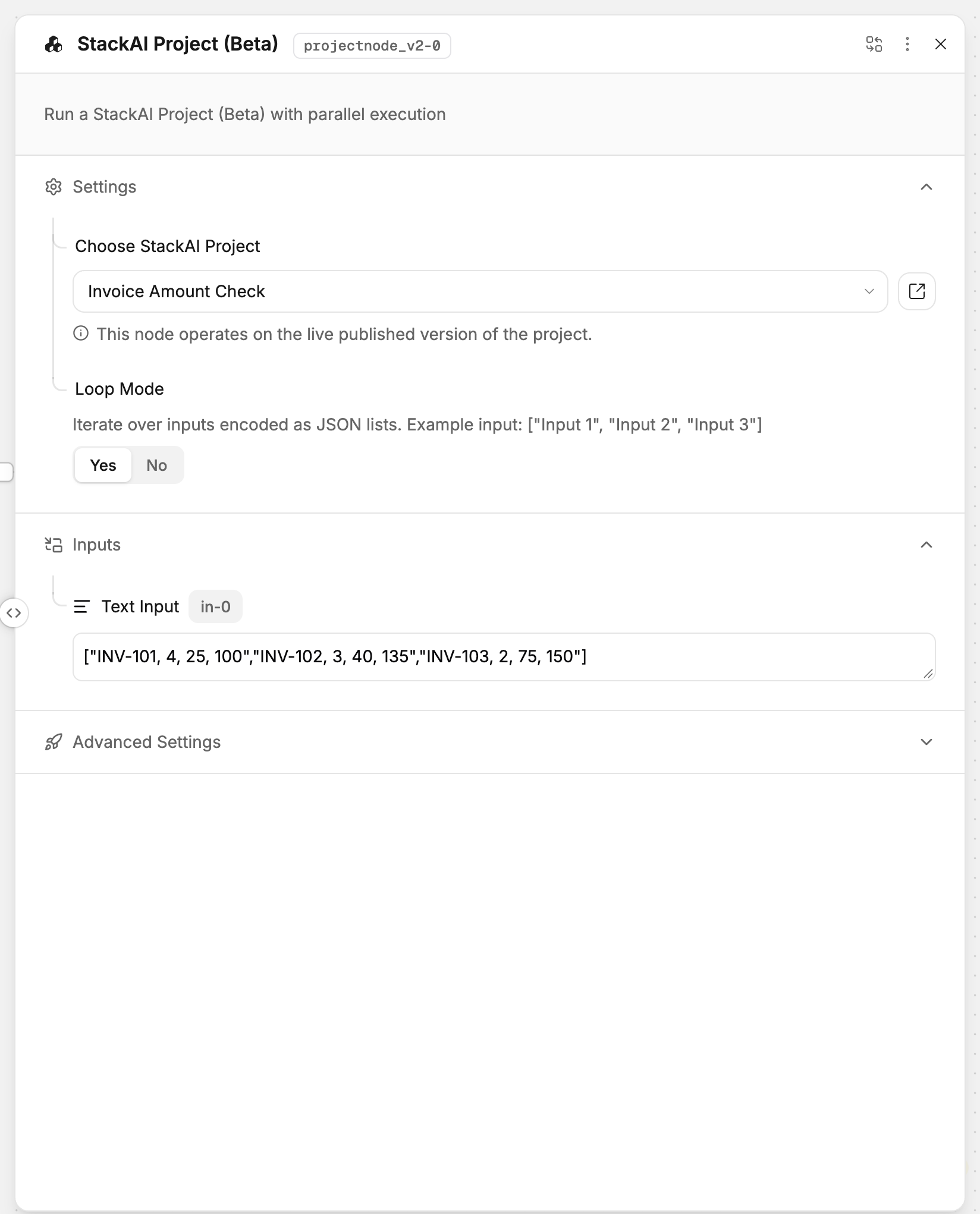
Select the child workflow in the Beta node and review its input and loop settings.
Enable loop mode only when the input represents multiple executions.
Choose the original node for its streaming behavior or Beta for independent item processing. Inspect the returned result and child run details.
You reuse the child process with the execution behavior needed by the parent workflow.
Behavior and limitations
Beta retries eligible temporary failures. Repeated execution can repeat an external action. Map completed child outputs to the parent output explicitly; a child result is not automatically the final interface response.
Answer delivery
Can return updates during execution.
Returns completed results.
List processing
Processes items one at a time.
Supports independent parallel iterations.
Conversation across loop items
Shared across the list.
Isolated for each item.
Result order
Follows list processing.
Restores input order after collection.
Related resources
Was this helpful?