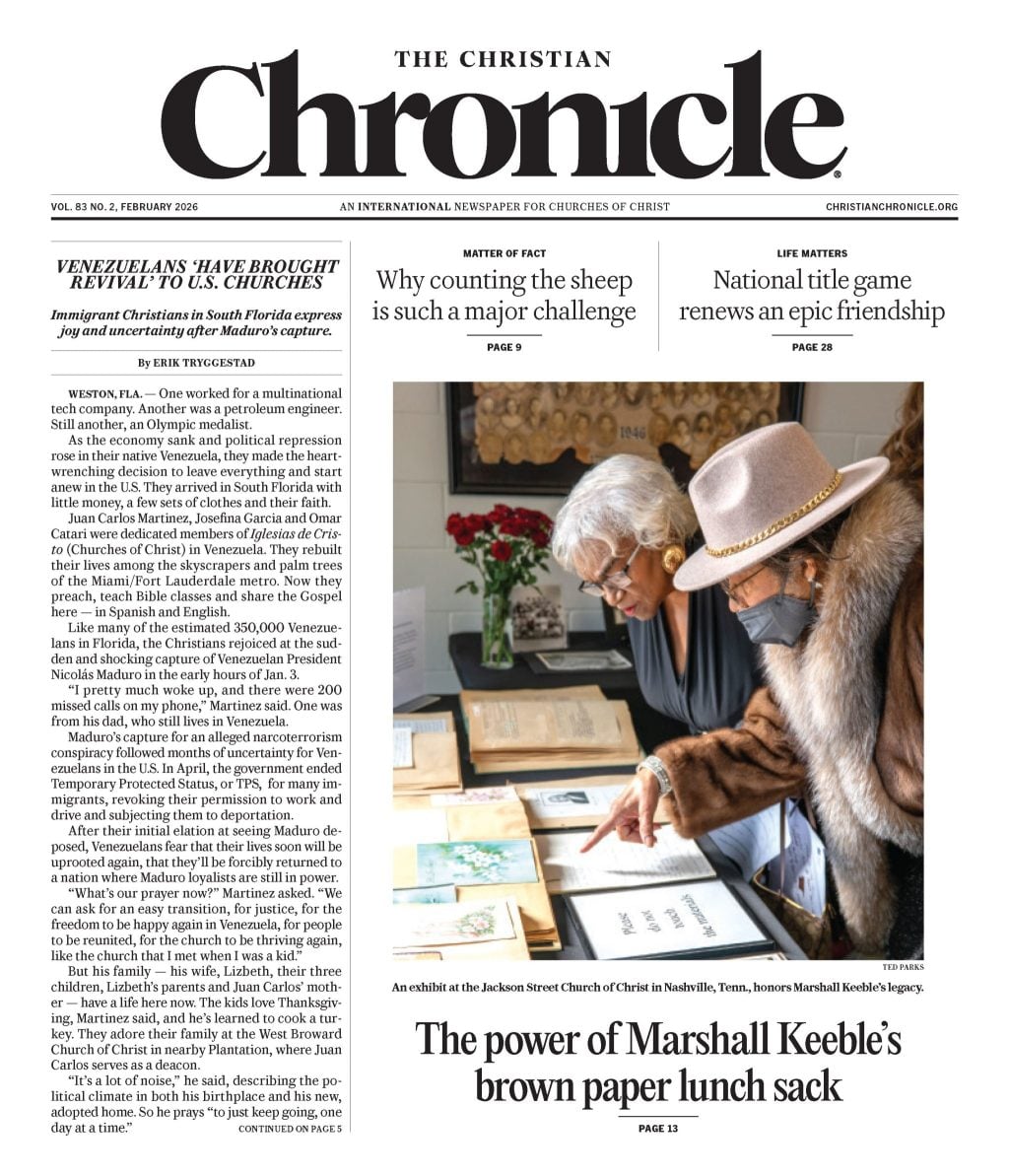

Editorial: Why counting the sheep matters
In church life as in much of life, we owe…

|
Getting your Trinity Audio player ready...
|
The parable of the lost sheep wasn’t written about church directories.
Researchers counting the number of congregations and members of Churches of Christ in the U.S. just want to know where the sheep go to church — no small task in a fellowship that prides itself on autonomy.
“So autonomous we’re anonymous.”
This is part of a series exploring the identity of Churches of Christ. Read more here.
That’s how Royce Money, a former minister and the retired president of Abilene Christian University in Texas, once described Churches of Christ.
As the Church Research Council — formed in 2024 by four church-associated entities — gathers statistical data from congregations through a new, nationwide survey, Money’s statement holds true.
“I want to know who we are,” said Suzie Macaluso, the sociologist and statistician who designed the survey.
So far, Macaluso has found more questions in the answers. What counts as a congregation? What if the church is two widows in a building?
Macaluso believes it’s important work.
“We know where we come from and have a good sense of history,” she said. “But given the state of religion in the U.S., I want to know who we are and where we are centered.”
In the 1950s and 1960s, Churches of Christ were heralded as one of the — if not the — fastest-growing religious groups in America. Estimates in the mid-1960s put total membership at about 2.5 million.

Mac Lynn
But those figures were highly inflated. Mac Lynn, then a teacher of ministry and church growth at what became the Harding School of Theology in Memphis, Tenn., discovered that when he began a national membership survey in 1973, a project he didn’t complete until 1980.
Various church leaders relied on estimates “based on a common perception that Churches of Christ were growing rapidly,” Lynn told The Christian Chronicle in 2007. “The figures they submitted simply added a percentage like 10 percent each year.”
Others began to use these figures, and so the word spread.
Lynn’s research concluded that Churches of Christ did experience a steady upward membership trend in the post-World War II era. But growth fell below the “ballooned estimates,” he said.
The figures reported by Lynn hit a high of 13,174 congregations and nearly 1.7 million adherents in 1990 before a steady decline in the 2000s.
Related: Editorial: Why counting the sheep matters
Lynn compiled updates every three years before turning over the national survey to Carl Royster with 21st Century Christian, a publisher based in Nashville, Tenn.
The most recent data provided by Royster — in the pre-pandemic 2018 edition of “Churches of Christ in the United States” — put the number of congregations at 11,965 with 1.4 million adherents.

Dale Jenkins
But those figures included churches from earlier editions that had not responded to update requests — sometimes for years.
And numbers experts who have worked on the directory, and others such as Tennessee minister Dale Jenkins, who leads the Jenkins Institute with his brother, Jeff, acknowledge that some of those “best guesses” were just that.
Dale Jenkins said he thinks there are between 9,000 and 12,000 Churches of Christ in the U.S. But, he added, they “can’t be numbered.”
The principle of autonomy supports the restoration ideal of unity and individual congregations’ right to follow doctrine and leadership as they believe Scripture teaches, however they define their lineage.
Still, the different interpretations of church doctrine led to decades of directories dotted with codes explaining the divisions.
NI means non-institutional. NC means non-class. ME means mutual edification. OC means One Cup, but four other OC designations detail beliefs about classes, fermented fruit of the vine and broken or unbroken loaves. Other codes indicate ethnicity, language and service to military bases. In the past there have been others.
When the COVID-19 pandemic hit, data gathering had just begun for a 2021 edition of “Churches of Christ in the United States.”

Carl Royster
Royster said the publisher nearly went under. Churches across the country began meeting online if at all. Data collection hit a full stop, and that’s where it stayed until 2024, when a coalition of parachurch entities formed the Church Research Council.
21st Century Christian, Heritage21, ACU’s Siburt Institute for Church Ministry and the Chronicle pooled resources and expertise not only to make directory information available once again but to provide an accurate picture of the fellowship in the U.S.
Stan Granberg, the Church Research Council’s president, explained the process of working through the same nine regions that the U.S. Census uses: New England, Middle Atlantic, East North Central, West North Central, South Atlantic, East South Central, West South Central, Mountain and Pacific.

Stan Granberg
A church planter and former professor at three colleges associated with Churches of Christ, Granberg knows churches nationwide. For each region, he begins by verifying addresses via websites, gathering mailing addresses and sending emails to every church that has an email, encouraging them to complete the survey.
He’s finished New England and West North Central and is now working through the Pacific region.
“I’m doing it myself but also trying to get help … because it’s a long process,” Granberg said.
The goal is to verify information and cleanse the 21st Century Christian database, which had never been fully updated.
Royster explained that of the 10,500 to 11,000 questionnaires sent every three years before the pandemic, about 700 to 800 were returned as undeliverable. Over three years, 21st Century Christian achieved about a 40 percent response rate between editions.
“In the two regions I’ve completed, about 20 percent of the churches in the 2018 directory are no longer meeting.”
“The other 60 percent we would have to carry over with the idea that if we didn’t have anything solid, we had to make the assumption they were still there,” Royster said.
Granberg is trying to deal with that 60 percent. It’s slow going.
“In the two regions I’ve completed, about 20 percent of the churches in the 2018 directory are no longer meeting,” he said. He thinks most of those were very small, often with 10 to 15 members.

Old “Churches of Christ Yearbook” directories rest on a shelf at Abilene Christian University’s library.
In addition to seeking help from within different regions, he tries to find volunteers from different streams within the fellowship to encourage their congregations to participate. Those streams include non-institutional Churches of Christ, which do not practice church-level support of parachurch organizations and nonprofits. These churches also oppose the “sponsoring church” model for mission work and instead practice direct oversight of missionaries and benevolence work.
“They fit our average size church of 50 to 60 people and do have some larger ones with 100 to 200,” Granberg said of the non-institutional churches. Complicating their participation in the survey is the nature of the Church Research Council itself, which essentially is an “institution.”
Most religious groups have some sort of data gathering entity, said Ryan Burge, political scientist with the Danforth Center on Religion and Politics at Washington University in St. Louis.

Ryan Burge
For example, Southern Baptists call their congregations autonomous but have record-keeping and data gathering through Lifeway Christian Resources, said Burge, a national expert who writes about the religious landscape in his Graphs about Religion Substack.
“The United Methodists have been less than forthcoming with data for the last couple of years because of the schism,” said Burge, referring to that denomination’s split over issues such as LGBTQ+ clergy and members. “But they used to be very responsive.”
Fellow Restoration Movement heirs the Christian Church (Disciples of Christ) have records, but “you have to pay to access them,” Burge said.
“They’re down 75 percent since 1987,” the former American Baptist pastor added, “with only 300,000 people now.”
Burge said among major religious groups, the closest level of autonomy to Churches of Christ would be the nondenominational networks that are forming nationally. Another group with ties to the Restoration Movement, Independent Christian Churches, have also maintained autonomous congregations.
Where are Churches of Christ? How many are there? Are they growing or shrinking? What trends are driving growth or loss? How do members worship? Do they serve their communities?
The Church Research Council endeavors to answer such questions.
As Granberg continues gathering contact information, the survey process is underway, posted online at the council’s website and promoted through mailings, advertisements, personal contact and every other means Granberg can come up with.

Mac Ice shows a visitor some of the directory collections in the library archives at Abilene Christian University in Texas
The survey has two parts: Part one requests basic directory information: name, address, contact information, social media platforms, size and which, if any, of those codes a congregation might choose.
Answers help travelers or those new to a community locate a congregation and know a little about it before they visit.
Part two inquires about the type of region served, worship style, ministries, leadership and staff. One question of the 42 asks about women’s roles.
Related: Special project: Who Are We?
That information can help answer some of the “Who Are We?” questions.
That’s where Macaluso comes in. Her scholarship on churches and religion in America runs deep.
“We want to know where we’re at,” she said. “We want accurate representation of numbers, but we also want to know what are the things that still divide us? Are we more or less fractured?”
“We want to know where we’re at. We want accurate representation of numbers, but we also want to know what are the things that still divide us? Are we more or less fractured?”
After Macaluso drafted the survey, a group worked to refine it before launching in late summer 2024 with an email or mailed questionnaire to everyone on the list from 2018.

Suzie Macaluso
“We began with a list of 11,000 churches,” she said. That quickly dropped to about 10,800, then narrowed a little more as they found some churches that had closed.
One mailer was designed specifically for small congregations with 50 or fewer members. The council sent four postcards over the course of a year.
As of September 2025, they had heard from more than 2,500 congregations, with all 50 states represented.
“Based on churches that we know for sure are closed, if we think of them as proportional and extrapolate, we estimate we have around 10,100 congregations,” Macaluso said.
She estimates regular attenders at somewhere between 850,000 and 950,000. The 2018 directory put that number at about 1.1 million.
“Based on churches that we know for sure are closed, if we think of them as proportional and extrapolate, we estimate we have around 10,100 congregations.”
Past surveys reported members, adherents and attenders. She’s not sure those terms still work with many congregations.
The survey link remains open, and efforts to encourage participation continue.
Some churches will never respond. But directory editors are a determined lot. They know barriers are sometimes logistical, sometimes about conscience. Just like the divisions among Churches of Christ.
Lynn, a retired professor at Lipscomb University in Nashville, sees the roots of division in Restoration History itself and “the way we approached Scripture and determined what was right and what wasn’t.”
“The Campbell approach was direct command, necessary inference and apostolic example,” Lynn said in a recent interview. “But people couldn’t see it alike and couldn’t decide where to stop.”

Past directories of Churches of Christ in the U.S. are displayed. Respond to the new census survey here.
Lynn describes many of today’s divisions as cultural. Most Christians today know nothing about the Campbell hermeneutic.
Lynn lists Sunday schools, one cup, Sunday night worship, instruments, women’s roles and more as examples of belief or practice that have prompted division but reflect culture.
“We just do these things because we like to do them,” he said.
“We have to use culture — we have to have a way of doing everything. If culture turns bad, that’s bad culture. We’ve got all kinds of cultures.”
And culture isn’t always negative:
“We have to use culture — we have to have a way of doing everything. If culture turns bad, that’s bad culture. We’ve got all kinds of cultures.”
Royster said some people accused the directory of creating division.
Related: ‘We don’t have to settle for divide’
“But it’s always been about trying to bring in unity and not division,” he said.
“It’s about saying ‘Here we have different families and different looks. But we’re all still under the body of Christ. We can work together, worship together, serve those around us and try to spread the Gospel and encourage each other to God’s glory.”
Jenkins, who is not a part of the Church Research Council, said some churches will not participate because they see the council’s members as progressive.
“In conservative organizations, if an organization develops a reputation, then anything that comes out of that is suspect.”
“In conservative organizations, if an organization develops a reputation, then anything that comes out of that is suspect,” Jenkins said.
But others in conservative churches find directories helpful. Craig Evans, minister for the Mt. Juliet Church of Christ in suburban Nashville, said some people may oppose being in a book with someone they don’t consider in fellowship. But he thinks the information is useful, and distinctions similar to those in the old directories are helpful.

North Las Vegas minister Leo Gay speaks to attendees of the 2025 West Coast Preachers and Leaders Forum.
“To know if a church is instrumental or non-instrumental, for example, because that saves some embarrassing moments for people,” he said. “They like to know what they’re getting into before they get there.”
Outside the Bible Belt, others agree.
Leo Gay, minister for the North Las Vegas Church of Christ in Nevada, leads a predominantly Black congregation of about 220. He thinks the directory and informative designations are useful.
“I’ve told members I can’t direct them to churches because I know they have strayed from what I understand and believe the Bible to teach, and they’ve gotten into women leading and praise dancing,” Gay said. “And you’ve got to take your chances and go in, and if it’s not what you’ve been taught, find another one.”
“I’ve told members I can’t direct them to churches because I know they have strayed from what I understand and believe the Bible to teach.”
He also believes ethnic codes can be useful, even though “biblically there’s no such thing as Black and White churches.”
Still, such a directory is helpful, he said, “just to give a better perspective and overview of where churches are and what worship is like and if it’s predominantly Black or White or Hispanic. If you go to a Hispanic church, and you don’t speak Spanish, you’d probably rather find one that speaks English.”
The Greenbank Church of Christ in Wilmington, Del., represents the merger of a predominantly White church with a Black church in 2019. Preaching minister Domingo Reyes is bilingual and also serves Spanish-speaking members.

Minister Domingo Reyes, left, teaches a Bible class for Spanish speakers at the Greenbank church. He discusses the points he will cover in his sermon later that morning.
And he’s aware of French-speaking congregations that serve French/Haitian and Nigerian immigrants. And one that serves the deaf and another that’s designed spaces to serve children with autism. Having a way to know all that would help people find a church, Reyes said.
“Context is so different here than in the Bible Belt,” Reyes said. “There are arguments I don’t have to fight because we don’t have enough Churches of Christ for people to even know there’s a difference.”
So the search for the sheep goes on.
CHERYL MANN BACON is a contributing editor for The Christian Chronicle. She served for 20 years as chair of the Department of Journalism and Mass Communication at Abilene Christian University in Texas.
In church life as in much of life, we owe…

Find links to all the articles in the “Who Are…

ATLANTA — Hundreds of Christians came to Atlanta seeking true…

The heartbeat of the American Restoration Movement is propelled by…

‘The Churches of Christ salute you.” A line from the…
The church in America is shrinking. The number of men,…
Subscribe today to receive more inspiring articles like this one delivered straight to your inbox twice a month.
Your donation helps us not only keep our quality of journalism high, but helps us continue to reach more people in the Churches of Christ community.