With prayers, proverbs and psalms, Venezuelan Christians react to Maduro’s capture
For many Venezuelans, the capture of President Nicolás Maduro is…

|
Getting your Trinity Audio player ready...
|
WESTON, FLA. — One worked for a multinational tech company. Another was a petroleum engineer. Still another, an Olympic medalist.
As the economy sank and political repression rose in their native Venezuela, they made the heartwrenching decision to leave everything and start anew in the U.S. They arrived in South Florida with little money, a few sets of clothes and their faith.
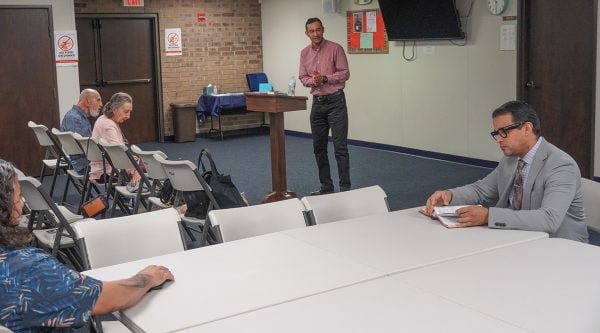
Juan Carlos Martinez, right, prepares to lead Spanish-language Bible class for the West Broward Church of Christ in Plantation, Fla.
Juan Carlos Martinez, Josefina Garcia and Omar Catari were dedicated members of Iglesias de Cristo (Churches of Christ) in Venezuela. They rebuilt their lives among the skyscrapers and palm trees of the Miami/Fort Lauderdale metro. Now they preach, teach Bible classes and share the Gospel here — in Spanish and English.
Like many of the estimated 350,000 Venezuelans in Florida, the Christians rejoiced at the sudden and shocking capture of Venezuelan President Nicolás Maduro in the early hours of Jan. 3.
Related: With prayers, proverbs and psalms, Venezuelan Christians react to Maduro’s capture
“I pretty much woke up, and there were 200 missed calls on my phone,” Martinez said. One was from his dad, who still lives in Venezuela.

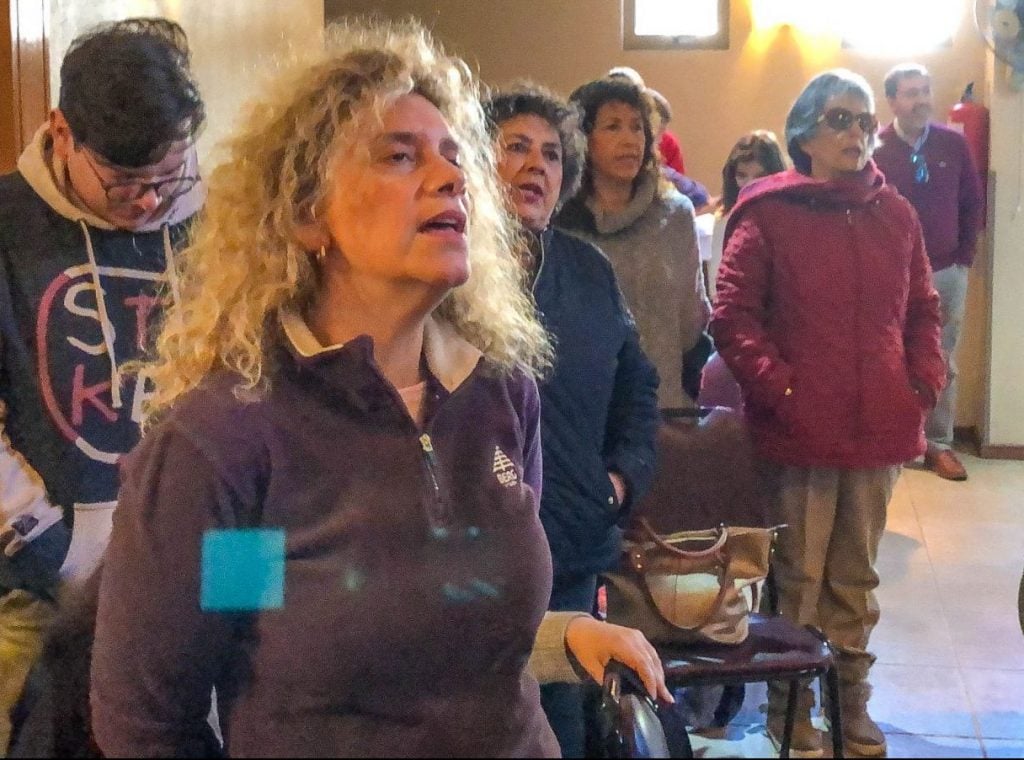
Church members pray during the Spanish Bible class of the West Broward Church of Christ in Plantation, Fla.
Maduro’s capture for an alleged narcoterrorism conspiracy followed months of uncertainty for Venezuelans in the U.S. In April, the government ended Temporary Protected Status, or TPS, for many immigrants, revoking their permission to work and drive and subjecting them to deportation.
After their initial elation at seeing Maduro deposed, Venezuelans fear that their lives soon will be uprooted again, that they’ll be forcibly returned to a nation where Maduro loyalists are still in power.
“What’s our prayer now? We can ask for an easy transition, for justice, for the freedom to be happy again in Venezuela, for people to be reunited, for the church to be thriving again, like the church that I met when I was a kid.”
“What’s our prayer now?” Martinez asked. “We can ask for an easy transition, for justice, for the freedom to be happy again in Venezuela, for people to be reunited, for the church to be thriving again, like the church that I met when I was a kid.”
But his family — his wife, Lizbeth, their three children, Lizbeth’s parents and Juan Carlos’ mother — have a life here now. The kids love Thanksgiving, Martinez said, and he’s learned to cook a turkey. They adore their family at the West Broward Church of Christ in nearby Plantation, where Juan Carlos serves as a deacon.
“It’s a lot of noise,” he said, describing the political climate in both his birthplace and his new, adopted home. So he prays “to just keep going, one day at a time.”
Weston, at the edge of the Florida Everglades, is a hub for the Venezuelan diaspora. At a coffee shop in a strip mall, Martinez, 45, spoke with The Christian Chronicle on a Monday morning. He taught Bible class and preached for the West Broward church’s Spanish service the day before and had a few hours before his shift began at a nearby pizzeria.
Related: The Venezuelan diaspora
His grandmother was one of the first converts baptized in the Venezuelan city of Barquisimeto in 1979. Martinez grew up in Iglesias de Cristo and preached for congregations in Caracas and Mérida, where he met Lizbeth. He worked for a tech company and traveled to the U.S. four times per year to a trade show in Las Vegas. When he returned, Venezuelan border guards pelted him with questions. Was he working for the Americans? How could he afford to travel when the economy was failing?

During the COVID-19 pandemic in 2020, children in Venezuela’s Cojedes state receive meals paid for by Churches of Christ in the U.S.
Meanwhile, in Caracas, “the situation was getting worse and worse,” Martinez said. The Maduro government’s populist policies, overreliance on oil revenue and international sanctions resulted in frequent blackouts and internet outages. The tech company relocated to neighboring Colombia. Then, in 2020, as Martinez returned from the trade show, border guards held him in a room for nearly 10 hours, strip-searched him and refused to stamp his passport.
It was time to leave.

A sign in Cucuta, Colombia, points the way to the border crossing into Venezuela.
He and Lizbeth filled small suitcases. Their kids, then ages 10, 8 and 6, packed a few toys into backpacks. A guide took them across rivers and through forests, paying people along the route to assist them or look the other way. Finally, they arrived in the border city of Cúcuta, Colombia. It was the first time Lizbeth and the children had left their homeland.
Related: A rescue mission
A church-planting team of Latin American Christians in Cúcuta, Colombia, serves Venezuelans as they stream across the border.They paid the Colombian government to get their documents in order and flew from the capital, Bogotá, to Orlando, Fla., where Martinez’s sister and brother-in-law live. They looked for a church home — not an easy task in the midst of the COVID-19 panic. Searching online, Martinez found West Broward, one of the few Florida churches offering in-person, Spanish-language worship.
“It was love at first sight,” he said of their initial visit.

Church members read Scripture during the Spanish Bible class of the West Broward Church of Christ in Plantation, Fla.
His children, who spoke only Spanish, struggled — and, at times, wept — as they adapted to Florida’s public school system. Five years later, they’re bilingual. The oldest still likes arepas (savory Venezuelan cornmeal patties) for breakfast, but their middle child, a daughter, is as likely to ask for a bagel. As for their youngest, Martinez says, “he’s not an American on paper, but I can tell you, I have an American kid!”
About 10 families at West Broward are Venezuelan, Martinez said. On Sunday, he preached from the book of Nehemiah, which tells the story of a devout Jew who, after years of serving in the royal court of Persia, traveled to Jerusalem to rebuild the city’s walls.
It seemed appropriate, he said, as Venezuelans ponder the possibility of returning to their homeland.
South of Weston, Venezuelans worship in the Spanish- and English-language services of the Sunset Church of Christ.
@christianchronicle MIAMI — During Spanish- language worship, members of the Sunset Church of Christ make contributions while singing “God Will Make a Way.” #miami #spanishworship #iglesiadecristo #churchofchrist ♬ [Live recording] Record playback noise 04 (5 minutes) – Icy Light
On Sunday, bilingual minister Jim Holway preached for the English service in the fellowship hall and then walked to the auditorium to preach for the Spanish service. After worship, he gathered a small group of Venezuelans — including the church’s new youth minister, Gustavo Rivera, and his wife, Gaby — to speak with the Chronicle. Holway translated for those not fluent in English.

Jim Holway preaches for the Spanish-language service of the Sunset Church of Christ in Miami.
The Miami congregation rents part of its facility to a charter school. The small group met in a classroom used to teach elementary Spanish. Behind them, next to a photocopy of a U.S. passport, letters spelled out “Leer es viajar sin pasaporte” — “Reading is traveling without a passport.”
Growing up in Venezuela, Omar Catari was a fighter. Coaches recognized his talent and trained him to be a boxer. The discipline kept him out of trouble, he said. He won bronze in the 1984 Summer Olympics in Los Angeles and worked for Venezuela’s ministry of sport. Maduro’s regime “tried to pull him into more and more political events, and he wasn’t interested in doing that,” Holway translated. “And then they started making his life difficult, and they recorded him on two occasions saying things that, in their minds, were against the government.” Catari and his wife, Amparo, fled to South Florida in 2019.

Omar and Amparo Catari, left, talk about their exodus from Venezuela.
Josefina Garcia worked as a petroleum engineer until former President Hugo Chávez booted her and hundreds of her coworkers from their jobs on national TV and announced that he was nationalizing Venezuela’s oil industry. Garcia tried to continue in the oil business, but new government regulations made it impossible. She moved to Miami in 2010 and now works as Holway’s administrative assistant.
When they heard about Maduro’s capture, the Venezuelans felt “a controlled, limited joy,” Amparo Catari said. They later learned that some political prisoners in their homeland were freed, but some of their friends are still in custody. Meanwhile, rumors swirl that Venezuelans who return could be jailed or harassed if images of them celebrating Maduro’s downfall appear on social media.

Aris Granda speaks with The Christian Chronicle in a classroom used to teach Spanish.
This adds to their anxiety about the loss of Temporary Protected Status — even for Venezuelans who are now U.S. citizens, said Aris Granda. She moved to South Florida 18 years ago with her daughters. Granda’s husband, a Cuban, has preferred status, which helped her attain her citizenship. But her two adult daughters are in limbo. One lost her work permit, and the other daughter’s expires in March.

Josefina Garcia
Garcia also has become a U.S. citizen. She’s heard President Donald Trump’s promise to rebuild Venezuela’s economy using workers in the oil business. But at age 67, she doesn’t anticipate returning to her former life. Nor do her former coworkers.
“It’s difficult for us to think of returning to Venezuela,” Garcia said, “because we are building a new life here or in Canada. Maybe our sons and grandsons will go to Venezuela — the new Venezuela.”
In addition to building new lives, Venezuelans “have completely transformed the South Florida culture,” Carlos Carbajal said. “You feel the vibe.”
Carbajal, a native of Honduras, came to the U.S. to work with the Sunset church. His wife, Karla, was a human rights attorney in Honduras. As her husband ministered in Miami, Karla earned a U.S. law degree and worked with a nonprofit that served immigrants, especially unaccompanied minors.

Carlos and Karla Carbajal speak with The Christian Chronicle in Doral, Fla.
A few years ago, the couple launched Oikos, a Spanish-language church that takes its name from the Greek word for household. Karla also started a law firm specializing in immigration. Most of her clients are Venezuelans.
The couple spoke with the Chronicle at Bocas House, a Latin American restaurant in Doral, a city in western Miami-Dade County that has earned the nickname “Doralzuela” for its booming Venezuelan population.
“The reality is, there’s two Venezuelas — the Venezuela over there and the Venezuela over here,” Carlos said.
The removal of TPS is the latest discrimination that Venezuelans have endured in the U.S., Karla said. Police target and detain immigrants based solely on their tattoos, accusing them of membership in Tren de Aragua, a notorious Venezuelan gang. Immigrants from Guatemala and other nations don’t receive this kind of scrutiny, the attorney said.

Carrying small bags filled with food and medicine, Venezuelans walk across the Tachira River from Cúcuta, Colombia, to San Antonio del Tachira, Venezuela, in 2017.
Many Venezuelans also fall victim to scammers who offer to file their asylum cases and charge up to $25,000 and then disappear. When Karla takes over their cases, she discovers that the immigrants’ paperwork was never filed.
“It doesn’t make sense that, at this time of the year, many churches are already planning to do their mission trips to Latin America — to communicate the goodness of the Gospel — but they have been silent about these migrants.”
Carlos, who works alongside his wife and the firm’s 10 employees, said he would like to see churches do more to serve and advocate for their immigrant neighbors.
“It doesn’t make sense that, at this time of the year, many churches are already planning to do their mission trips to Latin America — to communicate the goodness of the Gospel — but they have been silent about these migrants,” he said. “Part of the Gospel, which is essential, is to be the voice of those who cannot express themselves.”
Despite the prejudices they endure, Venezuelans make America better, he added. “They’re extremely welcoming. That’s something that is in their DNA. They make others feel like part of them, family.” As a result, “they have brought revival to churches.”

Gaby and Gustavo Rivera visit with youths after the English-language worship service at the Sunset Church of Christ in Miami.
At Sunset, Josefina Garcia attributed her countrymen’s evangelistic zeal to missionaries from Churches of Christ, including Bob Brown, Albert Acosta, Larry Moran and Jon Steffins who planted the first Iglesias de Cristo in the 1970s and instilled in Venezuelans “a missionary spirit to plant a church wherever they went,” Garcia said.
Now, in Venezuela, young Christians don’t just “go to church because of their parents,” said Gustavo Rivera, the Sunset church’s youth minister. They take active roles and ownership in their congregations. Rivera works to instill those values in young believers in Miami.
The Venezuelans’ impact is noticeable, said Alphonso Thomas and Jeff Hinson, elders of the Sunset church. The immigrants are devoted and hard-working, Hinson said, and because of what they’ve endured, “they do just appreciate so much the family that they have here.”

Alphonso Thomas leads the closing prayer for the English-language service of the Sunset Church of Christ in Miami.
Thomas added, “If you believe in Christ, and you are part of the Church of Christ, no matter where you’re from — Venezuela, America, any other Spanish country — it is good. They have enriched us.”
Back at the coffee shop in Weston, Juan Carlos Martinez reflected on his own exodus from Venezuela to South Florida. He identifies a bit with Moses, who also fled his homeland at age 40 and started over in a new land.

Juan Carlos Martinez speaks with The Christian Chronicle over coffee in Weston, Fla.
But no earthly place — Egypt or Midian, Venezuela or the U.S. — will ever really be home, he said.
“It’s never like, ‘Breaking news: happiness! Everything is perfect!’” he said. “Because that’s heaven. … We don’t belong here, and we weren’t meant for all this craziness. We’re meant for a better thing.”
ERIK TRYGGESTAD is President and CEO of The Christian Chronicle. Contact [email protected].
For many Venezuelans, the capture of President Nicolás Maduro is…

As the South American nation of Venezuela fell into social…

From across Latin America, a team of Christians has come…

After training at the Baxter Institute in Tegucigalpa, Honduras, a…

NASHVILLE, Tenn. — ‘Go Dawgs!” That wasn’t a phrase I expected…
SANTIAGO, Chile — “Can we talk over here?” asks Alejandra…
Subscribe today to receive more inspiring articles like this one delivered straight to your inbox twice a month.
Your donation helps us not only keep our quality of journalism high, but helps us continue to reach more people in the Churches of Christ community.