 Tennessee

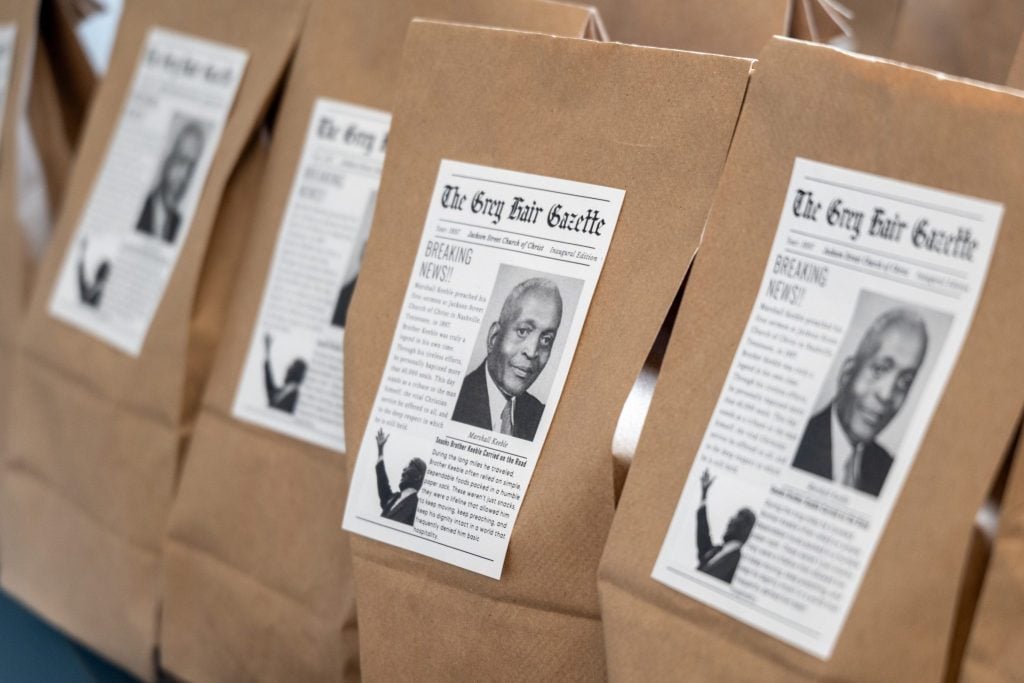
The power of Marshall Keeble’s brown paper lunch sack
NASHVILLE, TENN. — For Marshall Keeble, traveling all over the South…

|
Getting your Trinity Audio player ready...
|
NASHVILLE, TENN. — To Gwen Cummings, the late Marshall Keeble was more than a famous traveling evangelist.
He was her “Pop.”
Keeble was born in 1878, 13 years after the end of the Civil War. He died in 1968, 16 days after the assassination of Martin Luther King Jr.
Keeble’s formal education stopped at the seventh grade, and the Tennessee native lived most of his 89 years in the Jim Crow era of racial segregation.
Yet the humble, humorous son of former slaves became a renowned gospel preacher, baptizing tens of thousands of people, planting hundreds of churches and quietly working for integration.
I first met Cummings, Keeble’s great-granddaughter, when I interviewed 104-year-old Laura Keeble — Marshall’s widow — for The Associated Press in 2003.
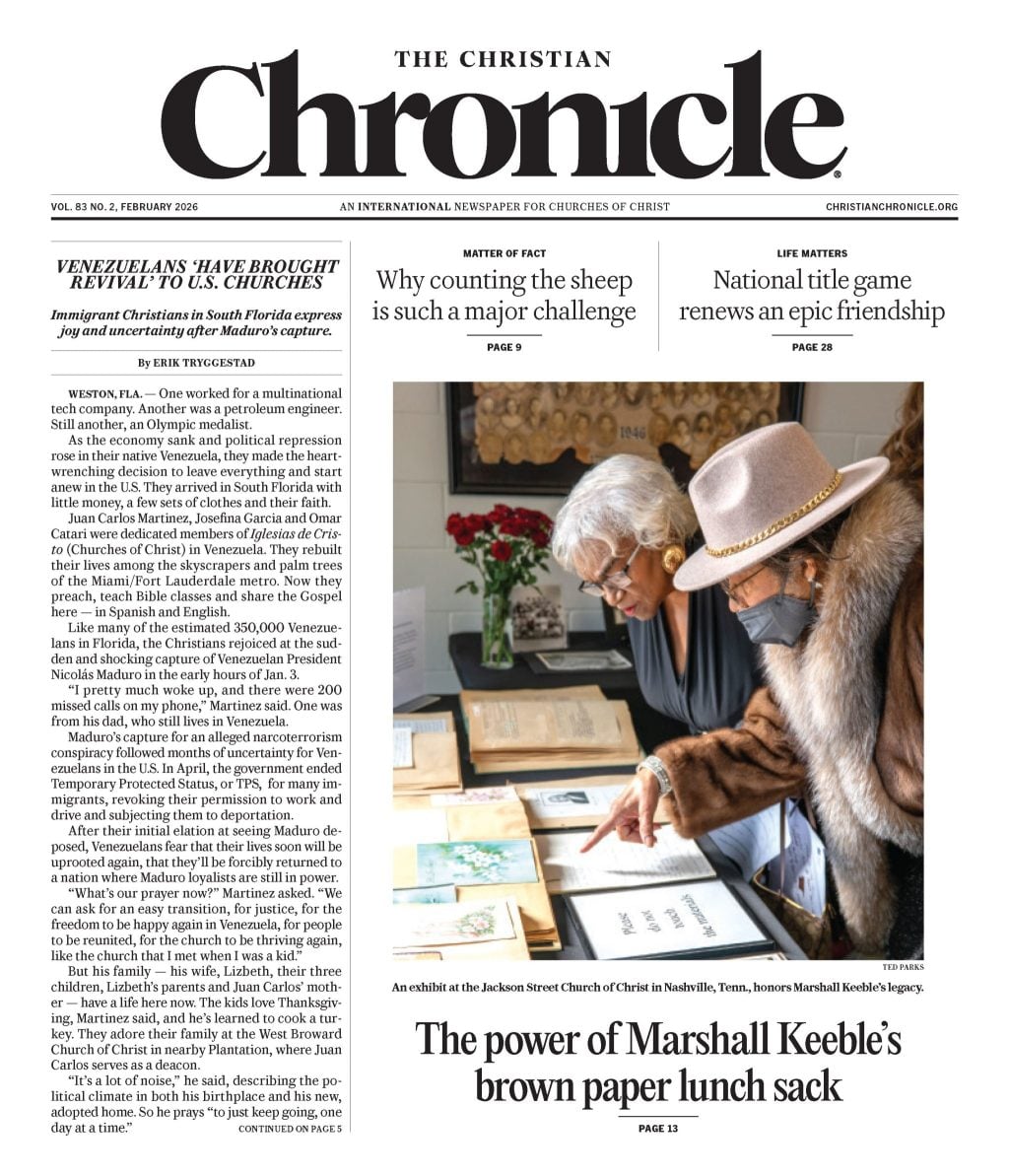
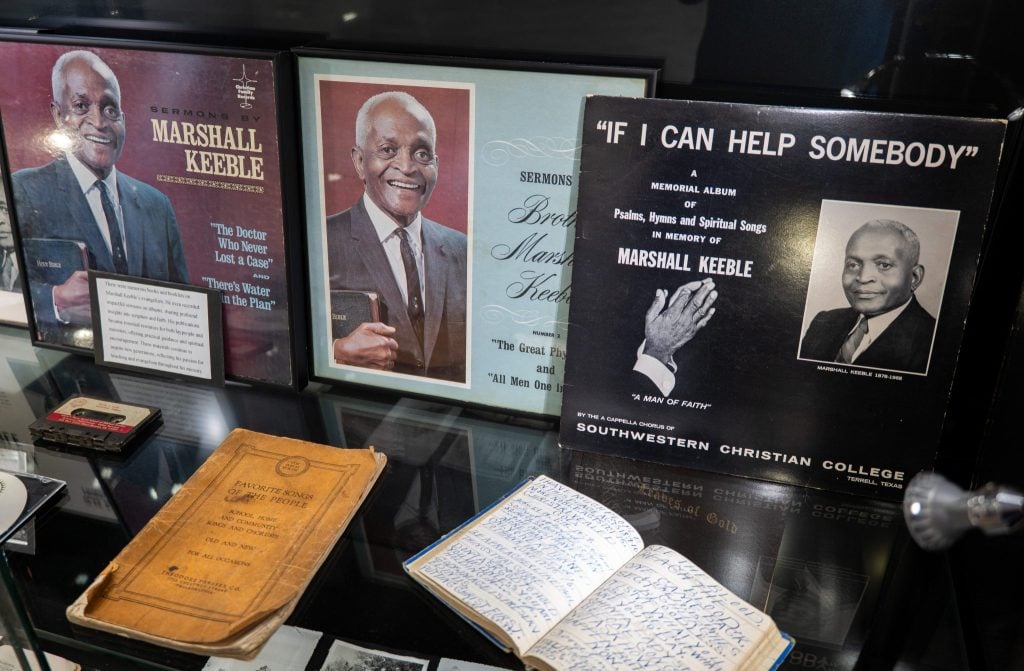
Twenty-three years later, Cummings invited me to cover this week’s opening of a new exhibit at Nashville’s Jackson Street Church of Christ paying tribute to Marshall Keeble’s enduring legacy.
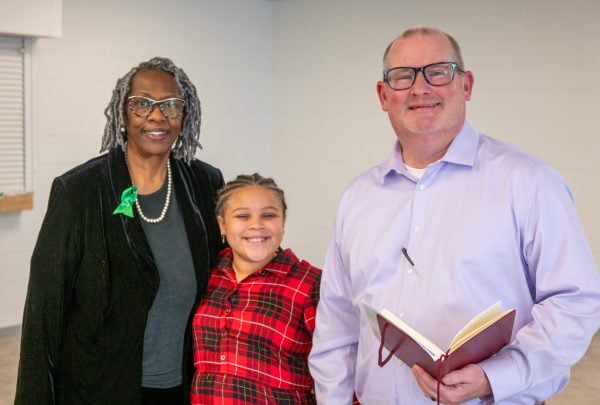
Bobby Ross Jr., right, visits with Gwen Cummings and her 8-year-old granddaughter, Makenna, at the new exhibit’s opening.
I enjoyed catching up with Cummings, 75, and hearing her personal reflections on the Keebles.
These highlights from our discussion have been lightly edited for clarity and brevity:
“My mother’s parents died early in her life, so Marshall and Laura raised her and her sister. They were Valentines, but brother Keeble changed their name to Keeble because he had to raise two little girls.
“As a result, I grew up with him being more like a grandfather than a great-grandfather. And I lived with them a lot, in and out, both with my mom and the Keebles.

Gwen Cummings, second from left, at the Marshall Keeble exhibit’s opening. Also pictured, from left, are Darla Whitaker, Venessa White, Cathy Sherill and Stephanie Blacksmith.
“Then as I got older, when brother Keeble would leave to travel, I would stay with sister Keeble. Then as she got older, I just started staying more because I sensed that they really relied on me to be there and help them.
“And after he died, I just stayed with her. And then when she went to a nursing home, my husband — Jackson Street elder Dr. Clinton Cummings Sr. — helped me take care of her.”
“I know that this man was exactly what he preached. He was a good man, humorous and full of life, and he loved the Lord.
“He’d say, ‘When I meet the Lord, I’m going to tell him how I suffered for him.’ I’d say, ‘Well, don’t you know that the Lord knows that?’ He’d say, ‘Well, you’re too smart. I’m going to tell him anyway how I loved him.’
“He was just a genuine, true Christian, and I admired that.”

Marshall Keeble’s photo appears in an old directory of the Nashville Christian Institute.
“He said, ‘Well, I’ve got more strength in this other eye to read the Bible and carry on the Gospel.’
“His son Clarence was coming home one afternoon after work — he used to do a little odd job after school — and there was a thunderstorm. And he was electrocuted right in front of the Keeble home.
“Marshall said Minnie was never the same. But he said, ‘It gave me more strength to look out and have more sympathy when people go through things.’
“And the week after Clarence’s death, he went right on and held a meeting.”

A picture displayed at the exhibit shows Marshall Keeble, front center, with four of his “boy preachers,” including Hassen Reed and Robert McBride, both standing, and Robert Wood and Fred Gray.
“When he came home that Saturday morning, I rushed into the bedroom. And my grandmother told him, ‘We lost brother.’ So he said, ‘When did it happen?’ She said, ‘It happened yesterday.’ And he said, ‘OK.’
“And we went to pick out the casket. He was so strong. And he said, ‘Well, the Lord’s will is being done.’ And he broke down crying.
“Very few times have I seen him cry, but he cried, and he was just through with it. And then he turned to me and my sister and told us to look out for Grandmama.
“He didn’t say, ‘Look out for me.’ He said, ‘Look out for Grandmama.’”

Elders of the Jackson Street Church of Christ in Nashville, Tenn., pose by the new Marshall Keeble exhibit. Pictured, from left, are Terry Primm Sr., Richard Southall, Dr. Clinton Cummings Sr. and Jesse Tucker.
“Because they could joke with you. He especially could joke with you and play with you and have fun and sneak you some of his sweet coffee.
“My grandmother didn’t want me to have coffee. And he would drink it just black, strong, nothing in it but sugar. And he’d just slide me a little on the saucer, and I’d turn it up at the table.
“And he would tell funny stories and tell little boys that I couldn’t stand that I liked them. And oh, he’d get a kick out of that. He’d say, ‘Gwen would love for you to call her.’
“I’d say, ‘Grandmama, make him stop. He knows I’m not saying that.’ But oh, he’d get a kick out of it. He was just a big tease with me.”

Attendees visit during the opening of the Marshall Keeble exhibit.
“Every year at Christmastime, brother Goodpasture would buy him a suit and a shirt and a tie. It got to the point where brother Keeble said, ‘I’m not going to be naked or in need of a suit because brother Goodpasture is going to make sure I have a suit.’ And that would tickle brother Goodpasture.
“Brother Goodpasture and brother Keeble were friends way before brother A.M. Burton (a key White supporter of Marshall’s ministry) came on the scene. And brother Goodpasture did brother Keeble’s eulogy in 1968.”
“So this minister said, ‘Lord, have mercy. There’s sister Goodpasture and sister Keeble. What could I possibly preach about and say to them?’
“Even though sister Keeble went to a nursing home, I made it my mission to be at that nursing home just about every day. She loved being at Lakeshore, which was a Church of Christ facility, because people would remember her husband. And she’d just sit in her wheelchair in the lobby and wait for her meals.”

The late Laura Keeble, then 104, talks with Corrinne Osei at the Lakeshore Estates Retirement Nursing Home in Nashville, Tenn., in 2003.
BOBBY ROSS JR. is Editor-in-Chief of The Christian Chronicle. He traveled to Nashville to report this story. Reach him at [email protected].
NASHVILLE, TENN. — For Marshall Keeble, traveling all over the South…
LOS ANGELES — In 1963, an 11-year-old named Dewayne Winrow…

I never got to meet Marshall Keeble or hear him preach.…

HOUSTON — DeMeco Ryans required no introduction as he stepped…

NASHVILLE, Tenn. — Forty-five years ago, civil rights attorney and…

BROKEN ARROW, Okla. — At the 100th anniversary of the…
Subscribe today to receive more inspiring articles like this one delivered straight to your inbox twice a month.
Your donation helps us not only keep our quality of journalism high, but helps us continue to reach more people in the Churches of Christ community.