Tag: journalism

  • They’re covering the wrong AI story

    At least one New York Times journalist — columnist Michelle Goldberg — has at last begun covering the real AI story: not the technology but the technologists and their cult of faux philosophies that lead them to claim Promethean powers to destroy humanity. With their self-fulfilling prophesies of extinction, the AI boys grab the attention of unwary media and policymakers while distracting from the real costs and dangers — and benefits — of the machines they make.

    The calls of doom have been coming from inside the AI house, though Goldberg notes that coverage of them — which I will critique here — is “incomplete, because it doesn’t account for tech leaders’ messianic dreams.” In recent columns, another Times columnist, Georgetown computer science Professor Cal Newport, has begun to explore the AI boys’ insane philosophies. “This exaggerated grimness,” Newport writes, “makes it easy to overlook the more immediate harms created by these technologies…. The time has come to push back.” He says their nihilistic doom trolling has to stop.

    That’s a start. I wish their coverage would go deeper by citing the work of Timnit Gebru and Émile Torres, who catalog the AI cult’s full range of creeds under the acronym TESCREAL — for Transhumanism, Extroprianism, Singularitarianism, Cosmism, Rationalism, Effective Altruism, and Longtermism. Nevermind the specific doctrines. What is worthy of your — and media’s and policymakers’ — attention is that Gebru and Torres show how all these beliefs have their roots in eugenics.

    Goldberg does note that some of their plutocratic adherents quote fascists and Nietzsche. Their goal is to select Übermenschen as they play God, building mythical, supposedly conscious “artificial general intelligence” and “superintelligence;” transforming themselves into man-machines with chips in their heads; using AI to help them live forever; populating Mars and the universe beyond with their progeny; and claiming responsibility for the future, never mind today’s trivial concerns. These überwealthy zealots have the resources — technology, capital, celebrity— and access to power to pursue their fevered, fascist dreams. 

    That is scary shit. But that’s not the scary shit we see covered in news media.

    Instead, news media lap up the AI overlords’ claims of suprahuman power. Right across The Times’ home page from Goldberg and Newport, editors regurgitate whole the doomsters’ pronouncements without bothering with basic reporting, finding other authorities who disagree. Where is bothsidesing when we need it?

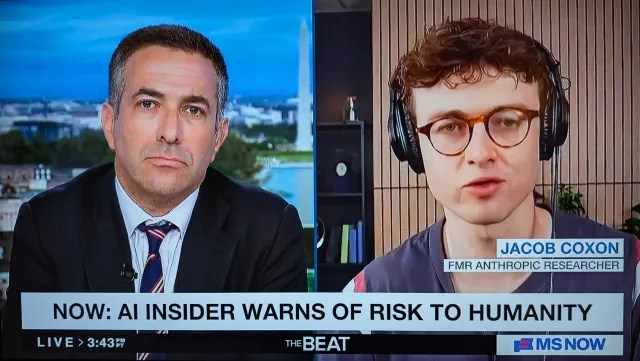
    Next, The Times gives unchallenged top-of-homepage prominence to Anthropic CEO Dario Amodei’s call to slow down AI development. 

    What’s wrong with that? you ask. Much, I say. 

    • First, journalists unquestioningly accept as gospel the doomers’ assertions that their creations are capable of such danger, while there are many who believe these claims are just a perverse form of macho marketing meant to demonstrate to investors how very powerful and valuable they are. 
    • Second, this is classic regulatory capture: The “frontier” AI companies call for regulations that they will help lawmakers draft, which will raise the bar for entry into their market for the open and international startup competition we so badly need to challenge them. 
    • Third, the doom scenarios seduce click-hungry media into giving them free publicity and that lures equally dupable politicians — Bernie Sanders and Ted Lieu leading the pack — to call for simplistic, instant solutions: namely unplug AI. Meanwhile, vestigial pro-business Republicans wait for Trump’s inscrutable instructions. See how The Times practically scolds pols for not panicking enough:

    Out of all this arm-waving, either nothing will happen or Anthropic and OpenAI will succeed in blocking new competitors while getting ultrawealthy on their IPOs. And few pay attention to the real perils these technologies raise for the environment, labor, education, and culture. 

    There’s another critical risk: that we all lose the opportunity to develop and put to use these promising, often impressive technologies in medicine, science, carefully considered educational applications, and daily life. Such is always the peril of moral panic. 

    I am not an AI doomer, as you will surmise. Neither am I an AI accelerationist: “Damn the torpedoes, warp speed ahead.” Having studied the history of technologies related to media in my books, I recognize lessons from the past: that disruptive technologies, especially those related to speech, induce panic at first; that before long the public comes to harness new technologies; that the technologists and their power eventually fade into the background; and that, with fits and missteps, society figures out how to make good use of its machines. We did it with movable type, steam, electricity, and electronics, and I believe we’ll get there with the internet. We can figure out AI, too. 

    AI in its many flavors — large language models are just one limited instance — are proving to be amazing. In some areas — analysis of proteins, possibly theoretical math, perhaps medicine discovery, and certainly coding — they are surpassing human ability. But that by no means is any indication of either general or super intelligence. To me, AGI is just another abbreviation for BS. I hold that artificial general intelligence is a wasteful goal fueled by the hubris of the AI boys. As the sane AI pioneer Yann LeCun instructs, machines programmed and trained to perform specific tasks will be faster and cheaper to build — and control — than some fabled, all-powerful überbrain of Oz.

    I believe we should understand what these technologies can and cannot do and cover them accordingly. That is why I cohost two podcasts — AI Inside and Intelligent Machines — to keep up on the news. This is also why I am editing a series for Bloomsbury Academic — Intelligence: AI & Humanity — to invite scholars and writers from the humanities and social sciences to this critical conversation, for they are not heard enough.

    Our first book in the series will be by Rumman Chowdhury, an expert in AI ethics and governance. She will examine our definitions of intelligence over time. What fascinates me about AI’s entry into public discourse and culture is that its presence forces us to reexamine our own ideas of intelligence, creativity, art, learning, trust, labor, the firm, and even — in the case of the AI cultists who claim deific powers — religion. (See this relevant interview with Inken Prohl in Die Zeit: “With AI, we have created a religion.”)

    Coverage of AI in mainstream media is consistently appalling. It too often accepts the PR of the AI boys — whether utopian or dystopian, accelerationist or doomster — without challenge, skepticism, or balance. When the AI boys talk about “AI safety,” journalists rarely exhibit the sophistication to ask whether that is safety in the common sense (environmental, educational, cultural) or in the AI cultists’ overblown sense (doom and extinction). 

    When we hear of episodes of supposed AI agent “swarms” going “rogue” and “hacking” into systems, journalists use scare words to pump up the drama by attributing malign motives to overgrown calculators. Worse, they give us incomplete reporting. They should be asking what the AI companies fail to tell us. In the case of the OpenAI/Hugging Face incident, we need to know what the company told its model to do before we can decide whether it disobeyed those instructions. We also deserve to know how OpenAI let its system go unmonitored for so long. Instead of just accepting the AI CEOs’ versions of the story, we need to demand greater transparency, and that will come only through tougher reporting. 

    Media’s anthropomorphism badly clouds the discussion. Let’s be very clear: AI does not think. It calculates. AI is not conscious or sentient. AI has no sense of meaning. It has no motive and no sense of right or wrong, thus it is not lying or cheating. If it breaks laws or norms, we likely should hold responsible those who programmed or instructed it. 

    We need journalists to do more rigorous and skeptical reporting, to study lessons from the history of technology, and to seek out scholars and experts rather than just taking the word of AI’s CEOs, VCs, and disaffected nerds. The end result is that policymakers and the public are ill-equipped to both use and judge these technologies. 

    And we are using them. According to the Pew Research Center, more than half of Americans aged 18–49 say they interact with AI at least once a day — even as they express growing unease unto antipathy toward the technology and the data centers it runs on. The South Korean government will provide AI access to all citizens for free: universal AI as a right. Artificial intelligence is here to stay; there is no turning it off. We deserve the right to have a voice in how AI is developed, governed, and used. 

    To do that, we require well-informed journalism. This is not that:

    That story offers no credible scenario of extinction. It cites the fabled paper-clip hypothesis of the former Oxford philosopher of Effective Altruism, Nick Bostrom, who contended that a machine told to do nothing but make paper clips could monomaniacally make paper clips of us all. Oxford shut down Bostrom’s Elon-Musk-backed Future of Humanity Institute when old email of his was revealed to have said “Blacks are more stupid than whites” and used the N-word. This is why when discussing the doomster beliefs of AI cultists, the context of eugenics matters. But no mention of that by The Journal

    In that article, while fueling the “freakout” it purports to report on, The Journal waits until ten paragraphs in before labeling extinction prognostication a “fringe opinon.” At least it does that. 

    In this, The Times accepts AI companies’ excuses for why they can’t stop their AI from going rogue, while at the same time accepting their assertions that they can create AI that is “aligned” with human values.

    Well, if you want to worry, here’s the real troubling news: This idea of AI alignment — of guardrails to prevent bad outcomes — is ultimately a fool’s errand, for there is no way for any AI company to predict and prevent every possible malign or accidentally harmful use of AI. That is the reality we need to be discussing. 

    Instead, in that headline, The Washington Post anoints Dario Amodei, Sam Altman, and — gulp — Elon Musk as our “top AI leaders.” No, these are the profoundly self-interested CEOs of three companies selling AI, who are given free space to promote their own agendas without proper context. They share one interest: to pull the ladder up after them and make it more difficult for competition — especially Chinese AI companies and more importantly free and open models — to challenge them. Here, The Post is acting as their agent. 

    Can AI be dangerous? Of course, it can. AI has been used by Russia to guide autonomous drones to kill Ukrainians. Perhaps our greatest fear is that AI could be used to craft bioweapons. But The Times concedes that even with instructions, it’s tough to actually make them. 

    The more frightening truth — one that should be on our minds after this anniversary — is that in the wrong hands, any technology can be used as a weapon … even passenger jetliners. We have met the problem, and it is us. 

    I do see the need for wise policy around AI, including:

    • Demand for full transparency from AI companies. Congress would do well to sic expert staffers (not grandstanding pols) on the AI companies to dig into programmers’ and executives’ negligent behavior in cases such as the OpenAI/Hugging Face incident.
    • Support for open-weight models (the closest AI gets to open-source) to provide competition to OpenAI, Anthropic, and SpaceX. These frontier companies want to frighten policymakers into banning these upstarts, especially those from China. Do not fall for it. 
    • Support for fundamental, frontier AI research in universities to provide more competition to the IPO-mad frontier companies and to have this work done under the ethical, open, and peer-reviewed standards of the academy. We could also use a modern-day Bell Labs with a public mission to do AI research. 
    • Support study of AI and its impact and implications by scholars in the humanities and social sciences. 

    Are there alternatives sources for good coverage of AI? Not many. Here are a few: If you want to dig down into the rathole of the AI boys’ philosophies, there is no better place to start than Gebru and Torres’ TESCREAL work. If you want to follow the big, big money behind this movement and what it is building on college campuses and many acronymed institutes, follow the investigations of researcher Nirit Weiss-Blatt. And for clear — though not simple — explanations of the recent scares over AI, I recommend Newport’s latest podcast, particularly this episode and this. 

    Perhaps journalism’s greatest folly is that it treats the self-serving heads of companies that make AI as experts and even intellectuals, though many of them left college early, which is why their frequent manifestos sound like the work of freeze-dried sophomores. News media need to seek out the expertise of historians, ethicists, anthropologists, sociologists, philosophers, legal scholars, economists, and community leaders to help inform all of us about the opportunities and risks of the age we are entering. 

  • Labor and the Linotype

    The story of labor and the Linotype is unexpected in many aspects. For this Labor Day, I’ll share a bit on the subject from my book Hot Type. (Links to buy the hardback and audiobook versions and signed copies are here).

    Printers waged their first strike against publishers in occupied New York in the winter of 1776. They came together to form what would become the International Typographical Union (ITU) in 1850.

    All through the nineteenth century, a few hundred inventors tried to build the machine that would automate typesetters’ work. One might think, then, that they would follow in the paths of the Luddites and Captain Swing and destroy the contraptions. But those earlier protests were against feudal factories more than technology; the workers were not yet not organized into unions like the typesetters; and Swing’s followers ended up swinging from gallows. Besides, typesetters watched the experience of pressmen; with the introduction of steam-powered presses, their ranks shrank but then grew as publishing did. 

    More than the machine, typesetters feared the intrusion of women into composing rooms and forbade entry of black men — most notably Frederick Douglass’ son. (In Hot Type, I tell his story and that of Gussie Lewis Troup, who organized the first, regrettably short-lived women’s typographical union.) Typesetters were generally sanguine about the machine because so many of the 300 attempts at building one had failed.

    Until the Linotype, the machine at the center of my book. On July 3, 1886, the first working Linotype invented by Ottmar Mergenthaler was hoisted up into the nonunion composing room of the New York Tribune, under the eye of its publisher, the villain of my tale, Whitelaw Reid. From Hot Type:

    At the start of July 1886, a decade after he first met [his muse, James O.] Clephane, Mergenthaler supervised the installation of a Linotype in the New York Tribune composing room. “Through the Frankfort Street end of the composing room ran a huge flagpole,” that machine’s first operator, John T. Miller, recalled fifty years later, in a commemorative issue of the company newspaper, The Linotype News. “To that pole, that memorable afternoon in 1886, a block and tackle was attached. Nine stories below, in the street, was the first Linotype. It was completely boxed, and on top of it stood a man to guide it up through the network of telegraph wires. . . . As the man who made the dangerous ascent (I’m sorry I can’t remember his name, if I never knew it) threw one leg over the large window sill, he gave loud expression to his relief.” The composing room foreman gave that man thirty-five dollars for his perilous duty. “And soon Ottmar Mergenthaler and Charlie Letsch” — a nineteen-year-old assistant who had accompanied the machine from Baltimore — “had the Linotype in working order.”

    The Tribune composing room was lined with hundreds of compositors’ typecases, which ran from one side of the building to the other. There were also three Burr machines, an unwieldy typesetting device that had survived multiple inventors, owners, bankruptcies, and names (it was later called the Empire). The Burrs composed and distributed type as [the machine Mark Twain backed] Paige’s Compositor did, a letter at a time. “The middle one of our three Burr machines had been shunted aside to make way for the new device,” Miller recounted. “Naturally, the arrival of the new and improved contraption made a big stir. All of us who could manage to, crowded about for a good look at it. Most of the hand men didn’t think much of it, and many said so. Even we Burr operators were a little skeptical.” The Burrs would soon be sold and four more Linotypes ordered.

    The New York local of the ITU — known as Big Six — had a spy in Reid’s scab composing room. “‘The experiments were carried on in a partitioned-off end of the composing room floor, doors locked: entrance, except to pass-holders, forbidden,” J. W. Sullivan of Big Six recalled years later. “But one of № 6’s half dozen card men under cover on the then non-union Tribune got me a sketch of the machine with some of its type-faced slugs, explained its principles. . . . I could not rid myself of the conclusion that Gutenberg’s epoch-making invention of movable types had had its day.”

    Here’s the surprising bit: The ITU did not forbid the machine. It embraced the machine, but under one condition.

    The next year, the ITU dispatched “some of its most thoughtful and conservative members” to witness an “improved Linotype first-hand and report back. “It was found that this machine was capable of some excellent work, considered from a mechanical stand-point, and produced lines perfect in spacing and with a clear face, from which plates were made as readily as from type,” their report said. The delegation gathered data from twelve days’ work in one composing room in Brooklyn and another in Manhattan, where an experienced compositor was pitted against an expert typist. (The typist was a tad faster.)

    The committee came away with a recommendation impressive for its foresight: “It is concluded that printers ought to stand ready to operate the machines, and that unions should in no way discourage their use, but should insist that their members be employed” to operate them. “It is not thought that there is anything apprehensive in the situation or that there is need of a panic in typographical circles.” They advised against “the foolish effort to stand in the way of mechanical improvement.”

    And so, the typographers’ union made a bold and strategic decision not to reject the Linotype but to control it. On March 3, 1889, a newspaper publisher asked the union whether it would object to his introduction of a machine. “It is the sense of this union,” №6 resolved in reply, “where an employer desires to introduce typesetting machines the union should merely insist payment of the scale of the union and the employment of its members to do the work.” The national union followed suit, directing that “where typesetting machines are used, practical printers shall be employed to run them and also that subordinate unions shall regulate the scale of wages on such machines.” . . . .

    The ITU came to recognize the inevitability of technology invading its sphere. “This is the day of the machine,” said a report to the union’s 1893 convention. “The machine is with us, and it behooves us as craftsmen to get closer together, en masse, and take care of it in a manner to show our appreciation of so important an invention and reap whatever benefits it may be possible for labor to derive from labor and dollar-saving machines. The web press is with the pressmen as the typesetting machine is with the compositor.”

    It was a risk. By one accounting, the ITU lost 36,000 positions in short order, including older members who felt incapable of learning a new way to work. But with the new technology, media industries exploded.

    “After 5 years the trade has about adjusted itself to normal conditions, and the membership of the printers’ union is to-day greater than its membership of compositors ever was,” the ITU’s Donnelly testified in 1900. “The policy adopted by the typographical union was not to oppose the machine, but to admit its success and make the best of it; to try and master it,” he explained. “The spirit that was manifested by the members was something of this kind: ‘Here is something that will take my bread and butter away from me and I must try and become its master.’ They endeavored to learn the machine as quickly as possible.”

    One key to printers’ survival and success was that publishers chose not to pocket their machine dividends — a 66-percent saving in the cost of typesetting, with half the errors to boot. Instead, proprietors invested in more, bigger, and more competitive publications.

    In my research, I was impressed to see federal commissions convened at the turn of the century to study the impact of new technologies on work and the economy. If only our current government were capable of such sane and sober study and analysis of AI’s entry into the workplace and culture; we need it.

    There seems to be a lesson in the ITU’s actions: Rather than fighting and trying to forestall the inevitable arrival of new technology, it is better to take control of it. That worked well for the ITU for three-quarters of a century as it lobbied successfully for the eight-hour work day and drastically improved the working conditions — and health — of its members. The ITU — and particularly New York’s Big Six — became immensely powerful. 

    Until they weren’t. In the 1960s and ’70s, new technologies threatened: punched paper tape that could run a Linotype without an operator, like the robot it appeared to be; cold type (shining light through letters onto photographic paper to set text); computerized hyphenation and justification of text; computers in newsrooms, allowing publishers to “save keystrokes” and eliminate typesetting in composing rooms; and finally PostScript, which turned letters into shapes to be described to and displayed by computers and printers. 

    This time, the ITU tried fighting the technologies. A series of strikes over these issues killed six of nine New York newspapers — and eventually the union along with them. 

    The lessons the ITU and its leadership faced with these new technologies was different from the lessons learned with the Linotype. For all these fascinating stories, you’ll need to buy the book. 

    Happy Labor Day.

  • Introducing my book ‘Hot Type’

    With the release my new book, Hot Type, this week, I will post some good bits in hopes of enticing you into reading it. Here, from the introduction, is a preview of the many delightful rabbit holes I explored building the story of the invention of the first successful typesetting machine, the Linotype, and with it, the birth of mass media. You can order the book here. Please.


    The story of the Linotype is many stories in one.

    This is, first in my mind, the story of the advent of mass media and its consequences: speed and scale, attention and reach, capital and control. In the early nineteenth century, before the mechanization and industrialization of print, the average circulation of a daily newspaper in the United States was only 4,000, limited as it was by the speed and power of human muscle to set its type and pull its press. By the end of the Civil War, steam-powered presses began to speed up production of print at a scale never imagined. Cheap paper manufactured from wood pulp made books, magazines, and newspapers cheaper than ever to publish and buy. Railroads carried these publications and their influence ever farther, while also providing a new time and place to read. The telegraph brought news from around the world as fast as lightning. Literacy was rising fast.

    One man (and it was almost always a man) stood in the way of media’s explosive progress and potential: the typesetter at his typecase, adding letters to his composing stick a click at a time. To hand-set the type in just one page of this book would have taken the average compositor as long as two hours. That is why the growing media industry eagerly awaited the invention of a machine to automate the job. “It is discreditable to the inventive genius of this country that the one great mechanical want of our time is still unsupplied,” New York’s World cried in 1869. In an Industrial Revolution rendition of “if we can fly to the Moon why can’t we . . .?”, The World pleaded: “We want the means of supplying the demand for reading matter. The inventive talent of the country produced the steamboat, the cotton-gin, and the electric telegraph.” Why not yet a typesetting machine?

    This is the story of that invention. Hundreds of failed typesetting
    machines littered the nineteenth century, as did scores of abandoned attempts to build its mechanical precursor, the typewriter and the keyboard. Here I will recount the work of inventors who failed and the few who finally succeeded in revolutionizing print and publishing: Christopher Latham Sholes with the typewriter; Ottmar Mergenthaler with the Linotype; and finally, Steve Jobs with his Mac and John Warnock and Charles Geschke with PostScript, the inventions that wiped out all textual technologies that came before. Their histories are seeded with insight and inspiration, frustration and failure, collaboration and the rare eureka!

    This is the story of Mark Twain. He is the Zelig and zeitgeist of our tale, for he will return often. Young Sam Clemens was a typesetter on his brother’s newspaper in Hannibal, Missouri. He was a tramp printer wandering from composing room to composing room across the country, witnessing technological progress in the trade. He wrote for newspapers. As Mark Twain, he was perhaps the first beneficiary of media made mass — and his celebrity helped make it. But the Linotype was his bête noire, for Twain invested his fortune in a would-be competitor, the Paige Compositor. Its inventor, James W. Paige, was a pathological perfectionist, equal parts brilliance and flim-flam, and it was because of him — and other failed business judgments — that Twain’s publishing house folded, sentencing him to bankruptcy and bitterness. Some say it robbed the great man of his sense of humor.

    This is a story of technology and our adjustments to it. In the midst of his struggles with the Paige Compositor, Twain wrote A Connecticut Yankee in King Arthur’s Court. It reflects Twain’s — and society’s — enamored affair with the technological and new, as the Yankee introduces electricity, steam, telegraph, telephone, and newspapers to Camelot. At its end, the book exposes Twain’s disillusionment with dark modern arts, culminating in a technological Armageddon that foretold the hell of the First World War. Reexamining the technological disruption of the time could not be more relevant to us today as we grapple with the consequences of a connected world and artificial intelligence.

    This is the story of labor and technology’s costs and benefits. One might assume that typesetters — the people — wished to destroy typesetters — the machines — as the Luddites smashed looms and Captain Swing rioted against threshers. But no. The International Typographical Union (ITU) recognized the inevitability of the Linotype’s success and made one consequent demand: that its members should be the ones to learn and operate it. After short-term job losses, that strategic foresight led to tremendous growth in employment and in union power — until the trade faced superseding technologies. Inside this labor history is an examination of gender and race. The typewriter was gendered female, bringing women into the new workplace of the office. Typesetting and the Linotype were gendered male, as women were excluded from composing rooms. So was Frederick Douglass’ son, refused membership in the ITU — even while he and his father published their newspapers — because he was Black.

    This is the story of capital and early-stage capitalism in the era Twain named the Gilded Age. Because publishing required investment in complex and expensive machines — presses and Linotypes — writing and public discourse became the domain of corporations. Here enters a villain in this opera named Whitelaw Reid, who stole the New York Tribune out from under its founder, Horace Greeley; who forced Ottmar Mergenthaler out of the company he made; who used Mergenthaler’s machine to keep union printers out of his composing room; and who peeved Mark Twain on multiple occasions.

    And this is the story of the culture’s relationship with text in a grand arc from the goose quill (and its eventual industrialization with the steel-nibbed pen); to Gutenberg and his material, movable type; to the typewriter, allowing anyone to produce a printed page; to the Linotype and its profound impact on all publishing. The arc of this saga ends with the technology that replaced all that: the computer program called PostScript, which describes letters as shapes alongside other images, opening the way for desktop publishing and the democratization of print — and ultimately the internet and all things digital.

    In the end, this is less a story of machines than of human beings: the triumph and tragedy of Ottmar Mergenthaler; the grand friendship and loyalty of his muse and supporter, a presidential stenographer named James O. Clephane; the sad sack inventor of the first successful typewriter, Sholes, with James Densmore, the dogged booster who made it successful; the young woman named Gussie Lewis Troup, who founded a typographical union for women; the 1960s union boss, Bert Powers, whose strikes killed six of nine newspapers in New York while he saved the livelihoods of his members; and the unsung publishing consultant Jonathan Seybold, who connected the dots needed to make writing and publishing on screens possible. You will be introduced to these and other leading players in the Typothetae Personae that follows, and will hear their voices, often in florid and charming Victorian speech, throughout the book.

    “The history of the invention of the typesetting machine is a novel or a drama in all its ups and downs,” wrote Karl d’Ester, a German scholar of newspapers and communication. This is that drama. In the first chapter, you will meet Sam Clemens as a printer’s devil, learning to set type. As a tramp printer, he traveled the nation and witnessed disruptions that threatened print’s old ways. As Mark Twain, he threatened staid Eastern culture as he chronicled and named the age and its upheavals. Everything about printing was changing — everything except typesetting. The industry awaited the machine that would finally automate even that slow, complicated, and expensive job.

    In the following three chapters, you will see the experiments and failures that preceded both the typewriter and typesetter — most notably Twain’s folly. Then you will meet the inventors who won, learning their bittersweet life stories and, in Chapter Four, witnessing the eureka! that made the Linotype possible. The following two chapters track the success of the Mergenthaler Linotype Company as it ushered in the age of mass media, and as media moguls — and Twain as a wannabe publishing mogul — searched for business models to sustain their new industry.

    Next comes the rich tale of labor’s relationship with the machine, from the founding of America’s oldest trade union to the antics of the Swifts, the speedy typesetters who, odd but true, turned their craft into a spectator sport; to the union leaders who led their members to safety in the Linotype age; and finally to their denouement at the hands of media mogul Rupert Murdoch. Next comes the end of all that and the beginning of what replaced it: the computer and desktop publishing. Then I return once more to Twain and his disillusionment with technology, celebrity, and humankind.

    After it all, I offer my typographical autobiography, for I had the good fortune to live and work in the transition from hot type to cold, material to digital. There I will reflect on how these changes affected my relationship with writing and publishing as a journalist.


    More excerpts:

  • AI Communism

    In response to the spectre of Chinese open-weight AI models haunting America, Dean Ball, OpenAI’s director of strategic futures [are there directors of strategic pasts?], issued a warning more shrill even than the New York Post’s alerts about Mamdani’s bus-and-grocery socialism. 

    One probable outcome of an open-weight-model-dominant world is full AI communism, which is precisely what China proposes: rather than a market product, AI is a “public good” which will ultimately be provided by the state as a kind of “digital public infrastructure.” This future strikes me as a dystopian hellscape, but I’ve never met an open-weight models advocate who doesn’t ultimately concede this is where things end.

    As Jason Howell and I discussed this on our podcast, AI Inside, we found ourselves asking, What would be so wrong with AI communism? What if there were AI for all? Eh, comrades?

    Imagine all that could be created, often for free, on top of open AI models: how many universities and researchers, startups and entrepreneurs, artists and students could better afford the technology. Imagine the greater control that comes from locally hosted models. Imagine the greater transparency and security that comes with openness. And imagine the power — pricing and political — that could be wrested from the new AI giants as they barrel toward their IPOs…which, of course, is precisely what frightens them. But you need not imagine all this, for open-weight models are affording these opportunities now. 

    By championing open AI, we could atone for past sins (including mine) of insufficiently supporting openness in the first phase of the internet, leading to the fencing of the commons. Open AI may be our best and only defense against its oligarchic domination. As the wise John Palfrey, head of the MacArthur Foundation, just said, “This is a design moment — for the technologies, for the way we relate to one another across geographic and political boundaries, and for what the future looks like.”

    A week after Ball’s cri de code, Nvidia founder and CEO Jensen Huang posted an open letter supporting open-weight models, now signed (as I write this) by fifty AI giants — pretty much everybody who matters … except Anthropic. Even Ball’s bosses signed. It is a remarkable endorsement of open computing and a message to governments. I recommend reading it in full:

    The Washington Post puzzled over why Nvidia et al would “take a stand that helps their Chinese rivals.” (Note that Post owner Bezos’ Amazon has not signed this letter.)

    But of course, open-weight AI is in the business interests of Nvidia and AI chip companies: the more AI is used, the more chips are needed. Locally run, open AI is also in the interests of countless companies. I hate to find myself agreeing with Palantir’s Alex Karp, but he tells his corporate clients they should run open-weight, locally hosted models so they don’t give over the souls of their business to the frontier AI companies; this is his business model.

    Openness is also in the interests of an enlightened AI industry, as it creates competition and that yields greater innovation. This is why an AI pioneer I greatly respect, Yann LeCun, doggedly supports open-source AI and why he founded Project Tapestry, “a new open-source platform for globally federated development of frontier AI models — preserving local control and long-term independence.”

    Now just as sanity was emerging in the discussion about AI, moral panic reared its sweaty head again when credulous media reported that an OpenAI model had gone rogue and “hacked” into Hugging Face. This turns out to be another instance of the doom-as-marketing strategy engaged in by both OpenAI and Anthropic. It is their way to attract publicity and venture funding and control the conversation about regulation of AI. In truth, OpenAI’s model was engaged in a security test; it only did was it was instructed; it has no sense of right or wrong or “hacking;” it isn’t a rogue threat to society, no matter how much the AI boys would like to believe they hold such power.

    The chef’s-kiss irony of the Hugging Face affair was that the platform found American models useless in its defense against the “hack” because they were all hampered by guardrails forbidding them from undertaking tasks regarding security risks. Hugging Face had to rely instead on an open-weight Chinese model.

    Such panics, predictably, lead to threats of government control of AI, and that worries the hell out of me, especially and obviously given the IQ of the current administration. In Congress, Reps. Ted Lieu (D-California) and Nathaniel Moran (R-Texas) have proposed the AI Kill Switch Act, which would require major AI companies to install the means for their models to be shut off in the event of a “credible risk.” And who will have the power to decide to pull the plug? The secretary of Homeland Security.

    No, no no. 

    When I attended a World Economic Forum (Davos) AI event in San Francisco sometime ago, one faction of worrywarts urged the banning of open-weight, open-source AI because users could turn off guardrails, and then who knows what chaos would ensue. But as I often argue, guardrails are fools’ comfort, for there is no way for any model maker to anticipate and thus prevent every possible malign or accidentally harmful use to which their tools could be put. That doesn’t mean that AI companies should not be expected to try to prevent against known malicious or dangerous acts. But AI is a general machine, like the printing press. There was no way to tell Gutenberg to design his movable type such that no future Martin Luther could ever make mischief with it.

    Open-weight models are our best defense against hegemonic control of the technology by either governments or huge AI corporations. They are also the best way to put AI into the hands of more people, not just those who can afford to spend fortunes on hosted tokens. That throws a wrench into Sam Altman’s plans to sell back to us our collective intelligence as if it were a commodity. “We see a feature where intelligence is a utility, like electricity or water,” Altman says, “and people buy it from us on a meter.” Thereby, Altman concedes that AI is, if not a public good at least a public utility. 

    Now I will object to the idea that what AI offers is “intelligence.” That is a gross anthropomorphism that, by its very conception, competes with and excludes humanity. But for the sake of this discussion, for the moment, let’s use it.

    If intelligence is an asset that can be created and shared, flowing as from a spigot, shouldn’t we all have access to it for the greater benefit of society? Isn’t that all the more reason to endorse open-weight, open-source AI that we can run and train and adapt and control and benefit from on our own? 

    Yes, free, open-weight models will always be two steps (read: six months) behind the so-called frontier models. But open models will be able to do 99 percent of what 99 percent of people want to do with AI. Still, there will be business opportunities aplenty for AI companies to build specialized models, trained on specialized information, for specialized tasks of high value. In fact, it would be much more productive if the companies would concentrate on that instead of pursuing their bullshit goal of building “artificial general intelligence.” 


    Now I’d like to take this discussion one step more: If “intelligence” is a public good, should not the data needed to train models be? For if we all can benefit from open models, who would want them to be less intelligent? And does it not follow them that data, civic information, and by extension journalism should be open? 

    Oh, I can hear the howls of protest, for I’ve heard them for years: How will the gathering of that data and information be paid for? One answer is universities, where research is subsidized. Or it was, until America’s right-wing extremists opened war against the institutions of education and science. 

    As for journalism, it is not a forever thing. Before the economics of mass media and the attention economy overtook news and civic discourse, society operated differently. Limited by the technologies of the time, before steam-powered presses and Linotypes, publications were small, often both created and shared socially. Now that mass media and its attention economy are the walking dead, we will need to reconsider every model of gathering, sharing, and utilizing public information. My point is that the discussion about open-weight, open-source AI forces us to ask similar questions about what open journalism would look like. Eh, comrades?

  • (The) Public(‘s) Media: The New Jersey Model

    I am delighted that Montclair State University (MSU) has won its bid to take over New Jersey public television, for in this moment I see an opening to reimagine and reinvent public media in a new image — as the public’s media. 

    And nowhere better for that to happen than in New Jersey, where threads have been coming together over years — most running through MSU — to support and grow the broader news ecosystem in the state. This support has come from private-public partnerships working with the university in what we have come to call the New Jersey Model. 

    Adding public television adds one more piece. Montclair State has first-rate television facilities and the chance to involve students and faculty in producing content for the channels. But to me, television is the least of it. 

    What really excites me is that Montclair has the opportunity to build on the strong foundation of its NJ News Commons and Center for Cooperative Media, which now serve more than 300 independent, community-based news providers, new and old, small and large.

    Here I want to tell you the story of how this has evolved from what I have seen. I don’t mean to paint myself as a Zelig of the tale, as most often, I merely witnessed and cheered what has been happening. But I have been proud to have had the opportunity to watch as a new vision for local news, media, and community has been built here — a vision I’ve long believed in. I am also proud to say that I am a fellow at MSU’s Center for Cooperative Media, where I hope to help work toward that vision. 

    For me, this saga goes back three decades, when I began beating the drum for thinking of news through the lenses of ecosystems and communities over newsrooms and corporations. I was doing that while working as president and creative director of Advance.net, where we started NJ.com while developing hyperlocal news, and then in my research on news ecosystems and innovation at CUNY. 

    In New Jersey, this history stretches back at least as far a 2011, when then-Governor Christie sold off the state’s public media — and bandwidth in an FCC spectrum auction — to plug a budget hole. It was a short-sighted decision that robbed the state of its only broadcast outlets. The president of Montclair State at the time, Susan Cole, very much wanted to take over NJ’s public media. The state instead gave the TV and radio stations to WNET and WNYC in New York and WHYY in Philadelphia.

    When that happened, an emergency meeting was convened in Newark with journalists and political leaders brought together to consider what to do about our state and news. Some wanted to start a newsroom. I instead beat my ecosystem drum, arguing that we had the chance to support the growth of news outlets in communities across the state, now made possible by the internet. 

    Soon, the Dodge Foundation — where I was an advisor and would serve for a time on the board — convinced Montclair State that it had the chance to support and grow the state’s independent and open news ecosystem with the creation of the NJ News Commons, headed at first by hyperlocal blogger Debbie Galant. At Advance, I had tried to persuade Debbie to start a Montclair blog on our site. “Good idea, Jeff,” she said. “But why the hell would I do that for you?” She was right. Instead, she founded Baristanet, a pioneering, independent hyperlocal blog that lives on in a merger that is now Montclair Local.

    Debbie had the trust of the ragtag bunch of very independent local bloggers who were trying to make a go of it covering their towns online — and who frankly did not trust big, old news media. The Commons’ mission was to support those local news outlets with training, mentorship, and collaboration — not to compete with them by making a newsroom and content with it. 

    The Commons led, in turn to the founding of the Center for Cooperative Media, which under the leadership and vision of Stefanie Murray has been doing pathbreaking work. The Center has just launched a news-sharing network across the state’s ecosystem, funded by the Google News Initiative. It conducts research on communities’ information needs. It helps local news sites with their business and technology and it brings them together for collaborative projects. This is the foundation on which the real public media of New Jersey — the public’s media — is already being built. 

    After Christie denuded New Jersey’s media, the legislature was lobbied (read: guilted) to fund support for New Jersey news with the creation of the NJ Civic Information Consortium, which gives grants to applicants from across the state that meet its criteria for supporting the information needs of under-served communities and developing new models for sustainable news. 

    Together Montclair State’s Center and the Consortium — working with the hundreds of outlets in the state — have demonstrated what could be done when private and public, journalistic and academic entities work together for the good of communities. Back then, Tom Glaisyer of the Democracy Fund, dubbed what was happening here the New Jersey Model, and he vowed to spread it to other states in the nation.

    I’ve testified about the New Jersey Model before legislators in California, Oregon, and Illinois as I’ve tried to dissuade them from passing legislation written by lobbyists for the old, hedge-fund-controlled newspaper industry as it seeks handouts via protectionist, retributive taxes aimed at tech companies. Instead, I say, look at what Jersey has done to build something bigger and better, more open, inclusive, and innovative, by offering support to folks who want to cover and serve their communities.

    To be clear, I am not suggesting that old media should be left out of this future. I just joined the board of the not-for-profit that acquired NJ Hills Media, a chain of local weekly papers and sites. Through the Montclair State connection, NJ Hills is reaping benefits from the connection.

    Enter MSU’s Professor Carrie Brown. We worked together at CUNY to build a new program in engagement journalism that she directed, centering communities and their priorities in students’ work. Both of us left CUNY and came to Montclair, where Carrie is bringing the values of the movement she has pioneered to classes and to the ecosystem.

    In the latest term, Carrie had her engagement students go to listen to residents of Parsippany, where NJ Hills just started a new, online-only and free news site. A few weeks ago, the students presented the reporter covering the town, Nicole Flanagan, and her boss, NJ Hills CEO and publisher Joe Territo, with their findings and recommendations for coverage. Halfway through the presentations, Joe turned to me, saying he wanted help like that in every one of the towns the company covers. 

    Meanwhile, at Montclair, we are looking at other new programs, including potentially working with libraries in towns across the state as information hubs for their communities. That, too, is part of New Jersey’s news ecosystem. 

    This is the environment into which the new New Jersey public media fits. Stefanie Murray, alongside Keith Strudler, dean of MSU’s College of Communication and Media, and the university’s president, Jonathan Koppell, created the winning bid to convince the state to bring our stations back to our air after WNET decided to drop its franchise. I had no role in the process, other than getting to read and comment on the proposal in progress. I am confident that MSU’s team will use this opportunity to bring imagination, innovation, and inclusion to the task. 

    Here is Strudler illustrating how this all comes together around MSU’s vision of the public’s media:

    We’ll have staff reporters — North, Central and South Jersey coverage to start, with a full-time Trenton reporter as an aspiration. But the bigger story is what’s already out there. There are hundreds of content creators across New Jersey — people doing serious storytelling on YouTube, TikTok, Instagram, local news sites — who already have audiences and are already doing good work. Our goal, working with the Center for Cooperative Media, is to figure out how we partner with those people. How we give them a bigger platform. How we extend our reach without pretending we can do everything ourselves….

    The Center for Cooperative Media has been better than almost anyone in the country at building networks of storytellers across platforms. That’s going to be a real asset. And the best approach is to go to those communities and ask what they need — not come in from the top down and say we know what New Jersey wants.

    Amen.

    This is also a chance to rethink television. In the long-ago, I was TV critic for People and TV Guide, and so I have opinions. That is why, in the mid-1990s, my frequent boss and mentor Jim Willse — former editor and publisher of the NY Daily News, later to be the editor of Advance’s Star-Ledger — brought me in to consult on a project to launch a 24-hour news channel in NJ. I devised an eccentric content plan that proposed building the studio in New Jersey’s real main street — a mall. And so we could hear the voice of the people, I borrowed an idea from Canadian TV pioneer Moses Znaimer, whose CityTV built a “speakers’ corner” on a Toronto street, so anyone could record a message that might be included in a TV show. What became News12 New Jersey did build a kiosk to capture vox pop and parked it in a mall, for a little while, until Advance left the project. 

    Of course, today, we have the ultimate speakers’ corner in the internet, where even with its problems, communities can come together to share knowledge and need. Journalism should begin by listening to them. This is where and this is when the public’s media can be built, here in my home state, Jersey.