Tag: artificial intelligence

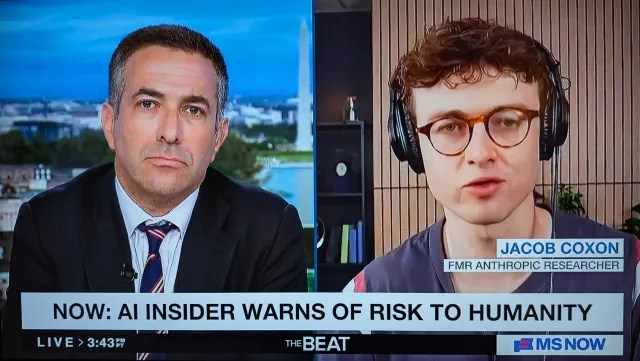
  • They’re covering the wrong AI story

    At least one New York Times journalist — columnist Michelle Goldberg — has at last begun covering the real AI story: not the technology but the technologists and their cult of faux philosophies that lead them to claim Promethean powers to destroy humanity. With their self-fulfilling prophesies of extinction, the AI boys grab the attention of unwary media and policymakers while distracting from the real costs and dangers — and benefits — of the machines they make.

    The calls of doom have been coming from inside the AI house, though Goldberg notes that coverage of them — which I will critique here — is “incomplete, because it doesn’t account for tech leaders’ messianic dreams.” In recent columns, another Times columnist, Georgetown computer science Professor Cal Newport, has begun to explore the AI boys’ insane philosophies. “This exaggerated grimness,” Newport writes, “makes it easy to overlook the more immediate harms created by these technologies…. The time has come to push back.” He says their nihilistic doom trolling has to stop.

    That’s a start. I wish their coverage would go deeper by citing the work of Timnit Gebru and Émile Torres, who catalog the AI cult’s full range of creeds under the acronym TESCREAL — for Transhumanism, Extroprianism, Singularitarianism, Cosmism, Rationalism, Effective Altruism, and Longtermism. Nevermind the specific doctrines. What is worthy of your — and media’s and policymakers’ — attention is that Gebru and Torres show how all these beliefs have their roots in eugenics.

    Goldberg does note that some of their plutocratic adherents quote fascists and Nietzsche. Their goal is to select Übermenschen as they play God, building mythical, supposedly conscious “artificial general intelligence” and “superintelligence;” transforming themselves into man-machines with chips in their heads; using AI to help them live forever; populating Mars and the universe beyond with their progeny; and claiming responsibility for the future, never mind today’s trivial concerns. These überwealthy zealots have the resources — technology, capital, celebrity— and access to power to pursue their fevered, fascist dreams. 

    That is scary shit. But that’s not the scary shit we see covered in news media.

    Instead, news media lap up the AI overlords’ claims of suprahuman power. Right across The Times’ home page from Goldberg and Newport, editors regurgitate whole the doomsters’ pronouncements without bothering with basic reporting, finding other authorities who disagree. Where is bothsidesing when we need it?

    Next, The Times gives unchallenged top-of-homepage prominence to Anthropic CEO Dario Amodei’s call to slow down AI development. 

    What’s wrong with that? you ask. Much, I say. 

    • First, journalists unquestioningly accept as gospel the doomers’ assertions that their creations are capable of such danger, while there are many who believe these claims are just a perverse form of macho marketing meant to demonstrate to investors how very powerful and valuable they are. 
    • Second, this is classic regulatory capture: The “frontier” AI companies call for regulations that they will help lawmakers draft, which will raise the bar for entry into their market for the open and international startup competition we so badly need to challenge them. 
    • Third, the doom scenarios seduce click-hungry media into giving them free publicity and that lures equally dupable politicians — Bernie Sanders and Ted Lieu leading the pack — to call for simplistic, instant solutions: namely unplug AI. Meanwhile, vestigial pro-business Republicans wait for Trump’s inscrutable instructions. See how The Times practically scolds pols for not panicking enough:

    Out of all this arm-waving, either nothing will happen or Anthropic and OpenAI will succeed in blocking new competitors while getting ultrawealthy on their IPOs. And few pay attention to the real perils these technologies raise for the environment, labor, education, and culture. 

    There’s another critical risk: that we all lose the opportunity to develop and put to use these promising, often impressive technologies in medicine, science, carefully considered educational applications, and daily life. Such is always the peril of moral panic. 

    I am not an AI doomer, as you will surmise. Neither am I an AI accelerationist: “Damn the torpedoes, warp speed ahead.” Having studied the history of technologies related to media in my books, I recognize lessons from the past: that disruptive technologies, especially those related to speech, induce panic at first; that before long the public comes to harness new technologies; that the technologists and their power eventually fade into the background; and that, with fits and missteps, society figures out how to make good use of its machines. We did it with movable type, steam, electricity, and electronics, and I believe we’ll get there with the internet. We can figure out AI, too. 

    AI in its many flavors — large language models are just one limited instance — are proving to be amazing. In some areas — analysis of proteins, possibly theoretical math, perhaps medicine discovery, and certainly coding — they are surpassing human ability. But that by no means is any indication of either general or super intelligence. To me, AGI is just another abbreviation for BS. I hold that artificial general intelligence is a wasteful goal fueled by the hubris of the AI boys. As the sane AI pioneer Yann LeCun instructs, machines programmed and trained to perform specific tasks will be faster and cheaper to build — and control — than some fabled, all-powerful überbrain of Oz.

    I believe we should understand what these technologies can and cannot do and cover them accordingly. That is why I cohost two podcasts — AI Inside and Intelligent Machines — to keep up on the news. This is also why I am editing a series for Bloomsbury Academic — Intelligence: AI & Humanity — to invite scholars and writers from the humanities and social sciences to this critical conversation, for they are not heard enough.

    Our first book in the series will be by Rumman Chowdhury, an expert in AI ethics and governance. She will examine our definitions of intelligence over time. What fascinates me about AI’s entry into public discourse and culture is that its presence forces us to reexamine our own ideas of intelligence, creativity, art, learning, trust, labor, the firm, and even — in the case of the AI cultists who claim deific powers — religion. (See this relevant interview with Inken Prohl in Die Zeit: “With AI, we have created a religion.”)

    Coverage of AI in mainstream media is consistently appalling. It too often accepts the PR of the AI boys — whether utopian or dystopian, accelerationist or doomster — without challenge, skepticism, or balance. When the AI boys talk about “AI safety,” journalists rarely exhibit the sophistication to ask whether that is safety in the common sense (environmental, educational, cultural) or in the AI cultists’ overblown sense (doom and extinction). 

    When we hear of episodes of supposed AI agent “swarms” going “rogue” and “hacking” into systems, journalists use scare words to pump up the drama by attributing malign motives to overgrown calculators. Worse, they give us incomplete reporting. They should be asking what the AI companies fail to tell us. In the case of the OpenAI/Hugging Face incident, we need to know what the company told its model to do before we can decide whether it disobeyed those instructions. We also deserve to know how OpenAI let its system go unmonitored for so long. Instead of just accepting the AI CEOs’ versions of the story, we need to demand greater transparency, and that will come only through tougher reporting. 

    Media’s anthropomorphism badly clouds the discussion. Let’s be very clear: AI does not think. It calculates. AI is not conscious or sentient. AI has no sense of meaning. It has no motive and no sense of right or wrong, thus it is not lying or cheating. If it breaks laws or norms, we likely should hold responsible those who programmed or instructed it. 

    We need journalists to do more rigorous and skeptical reporting, to study lessons from the history of technology, and to seek out scholars and experts rather than just taking the word of AI’s CEOs, VCs, and disaffected nerds. The end result is that policymakers and the public are ill-equipped to both use and judge these technologies. 

    And we are using them. According to the Pew Research Center, more than half of Americans aged 18–49 say they interact with AI at least once a day — even as they express growing unease unto antipathy toward the technology and the data centers it runs on. The South Korean government will provide AI access to all citizens for free: universal AI as a right. Artificial intelligence is here to stay; there is no turning it off. We deserve the right to have a voice in how AI is developed, governed, and used. 

    To do that, we require well-informed journalism. This is not that:

    That story offers no credible scenario of extinction. It cites the fabled paper-clip hypothesis of the former Oxford philosopher of Effective Altruism, Nick Bostrom, who contended that a machine told to do nothing but make paper clips could monomaniacally make paper clips of us all. Oxford shut down Bostrom’s Elon-Musk-backed Future of Humanity Institute when old email of his was revealed to have said “Blacks are more stupid than whites” and used the N-word. This is why when discussing the doomster beliefs of AI cultists, the context of eugenics matters. But no mention of that by The Journal

    In that article, while fueling the “freakout” it purports to report on, The Journal waits until ten paragraphs in before labeling extinction prognostication a “fringe opinon.” At least it does that. 

    In this, The Times accepts AI companies’ excuses for why they can’t stop their AI from going rogue, while at the same time accepting their assertions that they can create AI that is “aligned” with human values.

    Well, if you want to worry, here’s the real troubling news: This idea of AI alignment — of guardrails to prevent bad outcomes — is ultimately a fool’s errand, for there is no way for any AI company to predict and prevent every possible malign or accidentally harmful use of AI. That is the reality we need to be discussing. 

    Instead, in that headline, The Washington Post anoints Dario Amodei, Sam Altman, and — gulp — Elon Musk as our “top AI leaders.” No, these are the profoundly self-interested CEOs of three companies selling AI, who are given free space to promote their own agendas without proper context. They share one interest: to pull the ladder up after them and make it more difficult for competition — especially Chinese AI companies and more importantly free and open models — to challenge them. Here, The Post is acting as their agent. 

    Can AI be dangerous? Of course, it can. AI has been used by Russia to guide autonomous drones to kill Ukrainians. Perhaps our greatest fear is that AI could be used to craft bioweapons. But The Times concedes that even with instructions, it’s tough to actually make them. 

    The more frightening truth — one that should be on our minds after this anniversary — is that in the wrong hands, any technology can be used as a weapon … even passenger jetliners. We have met the problem, and it is us. 

    I do see the need for wise policy around AI, including:

    • Demand for full transparency from AI companies. Congress would do well to sic expert staffers (not grandstanding pols) on the AI companies to dig into programmers’ and executives’ negligent behavior in cases such as the OpenAI/Hugging Face incident.
    • Support for open-weight models (the closest AI gets to open-source) to provide competition to OpenAI, Anthropic, and SpaceX. These frontier companies want to frighten policymakers into banning these upstarts, especially those from China. Do not fall for it. 
    • Support for fundamental, frontier AI research in universities to provide more competition to the IPO-mad frontier companies and to have this work done under the ethical, open, and peer-reviewed standards of the academy. We could also use a modern-day Bell Labs with a public mission to do AI research. 
    • Support study of AI and its impact and implications by scholars in the humanities and social sciences. 

    Are there alternatives sources for good coverage of AI? Not many. Here are a few: If you want to dig down into the rathole of the AI boys’ philosophies, there is no better place to start than Gebru and Torres’ TESCREAL work. If you want to follow the big, big money behind this movement and what it is building on college campuses and many acronymed institutes, follow the investigations of researcher Nirit Weiss-Blatt. And for clear — though not simple — explanations of the recent scares over AI, I recommend Newport’s latest podcast, particularly this episode and this. 

    Perhaps journalism’s greatest folly is that it treats the self-serving heads of companies that make AI as experts and even intellectuals, though many of them left college early, which is why their frequent manifestos sound like the work of freeze-dried sophomores. News media need to seek out the expertise of historians, ethicists, anthropologists, sociologists, philosophers, legal scholars, economists, and community leaders to help inform all of us about the opportunities and risks of the age we are entering. 
  • Words matter. Damnit.

    On this week’s Intelligent Machines, we cohosts had a spirited disagreement about Anthropic’s watermarking of text, as required by EU regulation. The company just released more detail about how it will work, and now I’m upset for a different reason than I first thought.

    I’m angry as a writer.

    Anthropic’s method will alter its models’ word choices in a pattern based on a key only it knows, allowing it to detect writing (or editing or translation) by its machine — to an uncertain degree of certainty. The company contends there is no difference in meaning between the otherwise random choices “grey” or “overcast” in, for example, the context of weather. So what’s the issue?

    Thus Anthropic declares words fungible, language random, choice meaningless. Not to me. I try to select my words as carefully as I can for a number of considerations: style, tone, rhythm, avoiding repetition, but most of all meaning. You may quibble with my choices, but they are mine, not yours; that’s what makes my writing mine, to communicate what I wish to communicate. “Gray” and “overcast” are not the same, damnit. That’s the reason we have both of them.

    So I resent Anthropic et al dismissing the value of a writer’s selection of one word over another for the impact that decision has on expression, on impression — occasionally on art.

    We humans might not be able to detect whether the machine or the key is being used. That’s not the point. The selections/changes/alterations made in accordance with the key will affect sense and style on an ever-larger proportion of text entering discourse, and the fact that Anthropic (and the EU) consider this acceptable, unimportant, even trivial has cultural impact on the worth of words. They devalue writing. At the very moment when LLMs commodify writing and writers, this is just another kick to the kidneys for a challenged craft.

    And why is this forensic breadcrumb trail being required? Because of prejudice against the technology: fear unto moral panic. But technological solutions to perceived technological problems have just as many unintended consequences as the problems themselves, often more. The irony is that in a zealous effort to protect the distinctiveness — the sanctity — of human text, the authorities and the technologists deprecate what makes text human.

    In my new book Hot Type, I quote critics such as Friedrich Kittler insisting that typewriters changed how Nietzsche, Hemingway, or Hesse wrote and thought. At the end my book, in what I call a typographical autobiography, I recount how technologies, from typewriter to computer to PostScript, affected my composition and cognition. These technologies affected my methods, but that makes my prose no less human. We should debate what the impact of this next technology, AI, might be on creativity and perception, but we should give that process time. Rushing to regulatory and technological solutions to a problem not yet fully understood is foolish.

    So I’m pissed.

    Here is a sentence from the first page of Hot Type, one I chipped away at innumerable times. These are the choices I made:

    Unlike what we now call machines — computer chips veiled inside sleek and sealed grey boxes with no moving parts, save fans to cool their brains— the Linotype’s innards were left exposed, as if to show off the genius of its works: its troop of idiosyncratically shaped cams, gears, belts, arms, and wheels marching to instructions foreseen more than a century before by their inventor, German-born watchmaker Ottmar Mergenthaler.

    Now let us recast it with perfectly acceptable synonyms, as Anthropic’s detection key might, in composition, editing, or translation. In fact, I asked Claude to do just that. Here is what it delivered as “a synonym-substituted version, keeping the structure and meaning intact.”

    Contrary to what we presently term machines — microprocessors concealed within polished and enclosed grey containers with no moving components, except fans to cool their circuitry — the Linotype’s mechanisms were left visible, as if to display the ingenuity of its craftsmanship: its brigade of distinctively shaped cams, gears, belts, arms, and wheels progressing to directives anticipated more than a century earlier by their creator, German-born horologist Ottmar Mergenthaler.

    You may find Claude’s just fine. I find that it misses the wonder, cadence, and anachronism I tried to convey. Anthropic’s engineers and the EU’s regulators may ask, what’s the prob? Much, I say.

  • To redefine progress

    In an urgent and provocative essay in Die Zeit, journalist Georg Diez calls for a redefinition of progress in the time of AI. Taking lessons from the genesis of progressivism — a response to the Industrial Revolution and the (first) Gilded Age — we cannot now surrender the power to decide society’s future to present technologists.

    “A notion of progress that inspires society and supplies it with new energy, both intellectually and emotionally, must therefore be comprehensive, systemically conceived, and grand,” Diez writes (with apologies for my translation). “It must be formulated collaboratively by politics, business, science, and civil society, and it must answer the question of what technology we want — and under what terms.”

    I write this just as the ultimate profanity of capitalism’s coupling with technology — Elon Musk’s SpaceX — comes to the market at the absurd and obscene valuation of $2.11 trillion. Thus he, the world’s richest man, is funded and empowered to define progress according to his insanities: colonizing Mars and beyond with the seed of his loins and fevered dreams.

    We cannot let this stand.

    Diez asserts that “the situation is schizophrenic. On the one side, large swathes of Western societies seem to have lost faith that the future will be better. On the other side, a techno-optimist progress cult has established itself in Silicon Valley, promising incredible prosperity and undreamed-of convenience for all, because artificial intelligence will enable a giant leap in productivity.”

    These extreme worldviews preempt reasoned public discourse over progress’ direction. “What does it mean,” Diez asks, “especially for a society that is experiencing the end of its old certainties, without having yet found new ones?” He says that in the past, progress equaled “technology plus values” and society was able to negotiate “how the advantages and gains of technological progress could and should be distributed.” I’m not so sure we’ve done such a good job of it of late. Still, he is right to add that today, we must recognize changed circumstances: the decline of the West in the face of advances by China, India, and Indonesia. “This makes it all the more urgent to formulate a concept of progress for the 21st Century.”

    For this, Diez turns to the 19th Century, to the Industrial Revolution and the impact of the era’s coal, steel, and railway barons. “Driven by the first Industrial Revolution, a technological and economic transformation produced both mass proletarian misery and stark wealth.” Resistance to both gave birth to the politics of progress.

    I write about a slice of this history in my upcoming book Hot Type, tracking the response of America’s oldest national labor organization, the International Typographical Union (ITU), as it was faced with the imminent arrival of the typesetting machine, the Linotype, in 1886. Having learned from the failures of the Luddites and Captain Swift against mechanical feudalism, as against the eventual perseverance of pressmen at the advent of steam, the union did not fight technology but instead insisted on controlling it and benefiting from its efficiencies, while leading the national movement for the eight-hour day and safer working conditions. The ITU flourished in pay and power until faced with a next technology it could not control (for that story, you’ll have to order the book).

    Such was a spirit of “militant optimism,” in Diez’ words. “Progress, as was clear then and should be clear now, can only be achieved with technology, not against it.” The task is to balance certainly legitimate criticism of technology with a clear vision for how its fruits might benefit society.

    The difference today, Diez says, citing VC Vinod Khosla, is that AI will shift the distribution of power and wealth to capital, away from labor. In response, Khosla proposes exempting the lowest-paid workers from income tax, making up the difference taxing capital gains; various AI boys have touted a universal guaranteed income. But note well that in his encyclical, Pope Leo XIV rejected the latter, for “work is not simply an instrument; it expresses and enhances the dignity of our lives.” Redistribution of wealth is imperative — see: the trillionaire — and should occur through taxation to support social programs.

    A new concept of progress, Diez argues, must be conceived from the perspective of humanity. Amen. This is why I work on new educational programs that emphasize the humanities in the time of AI. And this is what inspired me to edit a new book series called Intelligence: AI & Humanity, to open the discussion to writers from the humanities and social sciences.

    “Artificial intelligence challenges us to redefine who we want to be, both as individuals and as a community,” Diez observes. “It provokes questions such as: What constitutes quality of life for us?… A new concept of progress should be shaped neither by technophobia and austerity nor by the promise of exponential growth.”

    Today, it has been left to the technologists — to the wrong sorts of technologists, often sophomoric dropouts: the Musks, Altmans, Thiels, Karps, Zuckerbergs, Bezoses— to impose their ideas of progress on the rest of us. There is no better example lately than Anthropic positioning itself as savior of humankind, touting its AI “constitution,” while building what it deemed to be AI so dangerous it could not be revealed to mere citizens — prompting Trump to ban it to foreigners, resulting in turning it off for all. This is not progress. 

    No, progress must be the result of open public discourse and political discernment and negotiation. In the 19th Century, trade unions fought for their share of newly created wealth while social movements fought for justice: abolition and suffrage. Today, the debate over the limits and fruits of technology must be driven by new leaders representing the rest of the world outside Silicon Valley.

    This is not to say that technologists should not be parties to the discussion. They should take part in the conversation based on the merit of their work and ideas, not their market caps. But as I have learned in researching and writing my histories of technology and media — of print, magazines, the mechanization and industrialization of mass media, and even the internet — one clear lesson I have taken away is that once a technology becomes commonplace and is put to use by others, the technologists inevitably fade into the background. They hold their power of as priests only temporarily, so long as their mysteries may prevail. This fall from the heights, I predict, will be their fate much faster in the case of AI, because it is the tool made so simple anyone can use it, and because so many of its masters are so deservedly disliked.

    And that is why I share Diez’ arguments with you, for I agree that it is vital that we — workers, students, academics, creators, citizens — take charge of this new technology and of the discussion about its effects. We must define progress not in terms of the AI boys’ bullshit — AGI (artificial general intelligence), ASI (artificial superintelligence), the end of labor, the colonization of unlivable Mars, a world post-humans — but in human terms: dignified work; shared wealth; the benefits of science, art, and creativity; education for all; equity and justice; and community. It is our future we need to map, a task far too vital to leave to programmers and capitalists.

  • AI has a communication problem

    Artificial Intelligence, though more than a half-century old as a technology, has occupied front-of-mind cultural consciousness for only a few years, since ChatGPT. Yet AI is already profoundly disliked and distrusted in both media meme and apparently in public opinion.

    The techlash against the internet and then social media took at least two decades to ferment, while the AI backlash feels more like an instant reflex. Fifty-seven percent of Americans say AI’s risks outweigh its benefits, making it less popular even than ICE! Half fret about its ill effects on creativity, meaningful relationships, news, and elections. In rare consensus, Republicans and Democrats alike are NIMBYing data centers across the nation. A German digital conference offers a workshop in poisoning AI data. The FT declares “a new Luddite movement.” And commencement speakers daring to utter the letters A and I are sure to be booed.

    It is, however, difficult to discern true public opinion from performative public opinion polls, as polls reflect media’s self-fulfilled prophesies. In reality, even as views of AI sour, the public’s use of the tools soars: more than half now employ it to, for example, research topics of interest, a thirty-eight percent increase in a year.

    Who or what is to blame for AI’s bad rep? In The Web We Weave, I assert that the problem is less the AI than certain AI boys who make up the newest oligopoly. Look no farther than the now-finished OpenAI trial: technology’s Godzilla v. Mothra, unlikeable Musk v. unreliable Altman. Now add the creepy dramatis potens of West Coast billionaires (before they all dodge taxes and move to Miami) — Thiel, Andreessen, Karp, Zuck, Ellison, Bezos — plus the moral entrepreneurs trying to pump and exploit technofear (Tristan Harris, Eliezer Yudkowsky, Nick Bostrom, William MacAskill, Dustin Moskovitz) — and it’s no wonder people profess dislike for their algorithmic progeny. And it doesn’t help relations when they dismiss us humans as “meat computers.”

    Yet AI is amazing, constantly wowing even the skeptical with its feats and tricks. Every week on the two (yes, two) AI podcasts I co-host — AI Inside and Intelligent Machines — I both both marvel at and fault the capabilities and implications of this new and powerful technology. Because I am also editing a new Bloomsbury book series about AI and humanity, I am constantly trying to get my head around how AI works, what it can and cannot do, what its benefits and perils might be, and what its creation, use, and product says about us as humans.

    To learn more about AI, I do not turn to the boys above. I turn to critics, yes; there are many. But to understand AI’s innards I find it best to look to a few of the field’s master communicators and teachers, notably Jensen Huang, founder and CEO of Nvidia, and Yann LeCun, NYU professor and founder of the new AMI Labs. Unlike AI’s blind proselytizers, they do not market superheated claims of superintelligence a day away, nor in the doomsters’ dire warnings of AI-combusted human extinction.

    Below are videos of each; dip in and you will learn more about AI.

    Each man has clear economic interest in the success of AI; Huang leads the world’s largest corporation by market valuation and LeCun has raised $1 billion to envision a next generation of AI, past LLMs. Each tries to present realistic and credible perspectives on the present and near-future state of the art and technic of AI. Each calls bullshit on others when warranted. The most important reason I watch these two is because in their public appearances, each educates, addressing multilayered constituencies: customers, partners, investors, employees, policymakers, journalists, students, and the public.

    I am fascinated by their presentation skills because, as a journalist, we’re supposed to be communicators. They also interest me because I am a visiting professor at Stony Brook University, where I work with the Alan Alda Center for Communicating Science (see this Wall Street Journal report explaining their work). I am trying to dissect these technologists’ skills at communication to see how others might communicate technology more effectively and honestly for more informed and necessary public discourse.

    All this is why I became a loyal connoisseur of Huang’s keynotes. They are bravura solo performances: two hours or longer on stage before appreciative industry audiences, presenting new product announcements while holding up and showing off chips and boards that are, in truth, as enigmatic in their appearance and ways as an obelisk to a 2001 ape. All the while, he explains Nvidia’s accomplishments and position in the field and the market. It shouldn’t be mesmerizing, but to me, it is.

    As a student of Huang’s addresses, I soon learned that in each, he has a new lesson to impart, in addition to promoting a new chip or software or deal. The first talk that really hooked me was his Nvidia developers’ conference keynote of March, 2024. In it, he helped me begin to grasp the scale of AI technology.

    For a next book project on the birth and death of mass media, I’ve been reading up on the invention of the the triode vacuum tube and amplifier in 1906, which enabled radio as well as the loudspeaker. Four decades later, the tube was superseded by the transistor and eventually, in 1958, the chip. (BTW, if you’re interested in that history, I recommend Conquering the Electron: The Geniuses, Visionaries, Egomaniacs, and Scoundrels Who Built Our Electronic Age by Derek Cheung and Eric Brach.)

    On stage in 2024, Huang announces a new, bigger chip — a GPU or graphics processing unit named Blackwell — that holds 208 *billion* transistors shunting electrons and with them logic and knowledge. Then AI-generated animation on the giant screen behind him multiplies those chips in racks and in turn multiplies racks—each component clicking into place with satisfying, synthetic clunks — to add up to an entire data center populated with 32,000 GPUs — thus six quadrillion transistors. Mind blown. Here is that moment, beginning at minute 26:

    Huang’s lesson in that keynote is the value of scale, for the wonders of generative AI have been made possible not only by Google’s theoretical breakthrough in 2017 but by the massive computing power (“compute” in their abbreviated argot) powered by Nvidia’s processors (and megawatts).

    In that and subsequent keynotes, Huang imparts more lessons. He lectures on the economy of tokens — generative AI’s numerical abstractions of words, for instance, which LLMs create to calculate their predictions. He explains the need to manufacture tokens at ever-high speed and ever-lower cost in the data centers he characterizes as factories (of tokens). He declares the end of Moore’s Law, which since the 1960s predicted the rate of growth of the number of transistors on a chip: a 100x increase in computing power every ten years. Huang touts instead what he calls accelerated computing, boasting that Nvidia’s chips and its CUDA software platform have multiplied computing power 1,000x in just eight years.

    I am transfixed as he animates the idea of digital twins: how AI, trained on a massive number of possible scenarios, computes every alternative that could next face a factory robot or an autonomous car. (I am so taken with the idea of the digital twin that I keep imaging there’s a novel in it: the machine that predicts the consequences of every choice we face.) It is clear from what he shows off that Huang believes robotics represents the next industrial explosion.

    Last fall, Huang gave a keynote to Nvidia’s Washington conference, in which he deftly thanks the Trump administration and Department of Energy for helping his industry’s cause, without sacrificing a gold bar or too much dignity. Here he wants to teach policymakers about the needs of the industry that is holding up our economy even with tariffs and war.

    It turns out Huang is not just a presenter but also an effective debater. See him here making his case for allowing sales to China as a benefit to American industry, in this podcast with Dwarkesh Patel.

    Huang took a company that began making chips to power computer — and particularly game — graphics and positioned it to be at the heart of the AI explosion, its market valuation exceeding $5 trillion. If anything would give a CEO license to make outlandish claims and predictions, that would. But Huang doesn’t talk about flying to Mars. Instead, he tries to explain the value of what is being built. To his DC audience, he asserts that “AI is not a tool. AI is work. AI is work that can use tools.” I think that is new.

    If you’re hooked now like me, watch his latest California keynote, in which he talks about the agentic age suddenly upon us.

    Yann LeCun is a different kind of communicator. He is first and foremost a researcher and educator, secondarily now an entrepreneur. I have tried to read and watch his presentations to NYU students and I must confess that not too long in I regret my success at dodging higher mathematics courses … in high school. Yet LeCun is also an effective communicator even to humanities dolts like me. Here he is a year ago patiently explaining his perspective on AI to Jason Howell and me on our podcast, AI Inside:

    Getting to speak with LeCun is a privilege, for he is one of AI’s godfathers (though, as he says, living in New Jersey, he’d prefer a different honorific). Among his many accomplishments and recognitions, he has received— alongside Yoshua Bengio and Geoffrey Hinton — the 2018 Turing Award for work on deep learning.

    What I value most about listening to LeCun is that he does not suffer bullshit, whether that is claims of imminent superintelligence or prognostication of inevitable disaster for jobs or humankind itself. As a clear-eyed academic, he never shies away from debate or disagreement rooted in research.

    Lately, LeCun has developed a reputation as a contrarian regarding LLMs, though his is a view he has long held. While the putative Wunderkinder of the infant industry — the leaders of OpenAI, Anthropic, et al — insist that all they need is ever-more compute to reach their Everest of so-called artificial superintelligence (any day now), LeCun argues persuasively — to me — that LLMs, though impressive and useful, are essentially a dead-end, for they traffic in text, which represents a finite sphere of representation of life.

    LeCun has argued instead for devising world models to teach the machine the sort of experiential constraints a toddler or a kitten can learn: about gravity acting upon a ball falling off a table, where it persists, though now unseen. If one wants to build AI for the real world, one must conquer Moravec’s paradox: that “it is comparatively easy to make computers exhibit adult level performance on intelligence tests or playing checkers, and difficult or impossible to give them the skills of a one-year-old when it comes to perception and mobility.” This from LeCun’s presentation:

    For an effective starter course in LeCun’s worldview, I highly recommend watching him debate LLMs vs. world models with Google DeepMind’s Adam Brown, in this Scientific Controversies discussion moderated by Janna Levin at Brooklyn’s Pioneer Works.

    In 2022, LeCun published a paper proposing a “path towards autonomous machine intelligence… enabling them to reason, predict, and plan at multiple time horizons… [as] intelligent agents.” Or as he sums up the goal: to work with common sense. Here, too, is a 117-slide presentation he made to NYU students explaining his ideas. I’ll admit I am soon lost in the formulae, though the lecture isn’t meant for the likes of me. This is how he instructs students, fellow computer scientists, competitors — and now funders, as LeCun has founded AMI Labs to build advanced machine intelligence on his model for the future, which he calls Joint-Embedding Predictive Architecture (JEPA).

    I will do a bad job summarizing his proposal; that’s why I offer the videos below, for they are far more effective at communicating the ideas than I am. But in short, LeCun describes using photos and videos from real life to train models — or to train them to train themselves — so they understand representations of the world and consequences of actions, rather than trying to predict every pixel or merely ape human teachers. That is, his method can discern, say, a ball as a ball and predict the result of action on it. JEPA does this by encoding an original image alongside a corrupted version so the system can, in LeCun’s words, “predict the representation of the original image from the representation of the corrupted one.”

    The implications are many. LeCun says JEPA will lead to models that can undertake a wider variety of tasks with less training, for they do not need to be taught every possible permutation of a situation. These models are also more efficient, for they concentrate attention on particular change — a ball thrown — rather than every change — countless leaves rustling in the scene — and need not predict the progress of every pixel.

    He says these systems will be capable of thinking. Unlike LLMs, they won’t — at first — listen or talk, which might make them less flashy than ChatGPT or Claude: fewer neat parlor tricks to convince journalists that they’re in love. But LeCun convinces me that being able to understand the world and its constraints and to operate in it is table stakes for the next paradigm of AI. This is what it will take for AI to deliver value to industry, including in robotics, industrial control, and health care. He also is persuasive when he argues that his framework will be safer than LLMs, for rather than producing the general machines that their creators claim can do everything better than all of us — as the AI boys insist — JEPA will produce specialized agents with bounded tasks, each built to “anticipate the consequences of its own actions.” JEPA won’t take over the world. LLMs, LeCun says, can be dangerous; haven’t we learned that?

    He says he is building “AI for the real world” — that is, world models — for as it turns out, “reality is way more complicated than language.”

    If you want to dig into LeCun’s view of AI’s future (and understand why, on my podcasts, I regularly declare myself on Team Yann), here is a series of videos, stepping up in complexity. The first is a casual conversation with Jacob Effron:

    Next is a more technical and deeper explanation of JEPA from Welch Labs. I had to watch a few times to understand some (not all) of it. It is an excellent primer (and here is part 2.

    And here is a video in which LeCun does not speak. It is a victory lap for his vision of building reasoning: building a system that can solve any problem given a set of constraints rather than just generating a next token (or writing a brute-force, old-fashioned program). The host, Ksenia Se of Turing Post, extols JEPA (but notes that it is “quite a tragic name for a beautiful idea”).

    Note the title of the video: “Yann was right.” To which Yann added when he shared it on his socials, “But of course I was.” (That’s another reason I like both these men; they have a sense of humor that is not evident in the other AI boys.)

    What I most appreciate about LeCun is the humility inherent in a scientist’s worldview. The generative AI companies display the hubris of believing they are almost done building the general machine that can take over every human task, or destroy us in the process. LeCun is, instead, on a scientific journey of discovery and iteration. He knows there is yet much work to be done.

    I also greatly respect his support for open source. When he was at Meta, heading a lab and then advising on AI, he fought for it to release its Llama models openly. This is how academics and scholars work: inviting challenges, teaching others, and collaborating and learning together.

    AI is here to stay. There is no wishing or protesting or regulating or boycotting it away. We must not surrender its future and ours to a few oligarchic billionaires. The only way we can have a voice in its direction is to understand it better. And the only way we can understand it is by listening critically to the people actually building it. That is why I want to see technologists better able to communicate about technology — so we can debate it and its effects. That’s why I’m studying these two masters of communication.

    LeCun in class at NYU
  • Pope Leo and human intelligence

    Pope Leo XIV’s encyclical, Magnifca Humanitas, is a learned, wise, eloquent, and useful document that is only partly about artificial intelligence. Its lessons should be helpful to many modern institutions — including my own, journalism.

    For those expecting the Pontiff to declare holy war on AI and Silicon Valley, they will be disappointed. Those who wish to claim AI as a new religion will be similarly bereft. Apart from a few timely and almost obligatory references to children and screens, this is not a document influenced by the moral entrepreneurs seeking to inflate and exploit fears of technology. Though it calls for regulation, it does not attempt to prescribe statutes. This is a document intended for generations, to inform our discourse as we manage secular upheaval. I will quote liberally, though I recommend reading it in full. 

    Leo opens with an apt Biblical metaphor, contrasting the Tower of Babel with the rebuilding of the walls of Jerusalem. Babel was a doomed project of immense hubris, constructing a tower to the heavens. “It was an impressive feat: a single language, a single technology, a single direction,” he writes. “However, the project concealed a profound danger: It was a project conceived without reference to God, supported by uniformity that eliminated diversity and that chose homogenization over communion.” That does sound familiar these days. 

    The rebuilding in Jerusalem, on the other hand, was undertaken following prayer and permission with the people of the city collaborating through acts of listening and communion. Leo’s encyclical is a profound testament to the value of community — a lesson I try to teach to students of media. 

    Leo goes to pains to make clear that “technology should not be considered, in itself, as a force antagonistic to humanity.” Quoting Pope Benedict XVI, he continues, “On the contrary, it has formed part of our history since the beginning as ‘a profoundly human reality, linked to the autonomy and freedom of man.’” He continues:

    Technology has the power to heal, connect, educate and protect our common home; but it can also divide, exclude and generate new forms of injustice. In the abstract, technology in and of itself is not a solution to humanity’s problems, just as it is not inherently evil. In practice, however, technology is never neutral, because it takes on the characteristics of those who devise, finance, regulate and use it. Therefore, the primary choice is not between a “yes” or “no” to technology, but rather between constructing Babel or rebuilding Jerusalem; between a power that claims to dominate the heavens and a people who work together in the presence of God to rebuild the walls of fraternal coexistence.

    He calls for technological innovations, including AI, to “be evaluated by asking a crucial question: Do they truly help individuals and peoples to become more humane and fraternal, while respecting our common home and future generations?”

    Leo warns of unprecedented control by private, transnational corporations that monopolize “expertise, data, and decision-making authority;” and of the “risk of being misled by deceitful goals, such as the prospect of a technology that promises to free us from all weakness;” and of the danger that “persons end up being reduced to a means of achieving results, a resource to be used and exploited, and are no longer recognized as a proper end in themselves who should never be instrumentalized.” He prescribes the means to instead claim agency and shared responsibility to build for the common good, “so that humanity will never lose its beauty.”

    The civilization of love will not arise from a single or spectacular gesture, but from the sum total of small and steadfast acts of fidelity that serve as a bulwark against dehumanization. For this reason, it is worthwhile pausing to reflect on some aspects of how we, each in our own way, can cooperate in building the civilization of love. Without presuming to exhaust this theme, I would like to propose five paths toward daily and public responsibility: the need to disarm words, building peace through justice, adopting the perspective of victims, cultivating a healthy realism and reviving dialogue and multilateralism.

    Generously quoting his predecessors to trace the history of the Social Doctrine of the Church — from Rerum Novarum through the Second Vatican Council to Pope Francis — Leo lays his foundation with sets of principles that guide the Church as a model for other institutions: “listening, dialogue, and service … the dignity of every person, the cohesion of communities, and the good of all … the contributions of philosophy and of the human and social sciences … the importance of listening to scientific research and of encouraging a serious and honest debate among experts while welcoming a diversity of opinions … justice … Understanding that the truth is a gift to be shared, not a possession to be monopolized.”

    As a journalist, that last observation on truth struck me. Journalists like to think they traffic in truth and — especially now in fights with AI companies over copyright — publishers claim ownership of it. Shouldn’t news organizations follow the same advice Leo gives to technology companies: that “truth is a gift to be shared, not a possession to be monopolized…. In this way, the truth of the Gospel is not imposed from above, but grows over time within the concrete interweaving of lives, communities, and cultures. This is not a truth that fears diversity, but instead welcomes and guides it. It does not eliminate conflicts, but transforms them, reuniting that which history tends to scatter.” Truth is too precious to hoard or sell.

    In discussing the power of technology companies, I believe Leo is also, if unwittingly, describing the exclusionary power that mass media have wielded over the last century: 

    These entities effectively set the conditions for access, determine the rules of visibility and shape the very possibilities for participation. When such power is concentrated in the hands of a few, it tends to become opaque and evade public oversight, increasing the risk of distorted forms of development that give rise to new dependencies, exclusions, manipulations and inequalities.

    It is not until halfway into his encyclical that Leo directly addresses artificial intelligence and “the danger of humanity becoming a victim of its own achievements,” saying he does not intend to offer a comprehensive treatment of the technic but wishes to “ensure that it will always be human intelligence, with its conscience and freedom, that guides technical innovations and responsibly determines their use and limits.” 

    Nor does Leo try to define artificial intelligence, though by examining — and defending — human intelligence, he defines what it is not. 

    [W]e must avoid the misconception of equating this type of “intelligence” with that of human beings. These systems merely imitate certain functions of human intelligence. In doing so, they often surpass human intelligence in speed and computational capacity, offering tangible benefits across many fields. Yet this power remains entirely tied to data processing. So-called artificial intelligences do not undergo experiences, do not possess a body, do not feel joy or pain, do not mature through relationships and do not know from within what love, work, friendship or responsibility mean. Nor do they have a moral conscience, since they do not judge good and evil, grasp the ultimate meaning of situations, or bear responsibility for consequences. They may imitate language, behavior and analytical skills, or even simulate empathy and understanding, but they do not understand what they produce, for they lack the affective, relational and spiritual perspective through which human beings grow in wisdom. Even when these tools are described as capable of “learning,” their way of doing so is different from that of a human person. It is not the experience of those who allow themselves to be shaped by life and grow over time through choices, mistakes, forgiveness and fidelity. Rather, it is a form of statistical adaptation based on data and feedback, which can be very effective, but does not imply inner growth.

    In his rejection of the claims of machine sentience, consciousness, or — God save us — life, I am on Team Leo: this is impossible, technically and definitionally. I am grateful to see the Pontiff directly reject transhumanism (“the enhancement of human beings through technologies — such as biomedicine, body engineering, devices and algorithms”) and posthumanism (which “challenges anthropocentrism and envisions a hybridization of human beings, machines and the environment, even anticipating a threshold where humanity surpasses itself in a new evolutionary stage”). In short: playing God. These are the quasireligious beliefs of some AI cultists, bundled into the acronym #TESCREAL (Google it). Leo further also calls out media for credulously covering these claims.

    These perspectives form the ideological background present in some centers of technological power and occupy the collective imagination in a simplified form, especially in the media and on social networks. They tend to foster enthusiasm for new technologies through a futuristic vision of an “enhanced human being” or “human-machine hybrid.”

    Therein hangs the odious stink of eugenics.

    If the human being is treated as something to be perfected or surpassed, it becomes easier to accept that some lives are less useful, less desirable or less worthy. In the name of progress, “necessary sacrifices” may begin to be justified, placing the burden on the most vulnerable in pursuit of a supposed optimization of the species. In this regard, the aforementioned warning of Saint Paul VI retains great foresight: indeed, scientific and technological advances, when detached from moral and social progress, end up turning against humanity. For this reason, a clear distinction must be made. It is one thing to integrate technology within a human-centered, relational vision; it is quite another to be guided by an outlook that devalues human limits and promises a purely technical form of “salvation.”

    So it is well and good — necessary, actually — that Leo examines the nature of human life and collective humanity in the context of AI.

    When we embrace the possibility of transcending ourselves through God’s grace, we do not deny our nature, nor do we become less human. On the contrary, as Pope Francis explained, “We become fully human when we become more than human, when we let God bring us beyond ourselves in order to attain the fullest truth of our being.” Herein lies the radical departure from Promethean dreams: what saves humanity is not enhanced self-sufficiency, but a relationship that liberates, a communion that transforms. In this light, a technology that merely classifies and optimizes what already exists can, however unintentionally, become an obstacle to change and growth. For an algorithm, an error is a flaw to be corrected; for a person, however, an error can be a catalyst for profound change. A person’s future is not calculable, but depends on one’s freedom — elevated by the inexhaustible grace of God — and on the relationships cultivated.

    In his exploration of artificial intelligence and its effects, Leo returns to the subject of truth in the context of democracy, noting that disinformation has been around long before the accelerating technology of AI. “Truthful information,” he observes, “does not arise from centralized or automated control.” Again, the lesson is not just for AI but for mass media, which has been centralized and controlled since its mechanization and industrialization at the turn of the prior century. (That is the subject of my upcoming book, Hot Type.)

    Then Leo adds an observation that leaves me applauding: that truth in public discourse “is deeply relational, built through bonds of trust and shared practices, as well as an honest exchange with others and with the world. Only the shared pursuit of the veracity of facts, perceived as a common good, can provide a solid foundation for just communication.” 

    In my research for my prior book, The Web We Weave, I researched what people did to ferret out truth before the invented institutions of editing and publishing imbued the technology of print with authority. I came across the concept of FAMA — Latin for “it is said,” the root of the words “fame” and “infamy” — a social system of maintaining one’s reputation for credibility as source, subject, object, or teller of information. Our print institutions turn out to be inadequate to the scale of speech today, so out out of necessity, we are are left to return to such a system of social responsibility. We as a society are out of practice with judging truth on our own, having been told it could be handed to us by media that claimed ownership. That was always an abdication of responsibility. “Indeed, dialogue is an ordinary part of human life,” says Leo. “It involves acquiring an attitude that seeks to forge bonds of fraternity built on listening, an open demeanor, making time for each other and even wasting time together.”

    I am gratified that Leo cites Arendt on the subject. “Indifference to the truth leads, slowly but surely, to a descent into totalitarianism. As the philosopher Hannah Arendt wrote, the ideal subjects of such regimes are not so much those who are ideologically convinced, but rather ‘people for whom the distinction between fact and fiction (i.e., the reality of experience) and the distinction between true and false (i.e., the standards of thought) no longer exist.’” He adds: “When people come to believe that nothing is genuinely true and that principles are hollow words, then the fuse in their hearts is lit for new eruptions of intolerance and aggression.”

    I am also tickled to hear Leo sounding positively McLuhanesque when he discusses “an ecology of communication,” recognizing, in terms James Carey might approve of, that communication “is not only the transmission of information, but it is also the creation of a culture.” This is the premise of my book, The Gutenberg Parenthesis: that before and after the age of print — both in the time of FAMA and in the age of the internet — public discourse and public opinion are emergent from the public, rather than imposed upon a mythical, monolithic mass. How we use these tools and powers again is up to us. 

    Leo has much to say about the value of education and schools in the age of AI: “We must learn, then, how to exercise restraint in the use of AI and to protect our young people from the promise of the perfect machine, from that subtle temptation which renders human thought seemingly superfluous precisely when it is most needed.”

    He has much to say about technology in the economy, decrying “finance for its own sake” and the metric of GDP, which neglects “aspects essential to the overall wellbeing of people and the environment. He cites Pope Francis, who denounced

    the growing dominance of a technocratic paradigm in our globalized world: the tendency to let the logic of efficiency, control and profit alone shape personal, social and economic decisions. This makes it clear that technology is not simply a tool. When it becomes the standard by which everything is judged, it begins to dictate what matters and what can be discarded, reducing creation to an object of exploitation and human beings to mere cogs in a system driven toward ever greater efficiency.

    And he worries about the dignity of work — including that which goes into the making of AI — and makes clear that the Church has long supported labor and unions. 

    Today, the convergence of automation, robotics and AI is rapidly transforming the very structure of work. It is said that this will bring great improvements for everyone. In reality, however, the “new ways” of working are not necessarily better, for “while AI promises to boost productivity by taking over mundane tasks, it frequently forces workers to adapt to the speed and demands of machines, rather than machines being designed to support those who work. As a result, contrary to the advertised benefits of AI, current approaches to technology can paradoxically de-skill workers, subject them to automated surveillance and relegate them to rigid and repetitive tasks. The need to keep up with the pace of technology can erode workers’ sense of agency and stifle the innovative abilities they are expected to bring to their work.” Precisely in order to avoid this drift, it is necessary to design systems that are centered on the human person and not solely on performance.

    Some in AI-Land argue the solution to a de-skilled and unemployed workforce is universal guaranteed income. Leo would seem to disagree. 

    For these reasons, work is not simply an instrument; it expresses and enhances the dignity of our lives. It is a requirement of the human condition, a normal path toward maturity, development and personal fulfilment. In this regard, financial assistance to the poor may at times be necessary in emergencies, but it cannot become the sole response, since the goal is to enable each person to live with dignity through his or her own work.

    The Vatican invited a co-founder of Anthropic to speak alongside the Pope, On the one hand, Anthropic presents itself as the good AI company, its leaders standing on conscience to prevent their tools being used as autonomous weapons of death. It promises that its models’ behavior will be aligned with its “constitution.” Then again, I have long argued that to believe an AI model can be imbued with ethics, let alone guardrails, is a fool’s errand, for — just as with Gutenberg’s type — there is no way to anticipate and prevent every possible malign use of a technology. It was, after all, movable type that opened the door — did not cause but made possible — the Reformation. Ethics cannot be baked into a machine; ethics must inform our use of it. Leo writes:

    It is not enough to invoke ethics in the abstract; robust legal frameworks, independent oversight, informed users and a political system that does not abdicate its responsibility are required. Otherwise, change will be governed only by technocratic thinking and presented as necessary and inevitable, ultimately imposing rules shaped by those who control data, infrastructure and computing power.
    We cannot be satisfied with merely calling for the moralization of machines — the so-called “alignment” of AI with human values — without also having the courage to insist on a further condition: the possibility of openly discussing the ethical frameworks involved and subjecting them to shared standards of social justice. Otherwise, those who control AI will impose their own moral vision, which will become the invisible infrastructure of these systems. A more moral AI is not enough if that morality is determined by a few. 

    The impossibility of technology’s moral autonomy is particularly potent given the state of technology and war. 

    Sometimes there is talk of “artificial moral agents,” as if machines were able to distinguish between right and wrong with greater consistency than a human being. Yet moral judgment cannot be reduced to calculation, for it involves conscience, personal responsibility and the recognition of the other as a person. Therefore, it is not permissible to entrust lethal or otherwise irreversible decisions to artificial systems. No algorithm can make war morally acceptable. AI does not remove the intrinsic inhumanity of conflict; indeed it can only bring about conflict more quickly and render it more impersonal, lowering the threshold for resorting to violence, transforming defense into threat prediction and thus reducing victims to data. In this way, it will accustom us to the idea that violence is inevitable and needs only to be optimized. 

    In the end, the encyclical is a meditation on technology, power, and justice.

    Indeed, entrusting an algorithm in practice with the power to select who is worthy or not, without anyone bearing responsibility for that judgment, is to hand over the task of redefining the boundaries of human possibilities….
    From this follows a simple but compelling consequence: we cannot consider AI to be morally neutral. In reality, every technical tool embodies choices and priorities through what it measures, ignores and optimizes, and how it classifies people and situations. If a system is designed or used in a way that treats some lives as less worthy, or excludes them without the possibility of appeal, then it is not merely a tool “to be used well,” since it has already introduced criteria that contradict the inalienable dignity of the human person. For this reason, ethical discernment cannot be limited to asking whether we are using a system for good or bad purposes; it must also examine how that system is designed and what vision of the human person and society is embedded in the data and models that guide it. 
    For AI to respect human dignity and truly serve the common good, responsibility must be clearly defined at every stage: from those who design and develop these systems to those who use them and rely on them for concrete decisions.

    Yes. Responsibility for AI rests not only with its creators but also with every user, with all of us. It is critical to end noting that Leo’s encyclical has much positive and constructive instruction on ways to responsibly use and manage the technologies of the age with transparency, accountability, choice, and justice. 

    At this point, however, a subtle temptation may emerge, namely the thought that the problems are too big and we are too small, and that our choices, therefore, cannot make a difference. This is a polite form of resignation, often disguised as realism. Certainly, not everyone has the same power to make a difference. There are those who govern, make investment decisions, lead institutions, conduct research, educate, produce or provide information, and then there are those who only seem to live their daily lives. Yet, no one is without responsibility. We all have our own areas for action, and it is precisely there — and nowhere else — that we must choose whether to fuel the mentality of force (even if only through indifference, cynicism, lies or hatred), or to preserve the mindset of peace (with truth, moderation, closeness and care).

    Amen.