antechapel display – winter Vacation 2017
A selection of images from the Michaelmas exhibition of medieval manuscripts at St Cross is now on public view in the antechapel in Broad Street:


Balliol ARCH C. 1. 9 #mss2017
Guest post by Sian Witherden
Balliol College Library has one copy of the Rudimentum Novitiorum (‘Handbook for Novices’), an encyclopaedia of world history whose author remains anonymous. This book was printed on paper in Lübeck by Lucas Brandis on the 5th of August 1475. The volume is quite large at 380 x 290 mm, and it is still in the original stamped leather binding. Other copies from the same print run are held in libraries across the globe, including Berlin, Copenhagen, Moscow, Paris, Prague, Princeton, Vienna, and Zürich. Each of these copies has its own unique history, but what is perhaps most remarkable about the Balliol copy is the way it has been dismembered by a later reader (or perhaps readers). Many of the woodcut prints in this volume have been cut out, though there seems to be no obvious reason why certain images were selected for excision and not others. Perhaps the reader wanted to keep these particular ones for a scrapbook or put them to use in another volume. Unfortunately, leaves are also missing from both the front and back of the book.

Another reader was evidently so dismayed by the extent of the losses that he felt impelled to make a comment in the margins: “Is it not a great shame to the scholars of Balliol College to suffer such a choice book as this is to be thus defaced?”[1] There is of course a distinct irony to this, as the annotator takes issue with the defacement of the volume while simultaneously adding his own blemishes to the same book.

In the sixteenth century, the book was evidently owned by John Wicham, whose name appears twice on the outer cover along with the year 1584. Curiously, the book is incorrectly identified as the Opus Historicum of Guillerinus de Conchis both on the spine and within a flyleaf note written in “a late sixteenth or seventeenth century hand,” according to Dennis E. Rhodes. The Rudimentum Novitiorum has no connection with Guillerinus de Conchis.
* * *
For further reading on this book, see Dennis E. Rhodes, A Catalogue of Incunabula in all the Libraries of Oxford University outside the Bodleian (Oxford: Clarendon Press, 1982), 296–7.
[1] Abbreviations have been silently expanded and orthography has been modernized.
– Sian Witherden, September 2017. Follow Sian’s tweets @sian_witherden
#mss2017 is open!
This year 308 people visited St Cross Church for Oxford Open Doors, 9-10 September 12-4pm both days. Here’s what they saw… and what you can see too, by making an appointment to visit between now and mid-December.
Watch this space for more public exhibition opening hours advertised later in the term, but individual and group visitors are very welcome almost any time by appointment. Visiting hours are normally Mon-Fri 10-1 and 2-5; appointments aren’t meant to be exclusive, it’s just that the exhibition and reading room are in the same space and we need to plan ahead to ensure that visitors and researchers are here at different times. Please come!

Many thanks to our Oxford Preservation Trust volunteers on both days – they staffed the front desk throughout, welcoming visitors and freeing staff to circulate and answer questions about the building, the conversion project, and the exhibition.

20+ medieval manuscripts on show, and all these people are doing the puzzle… it’s a good one, based on one of the manuscript images. Come and try it!

Start here – in fact the 1588 charter with the curtain is mounted permanently and isn’t part of the current exhibition, but it does fit nicely with its neighbour…

Case 1. College Archives D.4.1 Statutes of Dervorguilla. 1282, in Latin, on parchment. First Statutes of Balliol College, with seal of Dervorguilla de Balliol, Lady of Galloway, co-founder with her husband John de Balliol (d.1269) of the College. Shown in new mount and box, with enlarged images of both sides of Dervorguilla’s personal seal.

Case 2. College Archives Membership 1.1. First Latin Register of College Meeting Minutes 1514-1682, in Latin and English, on paper. Earliest surviving records of Balliol College’s Governing Body. Open at entries for the early 1560s, mostly concerning elections of Fellows at this stage rather than a full range of College business. Shown with images of damage and historic repairs to the last page of the volume, and illuminated medieval liturgical music manuscript reused (upside down) as binding waste.

Case 3.
L: MS 349. 15th century collection of nine texts related to the office of priesthood, in Latin, on parchment. Bequeathed to Balliol by Dr George Coningesby in 1768. Closed to show the only medieval binding in Balliol’s manuscript collection. Displayed with images of the text inside.
R: MS 350. 12th, 13th & 14th centuries, 3 medieval treatises on English law, including Herefordshire section of Domesday. Victorian vellum binding, in Latin and Anglo-Norman French, on parchment. Bequeathed to Balliol by Dr George Coningesby.

Case 4. MS 263 14th-15th century copy of texts on poetic and rhetorical composition, in Latin, on parchment. Rebound 1720s. Provenance unknown. Displayed upside down to show extensive water damage and loss to upper outer corners of the first 100 folios. Currently in unusable condition.

Case 5. MS 238E ca.1445. 5th volume of medieval encyclopedia, Fons Memorabilium Universi, compiled by Dominicus Bandini de Arecio, in Latin, on parchment. Conserved and rebound ?early 2000s. Copy commissioned and given to Balliol by William Gray, student at Balliol ca.1430 and later Bishop of Ely (d.1478).

Case 6. MS 148 2nd half 13th century. ‘Bernardi opuscula’, collection of short texts by 12th century Cistercian theologian and reformer Bernard, Abbot of Clairvaux, in Latin, on parchment. Rebound 1720s. Given to Balliol by William Gray, Bishop of Ely (d. 1478).

Case 7. MS 253 13th century. ‘Logica vetus’ and other texts by Aristotle, in Latin, on parchment. Rebound 1720s. Provenance unknown; late medieval Balliol ownership inscription.

Case 8. MS 12. Ca. 1475. Josephus, Antiquitates Judaicae (History of the Jewish People), in Latin, on parchment. Printed at Lübeck by Lukas Brandis, ca. 1475. Rebound several times, conserved 2010-11. Given to Balliol by William Gray, Bishop of Ely (d. 1478). Not a manuscript! But hand finished and decorated throughout, and mistaken for a manuscript by more than one early cataloguer. It also has a shelfmark as an early printed book, Arch.C.1.6.

And now to the chancel step for a case dedicated to the special issues of using and looking after tiny books…

Case 9.
L: MS 367. 11th century Antidotarium – medical recipes and remedies, in Latin, on parchment. Victorian binding. Probably given to the College by Sir John Conroy, 1st Bt, Fellow of Balliol 1890.
R: MS 348. 13th century Vulgate Bible, in Latin, on very thin parchment. ‘Pocket Bible.’ Rebound 1720s. In Balliol by the 17th century; provenance unknown.

Case 9. cont.
L: MS 451. 1480s. Book of Hours (Use of Rome), perhaps from Ghent or Bruges, in Latin on parchment. Early 19th century binding by by C. Kalthoeber of London. Given to Balliol by the Rev. EF Synge.
R: MS 378 Undated. Prayers to the Virgin Mary, in Ethiopic (Ge’ez), on parchment. Original wooden boards without cover. From the personal library of the Rev. Benjamin Jowett, Master of Balliol 1870-1893, other provenance unknown. This is not western or (as far as we know) medieva, but it’s Balliol’s smallest manuscript codex, and a link to the non-western manuscripts in the collection, most of which are as yet much under-studied.

Case 10. MS 396 Early 14th century. Five leaves of a noted Sarum Breviary, one of the liturgical books used for the Daily Office, in Latin, on parchment. These leaves were found in and removed from the binding of an ‘old dilapidated’ College account book in 1898, by George Parker of the Bodleian Library.

And back to the nave for a case full of medieval title deeds…

Case 11. College Archives E.1. 1320s-1350s. Title deeds relating to property and an advowson at Long Benton (Much/Mickle Benton) near Newcastle, given to Balliol College by Sir Philip Somerville in 1340, in Latin, on parchment, with seals.


Case 12. MS 116, later 13th century. Commentary by Eustratius, an early 12th century bishop of Niceaea, on Aristotle’s Nicomachean Ethics, in Latin, on parchment. Rebound 1720s. At Balliol by the late 14th century; provenance unknown.

Case 13. MS 277, late 13th century. Aristotle’s Metaphysics, and Meteorology, trans. Moerbeke, and Ethics, trans. Grosseteste, in Latin, on parchment. Rebound 1720s. May have been at Balliol in the 14th century, alienated and returned in the 15th; given by Mr Robert Rok (Rook).

Case 14. MS 384 15th century. English Book of Hours according to the Use of Sarum, in Latin, on parchment. 18th century binding. At Balliol since the 18th century; provenance unknown.

Case 15. MS 210 1st half 13th century. Several texts by C12-13 University theologians, in Latin, on parchment. Rebound 1720s. Given to the College by Roger Whelpdale, sometime Fellow of Balliol and Bishop of Carlisle in 1419-20 (d. 1423).

Case 16. MS 173A 12th and 13th century. Two collections of short texts bound together, on medieval music theory, in Latin, on parchment. Rebound 1720s. Given to Balliol by William Gray, Bishop of Ely (d. 1478).

Case 17. College Archives B.22.1, the oldest document in Balliol College’s archives, is an undated charter of ca. 1200, recording a grant of the Church of St. Lawrence-Jewry, London, with rents etc., from Robert, Abbot of St. Sauve, Montreuil, to John de St. Lawrence, with others.

Case 18. MS 354 Early 16th century. Commonplace book of London grocer Richard Hill, in English, Latin and French, on paper. Medieval song or carol texts, literary extracts, poems, religious and spiritual texts, notes on farming and trade, recipes, proverbs, etc. Original limp parchment cover. Provenance unknown.


Case 19. MS 240 12th and 14th centuries. Miscellany of religious texts, in Latin, on parchment. Conserved and rebound by Andrew Honey, 1990s. From the priory of Monks Kirby (Warwickshire). Given to the College by Richard Bole, Archdeacon of Ely (d.1477).

In addition to a wealth of original manuscripts exhibited, there are also several forms of supplementary material – here, a display on loan from OCC with more details about their work for the colleges’ collections – and Balliol items used for three of the four illustrations: B.22.1 above, MS 12 above, and Robert Browning’s DCL gown (awarded 1882). On the right visitors can touch and feel samples of just a few of the materials they use for repairs, e.g. papers and tissue, fabric and thread, parchment and leather.

At levels both lower and higher than the exhibition cases are more images from Balliol’s manuscript, for sheer enjoyment. Above, a much enlarged opening of MS 451, the 15th century Book of Hours; below, two miniatures from MS 383, a much-studied high-status 15th century copy of Ovid’s Heroides ina French verse translation.


The corridors around the sides of the church not only provide access to wall memorials and stained glass but also offer an unusual insight – windows into the climate-controlled repositories where the archives, manuscripts, and early printed books are stored.

With several hundred visitors in a few hours, there is always a queue for the loo during Open Doors – but even here one can enjoy more details of illuminated initials from Balliol manuscripts.

Some of the more than 300 Open Doors 2017 visitors enjoying the building, the manuscripts and a challenging custom jigsaw, based on an image from one of the manuscripts on display.
antechapel display – Broad Street I-Spy
A combination of branches mostly still bare, spring sunshine, and recent cleaning of a lot of stonework is showing up lots of details of stone carving around Balliol’s main site at Broad Street. All of the features below are visible from publicly accessible areas outdoors in the front and garden quads. How many can you find?


Q&A: war memorials at St Cross Church
There are four WW1 memorials in St Cross Church, Holywell – two also record information about the fallen in WW2.
St Cross parish War Memorial
WWI fallen: AS Adams, FF Hunt, EV Giles, CB Wren, TW Haydon, EH Freeman, HE Miller
St Peter’s-in-the-East parish War Memorial.
This was in the parish church of St Peter’s–in-the-East, which is now the Library of St Edmund Hall. It was brought to St Cross and placed on the north tower pier facing the St Cross War Memorial when St Peter’s was closed as a parish church. It is now permanently fixed in the south aisle next to the St Catherine’s Society memorial.
WWI fallen: R Andrews, J Balaam, C Butler, GRW Dickinson, H Griffith, RB Macan, E Rix, A Roe, AF Salmon, THS Townsend, MB Wilks, J Williams
WWII fallen: HC Nicholl-Smith
St Catherine’s Society War Memorial
For information about the Society, see the History of St Catherine’s College.
WWI fallen: RA Abrams,T Baker, EK Bonsey , EW Brooks, AC Burrows, T Cann, BM Carpenter, HF Clarke, HTS Cole, HC Crichton, F Dann, R Dell, WR Dibb, GRW Dickinson, HJ Dunn, Rev.VS Dunstan, KM Dyott, H Garth, Rev HJB Green, NGB King, C Lakin, C Lewis, DG Lloyd-Williams , DJ Macdonald, Rev GH Merrikin, WC Milne, JA Moore , JHC Morris, AC Neale, PLS Phipps, HT Pitcairn, GH Pollard, CB Shrewsbury, S Spencer, TG Thomas, TJB Trowman, CS Unwin, OT Walton, THH Ward, FL Warland, FWWhitlock, EE Wicks, SA Wilkes, HMWillimas, TPC Wilson THH Wood, AJ Wooldridge
WWII fallen: HF Banister, WAO Chandler, S Coshall, CGP Cuthbert, KG Hope, EWG Hudgel, PO Johnson, EA Legrand, EW McKeeman, AS Mitchell, GS Morris, HC Pugh , LF Sheppard, RWO Spender, JR Stephen, MD Thomas, BG Tillyard, CW Turner, ACA White, WD Paul.
Transcriptions and other information are repeated here, along with lists of the other known burials in the church. For more information about the war memorials and other commemorative inscriptions in St Cross Church, see JH Jones’ history of the building and parish. All surviving parish records, including burial records, are at the Oxfordshire History Centre. Balliol does not keep copies in the church.
Also at St Cross church is the WW1 memorial of the Balliol Boys’ Club; more information here, and all names listed here.
-

- St Cross parish war memorial (WW1)
-

- St Peter’s in the East parish war memorial (WW1, WW2)


-

- St Catherine’s Society war memorial (WW1, WW2)


-

- access to St Peter’s, Boys’ Club & St Catherine’s war memorials at St Cross church
-

- Balliol Boys’ Club WW1 memorial

exhibition
Last week saw an exhibition of medieval manuscripts at St Cross, produced for a private event organised by a Fellow of the College.
Music and medicine in medieval manuscripts at Balliol College
10 February 2016
Displayed in cases (follow linked MS numbers for more images):

MS 383. A particularly exquisitely written and illuminated 15th century copy of the French translation by Octovien de Saint Gelais, of Ovid’s Heroides. Open at ff. 84v-85r. The tenuous connection with medicine is that the grim and tragic stories of the Heroides have been cited as part of the literary tradition of ‘grief as medicine for grief’. The even more tenuous connection with music is the theory that Ovid may have intended the Heroides to be sung!

MS 396. Five leaves of an early 14th century Sarum breviary, with musical notation, written in two columns of 28 lines with large red and blue flourished capitals. The leaves had been used as binder’s waste (endleaves etc) for a college account book, and were removed from its binding in 1898. They show considerable wear (from their post-liturgical existence) and chemical damage from glues, as well as early 20th century conservators’ interventions. The current fascicule binding is modern. The college’s own liturgical manuscripts, which would have been used daily in the Chapel, did not survive Edward VI’s Royal Commissioners – and may have ended up as just such waste, lining other bindings.

MS 2. Late 13th century Bible, Italian, with very fine illuminated and historiated initials throughout. Open at ff.3v-4r, showing the Seven Days of Creation, accompanied by magnified prints. There is no definite information about how or when this book came to Balliol, but ownership inscriptions seem to indicate it must have been later than the 17th century.

MS 283. 13th century copy of Etymologies by Isidore of Seville. Medieval encyclopedias were attempts to encompass the whole of classical and contemporary thought and learning on all subjects; this one, written in Spain in the early part of the 7th century, was one of the most popular western medieval texts. Open at ff.50v-51r, showing entries on Medicine.

MS 192. A 15th century copy of the Quodlibeta of Duns Scotus as abbreviated by John Scharpe, and Robert Cowton’s Commentary on the Sentences (of Peter Lombard) as abbreviated by Richard Snettisham. Both of the main authors were Franciscans, theological heavyweights and contemporaries, or near-contemporaries, in Oxford in the late 14th century – their writings participated in, and in their turn became part of, a long tradition of theological verbal and written debate. No connection with medicine or music, but representative of the heavily theological content of the college’s medieval library. Open at ff. 66v-67r, part of a list of contents between the two main texts. The upper right of 67r shows several distinct cat paw prints – a recent news story about similar prints in a medieval manuscript got into the National Geographic and Smithsonian magazines, demonstrating the widening field of medieval codicology. Cats often feature in manuscript illuminations and scribal marginal doodles – here’s a post by Thijs Porck on the Medieval fragments blog, and one by Nicole Eddy from the British Library’s Medieval Manuscripts blog.

MS 317. A mid-12th century copy of Boethius’ De institutione musica, an influential summary of ancient Greek musical theory and a key text in the medieval quadrivium (secondary study: arithmetic, geometry, music, astronomy). Boethius emphasises the relationship between mathematics and music, and discusses the importance of music – a powerful influence with potential for good or bad – not only in society but upon the mind and body of the individual. Open at ff.53v-54r, showing one of numerous diagrams of the divisions of the scale, with names of the intervals.

MS 250. A 13th or 14th century copy of several texts by Aristotle, written in Greek and widely read in Latin in the western Middle Ages, in the fields of philosophy (Rhetoric) and natural history (On the Movement of Animals, Problems, and the first book of History of Animals . Open at ff.41v-42r, showing the beginning of De Problematibus; the first section consists of medical problems, outlined in a list of contents. The illuminated initial is a good example; accompanying images show the scribal or later penwork decorations, chiefly of rather engaging birds and clusters of leaves and grapes.

MS 173A. Two texts bound together, one from the late 13th century (ff.1-73) and the other from the early 12th century (ff.74-119), both collections of short texts, 16 in all, of medieval music theory. Authors include Avicenna, Isidore of Seville, Odo of Cluny and others. This manuscript also includes the text, with diagrams, of Guido d‘Arezzo’s famous treatise on music (De Musica) – though the well-known ‘Guidonian hand’ diagram does not feature in this particular copy. Open at ff.75v-76r, showing coloured illustrations of musical instruments in a letter attributed to St Jerome ‘de generibus musicorum’ (On the kinds of music) – the text explains the theological symbolism of musical instruments in the Bible.

MS 231. A late 13th century copy of more than twenty texts on medicine Galen, as translated into Latin from the original Greek – via Arabic. The handwriting is typical of university (rather than monastic) scriptoria of the period, possibly from Paris, but it is difficult to be certain, as books, scholars, scribes and styles moved back and forth across the Channel. Open at ff.1v-2r, showing later ownership and contents notes on the left and the beginning of the text on the right. The motif of a dog chasing a rabbit or hare, seen here decorating the bas-de-page on f.2r, is a common one in medieval manuscript illumination and does not relate directly to the text. The text on 1v provides unusual amounts of provenance information for this manuscript: Stephen of Cornwall, Master of Balliol ca. 1307, gave it to Simon Holbeche, who first studied at Balliol and continued his medical studies at Cambridge, becoming a Fellow of Peterhouse. Holbeche bequeathed it to Balliol, enjoining the Master and Scholars to pray for the soul of their former Master, Stephen of Cornwall, in 1334/5.

MS 329. A 15th century copy of four texts in Middle English: two lists of herbal remedies; a translation in verse by John Lydgate of Aristotle’s (attr.) Secretum Secretorum, under the Latin title of De regimine principum (Advice to princes); and Lydgate’s own The Fall of Princes. Open at ff.15-16r, giving the Latin and English names and medicinal uses of plants, including Herb-Robert, mortagon (turk’s cap lily), woodruff, henbane and hyssop.

MS 367. An 11th century copy, rebound in the 19th or 20th century, of an anonymous Antidotarium or book of remedies. Mostly of the later medieval (C13-14, Italian hands, in Latin) marginal notes add to the medical context of the main text, but one is a pen-trial (for testing a new quill) reading ‘Exurgens kaurum duc zephyr flatibus equor’. This phrase is a pangram or holoalphabetic sentence, i.e. containing all the letters of the (Latin) alphabet. Open at ff.7v-8r; one figure uses a brush to paint ointment on the arm of the other, illustrating the first paragraph, which describes the use of salve against cancre. This manuscript, one of the oldest at Balliol, is one of the most recently acquired of the college’s medieval books; it was given by Sir John Conroy, comptroller to the Duchess of Kent (mother of Queen Victoria), probably ca 1900.

MS 285. 13th century compendium of medical and religious texts by authors including Pseudo-Aristotle, Razes, and Ricardus Anglicus on medieval urinalysis. The volume is displayed open at a diagram of the hand, here used to illustrate a treatise on Anglo-Norman French, by the prolific Anon., on the principles of chiromancy or palmistry. The hand diagram was adapted by Guido of Arezzo for use in his famous treatise on music, and was widely used in the Middle Ages as a mnemonic device not only for teaching sight-singing, but also for outlining sermons, remembering prayers, and, of course counting; see Irene O’Daly’s article on the Medieval Fragments blog.

College archives: Foundation Statutes (1282)

Charter of Incorporation, 1588

medieval seal matrices and a John de Balliol penny

Balliol’s oldest document: A charter regarding a grant of the Church of St. Lawrence-Jewry, London, with rents etc., from Robert, Abbot of St. Sauve, Montreuil, to John de St. Lawrence, etc., ca.1200.
On open display:
MS 451. 15th century Book of Hours
Facsimile of the Book of Kells

MS 238E. Domenico de Bandini, Vol 5 of Fons memorabilium universi ‘Source of notable information about everything’) – one of several medieval encyclopedias, already declining in popularity by the time this copy was made. This volume contains De virtutibus theologicis et moralibus, ‘On the theological and moral virtues’. Balliol’s copy, like most others, is incomplete but still runs to five generous volumes; its most notable feature, particularly prominent in this volume, is the large number of finely executed pen-and-ink marginal drawings. Many of the drawings illustrate the text, and evidently portray complex allegories; they have not yet been fully described or analysed. Unusually, the scribe (probably the main illustrator in this case) is named in the manuscript.
– Anna Sander
guest post

Oxford, Balliol College, MS 200 p.1
A guest post to close the research year at St Cross:
Robert Cowton was an early fourteenth century theologian based in Oxford, and Balliol archives house three manuscripts containing some of his treatises. I spent my week on a “micro-internship”, organised through the careers service, digitising these manuscripts for a group of researchers based in Germany. Making the images available online will hopefully save them, and the planet, a flight over. The three manuscripts, Balliol MSS 199, 200 and 201, are all executed in the same hand with matching decorations in red and blue ink.
I started off by photographing each of the pages attempting to give a clear and legible picture of the text. Wrinkles, curling pages and minute annotations did not make this an easy task. Handling a manuscript carefully and making the pages sit flat often seem to be diametrically opposed aims. If some of the pages are a little hard to read, this is because I have erred on the side of caution. Despite these challenges it was a real pleasure to work with the manuscripts; getting to feel the parchment and see at first hand the way the skin has been stretched and tanned to make it fit to write on. The tiny marginalia left by successive readers; from the eighteenth century page numbering (often with corrections) to the little pointed fingers indicating important parts of the text show the continued life of a text in a way that a modern printed edition cannot.
Once I had finished photographing the manuscripts I then jumped to the other end of the temporal spectrum and attempted to upload the images to Flickr. In order to get both Windows Explorer and Flickr to read the right title field data, each file had to be named twice, in two different programs. Once I had got through the renaming and uploading process it was very satisfying to see the whole manuscript online, waiting to be read.
I am very grateful to Anna Sander, the college archivist, for giving me this opportunity and patiently dealing with my questions and problems, as well as to the staff at Balliol library for giving me a desk on Friday afternoon and covering my lunch in college during the week.
– Mary Maschio (Queen’s College)
Anna adds: Some of Mary’s images have already had dozens of views, and I am very grateful for her help furthering the progress of manuscripts digitisation and sharing. I also thank the Oxford University Careers Service for organising the microinternship scheme, and appreciate their consistently excellent pools of applicants for these placements!
antechapel display – Remembrance Sunday
Following college and public interest in a recent display board put up there for a visit by the GM Hopkins Society earlier this year, a new regular series of small displays has begun this term in the antechapel – by the door – in Balliol Chapel. The first was mounted to support or illustrate the Remembrance Sunday sermon in Chapel, which will be appearing in a College publication soon – link from here when it’s available.

Photographs (L-R, top to bottom):
1.’Practising trench making at Cumnor. No 1 section A Company Officer Cadet Battalion, Oxford; nearly all Australians, at “work” on our part of the line.’ Photos by JH Brian Armstrong. Balliol Archives ref. Accn 05/187. view album online
2. Summer 1915: Neville Talbot and Stephen Hewett on the Master’s Field; St Cross church and Manor Road houses in the background. Balliol Archives ref: FFU 7.26I.
Neville Stuart Talbot, MC, Fellow of Balliol 1909-1920, served as Chaplain to the Forces from August 1914. He was mentioned in dispatches from France twice and awarded the Military Cross in 1916. He was a co-founder of the TOC-H movement and later became Bishop of Pretoria.
Stephen Henry Philip Hewett, Balliol 1911, was a brilliant Classical Scholar and Exhibitioner. He swept the Craven, Hertford and Ireland Scholarships, and in addition to his academic achievements, played hockey for the University and the College XIs, played in the College Cricket XI, acted in OUDS and sang in the Bach Choir. He became a 2nd Lieutenant in the 11th Royal Warwickshire Regiment in January 1015 and went to France in February 1916. He fought in the Battle of the Somme and was reported missing and killed near High Wood on 22 July 1016, aged 23. His volume of poems and A Scholar’s Letters from the Front were both published later that year, edited by his family and his Balliol tutor, FF Urquhart, who took this photo while Talbot and Hewett were in Oxford on leave.
3. Balliol 2nd Torpid (spring rowing races) 1909. Back row: (3) SN Ziman (5) ENA Finlay (4) F von Bethmann Hollweg (Bow) Patrick Shaw-Stewart (2) CE Payne. Middle row: (7) Marquis of Tavistock (Stroke) MT Waterhouse (6) G Rufus Isaacs. In front, Cox, WB Menzies. More details of all in the College Register. Balliol Archives ref PHOT 31.33.
4. ‘Company of the 7th Battalion, Oxfordshire & Buckinghamshire Light Infantry, in College for 10 days (270 men) – coming in to Lunch in Balliol Hall’. Photo by FF Urquhart. Balliol Archives ref. FFU7.20C
5. Photograph of Adam von Trott zu Solz, ca 1931. Balliol Archives ref Dossier Adam von Trott.
6. Harold Macmillan in uniform. Balliol Archives ref FFU 7.24A
7. Julian Grenfell (Capt Hon Julian Henry Francis Grenfell, DSO), Balliol 1906, wounded 13 May 1915 newar Ypres, died at Boulogne 26 May 1915) and Patrick Houston Shaw-Stewart (Balliol 1906, Fellow of All Souls 1910, Gallipoli, Legion of Honour, Croix de Guerre; killed 30 December 1917. Balliol Archives ref PHOT 19.31.
8. Balliol 3rd Torpid 1938. Back row: (Bow) CJ Horne (5) Y Takagi (2) RM Hare (4) JB Ashley (3) RL Whitehead. Middle row: (7) JL Broderick (Stroke) EC Crosfield (6) HWE Randolph. In front, Cox RO Miles. Balliol Archives ref PHOT 39.15.
Students and Soldiers
Guest post 3/3 by our August OUIP intern, Sophie Lealan (Oriel College):
Students and Soldiers
Francis Fortescue Urquhart’s portraits of the various people housed by Balliol College during World War One record fragments of lives that sometimes went on to meet great success, but often were cut tragically short.

Oxford, Balliol College Archives, FF Urquhart Album 7.1F
Whilst, as an amateur photographer, Urquhart’s photographs sometimes lack in technical skill, they make up for this with the informal insights they offer into the lives of students. His portraits often show an intimate view of these young men, quietly studying or posing for his camera. One photograph depicts student Geoffrey Madan looking out of a window while sitting in Urquhart’s room. [FFU07-1-F] The sheets of paper beside him, perhaps an essay, suggest that this picture might have been taken during a tutorial with Urquhart. Other photographs in the album show students sitting in this same window seat or on Urquhart’s sofa with a book on their lap.
-

- Oxford, Balliol College Archives, FF Urquhart Album 7.20D
-

- Oxford, Balliol College Archives, FF Urquhart Album 7.20E
-
- Oxford, Balliol College Archives, FF Urquhart Album 7.20F
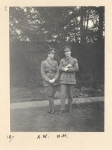
Urquhart was also able to capture the interactions and relationships between students. For example, one photograph shows Arthur Wiggin and future Prime Minister Harold Macmillan posing arm in arm in their new officer uniforms. The sense of playfulness is continued in Urquhart’s use of the camera, overlaying two portraits on top of each other as a double exposure. [FFU07-20-D-E-F]
-

- Oxford, Balliol College Archives, FF Urquhart Album 7.36B
-
- Oxford, Balliol College Archives, FF Urquhart Album 7.44B
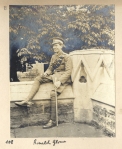
Macmillan, of course, became a prominent politician, but many other subjects of Urquhart’s photographs did not fare so well. Ronald Glover, for example, was killed at Ypres in 1917. He first appears in Urquhart’s album posing in the snow-covered college grounds, and then sitting cheerfully on the wall of the Fellows’ Garden in his officer’s uniform. Glover is one of the many students Urquhart documented before they left to fight and never returned. [FFU07-36-B] [FFU07-44-B]

Oxford, Balliol College Archives, FF Urquhart Album 7.63G
In some cases Urquhart had a direct influence on students’ military careers. Hardit Singh Malik was one such student. Initially rejected by the British air force because of his Indian origins, it was due to Urquhart’s intervention that he was allowed to fly during the war. Indeed, Malik can be seen proudly wearing his R.A.F. uniform in several of Urquhart’s photographs. [FFU07-63-G]
-

- Oxford, Balliol College Archives, FF Urquhart Album 7.30D
-

- Oxford, Balliol College Archives, FF Urquhart Album 7.24E
Students were not the only people Urquhart photographed. He took numerous images of the soldiers, mostly officer cadets, for whom Balliol was briefly a home during their officer training, and, as with his photographs of students, he appears to have been interested in capturing these subjects informally. A series of images (titled ‘A gentle warrior’) shows his small son clambering over the legs of Harold Brewer Hartley, in civilian life a Tutor in Physical Chemistry at Balliol, while his daughter grins at them from behind a tree. One image provides an unusually casual portrait of a group of officers, all sitting cross-legged on the grass and smiling – the group is from D Company, 7th Ox & Bucks LI, and includes several Balliol men whom Urquhart would have known and taught before the war. This photograph indicates the kind of picture that Urquhart thought was worth keeping, although like several others in the album it was taken by someone else (Urquhart has written ‘Pemberton fecit’ in the corner). [FFU07-30-D] [FFU07-24-E]
Urquhart’s album tells us much about the man who took and collected these photographs. Whilst his images undoubtedly act as documents of the changing times he lived through, they are also records of who Urquhart spent his time with, how he spent this time, and which fragments of these events and people he wanted to keep in his album. My research has only been able to scratch the surface of what Urquhart’s photographs can tell us about him, and about this period in Oxford’s history, and I hope that future scholars will be able to pick up some of the threads I have introduced here.
I am very grateful for the invaluable advice and assistance I have received from archivist Anna Sander, and librarians Fiona Godber and Rachel McDonald during my time at Balliol, and for the funding provided by Oxford University Careers Service.
– Sophie Lealan, August 2015
Selected Bibliography
Bailey, Cyril, Francis Fortescue Urquhart: A Memoir (London: 1936).
Elliott, Sir Ivo (ed.), The Balliol College Register, 1833-1933 (Oxford: 1934)
Graham, Malcolm, Oxford in the Great War (Barnsley, South Yorkshire: 2014).
Jones, John, Balliol College: A History (Oxford: Oxford University Press, 2005).
Malik, Hardit Singh, A Little Work, A Little Play: The Autobiography of H. S. Malik (New Delhi: 2010).
Sophie’s posts about FF Urquhart’s WW1-era photo album:
Life in Balliol during World War One
Guest post 2/3 by Sophie Lealan, one of our OUIP interns:

Oxford, Balliol College Archives, FF Urquhart Album 7.11F
Urquhart’s photograph album of 1914-1918 narrates, in hundreds of small, sepia images, the transformation of Balliol College from a site of parties and fancy dress to one of officer training and uniforms. However, amidst these dramatic developments many of the traditions and rituals of college life proved resilient.

Oxford, Balliol College Archives, FF Urquhart Album 7.12A
The summer of 1914 has often been described as a ‘Golden Summer’, and Urquhart’s photographs appear to testify to this. Students are shown punting and picnicking around Oxford, dressed in black tie for ‘Eric Lubbock’s “Twentyfirster”’, or having tea in the college gardens while dressed in kimonos. Of course, these were only the occasions to which Urquhart was invited, or of which he had a photograph, but they illustrate the light-hearted atmosphere of the summer. [FFU07-11-F] [FFU07-12-A]

Oxford, Balliol College Archives, FF Urquhart Album 7.21F
As the album progresses to Michaelmas 1914 students still smile and appear relaxed for Urquhart’s camera, only now they are dressed in army uniforms. Meyrick Carré is just one of the dozens of Balliol students Urquhart photographed in their new military outfits. In his portrait we can see a pile of dirty dishes on the ground, just within the entrance to staircase eighteen. [FFU07-21-F]
-

- Oxford, Balliol College Archives, FF Urquhart Album 7.20C
-

- Oxford, Balliol College Archives, FF Urquhart Album 7.55C
-

- Oxford, Balliol College Archives, FF Urquhart Album 7.21H
Like its students, the college took on new roles during the war. Balliol became a base for officer training programmes, and many of the resident cadets were captured by Urquhart’s camera. In one image we see a queue of men in uniform, each holding a mug as they line up the stairs for hall. Another photograph shows a distant view of a soldier standing beside a blackboard, addressing a group of soldiers who are gathered around him in a semi-circle on the college grounds. Balliol was not the only college to become a form of army barracks and several others became hospitals for wounded soldiers. Indeed, the war affected the whole of Oxford, as Urquhart documented in a view of soldiers standing in formation across Christ Church Meadow. [FFU07-20-C] [FFU07-55-C] [FFU07-21-H]
-

- Oxford, Balliol College Archives, FF Urquhart Album 7.52F
-

- Oxford, Balliol College Archives, FF Urquhart Album 7.43D
Of course, the buildings of Balliol College stayed the same, and much of its architecture remained a constant feature of Urquhart’s photographs. Subjects frequently sit on the walls of the Fellows’ Gardens, first as students and then as soldiers. Such images indicate a sense of continuity; whatever events might be happening in the world, the ritual of Urquhart taking one’s photograph in this spot was constant. Signs of college life continuing amidst the upheavals of war are also evident in details such as the rowing crest chalked on the wall behind two students (Eric Lubbock and Ernest Besly) in uniform. [FFU07-52-F] [FFU07-43-D]
-

- Oxford, Balliol College Archives, FF Urquhart Album 7.1H
-

- Oxford, Balliol College Archives, FF Urquhart Album 7.65A
The ways in which students spent their free time was also affected by the war. With fewer students, sports continued at a greatly reduced level. Images of young men playing tennis and cricket or rowing in Torpids open the album but, after war breaks out, such images almost disappear. However, the cadets at Balliol also became involved in sports, as can be seen in several of Urquhart’s photographs. One image shows Officer Cadet Battalions playing a game of rugby, whilst another image appears to show a tug of war between trainee officers. [FFU07-1-H] [FFU07-65-A]
-

- Oxford, Balliol College Archives, FF Urquhart Album 7.27G
-

- Oxford, Balliol College Archives, FF Urquhart Album 7.26F
-

- Oxford, Balliol College Archives, FF Urquhart Album 7.63C
Although visits to Urquhart’s chalet in the French Alps were suspended, other aspects of college life continued in various forms. Punting reappears frequently throughout the album, but one can imagine that such activities took on quite different meanings for students returning from the trenches. Tea in the college gardens is also a common subject throughout the war years, including one image in which a uniformed student appears with his arm in a sling. Urquhart also photographed several students wearing graduation robes and hoods over their army uniform, one of the aspects of Oxford life that was modified but not ended by the war. [FFU07-27-G] [FFU07-26-F] [FFU07-63-C]
Sophie’s posts about FF Urquhart’s WW1-era photo album:
Francis Fortescue Urquhart: Oxford Tutor and Amateur Photographer
A guest post by Sophie Lealan (Oriel College), our second OUIP (Oxford University Internship Programme) intern of summer 2015.
Francis Fortescue Urquhart: Oxford Tutor and Amateur Photographer
Life in Oxford during the First World War is presented to us vividly in Francis Fortescue Urquhart’s eleven photograph albums, currently held in the archives of Balliol College. Covering the tumultuous period of 1914 to 1918, the seventh of these volumes begins with partying students and ends with uniformed soldiers. As part of the Oxford University Internship Programme I have been researching what this album can tell us about Balliol College and its students during wartime, and these will be the subjects of upcoming posts. Firstly, I looked at how Urquhart used his photographs to record and even constitute his role as an Oxford tutor.

Oxford, Balliol College Archives. FF Urquhart Album 7.71A
As was expected of a tutor during this period, Urquhart (nicknamed ‘Sligger’) lived in college as a bachelor from his appointment in 1896 until his death in 1934, and dedicated his time to educating rather than researching. Indeed, he is often described as academically unremarkable but well-liked by his students, many of whom would gather in his rooms to talk late into the night. Although some, including Evelyn Waugh, criticised Urquhart for only associating with a particular type (namely good-looking old Etonians), he became a friend to many students [FFU07-71-A]. Evidence of such close relationships can be seen in his numerous photographs of picnics, walks and days out on the river with the young men of the college. Photographs also show Urquhart’s visits to students’ homes and former schools during the vacations, and even travelling as far as Italy with them.
-

- Oxford, Balliol College Archives. FF Urquhart Album 7.56F
-

- Oxford, Balliol College Archives. FF Urquhart Album 7.56E
-

- Oxford, Balliol College Archives. FF Urquhart Album 7.56D
-

- Oxford, Balliol College Archives. FF Urquhart Album 7.28A
Perhaps most indicative of the close, informal relationship between Urquhart and his students is the fact that he photographed them while participating in their social activities, not while merely observing them. Many images have been taken from within rowing boats and punts, including a series of three pictures which were clearly taken while Urquhart and two students passed the camera between them to take pictures of each other. [FFU07-56-D-E-F] He is frequently pictured sitting on the grass with students, and the low perspective in many of his own photographs indicates that Urquhart had placed his camera on the grass or on his lap while sitting down with those he was photographing. [FFU07-28-A]
-

- Oxford, Balliol College Archives, FF Urquhart Album 7.29B
-

- Oxford, Balliol College Archives, FF Urquhart Album 7.11E
This album also tells us about his more staged photographs. One image appears to show Urquhart in the act of taking a portrait. He is holding an object, possibly a box camera, in his hands and pointing it at a man in uniform, who poses next to a column that reappears in many of Urquhart’s portraits. [FFU07-29-B] This picture could indicate that Urquhart’s habit of photographing students had itself become a college institution worthy of being recorded. We can see another example of cameras being used in a photograph of two men in a punt, one of whom has a folding camera beside him. [FFU07-11-E]
-

- Oxford, Balliol College Archives, FF Urquhart Album 7.58G
-

- Oxford, Balliol College Archives, FF Urquhart Album 7.26I
Urquhart’s collection of photographs was notable within the college. The walls and mantelpiece of his rooms were filled with photographs of friends, and large albums sat on top of his bookcase. Having one’s picture taken by Urquhart and displayed in his rooms must have further strengthened the personal relationships between himself and his students. It is also likely that these photographs took on a particular significance during the war, as many of the young men pictured were enlisted. In an image of Maurice Jacks and his brothers, several of the portraits included in Urquhart’s 1914-1918 album can be seen sitting in frames on the mantelpiece, including an image of Neville Talbot and Stephen Hewett. The latter had died by the time this photograph of Jacks was taken, and so the framed portrait of him acted a memento of someone who was no longer present, as indeed the whole album does today. [FFU07-58-G] [FFU07-26-I]
Sophie’s posts about FF Urquhart’s WW1-era photo album:
Several of FF Urquhart’s photo albums have been digitised; images are available online.
What Balliol people read between 1677 and 1712
A guest post by Matthew Main (New College, 2012), our first OUIP (Oxford University Internship Programme) intern of summer 2015.

In the archives of Balliol Library there are two Folio ledgers, with dimensions suited for the task of recording tall columns of accounts. Alongside Bursar’s accounts and a partial early Library catalogue, they contain fragments of a lending register from the main College Library, chronicling intermittent periods between roughly 1677 and 1712. The register consists of a total of 565 entries, including some that are illegible or too vague to be identified. As part of my role as an intern at Balliol Library in the summer of 2015, I transcribed the lending register, before converting it into a searchable database for researchers interested in libraries and their usage in this period.

Use of the register was haphazard. A considerable portion of the entries remain unidentified, for various reasons; some are scored out, presumably upon the book’s return to the Library, while others are no more than an abbreviated scribble or a faded pencil mark. There appears to have been no agreed conventions for entering a record; one or more of the date, book, author, shelf mark and even borrower name may be missing from any given record. This made compiling a useful set of data a challenging task, but not an insurmountable one; I identified most books through a process of elimination and by consulting old Library catalogues.

It is difficult to say exactly how much the register can tell us about the historical intellectual community at Balliol. Officially, the Library was for Fellows of the College, although the register occasionally records instances where undergraduates and external visitors were apparently granted special dispensation to borrow from the collections. In Balliol College: A History, John Jones remarks that if one takes the register to be a picture of the College’s scholarship, ‘the impression is left . . . of a dilettante approach, lacking in concentrated effort or application’, an impression borne out by the dearth of meaningful academic work produced by the contemporary set of Fellows. This should not, however, put us off investigating the way that Fellows interacted on the page, and the entries offer an insight into the type of texts most commonly read in the wider period, as well as the specific, changing Balliol environment. After the Civil War, Balliol had been placed under the administration of the Bishop of Lincoln in an attempt to remedy its ailing financial health. The Fellows and successive Masters were engaged in raising funds in order to pay down accumulating College debts, many originating from years of unpaid battels, and a charitable explanation for the lack of academic output in the period might be that attentions were primarily focused elsewhere.
Close ins pection of the register reveals plenty of instances where a community of readers appear to recommend certain works to one another, suggestive of interaction between scholars. The College subscribed to Philosophical Transactions and the rival journal Acta eruditorum, and Fellows perused both frequently. Plenty of books were seemingly passed around, some of them more obscure; five different people are recorded as having borrowed mostly forgotten French writer Louis Ellies du Pin’s 13-volume History of Ecclesiastical Writers (1692–1699). Mathematics and theology were generally the dominant subjects, and as Jones reminds us, these were the only fields in which anything of note was published out of Balliol between 1675 and 1725. The nature of progress in both fields is somewhat cumulative, and existing work is often superseded rather than lasting on in our cultural imagination, which means that many of the mathematicians and theologians studied at the time are not household names today. Thus the lending register allows us to recover the names of people who shaped the discourse of their respective subjects but might otherwise have been forgotten. It might be tempting for us to think of the 17th century as the era of Paradise Lost, but if Balliol possessed a copy of the poem – and catalogue records suggest that it did – then the lending register suggests that it did not appeal to any of the Fellows at the time. The register offers a rare insight into what was actually read in the College, not simply owned or bought, and might force us to modify our understanding of what readers considered to be important.

Matthew uses the portable book cradle borrowed from the Oxford Conservation Consortium to photograph early College Library records at St Cross church.
During my time at Balliol I was privileged to borrow from the expertise of the archivist, Anna Sander, and the librarians, Naomi Tiley, Fiona Godber, and Rachel McDonald, all of whose guidance has been invaluable. I am deeply grateful for the opportunity to gain research and professional experience and the funding that has made that possible. I hope my work can play some small part in opening up this manuscript for further study by experts in this field.
===
– Thanks to Matthew’s research project, new digital images of three important archival sources for the history of Balliol College Library are now online:
Oxford, Balliol College Archives, Library Records:
display from the college archives
A small display in Balliol’s Historic Collections Centre at St Cross Church, Holywell, for the Friends of Reading Abbey, 8 July 2015


scan of seal dorse presented with reading copy of deed and transcript adapted slightly from Salter

display case with original deed and supporting facsimiles and transcript
original deed was flattened long ago – conservators probably wouldn’t do this now, but it does make it easier to display

with much-magnified scan print of seal face – beautiful and in pretty good shape

recto of document, face of seal

detailed scan of seal face

verso of document, with endorsements, and seal

black and white contrast-tweaked crop of the document for easier reading of the text
 Transcription:
Oxford, Balliol College Archives D6.21 Gifts by the abbot of Reading towards the building of the chapel of St Katherine.
1 January 1327/8. [Salter Oxford Deeds of Balliol College 584, adapted slightly]
1 Nouerint uniuersi per presentes quod dominus Nicholaus de Quappelade dei gracia Abbas Radyng’ liberauit sco
2 laribus domus de Balliolo in Oxonia viginti libras sterlingorum pro anima Ade le Poleter burgensis Radyng’
3 ad fabricam capelle sancte Katerine eiusdem domus. Item dedit predictus Abbas prefatis scolaribus decem marcas
4 argenti ad fabricam capelle predicte quas ab eodem Abbate per duo scripta obligatoria prius ex mutuo receperunt.
5 Dedit eciam predictus Abbas prefatis scolaribus unam fenestram vitream precii decem librarum & amplius
6 pro capella supradicta. Summa tocius xxxvj libras xiij s. iiij d. Item dedit eis meremium, lathes, & alia minuta
7 cum cariageo eorundem, que hic in specie non numerantur. In cuius rei testimonium tam predictus Abbas quam predicti
8 scolares presenti intenture alternatim sigilla sua apposuerunt. Hijs testibus magistro Thoma Othom tunc
9 Cancellario Uniuersitatis Oxon’, magistro Nicholao de Luceby tunc custode predicte domus, magistro Nicholao de
10 Tyngewyk’ & custode sigilli communis predictorum scholarium & multis alijs. Et remanebit una pars huius
11 indenture penes predictos scolares & alia pars penes custodem altaris capelle beate Marie virginis infra
12 Abbathiam Radyng’. Dat’ apud Radyng’ die veneris in festo Circumcisionis domini Anno domini millesimo
13 Tricentesimo vicesimo septimo.
Red seal 2.5 in x 1.75 in, bishop [?abbot] in mitre and chasuble, with book and pastoral staff. Legend: S’ NICHI’ DEI GRA… [?EPISCOPI] …ILCE.SIS.

A number of other documents from early in the college’s history were also on display, and visitors were interested in the history of the building and the other print and manuscript special collections kept as St Cross as well as the college’s administrative records. Our student intern explained his summer research project, working on another part of the college archives: the library’s 17th century book borrowing registers. Stay tuned here for some of his findings later in the summer…


#WW1 – Hardit Singh Malik (Balliol 1912)
The BBC has a fascinating series of stories on their WW1 At Home site – here is an index of all the Oxford related ones. The one that interests me particularly is that of HS Malik, the first Indian pilot in the Royal Flying Corps.
I can recommend his autobiography, A Little Work, A Little Play, published by his daughter in (?)2010, as an excellent read of a fascinating life lived in decidedly interesting times on several continents. Here is a review.
There is not a great deal of information about HS Malik’s time at Balliol (1912-1915) in the College Archives, but what there is illustrates his long-standing enjoyment of college cricket, his WW1 flying career and his abiding friendship with his tutor Francis Fortescue Urquhart, known as ‘Sligger’, a Modern History don and the first Roman Catholic Fellow of an Oxford college since the Reformation.


!['Malik, Fr[ench] Red Cross'. Summer Term (May/June) 1917, in the Fellows' Garden at Balliol. Balliol College, FF Urquhart Albums 7.52A](https://i0.wp.com/balliolarchivist.wordpress.com/wp-content/uploads/2014/08/malik-ffu07-52.jpg?w=192&h=249&ssl=1 "Malik-FFU07-52")


Please click on the images for more information and full archival references. To use these images, please send a completed copy of this form to the Fellow Librarian, who deals with all such requests on behalf of the Master and Fellows.
The series of five photos from Urquhart’s personal albums, now in the College Archives, is bookended by group photos of ‘Past v Present’ cricketers from the college’s sport albums, once kept in the cricket pavilion and documenting all college sport except rowing, which had its own set of albums in the boathouse – these are also now in the College Archives. HS Malik appears first in 1913 as a ‘Present’ cricketer and finally in 1931 as a ‘Past.’ Some cricket match records from the period also survive.
In his first year at Balliol, Malik is still wearing his Eastbourne College cricket blazer; by the next year, he has a Balliol blazer. The informal, light-hearted snap at the Pavilion is from about the same time as the last, Trinity Term 1914, just weeks before war was declared.
The first of Sligger’s wartime photos, from May-June 1916, is the only one of Francis Urquhart and HS Malik together – at this time they will have been discussing ways for Malik to fulfil his desire to join either the French or the British air force. The next also predates HS Malik’s groundbreaking acceptance as an officer in the RFC – at this point, summer 1917, through FF Urquhart’s connections, Malik is working as an officer ambulance driver for the Croix Rouge Français. (Urquhart volunteered at the American Hospital in Neuilly -sur-Seine during University vacations.) The caption of the next two photos, also from Francis Urquhart’s own albums, marks a milestone for HS Malik and for the Service he entered – he has become a pilot in the newly-formed RAF (merger of RFC with Royal Naval Air Service in April 1918).
Though he took his History degree in 1915, HS Malik returns to college cricket as a ‘Present’ for the 1920-21 year, while undertaking mandatory studies preceding posting to the Indian Civil Service.
The last photo is once again a ‘Cricket Past and Present’ group – HS Malik and his family are back in England as he takes up the post of Deputy Trade Commissioner in the Indian High Commission for three years from 1930. This posting to England came in time for Malik to see his friend and tutor again before Urquhart’s death in 1934.
The photos on this page are provided for educational and personal research purposes. Permission must be obtained in advance of any reuse or publication, including on the Internet.
Further reading:
Biographical entry for HS Malik in the Balliol College Register – see 1912 sections of the 2nd and 3rd editions
More of Francis Urquhart’s WW1 photos – see Vol. 7
Correspondence from HS Malik’s later career in the Monckton archive at Balliol:
- Letters to and from Walter Monckton, 1956-60
- Dep. Monckton 6R, fols. 85-7, 113-14, 147, 155, 243, 303, 309
- Dep. Monckton 7R, fols. 19, 37, 41, 75, 82, 114-15, 143-8, 154, 158-9, 162
- Dep. Monckton 12R, fols. 64-70, 75
- Copy of letter to T.E. Peppercorn, 1956, Dep. Monckton 7R, fols. 147-8.
College prayer during wartime
‘Prayer During the War’ by James Leigh Strachan-Davidson, Master of Balliol 1907-1916, for use in the College chapel during the First World War.

[Oxford, Balliol College, Strachan-Davidson Papers 4M.1]
O God with whom do live the spirits of just men made perfect, we give thee thanks for our brethren the members of this College who have willingly offered themselves, and have laid down their lives for us and for our country, and for the liberty of the world. Give us grace to follow their good example, that we may never lose heart, but may bear with patience and courage, as these have done, whatever thy Providence calls upon us to endure. Comfort the bereaved, and grant to all of us that our afflictions may purify our hearts and minds to thy glory. Through Jesus Christ our Lord.
Strachan-Davidson’s manuscript also includes a prayer for the wounded:
We beseech thy goodness O Lord on behalf of the members of our College who are lying stricken from wounds received in battle in a righteous and holy cause, especially for [names]. Comfort each one of them when he lieth sick on his bed and grant them thy strength and grace to bear the pain and weariness of their condition, and, if it be thy will, assuage their sufferings and grant them restoration to life and health. Through Jesus Christ, our Lord.
Strachan-Davidson himself died during the course of the war, in post as Master, on 28 March 1916, at the age of 72.
conservation survey notes 13

Balliol MS 385 is written in Pali on lacquered and gilt palm leaves enclosed and strung between painted wooden boards.

Detail of one of the boards


The inner side of one board and the outside leaf

Detail of an outer leaf


leaves from the middle of the manuscript, with text and decoration


detail of decorated leaf


Balliol has few Oriental manuscripts – the term under which all the non-western mss in languages and scripts from Pali to Persian, Hebrew to Hindi, have been lumped together. Most of them were given individually to the College as antiquarian curiosities, and they have not, on the whole, been evaluated, described or studied much at all in comparison with the collection of western manuscripts. But there are discoveries still to be made!

A description of MSS 385 and 386 by Prof FW Thomas, cited by Mynors as ‘kept with the MSS’, is lost, so as far as we know Balliol does not have information about the date or origins of this MS. There is no obvious documentation of how it came to Balliol, but there is a lot of acquisition information, at least for the 20th century, in the Annual Record, so we will at least survey that to see what we can discover.

In the meantime, our descriptions remain inadequate, but thanks to the efforts of archives, libraries and museums to put images from their own collections online, it is possible to put these ‘Balliol orphans’ in some kind of context with other manuscripts of their kind(s). I have found some (to the untrained eye at least) similar manuscripts – and therefore several useful descriptors and explanations of particular features – at:
- Trinity College Dublin Digital Collections (Dublin, Ireland) – try searching for ‘manuscript’ and then add Hebrew, Arabic, etc. This post from M&ArL@TCD’s blog about a Pali MS from Burma has images of something similar to Balliol 385.
- Walters Art Museum Illuminated Manuscripts (Baltimore, MD, USA) image collections on Flickr – includes a large collection of Islamic manuscripts
- The Wellcome Library (London, UK) image collection – search for e.g. ‘Pali’
- Metropolitan Museum of Art (New York, NY, USA) – a small online exhibition on ‘Early Buddhist Manuscript Painting: The Palm-Leaf Tradition’
- Northern Illinois University (DeKalb, IL, USA) – manuscript collections in their Southeast Asia Digital Library
Very little of the British Library’s large Southeast Asia collections is online, either images or descriptions, but you can find some images here: http://www.bl.uk/manuscripts/Default.aspx
For background knowledge rather than images:
- The Fragile Palm Leaves Foundation
- The Pali Text Society
- The Wellcome Library’s Catalogue of the Burmese-Pali and Burmese Manuscripts
conservation survey notes 12
Balliol MS 452 is a copy of the Koran, given to the College in 1983. The donor did not have information about its date or provenance. We will be asking experts in the field(s) to examine Balliol’s small collection of Oriental manuscripts and describe them in detail, most for the first time. Watch this space!

Physically, the book is currently in unusable condition. The spine and one cover are detached, and the unsupported sewing is weak with some breaks, making the textblock unstable. Any use in this state causes damage – we disturbed it as little and as briefly as possible for this examination, while documenting as much as we safely could.

The first folio features areas of illumination using gold and pigments above and below the text and on two, perhaps formerly three, sides of the border. This page shows some old repairs, of which there are many throughout the volume.


above, showing f1 with the blue linen spine lining exposed

The two sections of the fore edge flap have become detached, and the hinges between the three parts of the cover are mostly lost.

The red leather cover, now darkened, was painted with silver and gold or pigments resembling metals. The various layers, which would not have been visible when the book was new, are now showing more clearly as the materials age and wear.

The small square gold-coloured areas are made separately and stuck on – some are beginning to lift as the adhesives lose their strength.

A view of one of the endbands, showing the typical zigzag pattern, now broken about halfway.

This volume was housed until recently inside what was once a beautiful dark green silk velvet bag, evidently specially made for it. A stub remains from the bag’s lost tie, in a rather natty check or plaid. The textile itself needs conservation, and removing the book from the enclosure or replacing it is only causing further damage to both items, so they will be kept separately – but still together. Ideally, one both items have been treated they could be housed in separate areas of the same box.

Thanks to the survey, we hope that both the history and the future of this book will soon become clearer!
conservation survey notes 4
Today we have naming of parts – binding parts.

Balliol MS 248C – the front board is detached, held on only by the cloth lining the inner joint.

And here’s why – although the double alum tawed supports are clearly present in the spine…

… when the manuscript was rebound, the supports were cut, and not attached to the upper board at all. The leather covering the outer joint, which was doing a lot of the work of holding the board in place, has, unsurprisingly, split under the strain.

Close up showing the stumps of the supports on the spine side (lower part of photo) and the channels cut into the board for the supports to continue into – but the channels are empty! The linen inner joint, now damaged itself, is the only attachment between spine and board.
conservation survey notes 2
Several things to say about Balliol MS 149, a 14th century collection of sermons – on f 122r, the most eye-catching feature is the big manicula, aka Nota Bene hands, used as pointers the way we might use arrows, highlighting, underlining etc. How many fingers??

The handwriting is also notable – more or less a documentary hand such as we would expect to find in charters and other administrative documents, here unusually used in a formal book context. And lots of different types of text correction: rubbing out and writing over, superscript interpolations indicated by the still-current caret ^, dotting under the word to be deleted, crossing out… why has crossing out survived and expunction (underdotting) not? More about types of errors and corrections and technical notes on same – see especially IV.vii and V.ii.

Q&A: digitisation
I was recently asked: ‘I noticed that quite a bit of material from your archives has been digitized, and that you have put it to fine use by widening access to the collection on the website and through online exhibitions. I wondered how you are going about digitizing the items – are you working in-house, or are you using an external organization to do it, or a mixture of both? Please could you tell me how this is being financed, and if you are aiming to digitize the whole archive or just a part?’ This isn’t the first time I’ve been asked about my digitization programme at Balliol, and it prompted a bit of an essay on how I do things now and how that has changed since I began in October 2010. So here’s is an update to what I was thinking then.
 Who does the work?
I do the digitising myself – I have an excellent A3 scanner and a serviceable but outdated camera which I’m about to replace. I allocate a few hours a week to scanning & photography so that it progresses regularly, if not quickly, but I am posting about 2000 images a month these days.
The occasional exception is when someone wants to photograph an entire manuscript or series for their own research; in such cases I ask for copies of the images and permission to publish them online and make them freely available to other researchers, with credit to the photographer of course. So far the few people I’ve asked have been very happy to do this, since they have had free access and permission to photograph. (Sometimes their images are not as good as mine, so then I don’t bother!)
There are also numerous documents in the collections that are just too big for me to photograph – eventually, if and when they are asked for, we will have to think about having someone in to photograph them systematically. So far the multiple photos of each that I or the researcher have been able to do has sufficed.
For now at least, I have decided against a systematic digitisation of our microfilms of the medieval manuscripts. This would involve a lot of time and effort to fund and arrange, the images would all be black and white, and of variable quality, and there are knotty questions of copyright as well. Some of the MSS were only partly microfilmed, and none has more than a single full-page perpendicular view for each page – no closeups or angles to get closer to initials, erasures, annotations, marginalia or tight gutters, so there would still be considerable photography to do anyway. Also, see below.
Why don’t you apply for a grant and have a professional photographer do more than you can do yourself?
So far, I’m able to fulfil reprographics orders in a pretty timely manner and to a standard that satisfies enquirers. Aside from cost and time management for individual orders, because I can respond individually and fit them in around my other tasks, the great advantage of doing the digitisation myself is that I am getting to know the collections extremely well. If we had an outside photographer do it, all that direct encounter with each page would go to someone with no real interest in the collections, what a waste. This way, I’m checking in a lot of detail for physical condition, learning to recognise individuals’ handwriting, discovering/replacing missing or misplaced items, prioritising items that need conservation or repackaging, noticing particularly visually attractive bits for later use in exhibitions and so on, and not least ensuring that items are properly numbered – which many are not!
What is the cost?
 Because I work reprographics orders into my regular work schedule, there is no extra cost, except the £50 or so fee every 2 years for our unlimited Flickr account.
Do you charge for access?
I always mention that donations are welcome, but in general I do not charge for reprographics. Most of the requests are from within academia, and I think HE institutions have a responsibility to be helpful and cooperative with each other and with the public, particularly when it comes to access to unique items. On the one hand, I know that special collections are extremely expensive to maintain, and often have to sing for their supper, but on the other I know how frustrating it is to be denied the chance to take one’s own photographs and then to be charged the earth for a few images. Institutions like ours, whose own members may need such cooperation from other collections and their curators, should probably err on the side of the angels er scholars! Most of the other requests for images are for private individuals’ family history research purposes, and since many of those enquirers would otherwise have no contact with Balliol or Oxford, I think it’s good for the relationship between college, university and the wider public to be helpful in this way. Family history is usually very meaningful to researchers, and they remember and appreciate prompt and helpful assistance.
Balliol College reserves the right to charge for permission to publish its images, but may waive this for academic publications.
Are you planning to digitise all the collections or just parts? What are your priorities and how do you determine the order of things to be done next?
Most of the series I’ve put online don’t start with no.1. All the reprographics I do now are in response to specific requests from enquirers, and I don’t seriously intend, or at least expect, to digitize All The Things. Although 40,000 images sounds like a lot, and there’s loads to browse online, I’ve barely begun to scratch the surface; most collections aren’t even represented online – yet… This way, everything I post online I know is of immediate interest to at least one real person – if we did everything starting from A.1, probably most of it would sit there untouched. For the efficiency of my work and for preservation of the originals, digital photography is marvellous, enabling me to make every photo count more than once rather than having to photocopy things repeatedly over the years.
On the other hand, if someone asks for images of one text occupying only part of a medieval book, I will normally photograph the whole thing; or if the request is for a few letters from a file, I will scan the whole file. It’s more efficient in the long run, as a whole is more likely to be relevant to other future searchers than a small part.
What about copyright?
 I probably should mark my own photos of the gardens, but I don’t think anybody will be nicking them for a book and making millions with it. As for the images of archives and manuscripts, of course I am careful to avoid publishing anything whose copyright I know to be owned by another individual or institution, but for older material that belongs to Balliol, I’m with the British Library on this one. I think as much as possible should be as available online as possible, for reasons of both access and preservation.
We do have some collections whose copyright is held by an external person or body, and in some of those cases I am permitted to provide a few images (not whole works) for researchers’ private use, but cannot put images online or permit researchers to take their own photos.
How do you make images available?
Now that other online media are available, I am reducing image use on the archives website, to use it as a base for highly structured, mostly text-based pages such as collection catalogues, how-tos, research guides etc, as this information needs to be well organised and logically navigable. These days I am using this blog for mini-exhibitions discussing single themes and one image, or a few at a time.
Flickr is a good image repository for reference, not so much for exhibitions – I’ve written about that at https://balliolarchivist.wordpress.com/2013/05/01/thing-17/
I expect I will have rethought the digitisation process again in a couple of years’ time!
Thing 17
Thing 17 for 23Things for Research is Exploring images. Basically, it’s exploring Flickr. Which I use. So that’s handy!
I’ve uploaded about 40,000 images to Flickr by now, and have had more than 106,000 views of individual images. The bulk of the images are of (mostly entire) medieval manuscripts, but I’ve also added old photo albums, medieval title deeds, 19th century sketchbooks, letters, diaries, literary manuscripts, administrative records, transcriptions & finding aids… and my own photos of Balliol’s gardens in all seasons, which have proved surprisingly popular!
Flickr doesn’t fill my criteria for an online exhibition facility, because it’s set up so that photos have to be viewed in a highly structured, linear way. However, it makes a very good repository for zillions of images that do need to be arranged in a highly structured, linear way – e.g. a collection of Balliol’s medieval manuscripts, containing numerous sets, each of those containing images of each page of a manuscript, presented in (usually!) the same order as in the original book. It mirrors the structure of the real collections and their contents, and it’s easy to refer enquirers to freely available, high-resolution sources.
I also refer enquirers to Flickr when they ask for visual information about some building or other physical aspect of Balliol as it is now – because they will find a better pool of those images on Flickr than the college has itself. One good reason to continue to use and to add to it is that Flickr is becoming well known as perhaps the top place to go online to search for images of whatever particular something – much more effective than the image tab on search engines. So if it’s the best, more people will be using it, and it’s worth having a presence there. For instance: wish you’d got up early enough to catch all the merry May Day madness in the streets of central Oxford this morning? For a flavour of the atmosphere, you could do worse than start here.
What do we then do about online exhibitions? For a long time I wanted some kind of image slideshow facility on the college’s website, but now that seems dated and limited, no more interesting than what Flickr can offer (and more expensive!) Instead, I’m inclined to try some of the presentation tools I’ve investigated during 23Things – for instance, Prezi and some of the newspaper/magazine tools such as scoop.it, because they provide ways of presenting images and text in more visually flexible and interesting ways – one item doesn’t simply have to follow another; you can relate several things to each other in different ways. This also takes more planning and therefore time but I think I’ll end up with better presentations in the end. And blog posts are a great way of highlighting a single item, especially isolated ones such as my recent mystery postcard accession.
What about copyright? Well, I probably should mark my own photos of the gardens, but I don’t think anybody will be nicking them for a book and making millions with it. As for the images of archives and manuscripts, of course I am careful to avoid publishing anything whos copyright I know to be owned by another individual or institution, but for older material that belongs to Balliol, I’m with the British Library on this one. I think as much as possible should be as available online as possible, for reasons of both access and preservation.
Flickr has lots more potential than just getting good-quality images from A to B – indeed, I wish it were rather less clicky to get from one original-size image to the next in the set, and that there were a filename-preserving way of allowing viewers to download whole sets. I do use several other Flickr features:
– tags: obviously, this is the most efficient way to ensure that your photos are picked up in searches!
– descriptions: I use set descriptions to provide basic information about the source material, and to refer the viewer back to our website for more structured in-depth information, catalogues etc. So far I haven’t used individual photo descriptions much, as it would take huge amounts of time and would duplicate information on our website – I don’t really want to add a lot of new information to Flickr, because it’s hard to keep track of. But on the other hand, there is potential here for crowdsourcing/community projects such as mapping and transcription – more investigation and planning needed.
– flickandshare: a 3rd-party app that allows you to send, or include in your set description, a link that lets viewers download whole sets of your photos. Unfortunately, it doesn’t seem to preserve your filenames, so viewers may have to download the images one at a time from a list of filenames, which is tedious but at least less irritating than having to click through to and download each individual original-size image direct from Flickr. Come on app people!
– map: when marking up sets that relate to a particular place (especially outside Balliol, such as college livings, formercollege properties or addresses on old letters) I like to pin one or two (more makes it crowded and messy) to Flickr’s map – even though it does then label each mapped photo as taken in that place, which is hardly ever true in our case! This means that users who browse the map for a place that interests them will happen across Balliol’s relevant historic photos during their own search, rather than my waiting for them to make a structured investigation for e.g. documents about that place, which they might never do. And then they might just get interested…
– groups: I’ve joined and posted photos to a number of Flickr group pools – these usually have quite narrow remits, and are a way of becoming visible to different and perhaps unexpected potential audience. Here’s my list of groups – some predictable (Archives & archivists on Flickr), others perhaps not quite so much so (Tulips in Bloom) Come and have a look!
- Manuscript Journeys (16 members)
- Oxfordshire Churches (241 members)
- Art of Heraldry (390 members)
- Tulips In Bloom (80 members)
- Manuscripta mediaevalia (395 members)
- archives & archivists on flickr (226 members)
- The Great War Archive Flickr Group (540 members)
- Oxford Colleges (82 members)
- Oxfordshire Gardens (25 members)
- Historical Type and Lettering (553 members)
- Sealing Wax (95 members)
- ArchivesOnFlickr (298 members)
- Handwritten Ledgers (19 members)
- converted buildings (15 members)
- Archivists (23 members)
- Old Paper (15 members)
- Book Inscriptions (169 members)
Any recommendations of other Flickr functionalities I should explore? suggestions welcome!
To sum up: Flickr has a dual function for my image collections: as a structured ‘digital repository’ – of facsimiles only, I hasten to add! – to refer enquirers to who have already been in touch about something specific; and as an opportunity for serendipitous discoveries that may provoke a view or two, or may lead to more browsing, focussed interest and an enquiry.
some recent links
 The Cult of Beauty: the Aesthetic Movement 1860-1900. Balliol’s portrait of Swinburne by William Bell Scott will be appearing in this spring exhibition at the V&A, starting in April. More Pre-Raphaelites than you can shake a paintbrush at. College portraits are indexed here.
 Medieval manuscripts: images from Balliol MS 384 are now available on flickr. 384 is a 15th century Book of Hours – one the few liturgical books in the collection and also one of the few medieval volumes that was not created as part of the college’s working library. Donor unknown, but it was probably given to Balliol in the 18th century.
 Africa Through a Lens: Interesting public-input project from The National Archives at Kew – thousands of photos from the Africa Office are now online, and TNA is asking for help to identify them. There are probably photos taken by – and possibly of – the Balliol men then in Africa. Recognise anyone, anywhere?
update
Recently added to image sets online at flickr:
- Balliol Boys’ Club Magazine 1913 and 1921
- Balliol Boat Club Journals 1837-1842, 1858-1866, 1858-1871
- Clark’s Lists Vol 1 1520-90, Vol 3 1621-44, Vol 5 1674-98, Vol 6 1699-1719.


 Balliol College Archives & Manuscripts