
Upgrading & Twinning (Completed, and Planned)
Over recent years, much of the focus has been on “twinning” which puts at two lanes in each direction, divided by a median. This is equivalent to the standards for the US Interstate system.
All provinces have twinning programs underway, starting around major population centres.
British Columbia has twinned the #1 on Vancouver Island, through the Lower Mainland, and up the Coquihalla (this was done before Expo 86), providing fast access between West Vancouver and Kamloops. The up;grading of sections from Kamloops to the Alberta border are underway, but widening the highway through rugged and mountainous terrain (and where the railroad and the first 2-lanes of highway have claimed the easiest/best terrain) is both challenging and expensive. From Kamloops to the Alberta border they are twinning where possible, but where that cannot be done, BC is building a third passing lane every few kilomtres where terrain permits. The 4 kilometre winding section of the Kicking Horse Pass, just east of Golden was twinned and straightened in 2024 at a cost of $400 million. In Revelstoke, Glacier and Yoho National Parks, the federal government is working to upgrade the highways ina long-term project.
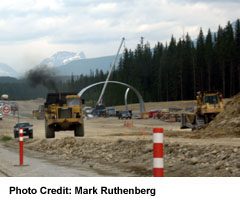
Animal Bridge Construction in Banff
Alberta’s stretch is completely twinned including through federally-managed Banff National Park, along with the addition of animal bridges, and the completion of Stoney Trail bypass (#201) around Calgary. Saskatchewan and Manitoba are fully twinned with by-passes around Moose Jaw, Regina, Brandon, Portage la Prairie, and Winnipeg. The last part of the highway untwinned in the prairies is through Whiteshell and Falcon Lakes Provincial Parks, adjoining Ontario, which is expected to be finished by 2027.
New Brunswick has been aggressive, twinning a new stretch in 2003, between Moncton and Fredericton, connecting to the long-twinned Saint John River Valley section, taking an hour off the travel time through the province.
Nova Scotia has already twinned the high traffic sections, including a short toll section in Nova Scotia over the Cobequid Pass, which has since been extended east to past Antigonish, Highway #102 has been betwen Truro and Halifax, and #103 twinned south of Halifax to Chester.
Ontario has focused on twinning the #69/#400 from Toronto north to Sudbury, and building bypasses around major communities like Kenora, Thunder Bay, Sault Ste Marie, Sudbury, and North Bay. The Ottawa Valley section (the #417) from Carp through Ottawa to the Quebec border has been twinned since before the 1976 Montreal Olympics. Highway 17 is being twinned the 39 km, from Kenora to the Manitoba border over the next decade (2030)
Quebec has twinned AutoRoutes #20 and #40 from the Ontario border through/round Montreal and east to Quebec City, and added a South Bypass AutoRoute #30 around Montreal (a toll-route). They have completed twinning AutoRoute 20 from Quebec City to Riviere du Loup and AutoRoute 85 south to the New Brunswick border at Edmundston.






 Provincial TCH History
 Itinerary Segment History

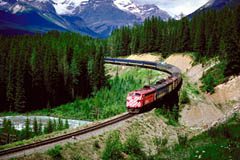 In the late 1800s, steamships brought European immigrants to Canada in only two weeks, and railroads quickly delivered them to the prairies to homestead in Canada’s “Last Best West”. The diverse linguistic and cultural mish-mash melting pot of Canada’settlers intermingled into a surprising homogenous culture and language. Much credit should go to the public school system which taught immigrants English so they could talk with their neighbours (usually from another country) in a ‘neutral’ third language.


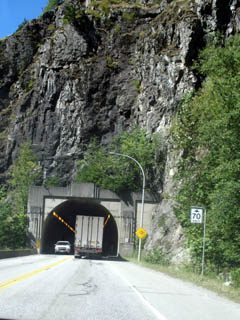 By 1956, the federal and provincial government came to a cost-sharing agreement to encourage the provinces to upgrade existing roadways to “Trans-Canada” standards, and receive 90% of the cost of building new stretches to fill gaps in the roadway. This was most notable in mountainous British Columbia, the rugged Canadian Shield north of Lake Superior, and across much of Newfoundland. The goal was to connect all 10 provinces by paved road by 1967, Canada’s centennial year.
 The Rogers Pass route followed some of the early tracks of the trans-continental railway that were abandoned years ago as too steep for trains, with the addition of a number of snow sheds to protect the highway from the many winter avalanches (the area gets about 200 ft of snowfall each year) and rockslides This stretch was opened June 30, 1962, and marked the official completion of the Trans-Canada (though at that time about half the 7,770 kilometres was still gravelled).
