On the Origins of New Forms of Life
5.6: Scala Naturae
EUGENE M. MCCARTHY, PHD GENETICS
(Continued from the previous page)
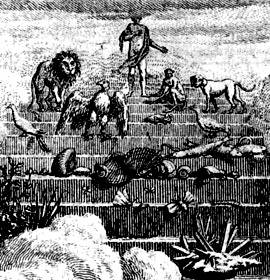 Scala naturae (Bonnet Œuvres d'histoire naturelle et de philosophie, 1781)
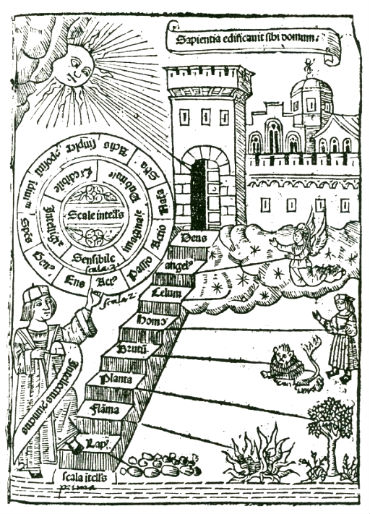 Another representation of the scala naturae (Liber de ascensu et decensu intellectus of Ramon Llull, written 1304, first published 1512).
What, then, is the motivation for the many, apparently unsubstantiated assertions that animal hybrids and the evolution of animals are somehow fundamentally different from those of plants? Is it perhaps the self-flattering notion that animals are somehow special, higher, nobler? In particular, is such reasoning simply a manifestation of the ancient tendency to place Homo sapiens above other, supposedly baser types of organisms?
This bias is indeed long-standing. When zoology was emerging as a science in the eighteenth century, its practitioners arranged their taxonomies in accordance with an age-old ordering principle handed down from medieval times, the scala naturae (literally, "the ladder of nature"). Also known as "The Great Chain of Being," this system had religious roots and pictured beings rising in a linear order of perfection, starting with inanimate minerals and rising through fossils (which were considered something between the mineral and the living), to plants, animals, humans, celestial beings, and, ultimately, God (this scale is illustrated at right).
As St. Albertus Magnus (De animalibus, thirteenth century A.D.) put it,
This is the so-called Law of Continuity ("Natura non facit saltum"), often cited by Darwin. In his De docta ignorantia (1440), the schoolman Nicolas of Cusa makes similar claims:
 Nicolas of Cusa
1401-1464
The scala naturae was the dominant worldview of European thinkers for centuries.3 It was strongly associated with the ideas of divine order, perfection, continuity, and gradualism. To a great extent, the view of evolution expressed in the Origin is a temporalization of a previously static scala,4 which is to say that it used the same sort of terminology and made many of the same assumptions, but placed the discussion in a temporal context. Thus, in describing the scala, the seventeenth century philosopher Gottfried Wilhelm Leibniz used many of the same terms ("chains," "missing links," "gradation,"…) later used in the context of neo-Darwinian theory:
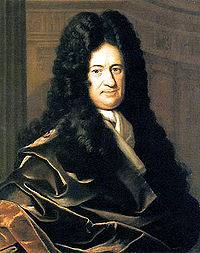 Leibniz
1646-1716
Having never seen among plants a progression in perfection from "base" to "noble," botanists rejected the scala as a basis of classification at an early date.6 But the concept of a linear chain of order held sway among zoologists until Georges Cuvier published his authoritative classification of animals, Le Règne Animal, in 1817, in which he divided the Animal Kingdom on the basis of anatomy into four phyla of equal rank (vertebrates, mollusks, radiates, and articulates). After Cuvier, no biologist would again assert an ordering principle of "growing perfection" constitutes an appropriate basis for constructing systems of classification.
But the tendency lingers, even today, to think of a mammal as somehow more advanced than a bird, or of a reptile as more complex than a fish, and certainly, of an animal as more advanced than a plant. This predisposition to place animals and, in particular, human beings "above" other organisms seems still to foster a mindset that discounts the extensive evidence demonstrating the significance of stabilization processes in animal evolution, since most such processes directly depend on the occurrence of hybridization. NEXT PAGE >>
Notes:
1. Translated in Lovejoy (1936: 79).
2. Translated in Lovejoy (1936: 80).
3. Lovejoy (1936).
4. Russell (1982: 214).
5. Translated in Lovejoy (1936: 144).
6. Mayr (1982: 200).