Showing posts with label WB-8. Show all posts

Thursday, November 3, 2011

Polywell Report - 3 Nov 2011

The researchers at Polywell Fusion have issued a report on their progress.
Project Status More than 50% Completed

Final Project Report Submitted No

Project Activities Description Other Scientific and Technical Consulting Services

Quarterly Activities/Project Description As of 3Q/2011, the WB-8 device has generated over 500 high power plasma shots. EMC2 is conducting tests on Wiffle-Ball plasma scaling law on plasma heating and confinement.

Jobs Created 12.00

Description of Jobs Created two full time plasma physicists and one full time microwave engineer. In addition, one full time equivalent electrical engineer.
It is not much of a report but it is all we have.

H/T The Boys and Girls at Talk Polywell where you can find a discussion of the nuances.

Thursday, March 18, 2010

WB-D

WB-8

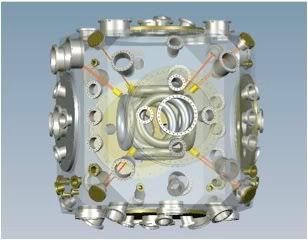
EMC2 (Polywell Fusion) has updated their site with an image of WB-8 shown above. The Drawing is labeled as "with diagnostics".

And then there is this picture:


Labeled:
WB-D 100MW Polywell Demo Device

Your Contributions Will Help Us Design The WB-D Polywell Device

Send your supporting contributions to:

New Mexico Community Foundation

Contact Energy Matter Conversion Corporation

1202 Parkway Drive Suite A
Santa Fe, NM 87507
Phone: 505-471-2050
Email: Rick at Emc2fusion dot com
There is considerable speculation at Talk Polywell as to what it all means.

And since from time to time there are people reading here who need to be brought up to speed on fusion I'm reposting my usual: You can learn the basics of fusion energy by reading Principles of Fusion Energy: An Introduction to Fusion Energy for Students of Science and Engineering

Polywell is a little more complicated. You can learn more about Polywell and its potential at: Bussard's IEC Fusion Technology (Polywell Fusion) Explained

The American Thinker has a good article up with the basics.

And the best part? We Will Know In Two Years or less.

I'm a big fan of small fusion projects. Especially after hearing what Plasma Physicist and author of Principles of Plasma PhysicsDr. Nicholas Krall said, "We spent $15 billion dollars studying tokamaks and what we learned about them is that they are no damn good." And they seem really hard to build even. And who knows, if the Polywell experiments being done by the US Navy are successful the ITER project may just wind up as a big hole in the ground in France.

Update:

Here is the progress report given so far by EMC2:
EMC2 Fusion Development Corporation has been formed as a charitable research and development organization in frontier energy technologies with emphasis on fusion.

Fusion R&D Phase 1 - Validate and extend WB-6 results with WB-7 Device: 1.5 years / $1.8M, Successfully Completed

Fusion R&D Phase 2 - Design, build and test larger scale WB-8 Polywell Device: 2 years / $7M, In Process

Fusion R&D Phase 3 - Design, build and test full scale 100 MW Fusion System: 4 years / $200M, In Design Phase

Successful Phase 3 marks the end of fossil fuels
Good luck and happy fusing to the EMC2 folks and Rick Nebel who is leading the project.

Sunday, October 25, 2009

The DOD Looks At Energy Security

The gentlemen and gentlewomen at Talk Polywell have come across a couple of major finds. The first is a discussion of American energy security and its military implications. Energy & National Security: An Exploration of Threats, Solutions, and Alternative Futures [pdf].
Abstract – Findings of multiple Department of Defense (DoD) studies and other sources indicate that the United States faces a cluster of significant security threats caused by how the country obtains, distributes, and uses energy. This paper explores the nature and magnitude of the security threats as related to energy—some potential solutions, which include technical, political, and programmatic options; and some alternative futures the nation may face depending upon various choices of actions and assumptions. Specific emerging options addressed include Polywell fusion, renewable fuel from waste and algae cultivation, all-electric vehicle fleets, highly-efficient heat engines, and special military energy considerations.
Interesting (to say the least) that Polywell gets a mention in the very beginning of the paper. We have come a long way since the Polywell program was nearly permanently shut down in 2006.

The second paper is about funding for various quick reaction [pdf] programs by the DOD. The interesting bits are on page 11 of the document. Look at just how small the effort was in fiscal year 2008.
EMC2/IEF
Boron Fusion The objective of this project is to continue research towards a proven, validated, and reviewed and approved final design basis for engineering development and construction of full-scale clean nuclear power plants. Boron/hydrogen reactions are radiation-free and non-hazardous and well-suited to direct electric power applications to Navy propulsion, as well as to modest scale ground power plants/systems, able to be run without fossil fuels. Such power plants would revolutionize DoD power systems applications and requirements.

FY 2008 Accomplishments:
This project continued research towards a proven, validated, and reviewed and approved final design basis for engineering development and construction of full-scale clean nuclear power plants. Payoff would be elimination of the need for fossil fueled plants. Boron/hydrogen reactions are radiation-free and non-hazardous and well-suited to direct electric power applications to Navy propulsion, as well as to modest scale ground power plants/systems, able to be run without fossil fuels. Such power plants would revolutionize DoD power systems applications and requirements.
Things are picking up speed in the Polywell research. You can find out more about the latest funding for Polywell at WB-8 Contract Details and at WB-8 Contract Progress.

You can learn the basics of fusion energy by reading Principles of Fusion Energy: An Introduction to Fusion Energy for Students of Science and Engineering

Polywell is a little more complicated. You can learn more about Polywell and its potential at: Bussard's IEC Fusion Technology (Polywell Fusion) Explained

The American Thinker has a good article up with the basics.

Sunday, October 4, 2009

WB-8 Contract Progress

The US Navy has just published a Justification and Award for EMC2's Polywell Fusion Reactor experiment.

The highlights:

* The award is for $10 million
* WB-8.0 report to be delivered 30 March 2010
* WB-8.1 report to be delivered 30 March 2012

The WB-8.1 effort is contingent on success with WB-8.0 experiments.

What does all this mean? It is possible that there has been much more progress than was expected. You can read about the expected progress at: We Will Know In Two Years. That was published in May of 2009. The minimum time expected for results when that was published was 18 months which would have been November of 2010. Actual time from the prediction to the end of the WB-8.0 contract is 10 months. Of course this is speculative. It may be that we won't know until March of 2012. Which would make the actual time line almost three years and not two.

You can read some of my previous posts on the WB-8 contract at:

Polywell Gets The Dough

The Boys At Talk-Polywell Have Struck Paydirt

WB-8 In The Works

And if you are not familiar with fusion in general or Polywell in particular may I suggest:

Principles of Fusion Energy: An Introduction to Fusion Energy for Students of Science and Engineering

Polywell is a little more complicated. You can learn more about Polywell and its potential at: Bussard's IEC Fusion Technology (Polywell Fusion) Explained

The American Thinker has a good article up with the Polywell basics.

Wednesday, June 17, 2009

The Boys At Talk-Polywell Have Struck Paydirt

The boys at Talk Polywell have uncovered the details of the WB-8 contract [pdf]. Those details can give us some insight into how WB-7 has gone. From the looks of things - rather well.
The current effort will build on what has been completed under these previous contracts as well as requirements to provide the Navy with data for potential applications of AGEE with a delivered item, wiffleball 8 (WB8) and options for a modified wiffleball 8 (WB8.1) and modified ion gun. The objective of this procurement is validation of the basic physics of the AGEE concept as well as requirements to provide the Navy with data for potential applications of AGEE. It builds upon previous concept-demonstration bench top versions of plasma wiffleballs. As such, it comes under the FAR 35.001 definition of applied research. The contract will be for a wiffleball 8 with 2 options for modifications to the wiffleball based upon it’s success.
OK. They are going into deeper validation. Which means WB-7 went OK.
3.1.1 The Contractor shall construct and test a small-scale MG Insulated, Wiffleball Polyhedral Device, WB8. WB8 shall be built based on results of WB7 (built under contract N68936-03-C-0031) and shall utilize design and performance knowledge gained from test of prior WB machines.

3.1.2 The design shall use circular coils around each main face cusp axis. The device shall use emitter electron gun arrays and an ion beam drive. The machine will be operated in magnetic fields with pulsed currents. WB8 shall be operated at a magnetic field strength of approximately 0.8 Tesla, which represents an increase of 8 times the magnetic field strength of previous WB machines. Improvements over previous WB machines in WB confinement, ion energy and fusion reactivity are expected as a result of these changes to WB machine design.

3.1.3 Within 20 days of completion of testing of the WB8, the contractor shall deliver a report detailing the results of the experimental testing of this MG Insulated, Wiffleball Polyhedral Device, WB8. The report shall provide sufficient information to guide programmatic and design decisions about further, refined design efforts for similar devices. The report shall address the plasma dynamics of WB devices, and shall address the scaling laws that apply to polywell fusion. (A001)
Circular coils means that there will be no significant change in geometry. That is good. Apples to apples comparisons. An increase of field strength by a factor of 8 means - if the scaling laws hold a factor of about 4,000 increase in power out. If WB-7 was similar to WB-6 it means an increase from 3 neutrons a shot to 12,000. A real countable number i.e the error bars will be much lower. A count of 3 can actually be considered a count of 3 +/-2. That is a big error bar. For 12,000 the error bar is on the order of +/-100 about 1%. That makes improvements or degradations of 5% easily detectable. Where as in the first situation (WB-6/7) changes that doubled or halved the output rate would be hard to detect.
3.1.4 Within 30 days of build and test of WB8, the contractor shall provide a predictive model of WB behavior including data points for detailed 2D/3D profile measurements of plasma density, ion energy and WB magnetic field structure during follow-on tests to validate the scientific basis for a Polywell fusion power reactor, and guide further research. The contractor shall coordinate with the Government for a program review meeting at the contractor’s facilities to be held no later than 40 days after the testing of the WB8 and shall provide the detailed predictive model and data points at this program review meeting.

3.1.5 The contractor shall deliver a periodic progress report specifying status information of the experimental testing of the MG Insulated, Wiffleball Polyhedral Device, WB8. (A002)
The magnetic profile of an operating device is critical for knowing how the device actually operates. Without that it is very difficult if not impossible to design in improvements.
3.1.6 The contractor shall deliver a conceptual design for a follow-on fusion demonstration device, WB-9. Conceptual studies will focus on the feasibility of extending the WB-8 results to this device and determining the suitability of this concept as a fusion reactor. This design will be delivered at the end of the contract.
So the program is starting to take on a life of its own. A WB-9 device is already under consideration even before experiments on WB-8 are even completed. This indicates a fair amount of confidence in the forthcoming results. Excellent.

Now here comes what I consider the most critical requirement of WB-8testing.
3.2.1 Enhanced Ion Drive with PB11 (proton/boron 11): Based on the results of WB8 testing, and the availability of government funds the contractor shall develop a WB machine (WB8.1) which incorporates the knowledge and improvements gained in WB8. It is expected that higher ion drive capabilities will be added, and that a “PB11” reaction will be demonstrated. The contractor shall investigate and validate the plasma scaling laws with respect to B-field, voltage and reactor size. The contractor shall investigate the feasibility of a neutron-free fusion power reaction using a polywell WB machine. It is anticipated that improvements in WB confinement, ion energy, and fusion reactivity will be demonstrated in WB8.1. Improvements over the WB8 predictive, computational model are expected, which should yield a better understanding of the WB fusion reaction thus allowing optimization of the WB machine.

3.2.2 The contractor shall deliver a report detailing the results of the experimental testing of WB8.1. The report shall provide sufficient information to guide programmatic and design decisions about further, refined design efforts for similar devices. The report shall address the plasma dynamics of WB devices, and shall address the scaling laws that apply to polywell fusion, and the feasibility of the PB11 reaction. The report shall address the conceptual requirements for a polywell fusion reactor capable of generating approximately 100mW. (A0001)

3.2.3 Within 30 days of testing, the contractor shall update the predictive computer model of WB behavior created under paragraph 3.1.4 using the PB11 reaction and shall deliver the model within 30 days of completion of initial tests specified in paragraph 3.2.1.
The fact that they are contemplating work on the pB11 reaction is very encouraging. That fuel is one of the most difficult to burn in a fusion reactor. Which means testing with lesser fuels (or simulated fuels) has gone very well indeed.

At 100 milliwatts for a follow on reactor they are starting to get into the power range. If they can get that kind of power with .3 m dia. coils and .8 T fields, then a reactor with 3 m coils and 10 T fields should produce about 2.5 Mega Watts if the scaling laws hold.

And just as a little kicker:
3.3.1 The contractor shall develop an enhanced ion drive system that is compatible with Wiffleball 8.1 and projected future wiffleballs. The ion drive system shall be capable of injecting protons (ionized Hydrogen), and ionized Boron 11. The ion drive system shall be capable of generating ions in sufficient quantity to fully fuel the wiffleball fusion machines.
If they are going to fuel even a small machine the ion guns are going to have to be capable of multi amp currents - each.

Well that is my first cut at digesting the news. If you want to figure out more a look at all the links at Talk Polywell will be helpful. I especially liked this inventory [pdf] of items purchased since about 1999.

All in all the new contract has a lot of good news. To sum up:

What it means about past work: it went well.
What it means for the future: verifying engineering rules
More: there is a plan to test the Hydrogen/Boron 11 fuel combination
More: They must be confident of results since they are planning a WB-9

You can learn the basics of fusion energy by reading Principles of Fusion Energy: An Introduction to Fusion Energy for Students of Science and Engineering

Polywell is a little more complicated. You can learn more about Polywell and its potential at: Bussard's IEC Fusion Technology (Polywell Fusion) Explained

The American Thinker has a good article up with the basics.

Why hasn't Polywell Fusion been fully funded by the Obama administration?

Wednesday, December 17, 2008

WB-6 Results Confirmed - Continuous Operation The Next Step

Alan Boyle at Cosmic Log announces the results of the WB-7 Bussard Fusion Reactor (BFR) experiments. And the results? No show stoppers so far.
An EMC2 team headed by Los Alamos researcher Richard Nebel (who's on leave from his federal lab job) picked up the baton from Bussard and tried to duplicate the results. The team has turned in its final report, and it's been double-checked by a peer-review panel, Nebel told me today. Although he couldn't go into the details, he said the verdict was positive.

"There's nothing in there that suggests this will not work," Nebel said. "That's a very different statement from saying that it will work."

By and large, the EMC2 results fit Bussard's theoretical predictions, Nebel said. That could mean Polywell fusion would actually lead to a power-generating reaction. But based on the 10-month, shoestring-budget experiment, the team can't rule out the possibility that a different phenomenon is causing the observed effects.

"If you want to say something absolutely, you have to say there's no other explanation," Nebel said. The review board agreed with that conservative assessment, he said.

The good news, from Nebel's standpoint, is that the WB-7 experiment hasn't ruled out the possibility that Polywell fusion could actually serve as a low-cost, long-term energy solution. "If this thing was absolutely dead in the water, we would have found out," he said.

If Polywell pans out, nuclear fusion could be done more cheaply and more safely than it could ever be done in a tokamak or a laser blaster. The process might be able to produce power without throwing off loads of radioactive byproducts. It might even use helium-3 mined from the moon. "We don't want to oversell this," Nebel said, "but this is pretty interesting stuff, and if it works, it's huge."
The next step in my opinion should be a continuously operating version about the size of WB-7. A device I used to call WB-7x and will probably be called WB-8.

Here are some links to what I think a liquid nitrogen (LN2) cooled magnet coil WB-8 (WB-7x) should look like.

Design Issues including laboratory equipment.
Reactor Vessel Requirements.
LN2 Storage
Magnet Power Supplies
Reactor Building And Reactor Controls
Power Supplies Update #1
Reactor Building Sketches
Electron Guns
Lab Tools
Other Instrumentation - Mass Spectrometer
Research Speed
PID Loops And Leak Valves
Orifice Sizing for leak valves.
Thinking About Control
Ionization Pressure Gauges
Detectors
Turbo Pump Ratings
Gas Valve Design
Data Collection
Vacuum Pumping
Transimpedance Amplifiers
The First Wall Problem
WB-6 Shopping List
LC POPS
Standardizing Fusion Test Reactors
Gauging With Intent
CAN Bus And System Control
Magnetic Field Measurement

For those of you not up to speed on the basics may I suggest:
Easy Low Cost No Radiation Fusion
The World's Simplest Fusion Reactor Revisited

And for those of you who would like to join in on the research at a very modest cost may I suggest Starting A Fusion Program In Your Home Town. There is a lot that can be learned from these very simple devices and some simple instrumentation. There is so much we don't know yet.

H/T Instapundit