Famulus at Prometheus Fusion had a close encounter with an angel investor from Europe. He gives an account of his interactions. Famulus was kind enough to ask me for some assistance with his proposal. I also got one of my physicist friends (Dr. Mike) to help out.
Famulus needs to raise funds to continue his experiments. He is getting close to his goal.
Donate Here.
Showing posts with label Experiments. Show all posts
Showing posts with label Experiments. Show all posts
Wednesday, March 10, 2010

Wednesday, February 17, 2010
Open Source With Superconductors
My friend Famulus is building an open source Polywell with super Conducting magnets. It would be the first superconducting Polywell in the world as far as anyone knows. Follow the link to see pretty pictures of the plan.
Here he discusses power supplies for the coils.
All very impressive. I wish I was there. There is a slight hitch. Famulus has run into a money problem.
As of the last time I checked he had 25 donations and only needs $1,958 to reach is goal. You can check his latest fund raising stats and donate at the link. And click on the "Updates" link at the top of the page. There are 6 of them.
But that is not the only motivational trick he has in his bag. He has custom T shirts too! I think he needs a better slogan for the shirt. Maybe I Helped Fund An Open Source Bussard Fusion Reactor And Got The Shirt As A Bonus. With suitable type faces.
And just in case you haven't heard of Polywell I can bring you up to speed. You can learn the basics of fusion energy by reading Principles of Fusion Energy: An Introduction to Fusion Energy for Students of Science and Engineering
Polywell is a little more complicated. You can learn more about Polywell and its potential at: Bussard's IEC Fusion Technology (Polywell Fusion) Explained
The American Thinker has a good article up with the basics.
And the best part? We Will Know In Two Years or less.
I'm a big fan of small fusion projects. Especially after hearing what Plasma Physicist and author of Principles of Plasma Physics Dr. Nicholas Krall said, "We spent $15 billion dollars studying tokamaks and what we learned about them is that they are no damn good." No I'm not against ITER, totally, but it is sucking all the oxygen out of the room. For a project that will not be done (regular power production) for 40 to 70 more years. With that kind of schedule we can afford to wait for some breakthroughs.
Oh yeah.
Pledge Some Money to help keep amateurs on the cutting edge.
Here he discusses power supplies for the coils.
All very impressive. I wish I was there. There is a slight hitch. Famulus has run into a money problem.
As of the last time I checked he had 25 donations and only needs $1,958 to reach is goal. You can check his latest fund raising stats and donate at the link. And click on the "Updates" link at the top of the page. There are 6 of them.
But that is not the only motivational trick he has in his bag. He has custom T shirts too! I think he needs a better slogan for the shirt. Maybe I Helped Fund An Open Source Bussard Fusion Reactor And Got The Shirt As A Bonus. With suitable type faces.
And just in case you haven't heard of Polywell I can bring you up to speed. You can learn the basics of fusion energy by reading Principles of Fusion Energy: An Introduction to Fusion Energy for Students of Science and Engineering
Polywell is a little more complicated. You can learn more about Polywell and its potential at: Bussard's IEC Fusion Technology (Polywell Fusion) Explained
The American Thinker has a good article up with the basics.
And the best part? We Will Know In Two Years or less.
I'm a big fan of small fusion projects. Especially after hearing what Plasma Physicist and author of Principles of Plasma Physics
Dr. Nicholas Krall said, "We spent $15 billion dollars studying tokamaks and what we learned about them is that they are no damn good." No I'm not against ITER, totally, but it is sucking all the oxygen out of the room. For a project that will not be done (regular power production) for 40 to 70 more years. With that kind of schedule we can afford to wait for some breakthroughs. Oh yeah.
Pledge Some Money to help keep amateurs on the cutting edge.
Friday, November 20, 2009
First Fusion
Prometheus Fusion has announced his first fusion neutron.
Drop by and give him an atta boy.
H/T Talk Polywell
Drop by and give him an atta boy.
H/T Talk Polywell
Wednesday, June 17, 2009
The Boys At Talk-Polywell Have Struck Paydirt
The boys at Talk Polywell have uncovered the details of the WB-8 contract [pdf]. Those details can give us some insight into how WB-7 has gone. From the looks of things - rather well.
Now here comes what I consider the most critical requirement of WB-8testing.
At 100 milliwatts for a follow on reactor they are starting to get into the power range. If they can get that kind of power with .3 m dia. coils and .8 T fields, then a reactor with 3 m coils and 10 T fields should produce about 2.5 Mega Watts if the scaling laws hold.
And just as a little kicker:
Well that is my first cut at digesting the news. If you want to figure out more a look at all the links at Talk Polywell will be helpful. I especially liked this inventory [pdf] of items purchased since about 1999.
All in all the new contract has a lot of good news. To sum up:
What it means about past work: it went well.
What it means for the future: verifying engineering rules
More: there is a plan to test the Hydrogen/Boron 11 fuel combination
More: They must be confident of results since they are planning a WB-9
You can learn the basics of fusion energy by reading Principles of Fusion Energy: An Introduction to Fusion Energy for Students of Science and Engineering
Polywell is a little more complicated. You can learn more about Polywell and its potential at: Bussard's IEC Fusion Technology (Polywell Fusion) Explained
The American Thinker has a good article up with the basics.
Why hasn't Polywell Fusion been fully funded by the Obama administration?
The current effort will build on what has been completed under these previous contracts as well as requirements to provide the Navy with data for potential applications of AGEE with a delivered item, wiffleball 8 (WB8) and options for a modified wiffleball 8 (WB8.1) and modified ion gun. The objective of this procurement is validation of the basic physics of the AGEE concept as well as requirements to provide the Navy with data for potential applications of AGEE. It builds upon previous concept-demonstration bench top versions of plasma wiffleballs. As such, it comes under the FAR 35.001 definition of applied research. The contract will be for a wiffleball 8 with 2 options for modifications to the wiffleball based upon it’s success.OK. They are going into deeper validation. Which means WB-7 went OK.
3.1.1 The Contractor shall construct and test a small-scale MG Insulated, Wiffleball Polyhedral Device, WB8. WB8 shall be built based on results of WB7 (built under contract N68936-03-C-0031) and shall utilize design and performance knowledge gained from test of prior WB machines.Circular coils means that there will be no significant change in geometry. That is good. Apples to apples comparisons. An increase of field strength by a factor of 8 means - if the scaling laws hold a factor of about 4,000 increase in power out. If WB-7 was similar to WB-6 it means an increase from 3 neutrons a shot to 12,000. A real countable number i.e the error bars will be much lower. A count of 3 can actually be considered a count of 3 +/-2. That is a big error bar. For 12,000 the error bar is on the order of +/-100 about 1%. That makes improvements or degradations of 5% easily detectable. Where as in the first situation (WB-6/7) changes that doubled or halved the output rate would be hard to detect.
3.1.2 The design shall use circular coils around each main face cusp axis. The device shall use emitter electron gun arrays and an ion beam drive. The machine will be operated in magnetic fields with pulsed currents. WB8 shall be operated at a magnetic field strength of approximately 0.8 Tesla, which represents an increase of 8 times the magnetic field strength of previous WB machines. Improvements over previous WB machines in WB confinement, ion energy and fusion reactivity are expected as a result of these changes to WB machine design.
3.1.3 Within 20 days of completion of testing of the WB8, the contractor shall deliver a report detailing the results of the experimental testing of this MG Insulated, Wiffleball Polyhedral Device, WB8. The report shall provide sufficient information to guide programmatic and design decisions about further, refined design efforts for similar devices. The report shall address the plasma dynamics of WB devices, and shall address the scaling laws that apply to polywell fusion. (A001)
3.1.4 Within 30 days of build and test of WB8, the contractor shall provide a predictive model of WB behavior including data points for detailed 2D/3D profile measurements of plasma density, ion energy and WB magnetic field structure during follow-on tests to validate the scientific basis for a Polywell fusion power reactor, and guide further research. The contractor shall coordinate with the Government for a program review meeting at the contractor’s facilities to be held no later than 40 days after the testing of the WB8 and shall provide the detailed predictive model and data points at this program review meeting.The magnetic profile of an operating device is critical for knowing how the device actually operates. Without that it is very difficult if not impossible to design in improvements.
3.1.5 The contractor shall deliver a periodic progress report specifying status information of the experimental testing of the MG Insulated, Wiffleball Polyhedral Device, WB8. (A002)
3.1.6 The contractor shall deliver a conceptual design for a follow-on fusion demonstration device, WB-9. Conceptual studies will focus on the feasibility of extending the WB-8 results to this device and determining the suitability of this concept as a fusion reactor. This design will be delivered at the end of the contract.So the program is starting to take on a life of its own. A WB-9 device is already under consideration even before experiments on WB-8 are even completed. This indicates a fair amount of confidence in the forthcoming results. Excellent.
Now here comes what I consider the most critical requirement of WB-8testing.
3.2.1 Enhanced Ion Drive with PB11 (proton/boron 11): Based on the results of WB8 testing, and the availability of government funds the contractor shall develop a WB machine (WB8.1) which incorporates the knowledge and improvements gained in WB8. It is expected that higher ion drive capabilities will be added, and that a “PB11” reaction will be demonstrated. The contractor shall investigate and validate the plasma scaling laws with respect to B-field, voltage and reactor size. The contractor shall investigate the feasibility of a neutron-free fusion power reaction using a polywell WB machine. It is anticipated that improvements in WB confinement, ion energy, and fusion reactivity will be demonstrated in WB8.1. Improvements over the WB8 predictive, computational model are expected, which should yield a better understanding of the WB fusion reaction thus allowing optimization of the WB machine.The fact that they are contemplating work on the pB11 reaction is very encouraging. That fuel is one of the most difficult to burn in a fusion reactor. Which means testing with lesser fuels (or simulated fuels) has gone very well indeed.
3.2.2 The contractor shall deliver a report detailing the results of the experimental testing of WB8.1. The report shall provide sufficient information to guide programmatic and design decisions about further, refined design efforts for similar devices. The report shall address the plasma dynamics of WB devices, and shall address the scaling laws that apply to polywell fusion, and the feasibility of the PB11 reaction. The report shall address the conceptual requirements for a polywell fusion reactor capable of generating approximately 100mW. (A0001)
3.2.3 Within 30 days of testing, the contractor shall update the predictive computer model of WB behavior created under paragraph 3.1.4 using the PB11 reaction and shall deliver the model within 30 days of completion of initial tests specified in paragraph 3.2.1.
At 100 milliwatts for a follow on reactor they are starting to get into the power range. If they can get that kind of power with .3 m dia. coils and .8 T fields, then a reactor with 3 m coils and 10 T fields should produce about 2.5 Mega Watts if the scaling laws hold.
And just as a little kicker:
3.3.1 The contractor shall develop an enhanced ion drive system that is compatible with Wiffleball 8.1 and projected future wiffleballs. The ion drive system shall be capable of injecting protons (ionized Hydrogen), and ionized Boron 11. The ion drive system shall be capable of generating ions in sufficient quantity to fully fuel the wiffleball fusion machines.If they are going to fuel even a small machine the ion guns are going to have to be capable of multi amp currents - each.
Well that is my first cut at digesting the news. If you want to figure out more a look at all the links at Talk Polywell will be helpful. I especially liked this inventory [pdf] of items purchased since about 1999.
All in all the new contract has a lot of good news. To sum up:
What it means about past work: it went well.
What it means for the future: verifying engineering rules
More: there is a plan to test the Hydrogen/Boron 11 fuel combination
More: They must be confident of results since they are planning a WB-9
You can learn the basics of fusion energy by reading Principles of Fusion Energy: An Introduction to Fusion Energy for Students of Science and Engineering
Polywell is a little more complicated. You can learn more about Polywell and its potential at: Bussard's IEC Fusion Technology (Polywell Fusion) Explained
The American Thinker has a good article up with the basics.
Why hasn't Polywell Fusion been fully funded by the Obama administration?
Tuesday, May 12, 2009
We Will Know In Two Years
Rick Nebel, the head of EMC2 Fusion (Polywell), has a few words to say in the comments at Next Big Future about the progress he is making in understanding The Polywell Fusion Reactor and its chances for power production.
What most excites me is that we will probably know in two years or less if this technology is viable. That is very exciting.
Bussard's IEC Fusion Technology (Polywell Fusion) Explained
Why hasn't Polywell Fusion been fully funded by the Obama administration?
If you want to learn more about the basics of fusion (Polywell is a little more complicated) may I suggest:
Principles of Fusion Energy: An Introduction to Fusion Energy for Students of Science and Engineering.
H/T Roger Fox via e-mail. You might want to have a look at Roger's video IEC Fusion for Dummies v5.7
rnebelI'm honored Rick thinks that I have made some useful contributions to the advance of this technology.
I believe we will know the answer for the Polywell in ~ 1.5-2 years. I haven't looked at MSimons design, but I know he has a lot of good ideas. We'll probably take a closer look at D-D reactors over the next 2 years.
What most excites me is that we will probably know in two years or less if this technology is viable. That is very exciting.
Bussard's IEC Fusion Technology (Polywell Fusion) Explained
Why hasn't Polywell Fusion been fully funded by the Obama administration?
If you want to learn more about the basics of fusion (Polywell is a little more complicated) may I suggest:
Principles of Fusion Energy: An Introduction to Fusion Energy for Students of Science and Engineering.
H/T Roger Fox via e-mail. You might want to have a look at Roger's video IEC Fusion for Dummies v5.7
Thursday, April 30, 2009
LANL Helps Polywell
Los Alamos National Laboratory gave the Polywell Fusion Experimenters some critical help when they needed it.
It all started out with this program.
As you can see the experimenters are starved for funds. So far the US Navy and the DoD are very interested in the experiments but the funding has been sparse. Upping it from its current rate to about $40 million a year would get us answers (like can it work) a lot faster. Now does this mean that the efficiency per dollar put into the work will decline? Of course. However, sometimes it is worth trading money for speed. I think this is one of them. If it can work it will change everything in America and the world. You can find out more by reading:
Bussard's IEC Fusion Technology (Polywell Fusion) Explained
50 Years of Stories: Lawrence Livermore National Laboratory
and if you want to read about Los Alamos:
Secret Mesa: Inside Los Alamos National Laboratory
Why hasn't Polywell Fusion been fully funded by the Obama administration?
H/T an e-mail from reader LCO
Thanks to Instapundit for the correction. LANL is Los Alamos National Laboratories. Corrected above.
It all started out with this program.
Northern New Mexico businesses are getting financial help from Los Alamos National Laboratory, and there are plenty of ways LANL can help boost local economies, according to LANL Director Michael Anastasio.And the help the Polywell folks got was not a grant. It was a loan of some equipment.
"There are plenty of challenges the country faces, and the lab has a lot to offer in that regard," Anastasio told guests at a recent breakfast meeting where lab personnel and prominent northern New Mexicans, including Santa Fe Mayor David Coss, met to discuss LANL's role in economic development around the region.
Richard Nebel's Santa Fe company EMC (which stands for Energy/Matter Conversion Corp.) has much grander designs. Like saving the world.I'm glad to get some more of the details of the Polywell Fusion Experiments.
"If this works, we can end dependence on oil, end global warming," Nebel said of a radiation-free nuclear fusion technology he's developing called "polywell," which "is clean, inexpensive and has enormous potential."
Nebel emphasizes polywell is "risky, because the physics may not work. It could be great or it could be a bust."
When EMC hit technological roadblocks, it got an assist from Northern New Mexico Connect's New Mexico Small Business Assistance Program. The whole experiment, Nebel said, had cost EMC about $200,000 when the company realized it needed the assistance of highspeed cameras -- which run more than $200,000 apiece. The program enabled EMC to use LANL's cameras.
"The stuff we do operates at hundredths of a second," Nebel said. "The cameras were critical."
"Northern New Mexico has tremendous resources of people," he said. "We're a hightech company, and I can find experts around here to help with anything."
As you can see the experimenters are starved for funds. So far the US Navy and the DoD are very interested in the experiments but the funding has been sparse. Upping it from its current rate to about $40 million a year would get us answers (like can it work) a lot faster. Now does this mean that the efficiency per dollar put into the work will decline? Of course. However, sometimes it is worth trading money for speed. I think this is one of them. If it can work it will change everything in America and the world. You can find out more by reading:
Bussard's IEC Fusion Technology (Polywell Fusion) Explained
50 Years of Stories: Lawrence Livermore National Laboratory
and if you want to read about Los Alamos:
Secret Mesa: Inside Los Alamos National Laboratory
Why hasn't Polywell Fusion been fully funded by the Obama administration?
H/T an e-mail from reader LCO
Thanks to Instapundit for the correction. LANL is Los Alamos National Laboratories. Corrected above.
Friday, January 30, 2009
What Next For Polywell Fusion?
Dr. Bussard thought that a full scale net energy Polywell Fusion program could be done for $200 million. What could be done to advance the knowledge base that wouldn't require that kind of commitment?
I have been giving some thought to what the next step in the Polywell Fusion experiments might be. Here is what I have so far:
I think a continuous operation experiment (LN2 cooled Cu magnet coils described at WB-7x Design) could reach .45 T for about $20 million. Most of that going into power supplies. That is a rough estimate: +/- 5 million is probably 1 sigma.
If I was begging that is one place to start.
Or maybe forget the big power supplies and go for a pulsed small superconducting model. If a lot of neutrons (1E12/sq cm Second) were not generated (or only generated in pulses) MgB would be a good candidate for the coil material if the coils were totally custom.
Heck it might be good just to buy an MRI machine for the coils. An MRI can be had for about $1 million. If you can get just the coils they might only be $200K. A WB machine built like that could be done for probably $5 to $7 million. If it shows good pulsed results pony up for the power supplies. And start thinking about a 100 MW machine.
Why hasn't Polywell Fusion been funded by the Obama administration?
I have been giving some thought to what the next step in the Polywell Fusion experiments might be. Here is what I have so far:
I think a continuous operation experiment (LN2 cooled Cu magnet coils described at WB-7x Design) could reach .45 T for about $20 million. Most of that going into power supplies. That is a rough estimate: +/- 5 million is probably 1 sigma.
If I was begging that is one place to start.
Or maybe forget the big power supplies and go for a pulsed small superconducting model. If a lot of neutrons (1E12/sq cm Second) were not generated (or only generated in pulses) MgB would be a good candidate for the coil material if the coils were totally custom.
Heck it might be good just to buy an MRI machine for the coils. An MRI can be had for about $1 million. If you can get just the coils they might only be $200K. A WB machine built like that could be done for probably $5 to $7 million. If it shows good pulsed results pony up for the power supplies. And start thinking about a 100 MW machine.
Why hasn't Polywell Fusion been funded by the Obama administration?
Tuesday, December 23, 2008
Rick Nebel Updates The Latest News
From Cosmic Log:
First of all, our work has been peer reviewed. An independent panel of experts has looked at these results. I don’t believe that there was anyone on the panel who has less than 40 years experience working with magnetic confinement. It included senior professors and people who have managed the fusion program. We asked them for their honest opinions and that’s exactly what we got. We are proceeding with our program in line with their recommendations.and
Secondly, the talk-polywell blog has a large variety of people who post there. There are Phd plasma physicists as well people from the general public. I think that’s a good thing. Science needs to be accessible to people.
Rick Nebel (Sent Saturday, December 20, 2008 12:08 PM)
Yes, there are neutrons and the numbers are consistent with the plasmas we are measuring. However, neutrons can be deceptive. A lot of fusion researchers have gotten in trouble in the past by relying on these types of measurements. You need to know where they come from and that's difficult to measure.Discussed at Talk Polywell. This is one of the places (among several) at the board where the news is being discussed.
R Nebel (Sent Saturday, December 20, 2008 4:31 PM)
Liquid Cooled Grid IEC Reactor
Roger at Talk Polywell provides a link to experiments done with a liquid cooled grid Farnsworth - Hirsh type IEC Fusion device. The device uses a magnetron type ion injector.
You can read about it at RTF Technologies.
I especially recommend the paper describing the construction [pdf].
You can read about it at RTF Technologies.
I especially recommend the paper describing the construction [pdf].
Tuesday, June 24, 2008
Students Achieve Fusion
Students at Penninsula College have achieved fusion. I am more than a little proud to say I had a little to do with it. At least in so far as getting them on the right track.
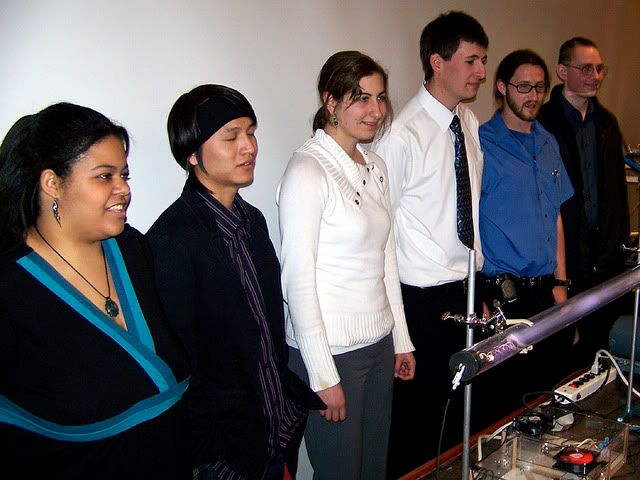
From left to right: Devon, Ivan, Sarah, Chris, Aaron, and Derek.
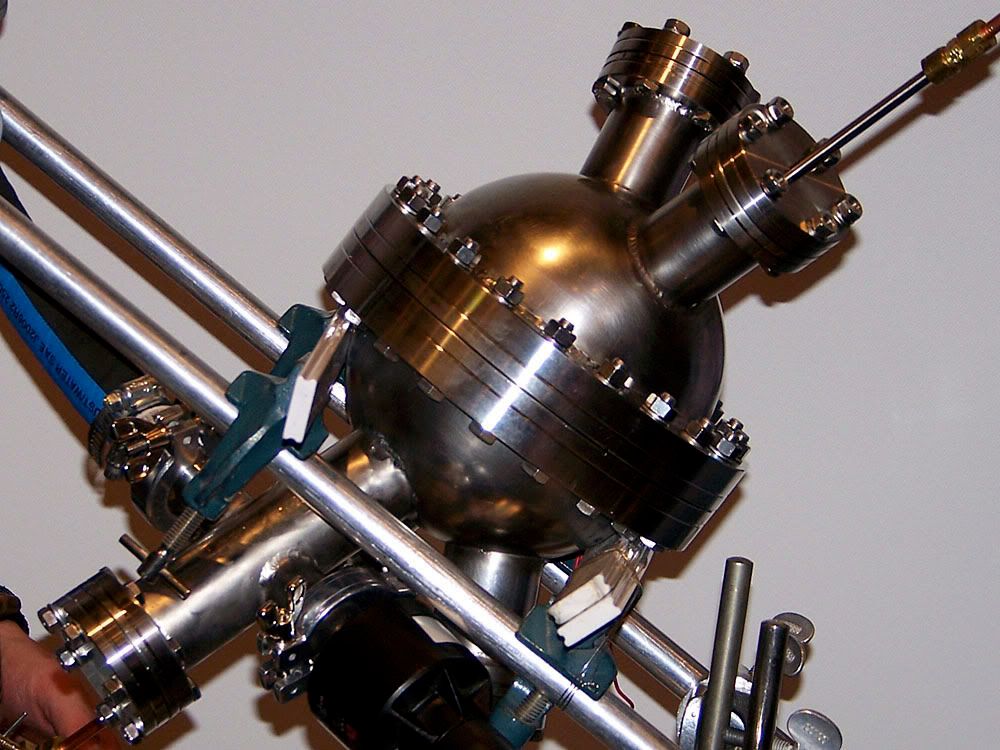
The Reactor
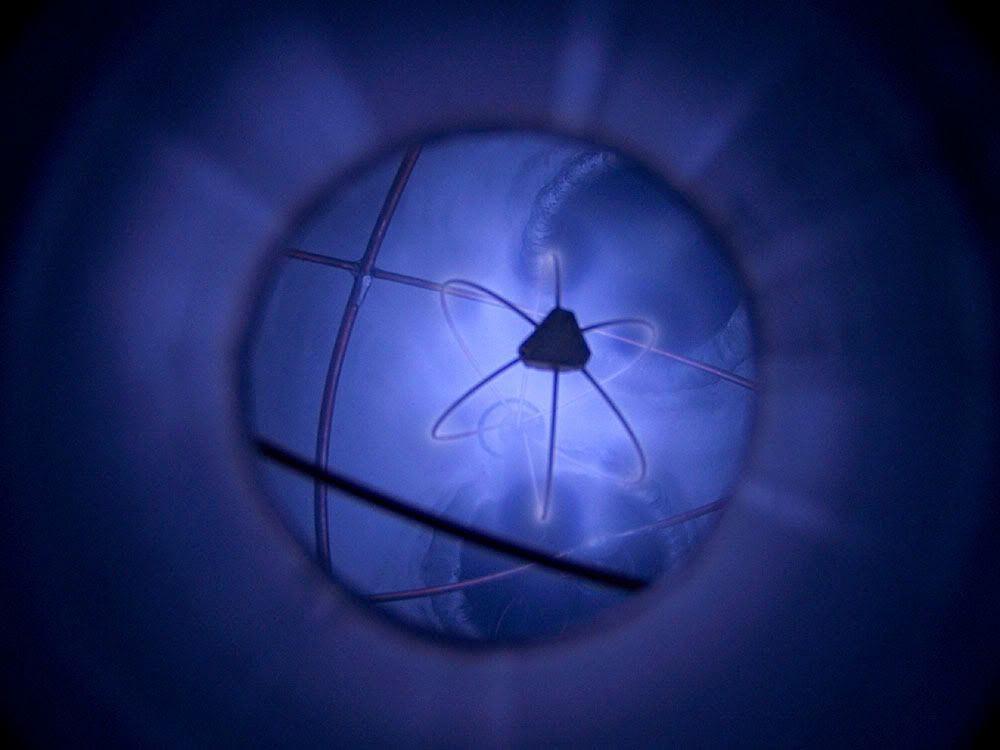
It glows
Which just goes to show that fusion research need not take big labs and big budgets. There is a lot that can be done in small labs to advance the state of the art. So let me encourage the rest of you: Start A Fusion Program In Your Own Home Town. America needs your help. The world needs your help.
Let me add that the genesis of this report was a bit done by ClassicPenny at Talk Polywell
Which just goes to show that fusion research need not take big labs and big budgets. There is a lot that can be done in small labs to advance the state of the art. So let me encourage the rest of you: Start A Fusion Program In Your Own Home Town. America needs your help. The world needs your help.
Let me add that the genesis of this report was a bit done by ClassicPenny at Talk Polywell
Saturday, May 10, 2008
Starting A Fusion Program In Your Home Town
It is getting to the point that to make advances in the field of IEC Fusion collaborative efforts will be required due to the range of knowledge required and the cost. The individual with the home built fusor is not a thing of the past by any means, but it is not the wave of the future. I have been contacted by people from Jr. Colleges who are interested in doing fusion research so that is probably the place to go. Get your local Jr. College or College interested.
Here is one College doing work in the field that I have provided some advice and direction to: Peninsula College Fusion experiments. Here is another link with more details to the Peninsula College Fusor Project. There is also this link describing the genesis of the project, the cost in materials ($3,000), and the educational benefits. They also have a very nice Resources Link page.
In that vein I have contacted Rock Valley College and Rockford College (in Rockford, Illinois) to see if I couldn't get something started. We shall see if anything comes of it.
Here are some links to get those interested started:
IEC Fusion Technology blog
Open Source Fusor Research Consortium II
The World's Simplest Fusion Reactor Revisited
Disciplines and areas touched upon in fusor construction
Standardized Fusion Test Reactors.
I'm going to add a list of Colleges and Universities that are working on small fusion (budgets under $100,000 - places like The University of Wisconsin at Madison which has a rather well funded IEC program - well above $100,000 - will not be on the list). If you get something going in your home town send me some info. I'll add you to the list.
UMass Lowell.
A Community College - no name given
Here is one College doing work in the field that I have provided some advice and direction to: Peninsula College Fusion experiments. Here is another link with more details to the Peninsula College Fusor Project. There is also this link describing the genesis of the project, the cost in materials ($3,000), and the educational benefits. They also have a very nice Resources Link page.
In that vein I have contacted Rock Valley College and Rockford College (in Rockford, Illinois) to see if I couldn't get something started. We shall see if anything comes of it.
Here are some links to get those interested started:
IEC Fusion Technology blog
Open Source Fusor Research Consortium II
The World's Simplest Fusion Reactor Revisited
Disciplines and areas touched upon in fusor construction
Standardized Fusion Test Reactors.
I'm going to add a list of Colleges and Universities that are working on small fusion (budgets under $100,000 - places like The University of Wisconsin at Madison which has a rather well funded IEC program - well above $100,000 - will not be on the list). If you get something going in your home town send me some info. I'll add you to the list.
UMass Lowell.
A Community College - no name given
Subscribe to:
Comments (Atom)


 Posts
Posts


