Showing posts with label Burnley. Show all posts

27.5.17

King George V

Image result for FA Cup George VBurnley 1914

1923


 Arsenal 1930

Image result for FA Cup George V
Manchester City 1934


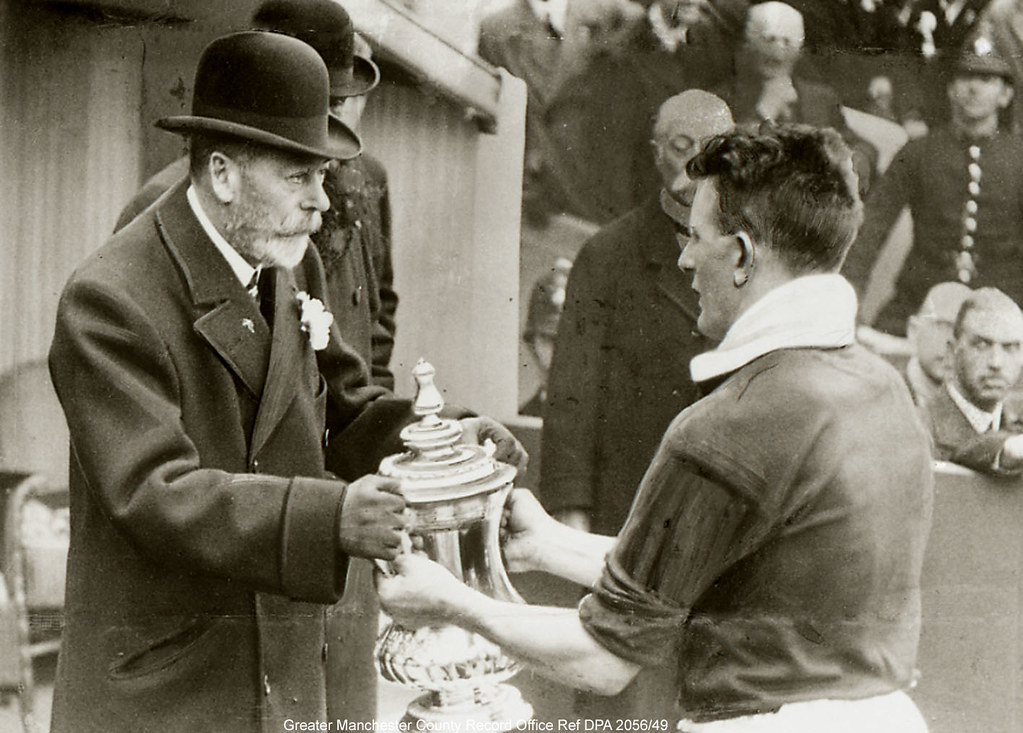
King George V was the first reigning monarch to attend an FA Cup Final (1914). He put in a number of appearances during his 26 years on the throne.
His presence at the Wembley fiasco in 1923 was said to have contributed to the relative restraint demonstrated by the 200,000 plus crowd. 


4.5.15

Bert Freeman


Bertram Clewley Freeman played a total of 321 league games, scoring 198 goals. He won 5 England caps between 1909 and 1912, scoring 3 goals. He scored the only goal of the 1914 FA Cup Final when Burnley beat Liverpool.
He began his professional carer with Aston Villa, but transferred to Woolwich Arsenal without ever having made a first team appearance. 
In 1908 Freeman was released by Woolwich Arsenal and joined Everton. This proved to be a shrewd bit of business on Everton's part, as in the 1908-09 season Freeman became the League's top scorer, with 38 goals in 37 games.  
Freeman scored 61 goals in 86 games for Everton (including 6 hat tricks). 
In 1910 he moved to Burnley, and was the  top goalscorer in the Second Division in both 1911-12 (32 goals) and 1912-13 (31 goals).

16.8.14

1914 FA Cup Final


The FA Cup Final, the first to be attended by a reigning monarch in the person of  King George V. It was the first Cup Final appearance of both clubs, and the last to be played at Crystal Palace. 
The souvenir card shows Tommy Boyle the Burnley captain, and Harry Lowe of Liverpool.
Lowe was injured in the League match at Middlesborough the week before the final. Ephraim Longworth led the Reds for the game with Burnley.

Dawson missed the final through injury.

 Referee Herbert Bamlett (a future manager of Manchester United) signals as Bert Freeman (bisected here by the crossbar) scores the only goal of the final in the 57th minute. 


The King presents the Cup to Boyle- Lord Kinnaird extreme right. 


2.1.14

Ernest Mangnall


Ernest Mangnall is the only man to have managed both Manchester City and Manchester United. 
 Mangnall's first position in 'management' was with Burnley. He  joined the club in March 1900, with relegation already a certainty.  He was in charge at Turf Moor for 3 whole seasons- after missing out on promotion by 4 points in the first there followed a modest mid table term and then re election having finished very bottom of Division 2. 
Mangnall  must have shown some administrative flair though. When Manchester United (one year on from the renaissance of Newton Heath) were looking for a new 'secretary' (United didn't have a 'manager' until 1914) he was the man they recruited. After missing out narrowly on promotion for his first 2 seasons, Mangnall guided United back into the First Division in 1905 after a 13 season absence. 
During his 9 seasons with the club, Manchester United won their first major honours, 2  League Championships (1908, 1911)  and an FA Cup (1909). 
Magnall's move to City was soured by the fact that in September 1912 he was still in charge of United when the 2 sides met at Old Trafford. The press picked up on the fact that Magnall showed undisguised joy that City  his 'new team', had won 1-0. 
The Magnall era at Hyde Road was punctuated by the war- in  8 seasons no silverware was won, but City were the dominant Manchester side.
Magnall oversaw Billy Meredith's return to City in 1921 having signed him for United in 1906. On both occasions Meredith had been on a 'free transfer'- though United had paid him a signing on fee of £500 in 1906. 

Season
Div.
Pos.
FA Cup
Burnley
157 games  36.31% win
1900-01
Div 2
3rd
R2 1
1901-02
Div 2
9th
R1
1902-03
Div 2
18th
IR2
Manchester United
471 games 51.38% win
1903-04
Div 2
3rd
R2
1904-05
Div 2
3rd
IR
1905-06
Div 2
2nd
R4
1906-07
Div 1
8th
R1
1907-08
Div 1
Winners
R4
1908-09
Div 1
13th
Winners
1909-10
Div 1
5th
R1 3
1910-11
Div 1
Winners
R3
1911-12
Div 1
13th
R4
Manchester City
350 games 43.14% win
1912–13
Div 1
6th
R2
1913-14
Div 1
13th
R4
1914-15
Div 1
5th
R3


1919-20
Div 1
7th
R2
1920-21
Div 1
2nd
R1
1921-22
Div 1
10th
R3
1922-23
Div 1
8th
R1
1923-24
Div 1
11th
semi-final
Total
978 games 46.01% win
1 Beat Newton Heath 7-1 in R1
2 IR= Intermediate round- a preliminary round before R1

Knocked out by Burnley


14.10.13

Strange days- 10 against 1

December 12th 1891- Burnley versus Blackburn Rovers at Turf Moor. In freezing conditions Burnley are 3-0 up at the interval. Blackburn are a bit slow in coming out for the second half and a fight breaks out between  Joe Lofthouse and Burnley's Alex Stewart.
The referee, no less a person than The Napoleon of Football, Mr Charlie Clegg, sends the two miscreants off. Nine of Lofthouse's teammates follow him to the changing rooms, leaving  goalkeeper Herby Arthur as the only Blackburn player on the pitch. 

Joe Lofthouse- early bath...


Herby Arthur- Offside Ref!


Mr Clegg- recognized a farce when he saw one...

Arthur is undaunted,  pointing out to Mr Clegg that there is no way that Burnley could be 'onside'. Mr Clegg is in agreement and he abandons the match. 
Burnley get the two points and Blackburn, full of contrition, are ordered to play a friendly at Turf Moor as a means of compensation. Rovers offer the explanation that their players had been too cold to continue...

4.4.13

Reddie Lang

J. J. Lang.

Originally a member of the 3rd L.R.V., Lang left that club and joined the Clydesdale in 1874. He played in the final, I think, as centre forward, and backed up Mr. J. R. Wilson. Possessing splendid dribbling powers, he was a very "showy" player, but his short steps did not make anything like the progress with the ball one imagined at the time. He was a somewhat heavy charger when he got the chance, and frequently preferred to take his man before the ball.
Scottish Football Reminiscences and Sketches by D. D. Bone 1890

James J 'Reddie' Lang was a Scottish forward who played in the 1870s and 1880s. He probably provides us with the earliest evidence of professionalism in association football.
Here are some milestones in Lang's career:

1874: Joined Clydesdale from Third Lanarkshire Rifle Volunteers.

 1874: On March 21st Lang played in the first Scottish Cup final. He was in the Clydesdale team that lost  2-0 to  Queen's Park. 


1876: Lang played in the Glasgow representative XI in their fixture against Sheffield on  February 19th. Glasgow won 2-0 and the Sheffield representatives were impressed with his display to the extent that they invited him to join The Wednesday.


1876: On March 25th Lang, still a Clydesdale player, made his international debut. He scored Scotland's 2nd goal in the 4-0 win over Wales.


1876: Lang joined The Wednesday and was given a job in the office of a blade manufacturer. He had no actual duties and stated that he used to just read the newspapers in the office. This effectively makes Lang the first paid professional in football history, although it would be another 9 years before professionalism was accepted in England and 17 in Scotland. 


1877: Lang returned to Scotland, joining Third Lanarkshire Rifle Volunteers.

1878: In his 2nd and last international Lang scored Scotland's final goal in a 9-0 rout of Wales (March 23rd).  

1878: The Scottish Cup Final-  Vale of Leven  1-Third Lanarkshire Rifle Volunteers 0. (March 30th).

1879: Lang rejoined The Wednesday. In the meantime he had lost the sight of an eye whilst working in the shipyards. He hid this minor detail from his new employers. 

1885Professionalism legalized in England.

1886: The Wednesday remained (officially) an amateur side so, ironically, Lang left the club who had paid for his services ten years before to pursue an openly professional career with Burnley. 

28.2.13

The Budapest Cup 1914

The Budapest Cup was won by Celtic at Burnley's Turf Moor on September 1st 1914. 
Burnley is 1600 km from Budapest, so some explanation is required.

Central Europe was a popular tour destination for English and Scottish clubs, and in the summer of 1914 both Celtic (Scottish Double winners) and Burnley ( then in the First Division of the Football league and 1914 FA Cup winners) undertook tours of Hungary, Austria and Germany. 

The Hungarian authorities arranged a match between the two. A silver trophy shaped like a lighthouse would be the prize, and the profits made from the fixture would be donated to charity. 
Apparently Celtic were unaware of the fixture until they arrived in Budapest.
However, 4 days after Celtic had begun their tour with a 2-2 draw against Ferencváros they faced Burnley (at Ferencváros' stadium). 


Celtic

May 21st was a hot day in Budapest and the two sides met on a dry and bumpy pitch before a crowd of around 10,000. The match was a hard and ill tempered contest. Jimmy McMennemy put Celtic in front through a  20th minute penalty. Burnley equalised from the penalty mark in the second half when Sunny Jim Young handled. Contemporary reports suggest that Celtic declined to play extra time. They agreed to travel to Burnley at a later date for a replay. The Hungarians would forward the trophy.

Burnley

Celtic continued on their tour with healthy wins over Wiener (6-2) and Hertha Berlin (6-0). VfB Leipzig beat the Scots 1-0 but BFC Preussen were dispatched 5-0.
The dates of Burnley's tour matches are not recorded clearly. However following the match with Celtic they lost 3-1 to Ferencváros before beating a Hungary Select XI. During the course of their travels thy also beat Viktoria Berlin and Rapid Vienna. The result of the match with DFC Prag is unknown.


The replay was held at Burnley's Turf Moor on September 1st 1914.
At half time with the score at 0-0 Celtic were reduced to 10 men by injury. However they took a 2-0 lead by the 70th minute through Jimmy McColl and Patsy Gallagher. Burnley got a late consolation from the penalty spot. 

 Of course, in between the 2 games, war had broken out. The intriguing trophy never reached Britain, but in 1988 Ferencváros presented Celtic with a vase to commemorate their victory.
Interestingly the clubs donated a share of the gate money from the repaly (the attendance was 10,000)  to the Budapest charities that the original match had been arranged to support (even though Britain and Hungary were now at war). 

13.7.12

The Football League 1888-89

When, in 1885, a group of clubs from the North West were on the verge of leaving the FA to form The British Football Association the FA eventually legalised professionalism, thus avoiding the type of 'great schism' that divided rugby a decade later. Professionalism was almost exclusively advocated and practised by clubs based in the more proletarian areas of the country,and the composition of the new league reflected this, with all 12 teams coming from a relatively small area in the Midlands and North West of England. Interestingly the league would only admit one club per town.
In order to generate the necessary income to support professionalism clubs needed a formalised programme of guaranteed fixtures.
Other social developments aided the development of a professional football league.   
The Factory Act of 1856 stipulated that all work would end on Saturday at 2 p.m., thus creating protected leisure time for the working man to watch or play football, and the development of the railways was also important, enabling teams to fulfil fixtures and supporters to follow their teams.


Accrington F.C.was founded in 1876. Suspended by the FA in 1883 for paying players. They dropped out of the league in 1893 and closed in 1896.  Not the later club Accrington Stanley.

Aston Villa Football Club was formed in March 1874 by members of the Villa Cross Wesleyan Chapel. Won the FA Cup and Football League 'double' in 1896–97. In 1981 the won the European Cup. They will play the 2012-13 season in the  first tier of the English pyramid.

Blackburn Rovers founded 1875. They will play the 2012-13 season in the second tier of the English pyramid.

Bolton Wanderers.  Founded  as Christ Church FC in 1874 by  Reverend Thomas Ogden, the schoolmaster at Christ Church . The club changed its name to Bolton Wanderers in 1877.They will play the 2012-13 season in the second tier of the English pyramid.

Burnley.  In  May 1882, Burnley Rovers Football Club decided to change from rugby to football. They will play the 2012-13 season in the second tier of the English pyramid.

Derby County Football Club was formed in 1884, as an offshoot of Derbyshire County Cricket Club who were seeking to generate extra revenue. They will play the 2012-13 season in the second tier of the English pyramid.

Everton was founded as St Domingo's in 1878 when the cricketers of St Domingo's Methodist Church decided to play sport year round .The club was renamed Everton F.C. in 1879. The only club to have played over 100 seasons in the top flight of English football, they will play the 2012-13 season in the first tier of the English pyramid.

Notts County are the oldest professional league club in the world having been formed in 1862,  pre-dating the The Football Association and initially playing its own variant of football. They will play the 2012-13 season in the third tier of the English pyramid.

Preston North End  were founded as a cricket club in 1863  and played their first football match in 1878, having tried their hand at Rugby from 1875. They completed the FA Cup and Football League 'double' in 1888–89, not losing a league game and not conceding a goal in the knockout competition.
They will play the 2012-13 season in the third tier of the English pyramid.

Stoke  F.C. was formed in 1863 under the name Stoke Ramblers, by pupils of Charterhouse School  engaged as apprentices at the North Staffordshire Railway works. In 1878, the club merged with Stoke Victoria Cricket Club, and became Stoke Football Club. Stoke became a city in 1928, and the club changed their name accordingly.They will play the 2012-13 season in the first tier of the English pyramid.

West Bromwich Albion was founded  as West Bromwich Strollers  in 1878 by workers from George Salter's Spring Works. They were renamed  in 1880. They will play the 2012-13 season in the first tier of the English pyramid.

Wolverhampton Wanderers were founded as St. Luke's in 1877 by pupils at St Luke's Church school in Blakenhall . In 1879 they merged with local cricket and football club The Wanderers, to form Wolverhampton Wanderers. They will play the 2012-13 season in the second tier of the English pyramid.


The Football League 1888-89- final table:

                        P   W  D  L   F   A   W  D  L   F   A  Pts
 1. PRESTON NORTH END  22  10  1  0  39   7   8  3  0  35   8   40
 2. Aston Villa        22  10  0  1  44  16   2  5  4  17  27   29
 3. Wolverhampton W.   22   8  2  1  30  14   4  2  5  20  23   28
 4. Blackburn Rovers   22   7  4  0  44  22   3  2  6  22  23   26
 5. Bolton Wanderers   22   6  0  5  35  30   4  2  5  28  29   22
 6. West Bromwich A.   22   6  2  3  25  24   4  0  7  15  22   22
 7. Accrington         22   5  3  3  26  17   1  5  5  22  31   20
 8. Everton            22   8  0  3  24  17   1  2  8  11  29   20
 9. Burnley            22   6  3  2  21  19   1  0 10  21  43   17
10. Derby County       22   5  1  5  22  20   2  1  8  19  41   16
11. Notts County       22   4  2  5  25  32   1  0 10  15  41   12
12. Stoke              22   3  4  4  15  18   1  0 10  11  33   12