
Export
Spine project files can be exported using the UI or the Data
Spine can export skeleton data as JSON or binary. This data can then be loaded by our JSON
If the size of the data file is important, use binary.
If the speed the data file is loaded at runtime is important, use binary.
JSON data is much larger than binary and loading JSON data is much slower, so generally using binary data in your applications is preferred. However, JSON is human readable and it is easy to write tools to parse and manipulate the data, if needed.
It is perfectly reasonable to export to JSON, process the JSON data, then Output folder
A JSON file will be created in this folder for each skeleton in your project. The name of the file will use the name of the skeleton.
The JSON files will use this file extension.
Spine can optionally write in JSON-like formats that are slightly smaller, easier to read, and easier to edit.
JSONStandard JSON.JavaScriptLike JSON, but names are only quoted if necessary. The data is valid JavaScript.MinimalLike JSON, but most names and values are not quoted. This format requires a lenient JSON parser, such as the one in Pretty print
When checked, the JSON is formatted to be more easily read by humans. This makes the file slightly larger.
If an older JSON version is chosen, Spine attempts to write data compatible with that older version of the Spine Runtimes. In many cases this is not possible, data will be lost, and warnings will be shown.
Exporting to older versions is intended only as a last resort to partially recover work when a project was accidentally saved with a newer version of Spine. See Nonessential data
When checked, additional data is included in the JSON data that is not usually needed at runtime. This makes the file slightly larger. This data is used if the JSON data is imported back into Spine. See Animation clean up
When checked, animation Export all
When checked, Spine will include items that have Export unchecked.
When checked, Spine will show any warning messages after exporting.
When checked, a texture atlas is packed during the data export. See Binary
Binary data is much smaller than JSON and it is very fast to parse at runtime. However, it is not human readable and it is not easy to write tools to parse and manipulate the data.
See Output folder
A binary file will be created in this folder for each skeleton in your project. The name of the file will use the name of the skeleton.
The binary files will use this file extension.
When checked, additional data is included in the binary data that is not usually needed at runtime. This makes the file slightly larger. This data is used if the binary data is imported back into Spine. See Animation clean up
When checked, animation Warnings
When checked, Spine will show any warning messages after exporting.
When checked, a texture atlas is packed during the data export. See Images
GIF
Spine can export animated GIFs, making it easy to share animations on the internet. GIF is an image format with only 256 colors, so some loss of quality may occur. GIF also doesn't support translucency, so pixels can only be either opaque or transparent.
Spine's GIF export is very sophisticated and produces the highest quality GIFs that are possible, but does not prioritize for a small file size.
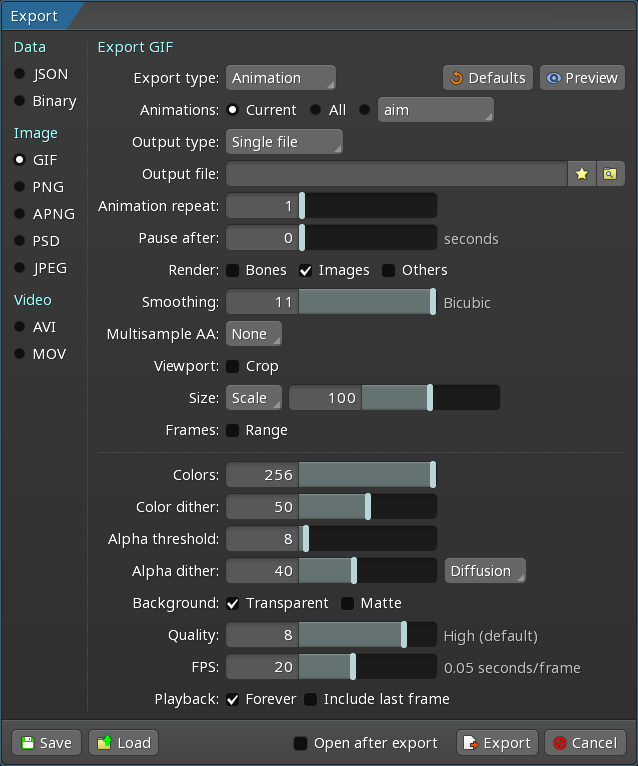
See Colors
The maximum number of colors in the GIF.
The amount of dither to apply to the GIF colors. Dither disperses the colors to prevent hard edges in gradients.
Alpha values below this value are treated as 0. Set to zero if your slots have Alpha dither
The amount of dither to apply to the GIF transparency. Dither disperses transparency to prevent hard edges. The type of dispersion and how the alpha range is used can be chosen for the best results with your images. Set to zero if your slots have Background
The background color to use.
When checked, completely transparent pixels will be transparent instead of the background color. When unchecked, the specified color is used for the background of the GIF.
Translucent pixels are made opaque using the matte color.
Higher quality produces better colors but takes longer to export.
The number of frames per second for the GIF animation. 50 generally provides the Forever
When checked, the animation is looped continuously.
When unchecked, the last frame of each animation is omitted. Unchecking this is useful for looping animations where the first and last frame are identical -- the same frame would be exported twice when this setting is checked.
PNG
Spine can export PNG image files. PNG is a lossless image format that supports transparency, so no loss of quality will occur.
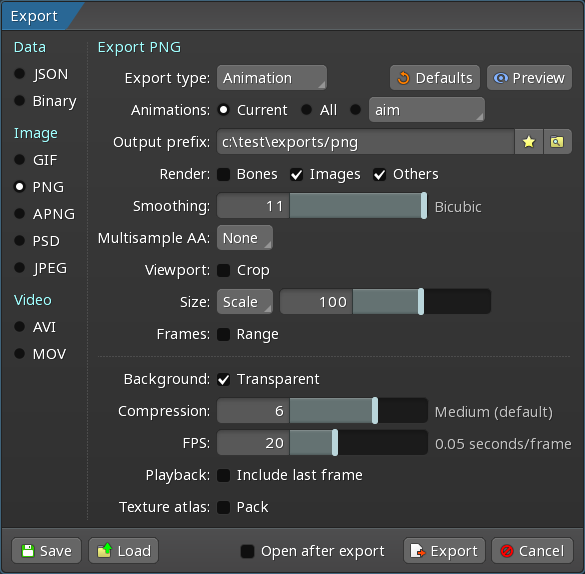
See Background
The background color to use.
Higher compression produces smaller files but takes longer to export.
The number of frames per second for the PNG sequence.
When unchecked, the last frame of each animation is omitted. Unchecking this is useful for looping animations where the first and last frame are identical -- the same frame would be exported twice when this setting is checked.
When checked, the exported images are packed into a texture atlas. This is convenient but running the texture packer separately provides more control over the packing. See APNG
Spine can export APNG image files. APNG is a lossless animated image format that supports transparency, so no loss of quality will occur. It is supported by most modern browsers and has much higher quality than GIF, but the file size is usually larger.
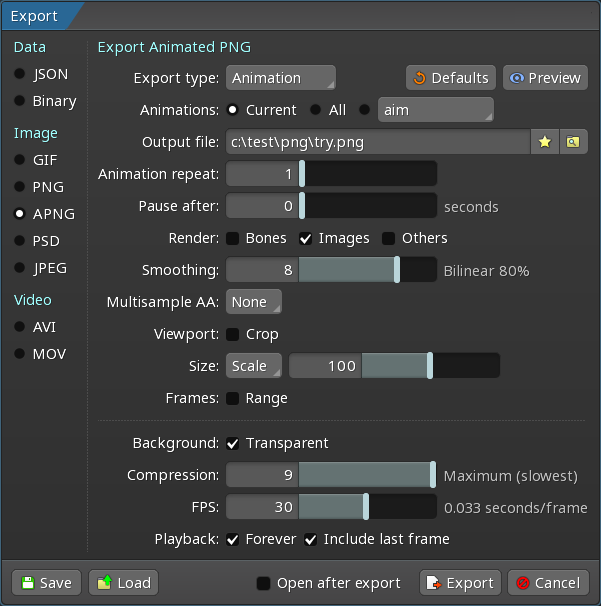
See Background
The background color to use.
When checked, the background of the APNG is set to transparent.
Higher compression produces smaller files but takes longer to export.
The number of frames per second for the PNG sequence.
When checked, the animation is looped continuously.
When unchecked, the last frame of each animation is omitted. Unchecking this is useful for looping animations where the first and last frame are identical -- the same frame would be exported twice when this setting is checked.
PSD
It can be very useful to export the current pose in the middle of an animation as layers in a PSD so you can more easily redraw attachment images for that pose.
Spine can export Adobe Photoshop PSD image files. A layer for each animation frame will be created inside the PSD file.
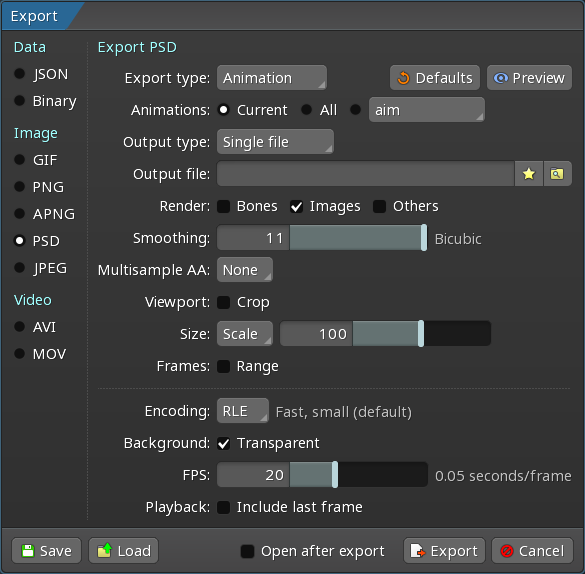
See Background
The background color to use.
When checked, the background of the images within the PSD is set to transparent.
The type of compression to use to create the PSD.
RAWAn uncompressed format. Encoding is fast but the exported PSD is very large.RLEEncoding is fast and the exported PSD is small.ZLIBEncoding is slow and the exported PSD is very small.
The number of frames per second for the PSD image sequence.
When unchecked, the last frame of each animation is omitted. Unchecking this is useful for looping animations where the first and last frame are identical -- the same frame would be exported twice when this setting is checked.
JPEG
Spine can export JPEG images. JPEG is a lossy image format that does not support transparency, so some loss of quality may occur depending on the specified quality.
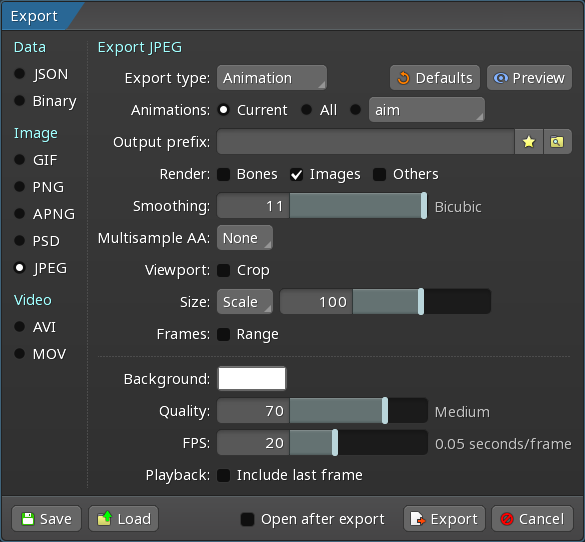
See Background
The background color to use.
Higher quality produces better images but the file sizes are larger.
The number of frames per second for the JPEG sequence.
When unchecked, the last frame of each animation is omitted. Unchecking this is useful for looping animations where the first and last frame are identical -- the same frame would be exported twice when this setting is checked.
Video
AVI
Please note that video playback support varies for different resolutions and encodings. Some video playback software is unable to play some video files, while other software can play them just fine.
Spine can export AVI video files. The RAW and PNG encodings for AVI files support transparency, which can be a convenient way to bring Spine animation into other software using a single file.
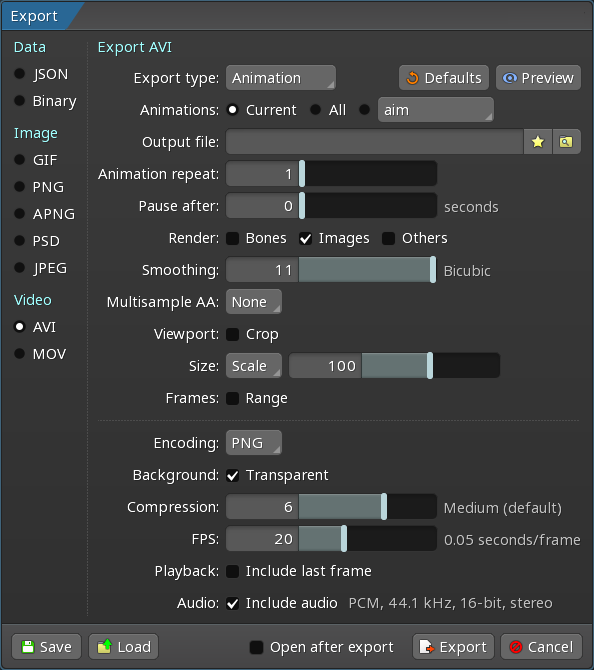
See Encoding
The codec to use to encode the AVI video.
The background color to use.
Higher compression produces smaller files but takes longer to export.
For the JPEG-based codec, higher quality produces better images but the file sizes are larger.
The number of frames per second for the AVI video.
When checked, the animation is looped continuously.
When unchecked, the last frame of each animation is omitted. Unchecking this is useful for looping animations where the first and last frame are identical -- the same frame would be exported twice when this setting is checked.
MOV
Please note that video playback support varies for different resolutions and encodings. Some video playback software is unable to play some video files, while other software can play them just fine.
Spine can export QuickTime MOV video files. The RAW and PNG encodings for MOV files support transparency, which can be a convenient way to bring Spine animation into other software using a single file.
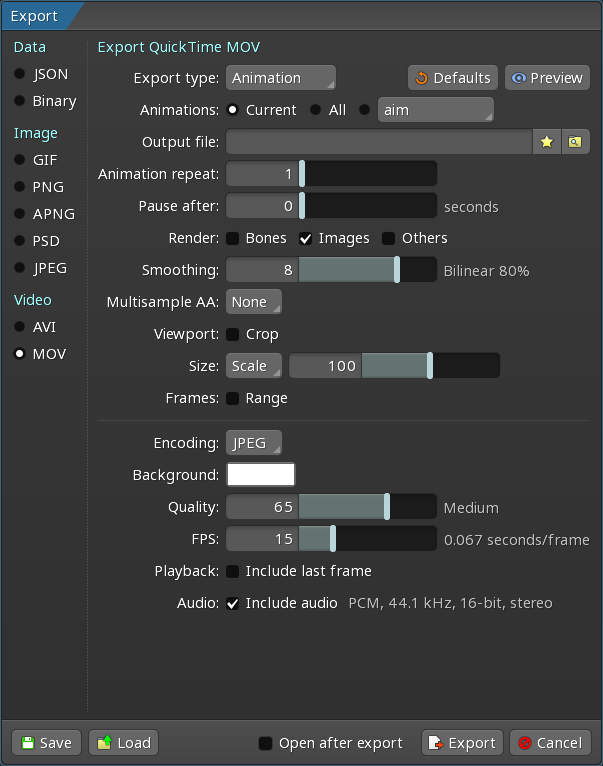
See Encoding
The codec to use to encode the MOV video.
The background color to use.
When checked, the background of the MOV video is set to transparent.
Higher compression produces smaller files but takes longer to export.
For the JPEG-based encoding, higher quality produces better images but the file sizes are larger.
The number of frames per second for the MOV video.
When checked, the animation is looped continuously.
When unchecked, the last frame of each animation is omitted. Unchecking this is useful for looping animations where the first and last frame are identical -- the same frame would be exported twice when this setting is checked.
Common settings
Most image and video exports have these settings. See the specific export section for other export settings.
| Setting | Description | ||
|---|---|---|---|
| Defaults | Resets all the export settings to the defaults. | ||
| Preview | Opens the preview panel for the export dialog. | ||
| Export type | Either animations or the current skeleton pose are exported. | ||
| Skeletons | All skeletons are rendered together in the same export, in separate exports, or only the chosen skeleton is exported. | ||
| Animations | The current animation, all the animations, or the chosen animation is exported. | ||
| Skins | The currently visible skins, all the skins, or all skins plus the skeleton without any skin active are exported. | ||
| Output type | Either creates a single file, a file per frame, a file per animation, a single file with multiple layers, or a single file with one frame. | ||
| Output file | The file to write (when a single file is exported). | ||
| Output folder | The folder where files will be written, including the beginning of the file name for each file (when multiple files are exported). | ||
| Output prefix | The folder where files will be written (when multiple files are exported). | ||
| Maximum bounds | When checked, each exported file will have the same dimensions. | ||
| Animation repeat | The number of times to play each animation. | ||
| Pause after | The number of seconds to pause after playing each animation. | ||
| Bones | When checked, skeleton bones will be rendered. | ||
| Images | When checked, skeleton mesh and region attachments will be rendered. | ||
| Others | When checked, other skeleton attachments will be rendered. | ||
| Smoothing | Controls how much smoothing is applied to the image. Smoothing is a way of blurring the image to hide the pixel structure when upscaling, meaning when images are displayed larger than their actual size.
When smoothing is greater than zero, exports are affected by the | The number of samples for multisample anti-aliasing (MSAA). See Crop | When checked, the specified bounds are exported rather than using the skeleton's bounds. The first two numbers are X and Y world coordinates. The next two numbers are the width and height of the area to export. When enabled, the bounds can be adjusted by dragging the orange corners in the preview panel. |
| Size | The type of resizing to perform. | ||
| Scale | The relative scale of the image as a percentage. | ||
| Fit | When selected, the output image will fit within the specified pixel values. | ||
| Enlarge | When checked and the image is smaller than the specified size, the image is proportionally stretched until one of the sides matches the specified size. | ||
| Pad | When checked, additional space is added to the image to match the specified size. | ||
| Range | When checked, only the specified range of frames will be exported. | ||
| Warm Up | The number of times to play each animation before export, allowing physics to start in motion. |
Preview panel
The preview panel shows a preview of the export.
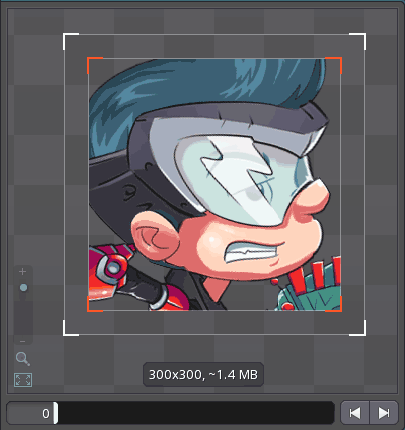
The frame slider and arrows at the bottom allow choosing the frame to preview. These frames may not correspond to the frames shown on the timeline in the Spine editor, as they depend on the FPS specified in the export settings.
A white box shows the bounds of the export. When Crop is checked, the bounds have orange corners that can be dragged and the box can be dragged to set the bounds for cropping.
The dimensions of the frame are shown in pixels along with an estimated file size for the export.
The edges of the preview panel can be dragged to resize the preview area.
Additive blending
When a slot uses additive Saving and loading export settings
Storing export files alongside your Spine project files can be useful to ensure exports are consistent. You can also save multiple files for specific outputs, such as sticker exports, along your game engine export settings.
The current export settings configuration can be saved as a JSON file by pressing the Save button in the lower left corner of the export window. This will store all the information currently displayed in the export dialog.
The saved JSON file can be then loaded by pressing the Load button in the lower left corner of the export window.
Disabling export
Skeletons, animations, attachments, and skins have an Export property that can be unchecked to exclude them from exports. For example, this is useful to use a skeleton or attachment as a background or animation reference.
To do so, select a skeleton, skin, or attachment in the tree, then uncheck Export in the properties at the bottom of the tree.

If an attachment is not exported but it is keyed in animations, the keys will not be exported. If a mesh is not exported, any linked meshes will also not be exported.