
Showing posts with label maintenance. Show all posts

Monday, 11 April 2011

Sachs 5 speed Torpedo Pentasport hub gear


This is a Sachs 5 speed Torpedo Pentasport hub gear - which is quite a mouthful of a name for a nice little german hub gear. This is the hub that will be going into my Stowaway build. It isn't stamped with a year and month as Sturmey Archer's handily are, so I can only guess at it's age. It is marked Sachs so precedes their taking over by Sram in 1997 and the 5 speed was introduced in 1987, so it's from sometime within that period.

It has got pretty respectable range of 251% which puts it a fair bit wider than a standard 3 speed (177%) and not too far away from my Shimano Nexus 8 (306%). The size of the steps between gears is also nice and even, with slightly shorter steps at either end of the range (1-2 & 4-5).

These Sachs/Sram hubs don't use a pull-chain that shorter range 3 speeds use, instead it has a 'clickbox' which clamps over the top of two push rods. The push rods are sleeved one inside of the other and when pushed in certain combinations will activate all 5 gears in sequence. It's this certain sequence that is dealt with inside the clickbox. The big advantage of this is that there is no adjustment to do, you just screw on the clickbox and hey-presto all 5 gears are selectable. The possible disadvantage of this is that the shifter, cable and clickbox come as a one piece unit. They are seperable, but each part is very specific and you can't for example just replace the cable as the cable is a solid wire with a special end fitting. You see most bike cables just have to pull, this cable has to push & pull. - which is a different kettle of fish. Basically if you need a new one, just go on ebay.de and buy the whole thing for a few euros.

Another aspect to this hub is the metal cover plate on the drive side of the hub. It's quite large. Meaning that the hub can't accept very small sprockets such as 15/14/13 maybe also 16. I haven't tested further, but it should be ok with sprockets larger than this. You can see in the wheelbuilding photos below that I've put a 15 tooth on just to hold the plate on whilst I do the build and this doesnt have enough clearance. This would probably make the hub unsuitable for smaller wheels such as a Brompton as they need small rear sprockets to maintain.a sensible gear range. But on this bike with 451mm wheels a 46 tooth front ring and, for example, an 18 tooth rear would give gear inches of 32 to 81 - a nice range.

I did open up the clickbox on mine out of simple curiousity and it was a bit of a mixed bag, it was a good thing because I renewed the grease inside of it, but a bad thing because it is quite fiddly to put back together.


Above is a view of the inside of the clickbox with some new grease in there. There isn't anything to worry about with this though, the casing and components are very solid and it is very well sealed. I only opened mine to regrease it because this thing is a minimum of 14 years old.

I've had this hub for a while, having got it off ebay in the spur of the moment sometime last year. So when I started thinking about what to put in my Stowaway built this seemed the obvious choice. Before I started building it into a new 451mm wheel I opened it up for the first time just to check if it needed regreasing.
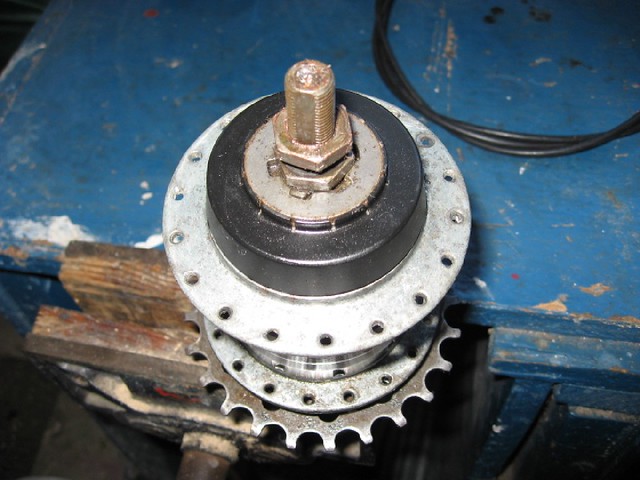

It's a very simple hub to open. Much simpler than for example the well known Sturmey AW 3 speed. All you have to do it undo the two nuts on the none drive side (shown above),....
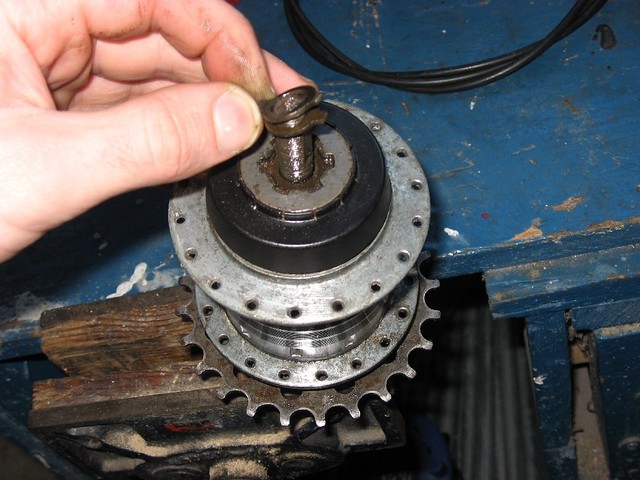
....then slide off the two retaining washer thingies.....
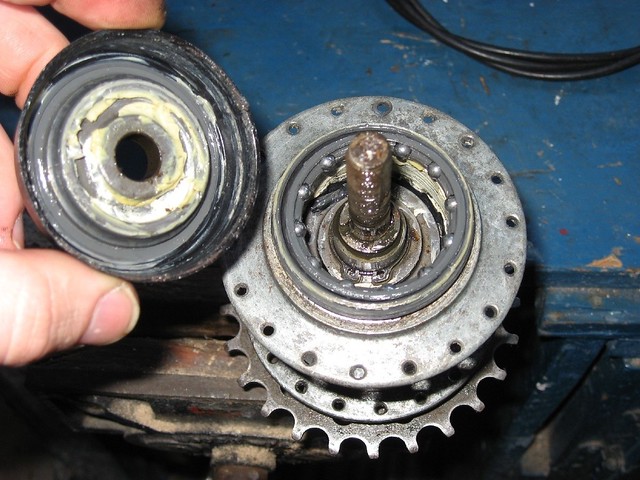
...and take off the big plastic dust cap. Once you have done that then the entire hub shell just lifts away from the internals - see below.
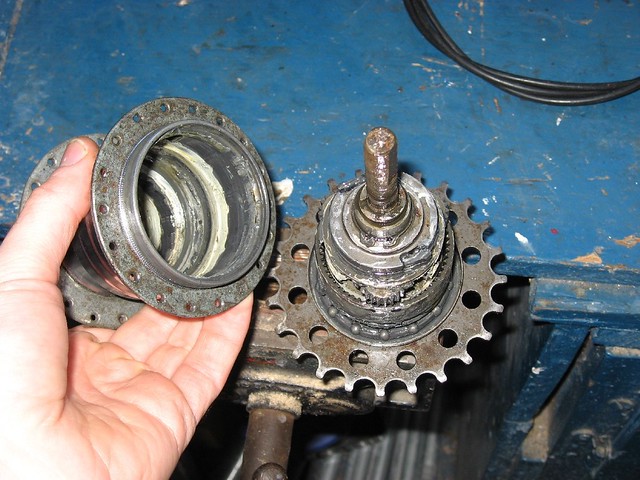

At first glance the inside of the hub doesn't look too delightful. but looking closer its actually very well greased up and doesnt require any attention. It has been regreased at somepoint by a previous owner using somekind of grey moly grease. Whatever it is, it is working just fine, so for the time being I'll leave it as it is. Below is the internals side by side with the shell.

With that done it's time to build it into the rim.
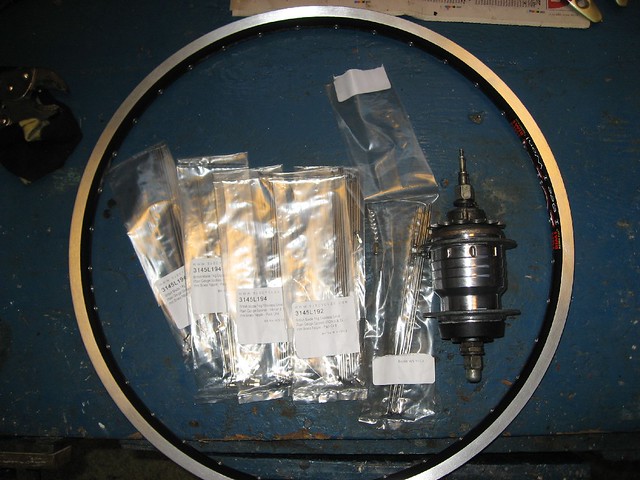
First of all the wheel needed a slight dish and fingers crossed this will all line up ok when the bike is built. Secondly the Damon Rinard spoke calculator Excel spreadsheet on Sheldon Brown's site came up with needing spokelengths of 198.5mm and 201.1mm for a 2 cross pattern. However I knew from building the Hopper that the calculator seems to overvalue the lengths by around 6mm. Maybe I'm using it wrong (I'm pretty sure I'm not), but I ordered lengths of 192mm and 194mm from SJSCycles and low and behold they were the perfect size. The rim is a Sun Ringle ICI-1 from Chainreactioncycles. They are very nice rims and the cheapest 451mm that it seems you can get with 36 spokeholes.
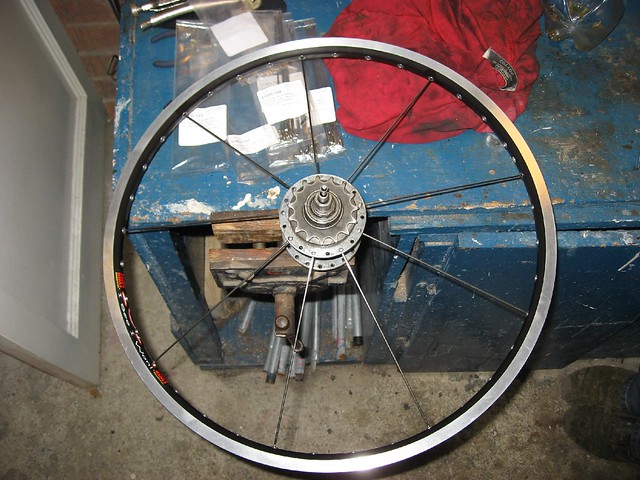

Starting off by loosely fitting a spoke from every other flange hole to every 4th hole along rim hole.
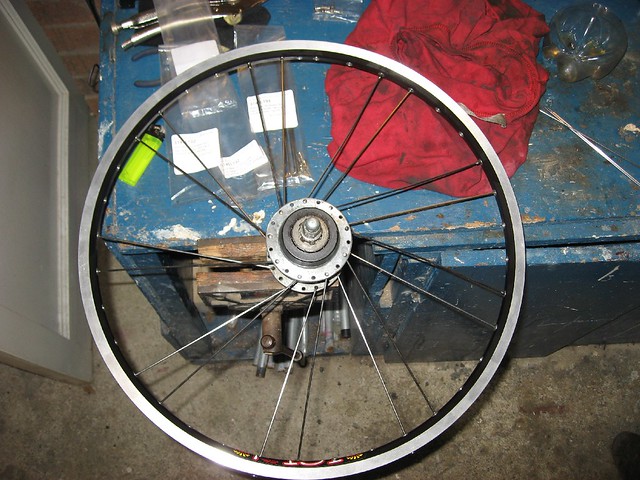
Then doing the same on the otherside
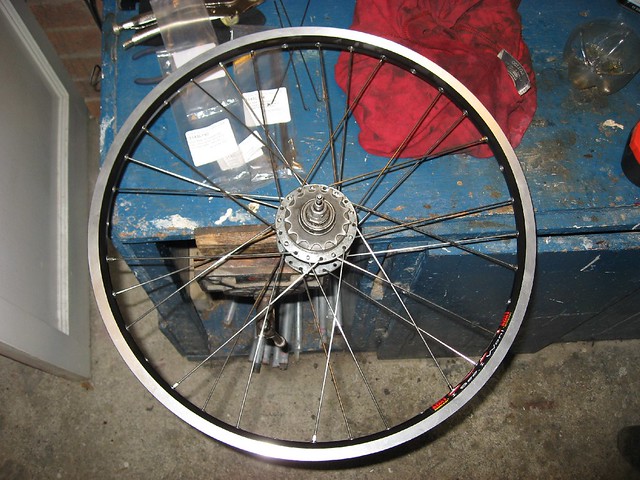
Now you start crossing the spokes by filling in the gaps on the hub flange with spokes coming in from the opposite side, crossing over the top of the next spoke and crossing under the spoke beyond that. That probably makes no sense, but there are much better wheelbuilding tutorials on the web than I can offer, besides the best way to understand it is to just build one and find out.
And repeat on the opposite side. Easy really. This is the first time I've built a wheel using brand new rims and I can tell you it is infinitely easier than using secondhand rims or existing ones from your bike. It simply laced up and was running tight and true without the slightest bother. (The Hopper wheels - built from well used BMX rims where the complete opposite and a real pain in comparison)


Wednesday, 6 April 2011

Shimano Nexus 8 Review & Regrease


I've had my Nexus 8 hub for about 9 months now. In that time it's been ridden almost everyday of the week in all weathers, in particular through a very snowy winter period when temperatures were down to -9 at times. I bought it second hand off ebay, meaning it had done at least X? number of miles before I started riding it. I guess this means someone had already 'bedded in' the hub first so I can't comment on how the Nexus 8 runs during that period. I can however say for certain that it once bedded in and doing decent daily mileage the hub performs beautifully, smooth and reliably.

I commute a minimum of 15.5 miles per day and often do as much as 20 miles depending on the route, meaning the hub has been doing around 80 miles + on average per week.

My hub is the SG-8R31 which I think is the current standard model of the Nexus 8. The SG-8R36 being the premium redband version which is better in some way (possibly rated for off-road use, I'm not sure. The alfine certainly is for off-road use though and also takes a disc brake). If you google for reviews and info about Nexus 8 hubs it can be easy to be put off when you come across the odd forum thread or blog post complaining about their hub being ruined by water ingress. It's my guess that these issues will all be relating to earlier versions of the hub such as the original SG-8R20 which may have had different designs of seals. 

The other possibility is that the issues have arose on hubs which have a roller brake fitted. If I was to fit a roller brake to my hub it would involve removing the plastic cover and an aluminium cap from one side to reveal the roller brake attachment. The problem with this that those two items do a very good job of sealing the hub on this side, without them - maybe the roller brake is not as good at providing a seal. This is total speculation on my part, but it does make sense when you are examining the hub itself. All I can say for my hub is that water ingress has not been a problem whatsoever. & this hub has been ridden straight through the middle of lakesized puddles, torrential Mancunian downpours and freezing snowy mornings.

The shifting is even and smooth. It is much easier to change down a gear than it is up. That's not to say it's difficult to change up gear, it's just extremely easy to change downwards. You can literally flick the hub right down the gears with one finger, even when under a mild pedalling load, which is a joy when you need to quickly lower the gearing on the go (Something you would struggle to do on a derailuer). The grip shifter is a decent piece of kit, but the plastic screen is quite susceptible to being scratched when you have the bike upside down (such as when fixing a puncture on the street). 

A huge bonus of hub gears is that they are very easy and simple to adjust and once adjusted they are much less likely to need anymore attention - unlike a derailuer gear setup. The Nexus takes this a step further, as there are yellow alignment markers on both the top and bottom of the hub. With the hub in 4th gear, when these markers are aligned - then it's adjusted correctly. That's it, job done. This makes the Nexus even easier to adjust than a Sturmey Archer, which can require a bit of trial and error to get it adjusted correctly.

For the first few months I was riding the hub whilst using SPD clipless pedals, it works just as well in this setup as it does with flat pedals. When Shifting you just have to ease off the pedalling more when using SPDs than you do without.

So in conclusion of this rather ramshackle review here's a few of my main pro's:
  • One gear shifter
  • Extremely easy adjustment (almost fit & forget)
  • Allows the use of a Hebie Chainglider
  • Totally sealed and virtually silent gears
  • Wide 306% range of gears is more than enough for anything I've needed (there are some big hills around here)
I'm not going to do a list of con's because there really aren't any when you compare it to the alternatives. OK if you want absolute lightness to gear range ratio than a derailuer is better, but this hub is not for racing, it is for town and commuting bikes which need reliability, minimum maintenance and a decent gear range for a decent price. Of all those aspects I don't think there is much else that can beat it. Obviously a Rohloff or other examples are better in their own respects, but factor in the price and a Nexus 8 takes the prize for me on my commute. I'm not saying I wouldnt' want a Rohloff, a Nuvinci, a Sturmey 8, or Sram - I'd love to have them all ;-) but a Nexus 8 is what I've got and I'm very pleased with it.

Now onto the regreasing. Last week I came across this excellent post by The Golden Wrench & whilst my hub felt fine and was still running as nice as the day I first got it I decided there was no harm in finally opening it up for the first time and regreasing the outer bearings as a purely preventative bit of maintenance.

Before you start this, bear in mind that although I know a little more than your average joe about hub gears, I'm not a qualified bike mechanic and I'm happily making this up as I go along. - take apart your expensive shimano hub gear at your own risk - not on my guidance ;-)
So lets get started:
The hub still in the frame. It's covered in road dirt and I need to remove my Hebie Chainglider in order to remove the wheel.
This is the outer gear changing mechanism. It removes very easily by twisting the lock ring in the opposite direction to the arrow (which lines up the yellow dots)
With the mechanism removed, you reveal a locknut, some more gear changer parts and the clip for holding the sprocket in place. There is a little plastic ring cap which just prises off (that's what I'm holding)
With the sprocket removed, you can see how dirty it is behind. This is no problem and even after I've cleaned it this grime will build up again after a bit of use.
Flip the hub over and we have the plastic cover which protects the rollerbrake attachment. Remove the big nut and prise off the plastic cover along with the aluminium cone.
Underneath we find the rollerbrake attachment and the top of the bearing cone. This grease had mixed with water a little, but this is outside of the hub. Some time around this point I gave the wheel and the outside of the hub a bit of a clean to remove any loose crap. I'm not totally relubricating the hub here, so I don't want any loose crap getting inside the depth of the gears by accident.
Undo the two nuts to free the hub internals from the shell. It took a bit of a firm tap to free the internals from the hub shell - proof of how well sealed the rubber seal was on the otherside.
Here is the internals straight from inside the hub shell. Everything was still well coated in grease, albeit a little sparingly. No signs of corrosion or ingress at all.
The inside of the hub shell looks like it has just come from the factory.
Presumably the pink spots of grease are something from the factory process. Or maybe a marker for Shimano to tell whether or not the hub has been DIY'ed by someone like me. There is a gap in the needle bearings here - No idea why.
I cleaned off the outside grease and removed a bit from these built up areas inside which had collected some dirt.
The grease all wiped off. As you can see the hub is still in great condition.
Inside the shell after giving it a wipe.
This is as far as the disassembly got.
All the bearings got a thorough coating in Shimano's internal hub grease. I followed the example on Golden Wrenches post of how much to put on, but I think this was probably a bit over the top. Better than too little though, I guess.

**UPDATE**: After a few weeks I decided that my gut feeling had been right and that this was too much grease afterall. The hub just felt a bit too draggy in 7/8th gear and wasnt freewheeling as well as it had previously. so I took the internals out again and removed around 2/3rd of the grease. everything then felt alot easier on the legs when cruising at higher speeds.

After putting the internals back in and turning them a couple of times I took it back out and took this photo to show how quickly the grease spreads around to where it's needed.
There'll be lots of excess over the rubber seal ring. The tolerances in this hub are tiny, it's a joy to see after opening 1970's Sturmey Archers with massive gaps all over the place.
Flip the hub over and put the race back in (the correct way up - I always get this wrong - photos help) and grease it.
Put the bearing cone back on finger tight. This will lock the internals back in place. Helpfully this screws onto its own seperate thread and not the long axle thread as is the case on many other hubs - that saves a boring task of screwing it all the way back down.
Grease the back of the dust shield and stick in back on.
Grease the back of the 2nd metal dust shield and stick that on too. Then refit all the little parts of the gear changer mechanism and lock them in place with the retaining nut.
Then you can refit the sprocket and put the outer gear change mechanism back on by lining up the red dots. then lock this in place with the yellow dotted lock ring.
Flip the hub back over and grease up the inside of the rollerbrake attachment cover & stick it on.
Then do the same with the metal cover. Then lock these down with the big retaining nut.
When it's all back together and back in the frame the hub was a tiny bit out of alignment - see the yellow lines don't quite line up.
A couple of twists on the handlebar adjuster and it was back in alignment.

With this done the gear change was immediately nicer and more solid feeling, even though it felt fine beforehand. The was a slight tick when freewheeling in the higher gears of 5-8 which are on a different clutch from gears 1-4, but this bedded in and disappeared after about 30 miles. Job done.

Tuesday, 12 October 2010

Hebie Chainglider (Nexus Part 7)

I've owned a Hebie chainglider for a few weeks now, but have only just managed to fit it last weekend.  Now it's on, it's amazing, but getting the thing fitted has been a complete pain in the arse.

First of all SJS Cycles (and many other stockists) sell the chainglider in two formats. One size fits 38 tooth chainrings, the other is supposed to fit both 42 & 44 tooth chainrings, which is the one I bought. Except this product fitting onto a 44 tooth ring is just a lie. It simply doesnt fit and I suspect the people out there that complain of excessive drag from a chainglider have been duped by this same situation and have forced their chainglider onto a chainring that is too big for it.

It took me a while to decide that it's not me going crazy or being simple and not understanding how it's supposed to fit, but that it simply doesn't fit anything other than a 42.

It's not Hebie's fault, looking closer at their website, the chainglider fits only distinct seperate rings and they don't state otherwise.There is no version that fits both 42 & 44. The one I got had 350 42 stamped on the back -i'ts been designed for a 42 tooth ring - nothing else. Who knows why the stockists they sell it as anything else. (except Velorution who seem to market it properly - I should've bought it from there)

So ok, nevermind. It just means I had to get a 42 tooth ring instead. So I ordered one from a seller on ebay and they sent me a chainring for a tandem!. So that went back for a refund and I got a Stronglight chainset from another seller instead. There are cheaper options available than a Stronglight, but they have the chainring bolted on, whereas the Stronglights are a lovely minimalist piece of kit that is certain to work inside the chainglider.

Here is the bike with 42 ring fitted and chainglider.
The next problem is that the chainglider is designed to fit a variety of sized frames and wheeled bikes. There is plenty of adjustment range on the back, but it was just too long to fit on my 26" wheel bike. So I had to chop some off.

I cut just enough off for it to work without fouling on the rear sprocket teeth.

Once that was done it was very straight forward and easy to fit, everything just clips into place. The plastic it's made from is pretty flexible soft feeling stuff, but it does feel solid and durable at the same time. Getting the inside section that covers the rear sprocket is a tiny bit tricky as it has to go behind the nexus hub gear cassette joint then the back section slides over and clicks into place on four little studs.

There is a demonstration video on the Hebie website to show you how to fit it. That shows the newest model, it has a fancier clipping system than mine which must have come from existing stock of the older design.

Here it is fully fitted.


I'm suprised just how silent and drag free it actually is (i.e. barely any difference from before). I gave the chain a good spray of chainlube before and after fitting. More than I would normally use on an open chain but certainly not a huge amount. Now the whole rigmoral is over I'd definately recommended the chainglider to anyone wanting to fully enclose their chain. But I would say that you need to be prepared to do some of your own work. I'm sure in some cases you can just fit it straight out of the box, but I'd imagine that anything with 26" wheels will require a little chopping, as I've done.

There isn't much info available about the kinds of problems I've encountered with fitting the chainglider, just a few complaints from people who I would guess have tried fitting it to chainrings that are too large or have not done some trimming to make it fit the rear sprocket. So hopefully this post can help anyone thinking of getting a chainglider, because it really does seem like a decent piece of kit to me.

An added bonus is that the hub seems to be running nicer with a 42 chainring. 42/20 is exactly on the 2.1 ratio that Shimano recommend you keep as close to as possible and it's noticeable how the change either side of 4th has improved a bit.

**Small update after 3 months use**
The chainglider is still performing brilliantly through rain, sun & snow. It's there to be forgotten about and quietly gets on with its job. 

I had been giving the chain a quick spray of chainlube through the little hole on the top every so often until a few weeks back when I noticed the chainglider was skipping occasionally on the way home. After taking it off to have a look I could see the chain was pretty dry so I've come to the conclusion that whereas the spraylube it great on open chains it's not the right stuff for inside the chainglider.- Obvious in hindsight, but the spraylube had impressed me so much on my open chains that it was just the first thing I reached for when I put  the chainglider together.

If you think about it, one of the benefits of having the chain completely enclosed is that you can have it bathed in copious amounts of oil without worrying about it going all over your trousers. So I put it back together with plenty of oil on the chain and plenty on the inside of the glider's parts. Then rotated the cranks a few times whilst pouring yet more into the oiling port.

It's now running seriously smooth & I wish I'd just done this right from the start. There was a little bit of excess made its way out of the rear section the next day, but hardly any really.

All in all an excellent piece of kit that lets you just use the bike for everyday transport.

Tuesday, 28 September 2010

Bike kit

This is the simple set of tools that live somewhere in the bottom of my pannier bag.


  1. Punture repair kit (with tyre levers inside)
  2. Crappy Muiltispanner
  3. Decathlon multitool
  4. Real spanner
  5. Mini pump 
Plus I keep an old sock tied to the seatpost, which is just for using as a rag if I ever need to touch the chain when out on the bike.

That's it. It's not much stuff and doesn't weigh much or take up much room. Obviously the main reason to carry this stuff is incase I get a puncture and need to do a roadside repair. But since March 09 when I started commuting everyday by bike I haven't had a single puncture to repair*, so this kit hasn't been a whole lot of use really but one day it might be the difference between a very bad day or just a slight inconvenience.

You have to hope that more people will steadily begin to commute by bike, but I can imagine something as simple as a puncture putting people off, so my tips would be:

  • Keep your tyres inflated fully - you are talking 50 psi+ even for cheap mountain bike tyres - much higher for skinny road tyres or small wheelers.
  • Carry a simple kit of tools like above.
  • If you're not prepared to do that - at least get a set of puncture resistant tyres such as Schwalbe Marathons. 
  • Stay out of the gutter - not just because it will encourage drivers to blast past you without a care but also because thats where all the glass and nails collect.
  • Don't go hopping on and off kerbs all of a piece - it pinches the tubes and twists rim tape.
  • Keep an eye on your tyres - give your tyres a once over every so often to check for any cuts or shards. - letting the air out temporarily will allow you to squeeze the tyre to reveal any nicks or shards embeddded in the rubber.
  • People also tends to get a number of punctures all at once. Probably because they've repaired the tube but not examined the tyre to make sure whatever caused the puncture in the first place isnt still embedded, waiting to cause another.

*Footnote:
I had this post all ready and lined up for posting when suprise suprise, I get off the bike at home to the sound of 'pssssssssssttttttttttttttttttttttttttt'. Puncture. Sods law strikes again. Anyway, at least it was at home and not halfway through the journey. So I'll be taking my own advice and replacing the Cityjets on the Nexus with a pair of Marathons as I'd orginally intended. 

Here's the bugger. A tiny shard of brown glass (do they even make brown glass anymore?, where the hell did that come from)


Tuesday, 24 August 2010

Getting ready for the Marin Trail

A few things to do before we go to the Marin Trail

With my brothers help we did some bodging to my old Raleigh to get it ready for the first ever bit of actual mountain biking it's done in the 14 years since it rolled out of Nottingham.

To start with:

Swap the rear deraileur that doesnt fit properly.....
...for one that does...
The one that didnt fit properly was a replacement off ebay many years ago after the original disintegrated on the streets of Newcastle. It worked perfectly well for riding on the streets, but would have been a major liability on bumpy single tracks. While we were at it, I replaced the gear cable for a new one since shiny new cables tend to work better than rusty 14 year old ones.


Then the big job - swap the fork for the cheapo suspension fork I bought a few weeks ago.
Satisfyingly large spanner for the headset


The bearings were in reasonable condition, but the bottom bearings were in desperate need of some new grease.

With the fork out, it got clamped in the vice....


...and the bottom bearing ring given some gentle persuasion to come off with a big pointy thing and a big hammery thing.

When that was off we found the bearing ring wouldnt fit onto the new fork. Being cheapo and chinese it hadnt been machined enough (you get what you pay for). After a bit of dremelling though it went on nice and tightly with a few knocks from a mallet.


The new fork had a shorter steerer than the original one. So we did away with the two original spacers to leave enough thread for the main nut to go back on.

With no compression on the fork you can see that the angle of the top tube has been raised by a couple of inches. I've no idea of this is good or bad - probably neither as the fork will compress with my weight over it as I go down the hills.


And finally a tiny bit of bodging to make the rear splattergaurd stay straight. These things are forever getting knocked to one side and are frankly a bit crap, but this should make it slightly less crap. One of many, many things that can be fixed with a hole and a ziptie.

Pump some air into the excessively knobbly Tioga Psycho II tyres and we are ready to go!