Showing posts with label war. Show all posts

Wednesday, October 9, 2024

Proportionality and deterrence

There are many contexts where a necessary condition of the permissibility of a course of action is a kind of proportionality between the goods and bads resulting from the course of action. (If utilitarianism is true, then given a utilitarian understanding of the proportionality, it’s not only necessary but sufficient for permissibility.) Two examples:

  • The Principle of Double Effect says it is permissible to do things that are foreseen to have a basic evil as an effect, if that evil is not intended, and if proportionality between the evil effect and the good effects holds.

  • The conditions for entry into a just war typically include both a justice condition and a proportionality condition (sometimes split into two conditions, one about likely consequences of the war and the other about the probability of victory).

But here is an interesting and difficult kind of scenario. Before giving a general formulation, consider the example that made me think about this. Country A has a bellicose neighbor B. However, B’s regime while bellicose is not sufficiently evil that on a straightforward reading of proportionality it would be worthwhile for A to fight back if invaded. Sure, one would lose sovereignty by not fighting back, but B’s track record suggests that the individual citizens of A would maintain the freedoms that matter most (maybe this is what it would be like to be taken over by Alexander the Great or Napoleon—I don’t know enough of history to know), while a war would obviously be very bloody. However, suppose that a policy of not fighting back would likely result in an instant invasion, while a policy of fighting back would have a high probability of resulting in peace for the foreseeable future. We can then imagine that the benefits of likely avoiding even a non-violent takeover by B outweigh the small risk that despite A’s having a policy of armed resistance B would still invade.

The general case is this: We have a policy that is likely to prevent an unhappy situation, but following through on the policy violates a straightforward reading of proportionality if the unhappy situation eventuates.

One solution is to take into account the value of follwing through on the policy with respect to one’s credibility in the future. But in some cases this will be a doubtful justification. Consider a policy of fighting back against an invader—at least initially—even if there is no chance of victory. There are surely many cases of bellicose countries that could successfully take over a neighbor, but judge that the costs of doing so are too high given the expected resistance. But if the neighbor has such a policy, then in case the invasion nonetheless eventuates, whatever is done, sovereignty will be lost, and the policy will be irrelevant in the future. (One might have some speculation about the benefits for other countries of following through on the policy, but that’s very speculative.)

One line of thought on these kinds of cases is that we need to forego such policies, despite their benefits. One can’t permissibly act on them, so one can’t have them, and that’s that. This is unsatisfying, but I think there is a serious chance that this is right.

One might think that the best of both worlds is to make it seem like one has the policy, but not in fact have it. A problem with this is that it might involve lying, and I think lying is wrong. But even aside from that, in some cases this may not be practicable. Imagine training an army to defend one’s country, and then having a secret plan, known only to a very small number of top commanders, that one will surrender at the first moment of an invasion. Can one really count on that surrender? The deterrent policy is more effective the fiercer and more patriotic the army, but those factors are precisely likely to make them fight despite the surrender at the top.

Another move is this. Perhaps proportionality itself takes into account not just the straightforward computation of costs and benefits, but also the value of remaining steadfast in reasonably adopted policies. I find this somewhat attractive, but this approach has to have limits, and I don’t know where to draw them. Suppose one has invented a weapon which will kill every human being in enemy territory. Use of this weapon, with a Double Effect style intention of killing only the enemy soldiers, is clearly unjustified no matter what policies one might have, but a policy to use this weapon might be a nearly perfect protection against invasion. (Obviously this connects with the question of nuclear deterrence.) I suppose what one needs to say is that the importance of steadfastness in policies affects how proportionality evaluation go, but should not be decisive.

I find myself pulled to the strict view that policies we should not have policies acting on which would violate a straightforward reading of proportionality, and the view that we should abandon the straightforward reading of proportionality and take into account—to a degree that is difficult to weigh—the value of following policies.

Thursday, March 3, 2022

The law enforcement model of war

When an army invades a country, the invaders break a massive number of that country’s laws. They kill, commit assault and battery with deadly weapons, recklessly endanger lives, and destroy property, and do all this as part of a concerted conspiracy. And they break all sorts of more minor laws, by carrying unlicensed weapons, trespassing on government property, littering, and presumably violating traffic laws all the time (I assume one can’t slow down the progress of a column of tanks by putting up a stop sign).

This means that there is an intermediate position between just war theory and complete non-violence. This intermediate position holds that law enforcement can appropriately make use of violent means, including lethal violence when this is proportionate, and that when one’s country suffers an unjust invasion, one may (and maybe often should) legitimately engage in appropriately violent law enforcement activities against the enemy. Call this the law enforcement model of war.

I do not advocate the law enforcement model, but it is interesting to think just how it would differ from the two more standard options.

The difference from complete non-violence is clear: on the law enforcement model, violent action in defense of the country’s laws is permitted whenever proportionate. Thus, it would be permissible to destroy a tank because it is a part of a conspiracy to commit murder and destruction of property, but not because it is simply refusing to stop at a stop sign. (And discretion being the better part of valor, issuing traffic tickets in the latter case is probably not a good idea.)

The differences from just war theory are also significant, though more nuanced. While in most cases where traditional just war theory permits a defensive war, the law enforcement model would also permit defensive violence, there would be significant limitations on offensive wars, due to the fact that law enforcement is bound by significant limitations of jurisdiction. While on traditional just war theory, the fact that Elbonia is violently persecuting a Kneebonian ethnic minority on Elbonian soil might be a sufficient just cause for a war, on the law enforcement model, execrable as such persection is, it is likely to be outside of the proper jurisdiction of Kneebonian state law enforcement. Indeed, there may have to be significant limits to extraterritorial defensive operations, though some version of the doctrine of “hot pursuit” may be helpful here.

Interestingly, the law enforcement model in one respect seems to point to greater violence. The presumption in law enforcement is that criminals are not only stopped but also punished. This suggests that on a law enforcement model, we would have a presumption in favor of putting all captured invading soldiers on trial. However, even in ordinary law enforcement, punishment is only a presumption, and it can be waived for the sake of significant public goods. In the special case of defending against invaders, having a general waiver, with exceptions tailored to mitigate the worst of evils (say, attacks on defenseless populations), in order to encourage the enemy to surrender would be prudent.

In regard to the waiver of criminal penalties, it is interesting to note one difference between how we feel about war and about ordinary crime. In the case of ordinary private crime, we do not feel that it is qualitatively worse when the criminal murders a civilian rather than a police officer—indeed, we tend to feel that there is something particularly bad about murdering a police officer. In the case of war, however, we do feel that it is much worse to kill civilians. On the law enforcement model, this difference in attitudes does not seem right. But the difference can still be defended within the law enforcement model. In typical cases, soldiers fighting an unjust war are subject to incessant propaganda that they are fighting for justice. There is thus a significant probability that they are not culpable for killing enemy soldiers, because they are rationally convinced that justice requires enemy soldiers to be stopped with lethal force. But it is much harder to come to a rational conviction that justice requires enemy civilians to be stopped with lethal force. Therefore, even if in an unjust war the intrinsic wrong of killing soldiers is just as great as that of killing civilians, there is a significant difference in likely culpability.

As I said, I do not endorse the law enforcement model. But I think it is an interesting model. And I think it presents a significant challenge to those pacifists who think that law enforcement violence is sometimes justified but that violence in war never is.

Tuesday, November 16, 2021

Subjective guilt and war

One of the well-known challenges in accounting for killing in a just war is the thought that even soldiers fighting on a side without justice think they have justice on their side, hence are subjectively innocent, and thus it seems wrong to kill them.

But I wonder if there isn’t an opposite problem. As is well-known, human beings have a very strong visceral opposition to killing. Even those who kill with justice on their side are apt to feel guilty, and it wouldn’t be surprising if often they not only feel guilty but judge themselves to have done wrong. Thus, it could well be that soldiers who kill on both sides of a war have a tendency to be subjectively guilty, even if one of the sides is waging a just war.

Or perhaps things work out this way: Soldiers who kill tend to be subjectively guilty unless they are waging a clearly just war. If so, then those who are on a side without justice are indeed apt to be subjectively guilty, since rarely does a side without justice appear manifestly just. And those who are on a side with justice are may very well also be subjectively guilty, unless the war is one of those where justice is manifest (as was the case for the Allies in World War II).

I doubt that things work out all that neatly.

In any case, the above considerations do show that a side with justice has very strong moral reason to make that justice as manifest as possible to the soldiers. And when that is not possible, those in charge should be persons of such evident integrity that it is easy to trust their judgment.

Monday, January 13, 2020

Double Effect and (narrow) pacifism

Suppose I see a sniper sniping at innocents, and if not stopped, she will kill a dozen innocents. Near the sniper are three enemy personnel who are standing around. I have two weapons, a precision rifle and a rocket-propelled grenade, and I can stop the sniper in one of two ways: (a) shoot her in the head or (b) fire the RPG.

Suppose that I hold this combination of views:

  1. Narrow Pacifism: It is always wrong to intentionally kill.

  2. The Principle of Double Effect is true.

  3. Broadness of Intention: Shooting the sniper in the head would be an intentional killing.

Then I am not permitted to to use the rifle to stop the sniper. But here is a paradoxical consequence: a strong Double Effect case can be made that I am permitted to use the RPG. For in firing the RPG, I can be credibly intending to destroy the sniper’s rifle, which is a legitimate target even for a (narrow) pacifist. (I am assuming that I couldn’t destroy the sniper’s rifle with my rifle shot, perhaps because my aim isn’t good enough, or because it’s protected by a sandbag.)

So, here is an odd dilemma for the narrow pacifist who accepts Double Effect. Either the narrow pacifist accepts Broadness or rejects it.

Acceptance of Broadness, together with the above argument, leads in a number of cases to significantly more violence: the RPG will not only kill the sniper but also her comrades. Note that this is not an issue that comes up just in “small” cases involving snipers and RPGs. Narrow Pacifism plus Broadness would lead to a perverse preference to shoot a tactical nuke at the area occupied by enemy infantry—of course, just in order to destroy their weapons—over a conventional infantry attack.

Rejection of Broadness, on the other hand, means that the narrow pacifist need not actually be all that pacific: she can allow soldier to lethally shoot the enemy as long as they intend to stop the enemy rather than to kill. The narrow pacifist who rejects Broadness is a very narrow pacifist indeed.

Objection: If one accepts Broadness, one will also think that firing the RPG is an intentional killing.

Response: Thinking that firing the RPG is an intentional killing seems to me to be rejecting the central ideas behind Double Effect. The point of Double Effect is to distinguish the target of the action from side-effects. It seems perfectly reasonable to take the sniper’s rifle as one’s RPG target. Unlike in the case where one aims at the sniper’s head, there is no intention to impose any harm on the sniper, or even to physically affect the sniper’s body in any way. There is simply the intention to destroy the weapon which the sniper is using. Unfortunately, the explosion that will destroy the weapon will also kill the sniper.

Monday, June 12, 2017

National self-defense

I think many of us have the intuition that it is permissible, indeed often morally required, for a decent country to defend itself against invaders when there is a reasonable hope of victory. The “decent” condition needs to be there: it was not permissible for Nazi Germany to defend itself against the Allies—they had the duty of surrendering. The “reasonable hope” condition needs to be there as well: if the consequence of fighting is nuclear attacks on all one’s cities, one should probably surrender.

If the Ruritanians invade Elbonia, a decent country, with the goal of killing all Elbonians, then at least if there is a reasonable chance of repelling the invaders, it is permissible for the Elbonians to defend themselves with lethal force. Only slightly less clearly, if the Ruritanians intend to cause no physical harm to Elbonians if the Elbonians surrender, but will wipe out Elbonian culture—they will forbid the use of the Elbonian language, ban the national pastime of painting intricate landscapes on pigeon feathers, and so on—then lethal self-defense is still likely to be permissible.

But what if the Ruritanians invade Elbonia simply in order to take away Elbonia’s sovereignty, so that if the Elbonians surrender, they lose sovereignty but nothing else? The Ruritanians won’t kill anyone, won’t disposs any individuals or corporations of their property, won’t interfere with any aspects of Elbonian culture, won’t conscript Elbonians into their military (the Ruritanians have an all-vounteer army), will not harm the Elbonian economical, educational and healthcare systems, etc. But they will take over national sovereignty. Moreover, the Elbonians are confident of this because the Ruritanians have a centuries-long record of expanding their empire on such terms, and many neighboring countries have lost their sovereignty but had no other losses. Furthermore, it is the Elbonians alone that are at issue. For geographic reasons, the Ruritanians are unable to expand any further, and so Elbonians in defending themselves cannot say that they doing so to protect other countries. And there are no other countries in the world capable of imperialism.

It is only permissible to wage war for the sake of a good that is proportionate to the great evils of war, after all. The question here is this: Is maintenance of national sovereignty worth the deaths—both Elbonian and Ruritanian—and manifold other harms of war?

I don’t know. A state is a valuable form of human community. The destruction of a state is prima facie a bad thing. But if the goods of culture and ordinary life are maintained, it does not seem to be a great bad. Suppose that there was no invasion, but the Elbonians voluntarily voted to join the Ruritanian Empire. Then while there would be some bad in the loss of the Elbonian state, it need not be a tragedy, and on balance it could even be for the good. It is, of course, gravely wrong for the Ruritanians to bludgeon the Elbonians into joining their Empire. But the good of sovereignty just might not be great enough for the Ruritanians to have a moral justification to resist to the death.

If this is right, then sometimes the mere fact that a war is one of just national self-defense is not enough to justify fighting. Do such perfectly clean cases occur? I doubt it: imperialist countries aren’t likely to be as nice as my hypothetical Ruritanians. However, one might have cases that are slightly less clean, where the expected damage to local culture is likely to be small relative to the expected harms of a protracted war, even if that war can be won by the defenders. Moreover, in real-life cases one needs to consider the value of policies that discourage future such attacks by this and other imperialist countries. If all small countries surrendered as soon as there was a Ruritanian-style invasion, then we could expect Ruritanians and others to mount a lot more invasions, which could indeed be harmful.

So our initial intuition about the permissibility of national self-defense is, I think, roughly right, though only roughly.

Thursday, April 13, 2017

Lying and killing

It initially seems to be a strange combination of views that (a) killing in defense of the innocent is sometimes permissible, but (b) lying is never permissible, not even in defense of the innocent. Yet that is the predominant view in the Christian tradition. Does this mean that truth is more valuable than life? That doesn't sound right, at least not in general.

I want to try a very speculative solution to this paradox, one I don't want to fully endorse as it raises some further problems. Thomas Aquinas has an interesting position on the lethal defense of the innocent: only officers of the state are permitted to kill intentionally, while private citizens may use defensive means that they foresee could be lethal only if they don't intend death.

Why the difference? Well, here is my crazy thought: perhaps all instances of permissible intentionally lethal defense of the innocent are effectively instances of the death penalty. In emergency situations, where there is an imminent threat to innocents, the state authorizes its officers to execute aggressors on the spot, without the usual legal safeguards. Every instance of permissible killing in a just war is an execution--we just don't call it that, because the emergency context makes very different procedures appropriate. Note, further, that as we learn from John Paul II's Evangelium Vitae, the death penalty is only permissible when there are no other means to the defense of society. Thus the intentionally lethal means to the defense of the innocent can only be deployed as a last resort. That is why, say, prisoners of war are not killed--there is no longer a need for an emergency execution once they are disarmed.

Suppose that this eccentric theory of lethal police and military action is correct. Then it is easy to see why there is a distinction between intentional killing and lying. Permissible intentional killing is an act of justice, an imposition of a just penalty on an aggressor. If we add Boethian idea that it is an intrinsic benefit to one to have justice done to one, then the aggressor is directly benefited by being punished. But even without that idea, the distinction between a defensive act of justice and a merely defensive act seems significant. There is a fine Kantian thought that just punishment constitutes a showing of respect to the person being punished; but a lie is innately disrespectful to the rationality of the person lied to.

Still, the puzzle remains. Why is it that the greater harm of death is appropriate punishment while the lesser harm of being lied to is not? But not every harm is appropriate as a punishment, and sometimes a lesser harm is inappropriate as punishment while a greater is appropriate. Sometimes, this is for reasons of dignity. Thus, it is a lesser harm to lose one's arms than to lose one's life, but judicial amputation is barbaric and contrary to the dignity of the criminal (it is hard to fully explain this intuitive judgment). Sometimes, the lesser harm just wouldn't fit the crime, or maybe ven any crime. Suppose a politician misused her office. Public infamy could be fitting punishment. But while the harm to reputation is greater in public infamy than in gossip, it just wouldn't be a fitting punishment to have officers of the court gossip about the politician behind her back. In fact, being gossiped about simply doesn't seem to be the right sort of harm to be a punishment--maybe it is the essential isolation of it from the consciousness of the person being gossiped about that makes it be inappropriate. I have the intuition that being lied to is pretty much like that--it is essentially isolated from the consciousness of the person being lied to (it's not a lie if they tell you they're lying to you!), and it just doesn't seem the right kind of harm to be a punishment.

The difficulty with this account is that modeling intentionally lethal police and military action as a form of the death penalty suffers from serious problems. The main one is that we have good reason to think that many enemy soldiers, even if their side is opposed to justice, are likely to be non-culpable, because they are likely to be ignorant of the fact that their side is opposed to justice. Perhaps, though, in an emergency situation--and a war is always an emergency--the evidential standards can be much lower, and so we don't need to examine culpability. Another problem is that this account will not allow the police to engage in intentionally lethal action against a clearly insane attacker. But perhaps that's the right conclusion.

Monday, March 27, 2017

Voting for Schmitler

Three people are running for election in Germany: Hitler, Schmitler and Bonhoeffer. Bonhoeffer promises just policies but has no chance of being elected. Hitler promises to kill 50% of minorities. Schmitler promises to kill 80% of minorities. You might think that at this point I will raise the difficult question whether it is permissible, all other things being equal, to vote for Hitler. But I won’t raise exactly that question.

Instead, I want to expand on the above scenario in a different way. Schmitler is incompetent and won’t manage to do more than a quarter of the evils he promises, unlike Hitler who is going to exactly what he promises. So, whom should you vote for? Bonhoeffer who has just policies but won’t be elected? Hitler whose policies are less bad than Schmitler’s, but who will do exactly what he promises? Or Schmitler whose policies are much worse than Hitler’s, but who will do much less bad than Hitler?

There is a good utilitarian case for voting for Schmitler. Here’s an argument for this case. Suppose the elections are occurring in the middle of World War II. It seems that a very reasonable thing for Allied spies to do is to ensure that incompetent people run Nazi Germany. One means to that goal is stuffing ballot boxes with votes for Schmitler. And while typically one shouldn’t stuff ballot boxes, this seems to be a case where the stuffing of ballot boxes would be permissible. So, Allied spies, we suppose, are stuffing ballot boxes in favor of Schmitler. Helga is a German resister to Nazism, working for the Allies. She is an excellent prestidigitator and is going to the voting booth with a sleeve full of Schmitler ballots, in order to stuff the box surreptitiously. If the Allied spies are doing the right thing, Helga is doing the right thing.

Now, if Helga can permissibly stuff the ballot box in favor of Schmitler, then she could permissibly do this: put in a vote for Bonhoeffer (or Hitler), then surreptitiously remove that ballot and replace it with a fake ballot in favor of Schmitler. But if that’s permissible for her, then it would be very strange if she wasn’t permitted simply to vote for Schmitler.

So, it seems, it is permissible to vote for Schmitler on the grounds that he is incompetent, despite the fact that his policies are significantly worse than Hitler’s. But if this is permissible, then it would be a fortiori permissible to vote for Schmitler if he promised to kill 5% of minorities, and this would seem to be permissible even if Schmitler were as competent as Hitler. So, we have an argument that it is permissible to vote for a candidate whose policies represent a lesser evil. Of course, one should never endorse an evil, even a lesser one. So, it follows that voting for a candidate is not endorsement of the candidate’s policies.

I am not wholly convinced by the above argument. I feel a certain pull to the strange view that while it would be permissible for Helga to replace her real Bonhoeffer vote with a Schmitler fake ballot, it would not be permissible for her to vote for Schmitler. After all, strange circumstances make for strange conclusions.

Tuesday, December 20, 2016

Bestowing harms and benefits

A virtuous person happily confers justified benefits and unhappily bestows even justified harms. Moreover, it is not just that the virtuous person is happy about someone being benefitted and unhappy about someone being harmed, though she does have those attitudes. Rather, the virtuous person is happy to be the conferrer of justified benefits and unhappy to be the bestower even of justified harms. These attitudes on the part of the virtuous person are evidence that it is non-instrumentally good for one to confer justified benefits and non-instrumentally bad for one to bestow even justified harms. Of course, the bestowal of justified harms can be virtuous, and virtuous action is non-instrumentally good for one. But an action can be good for one qua virtuous and bad for one in another way—cases of self-sacrifice are like that. Virtuously bestowing justified harms is a case of self-sacrifice on the part of the virtuous agent.

When multiple agents are necessary and voluntary causes of a single harm, the total bad of being a bestower of harm is not significantly diluted between the agents. Each agent non-instrumentally suffers from the total bad of bestowing harm, though the contingent psychological effects may—but need not—be diluted. (A thought experiment: One person hits a criminal in an instance of morally justified and legally sentenced corporal punishment while the other holds down the punishee. Both agents are equally responsible. It makes no difference to the badness of being the imposer of corporal punishment if instead of the other holding down the punishee, the punishee is simply tied down. Interestingly, one may have a different intuition on the other side—it might seem worse to hold down the punishee to be hit by a robot than by a person. But that’s a mistake.)

If this is right, then we have a non-instrumental reason to reduce the number of people involved in the justified imposition of a harm, though in particular cases there may also be reasons, instrumental and otherwise, to increase the number of people involved (e.g., a larger number of people involved in punishing may better convey societal disapprovat).

This in turn gives a non-instrumental reason to develop autonomous fighting robots for the military, since the use of such robots decreases the number of people who are non-instrumentally (as well as psychologically) harmed by killing. Of course, there are obvious serious practical problems there.

Monday, December 19, 2016

Intending material conditionals and dispositions, with an excursus on lethally-armed robots

Alice has tools in a shed and sees a clearly unarmed thief approaching the shed. She knows she is in no danger of her life or limb—she can easily move away from the thief—but points a gun at the thief and shouts: “Stop or I’ll shoot to kill.” The thief doesn’t stop. Alice fulfills the threat and kills the thief.

Bob has a farm of man-eating crocodiles and some tools he wants to store safely. He places the tools in a shed in the middle of the crocodile farm, in order to dissuade thieves. The farm is correctly marked all-around “Man-eating crocodiles”, and the crocodiles are quite visible to all and sundry. An unarmed thief breaks into Bob’s property attempting to get to his tool shed, but a crocodile eats him on the way.

Regardless of what local laws may say, Alice is a murderer. In fulfilling the threat, by definition she intended to kill the thief who posed no danger to life or limb. (The case might be different if the tools were needed for Alice to survive, but even then I think she shouldn’t intend death.) What about Bob? Well, there we don’t know what the intentions are. Here are two possible intentions:

  1. Prospective thieves are dissuaded by the presence of the man-eating crocodiles, but as a backup any that not dissuaded are eaten.

  2. Prospective thieves are dissuaded by the presence of the man-eating crocodiles.

If Bob’s intention is (1), then I think he’s no different from Alice. But Bob’s intention could simply be (2), whereas Alice’s intention couldn’t simply be to dissuade the thief, since if that were simply her intention, she wouldn’t have fired. (Note: the promise to shoot to kill is not morally binding.) Rather, when offering the threat, Alice intended to dissuade and shoot to kill as a backup, and then when she shot in fulfillment of the threat, she intended to kill. If Bob’s intention is simply (2), then Bob may be guilty of some variety of endangerment, but he’s not a murderer. I am inclined to think this can be true even if Bob trained the crocodiles to be man-eaters (in which case it becomes much clearer that he’s guilty of a variety of endangerment).

But let’s think a bit more about (2). The means to dissuading thieves is to put the shed in a place where there are crocodiles with a disposition to eat intruders. So Bob is also intending something like this:

  1. There be a dispositional state of affairs where any thieves (and maybe other intruders) tend to die.

However, in intending this dispositional state of affairs, Bob need not be intending the disposition’s actuation. He can simply intend the dispositional state of affairs to function not by actuation but by dissuasion. Moreover, if the thief dies, that’s not an accomplishment of Bob’s. On the other hand, if Bob intended the universal conditional

  1. All thieves die

or even:

  1. Most thieves die

then he would be accomplishing the deaths of thieves if any were eaten. Thus there is a difference between the logically complex intention that (4) or (5) be true, and the intention that there be a dispositional state of affairs to the effect of (4) or (5). This would seem to be the case even if the dispositional state of affairs entailed (4) or (5). Here’s why there is such a difference. If many thieves come and none die, then that constitutes or grounds the falsity of (4) and (5). But it does not constitute or ground the falsity of (3), and that would be true even if it entailed the falsity of (3).

This line of thought, though, has a curious consequence. Automated lethally-armed guard robots are in principle preferable to human lethally-armed guards. For the human guard either has a policy of killing if the threat doesn’t stop the intruder or has a policy of deceiving the intruder that she has such a policy. Deception is morally problematic and a policy of intending to kill is morally problematic. On the other hand, with the robotic lethally-armed guards, nobody needs to deceive and nobody needs to have a policy of killing under any circumstances. All that’s needed is the intending of a dispositional state of affairs. This seems preferable even in circumstances—say, wartime—where intentional killing is permissible, since it is surely better to avoid intentional killing.

But isn’t it paradoxical to think there is a moral difference between setting up a human guard and a robotic guard? Yet a lethally-armed robotic guard doesn’t seem significantly different from locating the guarded location on a deadly crocodile farm. So if we think there is no moral difference here, then we have to say that there is no difference between Alice’s policy of shooting intruders dead and Bob’s setup.

I think the moral difference between the human guard and the robotic guard can be defended. Think about it this way. In the case of the robotic guard, we can say that the death of the intruder is simply up to the intruder, whereas the human guard would still have to make a decision to go with the lethal policy in response to the intruder’s decision not to comply with the threat. The human guard could say “It’s on the intruder’s head” or “I had no choice—I had a policy”, but these are simply false: both she and the intruder had a choice.

None of this should be construed as a defence in practice of autonomous lethal robots. There are obvious practical worries about false positives, malfunctions, misuse and lowering the bar to a country’s initiating lethal hostilities.

Friday, April 8, 2016

Murder and injustice

Not every kind of killing is a murder. Only an intentional killing is a murder. And not every intentional killing is a murder--just killing in a just war isn't murder. Only a wrongful intentional killing is a murder.

But not every kind of wrongful intentional killing is a murder. Jim takes a vow of non-violence, is drafted into the military notwithstanding the vow and intentionally kills in a just war in a way that is wrong due to violation of the vow (in some cases it might be that the needs of defending the innocent could override the vow, but stipulate that this isn't one of those cases). This intentional killing is a vow-breaking rather than a murder. Samantha is a police officer who shoots down a terrorist shooter who is on a rampage. However (and Samantha knew this), this terrorist is a crazy scientist who has just discovered a cure for a medical condition that kills millions, a cure that he was going to share after murdering ten people. Killing the scientist is wrong, but it's not a murder. Frederick is an executioner executing a duly convicted person who clearly deserves death, but this is a case the death penalty is impermissible for reasons other than justice (say, because there is a less violent way to protect society, which according to Evangelium Vitae implies that the death penalty is wrong). Martha intentionally kills an unjust aggressor in a war where her side meets some but not all the conditions of a just war: there is just cause, but the condition of reasonable expectation of success is not met.

In the above cases, the intentional killing is wrong but for reasons other than justice to the person killed. Indeed, in at least the cases of Jim and Samantha, the person being killed isn't being wronged at all.

I hypothesize that an intentional killing is a murder only if it is wrong as an injustice to the person killed. But this condition is still not sufficient. Suppose Jim instead of taking a vow of non-violence promised Patricia that he would never do anything to physically harm her, unless it was his moral duty to do so. And now Jim faces Patricia in a just war, under circumstances such that apart from the promise it would be permissible but not obligatory for him to kill her, and with the promise it is impermissible for him to kill her. Killing Patricia would be unjust to her, but the injustice is that of breaking a promise to her, rather than that of murder.

It's looking to me that murder is an intentional killing that is wrong due to a particular kind of injustice to the person being killed. It is difficult to specify the particular kind of injustice in a non-circular way, though.

Corollary: If suicide is a form of murder, then it is possible to be unjust to oneself.

Wednesday, February 24, 2016

A puzzle about medicine and war

The following seem to be true:

  1. It is never permissible for the state to force on a non-consenting innocent patient medical procedures very likely to cause death.
  2. It is sometimes permissible for the state to force a non-consenting drafted soldier to go to near certain death in a just war.
In regard to (1), the state can legitimately force patients to undergo medical operations involving minimal risk and invasiveness, at least as long as the patients have no conscientious objection to them (a restriction that has an obvious military analogue): vaccinations are the standard example. This is very puzzling: Why the distinction?

Here is a suggestive hint. We can imagine circumstances where a war against a vicious enemy could only be won by an attack by non-consenting draftees even though it was morally certain that most of the draftees would be captured and horrendous medical experiments would be done on them by the enemy. Such an attack could well be permissible, even though much less extreme medical experiments could not be intentionally imposed on non-consenting patients even for an equal good (say, to defeat some awful disease). This suggests a difference between directly imposing harms and acting in a way that is morally certain to lead to the self-same harms. This is exactly the sort of difference that the Principle of Double Effect is sensitive to. Someone who thinks that foreseeing/intending differences do not matter is probably not going to be able to make the distinction between enforced medical procedures and the draft.

At the same time, the Principle of Double Effect does not seem sufficient to remove the puzzle concerning (1) and (2), since it doesn't really get at what it is that is so special about medical procedures likely to cause death as opposed to military operations likely to cause death. Probably another part of the puzzle has to do with the integrity of the body. But it's tricky: the importance of bodily integrity is not enough to make all enforced medicine wrong. It seems that the state can legitimately require procedures that are minimally invasive and minimally risky, but cannot legitimately require procedures that are minimally invasive but highly risky (think of injecting someone with a vaccine versus injecting someone with a fully functional virus).

Maybe it's like this: the fact that an intentional procedure directly transgresses bodily integrity typically calls for consent. But in at least some cases where someone's lack of consent is strongly irrational, that lack of consent can be overridden for a sufficiently good cause. But where the lack of consent is at least somewhat rational, the lack of consent cannot be overridden. When the risks are minimal, the lack of consent is strongly irrational, barring conscientious objection. But when the risks are high, lack of consent is at least somewhat rational. Medical procedures always transgress bodily integrity, so we get (1). On the other hand, commanding an attack likely to lead to death (or torture or being the victim of vicious medical experiments) does not transgress bodily integrity, and so a completely different set of standards for consent and authorization is in place. This is a mere sketch. I am not sure the details can be worked out.

Notice, also, that the account in the preceding paragraph does not apply to sexual cases. Even if someone's lack of consent to sex is strongly irrational (imagine a contrived case where a married person for completely irrational or even malicious reasons refuses to have sex with a spouse, despite the fact that great benefits would come to society from their having sex--perhaps a killer robot has been programmed by a mad scientist to stop its rampage only if they have sex), it is wrong for the state to force the person to have sex. Once again, sex is morally exceptional.

Tuesday, December 29, 2015

Trusting leaders in contexts of war

Two nights ago I had a dream. I was in the military, and we were being deployed, and I suddenly got worried about something like this line of thought (I am filling in some details--it was more inchoate in the dream). I wasn't in a position to figure out on my own whether the particular actions I was going to be commanded to do are morally permissible. And these actions would include killing, and to kill permissibly one needs to be pretty confident that the killing is permissible. Moreover, only the leaders had in their possession sufficient information to make the judgment, so I would have to rely on their judgment. But I didn't actually trust the moral judgment of the leaders, particularly the president. My main reason in the dream for not trusting them was that the president is pro-choice, and someone whose moral judgment is so badly mistaken as to think that killing the unborn is permissible is not to be trusted in moral judgments relating to life and death. As a result, I refused to participate, accepting whatever penalties the military would impose. (I didn't get to find out what these were, as I woke up.)

Upon waking up and thinking this through, I wasn't so impressed by the particular reason for not trusting the leadership. A mistake about the morality of abortion may not be due to a mistake about the ethics of killing, but due to a mistake about the metaphysics of early human development, a mistake that shouldn't affect one's judgments about typical cases of wartime killing.

But the issue generalizes beyond abortion. In a pluralistic society, a random pair of people is likely to differ on many moral issues. The probability of disagreement will be lower when one of the persons is a member of a population that elected the other, but the probability of disagreement is still non-negligible. One worries that a significant percentage of soldiers have moral views that differ from those of the leadership to such a degree that if the soldiers had the same information as the leaders do, the soldiers would come to a different moral evaluation of whether the war and particular lethal acts in it are permissible. So any particular soldier who is legitimately confident of her moral views has reason to worry that she is being commanded things that are impermissible, unless she has good reason to think that her moral views align well with the leaders'. This seems to me to be a quite serious structural problem for military service in a pluralistic society, as well as a serious existential problem.

The particular problem here is not the more familiar one where the individual soldier actually evaluates the situation differently from her leaders. Rather, it arises from a particular way of solving the more familiar problem. Either the soldier has sufficient information by her lights to evaluate the situation or she does not. If she does, and she judges that the war or a lethal action is morally wrong, then of course conscience requires her to refuse, accepting any consequences for herself. Absent sufficient information, she needs to rely on her leaders. But here we have the problem above.

How to solve the problem? I don't know. One possibility is that even though there are wide disparities between moral systems, the particular judgments of these moral systems tend to agree on typical acts. Even though utilitarianism is wrong and Catholic ethics is right, the utilitarian and the Catholic moralist tend to agree about most particular cases that come up. Thus, for a typical action, a Catholic who hears the testimony of a well-informed utilitarian that an action is permissible can infer that the action is probably permissible. But war brings out differences between moral systems in a particularly vivid way. If bombing civilians in Hiroshima and Nagasaki is likely to get the emperor to surrender and save many lives, then the utilitarian is likely to say that the action is permissible while the Catholic will say it's mass murder.

It could, however, be that there are some heuristics that could be used by the soldier. If a war is against a clear aggressor, then perhaps the soldier should just trust the leadership to ensure that the other conditions (besides the justness of the cause) in the ius ad bellum conditions are met. If a lethal action does not result in disproportionate civilian deaths, then there is a good chance that the judgments of various moral systems will agree.

But what about cases where the heuristics don't apply? For instance, suppose that a Christian is ordered to drop a bomb on an area that appears to be primarily civilian, and no information is given. It could be that the leaders have discovered an important military installation in the area that needs to be destroyed, and that this is intelligence that cannot be disclosed to those who will carry out the bombing. But it could also be that the leaders want to terrorize the population into surrender or engage in retribution for enemy acts aimed at civilians. Given that there is a significant probability, even if it does not exceed 1/2, that the action is a case of mass murder rather than an act of just war, is it permissible to engage in the action? I don't know.

Perhaps knowledge of prevailing military ethical and legal doctrine can help in such cases. The Christian may know, for instance, that aiming at civilians is forbidden by that doctrine. In that case, as long as she has enough reason to think that the leadership actually obeys the doctrine, she might be justified in trusting in their judgment. This is, I suppose, an argument for militaries to make clear their ethical doctrines and the integrity of their officers. For if they don't, then there may be cases where too much disobedience of orders is called for.

I also don't know what probability of permissibility is needed for someone to permissibly engage in a killing.

I don't work in military ethics. So I really know very little about the above. It's just an ethical reflection occasioned by a dream...

Sunday, January 5, 2014

The draft

Suppose Belgium is being attacked by a vicious enemy who is particularly targetting civilians—especially children—in a terroristic campaign. Currently, Belgium has an all-volunteer army. However, experts with excellent predictive track records estimate that conscripting 200,000 men for about a year will save almost as many lives, mainly those of children. These 200,000 draftees would be subject to the rigors and hardships of a tough year-long military campaign. Surprisingly, however, due to recent improvements in personal armor, the campaign is expected to result in fewer than 100 deaths of draftees.

There is nothing morally objectionable about the government having such a draft and those called up for it would have a moral duty to serve. Note that the projected death-rate expected from the campaign is about 50 times lower than the US military death-rate in WWII. Such a low death-rate makes this draft close to obviously right.

Now compare this to Judith Jarvis Thomson's arguments—like the famous violinist one—for abortion. In the Belgian draft case, in pregnancy and in Thomson's cases, people lose significant aspects of their ordinary freedoms and capabilities, and do so for the sake of saving the lives of others. I think the draft case underlines that Thomson's cases underestimate the degree to which we can be legitimately morally required to make significant sacrifices to save the lives of others.

Notice, too, three differences between the draft and violinist cases. While the particular people saved by the draft in my story are primarily children, and hence not the draftees themselves, the practice of instituting a draft in such dire wartime circumstances is one that all can potentially benefit from. If I am to be drafted and save the life of some child and I am considering running off, I should reflect that it's just a matter of my luck that the invasion happened now rather than when I was a child and when others would have been drafted to protect me. I need to do my bit or else I will be a freerider. It is not so in the violinist case. I am not a famous violinist. People are not at all likely kidnap anybody to provide life support for me! The pregnancy case here is like the draft case, but even more so. For we all not merely potential beneficiaries of the practice, but actual beneficiaries, since we all came into existence through pregnancy.

Second, in the draft case there is a not insignificant chance that the child whose life one's being drafted will save will be one's own child, while the violinist is a stranger. But in the case of pregnancy the child is almost always one's own (the exception is in cases of surrogate pregnancy). Again, the pregnancy case is more like the draft case, and even more in that direction.

The third difference may seem to play in a different direction, however. Both the pregnancy and the violinist cases involve direct use of one's internal organs. But in the draft, one's womb and one's kidneys are not being drafted—it is the use of external organs, like hands and legs, that is required of one. While there may be a small difference along these lines, I think the difference is not particularly significant. The soldier fights not just with hands and legs, but also with the brain, and is required to do so. To have one's kidneys get used, as in the violinist case, is no more invasive of one's person than to have to obey orders, to have to focus with one's brain and mind on the tasks that one's commander requires one to focus on. The loss of autonomy on a military campaign is, if anything, greater than in the pregnancy and violinist cases.

Note, too, that the draft argument gives support for two claims. First, it supports a moral claim: It is one's duty, on pain of freeriding, to do one's bit for saving lives. Second, it supports a policy claim: It can be both permissible and reasonable for the state to require this of one.

Wednesday, August 10, 2011

Tough double effect cases

I think the distinction between the foreseen and the intended is central to a lot of our moral thinking, and that some form of the Principle of Double Effect is correct.

Here is a pair of cases that I find particularly difficult, however.  This post owes things to a discussion I've been having with Daniel Hill.

Case 1: Matilda knows that a house contains two people, one an innocent and the other a terrorist.  Matilda is flying over the house and can drop a bomb on it, and if she does so, both people will die.  However, the terrorist will then be unable to detonate a bomb that would kill hundreds.  Matilda has no other way of preventing the detonation of the bomb.  Is it permissible for her to drop the bomb?

Case 2: This time Matilda is on the ground, and has a gun.  The two residents of the house are in front of her.  One of them is the innocent and the other is the terrorist.  She can't tell which is which.  The only way to prevent the detonation of the bomb is by killing the terrorist.  (Why is wounding not good enough?  Maybe from her position, she can only aim for the head, and so she'll either kill or miss.)  Is it permissible for her to shoot both?

The first case seems to be just like the standard double effect case of tactical bombing where if you drop the bomb on the enemy HQ, innocent visitors to the HQ (e.g., spouses of officers), will also die.  It is hard to distinguish Case 2 from Case 1, since it doesn't seem like it should morally matter whether one drops one bomb or takes two shots.  But the action in Case 2 seems wrong if you have strong deontological intuitions.  It sure seems like you're intentionally killing two people, where you know that one of them (but you do not know which--and that may change things) is an innocent.

So the challenge for the defender of double effect reasoning is to either show in a morally compelling way how Case 2 differs from Case 1, or show that the intuitions that the shooting in Case 2 is wrong are mistaken.

I will try for the first, but I don't know how morally compelling my story will be.  I think it will only be compelling to those who find double effect reasoning compelling.  Still I hope the story will have some plausibility.  Let the two people in the house be Susan and Tricia.  Matilda's intention in Case 1 is that the terrorist in the house die.  By what means?  By means of the place where the terrorist is being seared by an explosion.  Matilda need have no intention in Case 1 regarding the non-terrorist, or regarding Susan qua Susan or Tricia qua Tricia.  Her intention is explicitly about the terrorist as such.

Now consider Case 2.  Suppose Matilda has Susan in her gunsights and squeezes the trigger.  What are Matilda's reasons for so doing?  The most plausible account seems to be something like this: "Susan may be a terrorist, and if so, then many lives will be saved by her death, so I will shoot her."  In other words, the plan of action seems to be: "Shoot Susan dead, so that if she is the terrorist, the terrorist is dead."  If that's the plan of action, then Matilda is (literally) aiming to kill Susan.  And by the same token, Matilda is aiming to kill Tricia. Therefore, Matilda is intending the death of two persons, one of whom she knows to be an innocent.  She knows, thus, that in her overall action plan there is an innocent whose death she is aiming at.  And that is wrong.

Elsewhere, I have speculated that there are some actions that are only permissible with certain intentions.  For instance, perhaps it is only permissible to assert with the intention of avoiding the assertion of a falsehood and perhaps sexual relations are only permissible with the intention of uniting maritally.  It now seems quite plausible to me that intentional killing is like that.  To kill someone intentionally and permissibly it is not enough that one believe that the person is an aggressor (or is probably an aggressor?) that one is duly authorized to kill, or however exactly the exceptions on the prohibition of killing should be put.  The soldier or police officer needs to kill because the person is an aggressor that one is duly authorized to kill.  The Allied soldier who justly kills a German soldier must do so because the German soldier is an aggressor.  If the Allied soldier, instead, solely kills Helmut because Helmut is German or because Helmut has a long nose or because target practice is fun, the Allied soldier is morally corrupt.  (What if the Allied soldier kills Helmut both because Helmut is an aggressor and because Helmut is German?  I think more detail will be needed about the deliberative structure here, and I want to bracket this case.)

Now, let us suppose that in fact Susan is the terrorist.  Then Matilda in intentionally killing Susan is not killing Susan because Susan is a terrorist.  Rather, Matilda is killing Susan because Susan might be a terrorist.  And that is not good enough.  The intention to kill someone because she is a terrorist is compatible with love of that person, since doing justice to someone is compatible with love, and sometimes required by love.  But that is not Matilda's intention.

This has an interesting implication for military ethics.  It is often said to be necessary for soldiers to dehumanize their enemy in order to kill, to see them as enemies rather than as people, and this is often seen as a criticism of the military enterprise.  But if I am right, it is morally required that the soldier kill Helmut under a description that includes something like "enemy aggressor" rather than simply under the description "Helmut" or "that man over there, who no doubt has a family who are awaiting his return."  Perhaps in the ideal the humanity of the enemy, and the fact that he has a family who are awaiting his return, does enter into how the action is done--with compassion, sadness and only as necessary for due defense of the innocent.  But Helmut's aggressor status needs to be in the soldier's intentions.

But let us go back to Case 2.  One might cleverly object that it need not in fact be Matilda's intention that Susan die (Daniel Hill queried me about such an idea).  It could perhaps be Matilda's intention that Susan die if she is a terrorist.  Now, it is certainly possible to have such intentions.  If one has, or thinks one has, a magic bullet that kills only terrorists, one could shoot Susan intending that she die if she is a terrorist.  In that case, one's means to the conditional end that Susan die if she is a terrorist is shooting a bullet that discriminates between terrorists and non-terrorists.  But in the actual Case 2, one brings it about that Susan dies if she is a terrorist by bringing it about that Susan dies: the conditional end is brought about, in this case, by the unconditional means.  So one still intends that Susan die, as a means to the conditional end that Susan die if she is a terrorist.

But what if Matilda is a clever double effect casuist, and says: "My intention is that a bullet should go through such and such a location in space, and that if there be the head of a terrorist in that location, that terrorist should die"?   However, I think this is an incorrect statement of Susan's intentions.  Intentions aren't inner speeches.  They embody our actual reasons for acting.  Matilda's reason for sending the bullet to that location in space is that she can see Susan's head there.  Her plan for making sure that the terrorist in that location should die seems to be that Susan should die, and hence if the terrorist is there, the terrorist should die.  Susan's death still seems to be a means to the death of the terrorist in that location, if there be one there.  And likewise for Tricia's death.  I am not completely happy about this story, but it has some plausibility.

In Case 1, however, the aim is less personal, and that does actually matter: the only death aimed at is the death of "the terrorist", under that definite description.  Certainly, we would expect Matilda to be much more traumatized by Case 2 than by Case 1 (and if she weren't, we would think there is something wrong with her), and we should take such trauma to be defeasible evidence for a morally relevant difference between the two cases.

[Typo fixed.]

Monday, May 10, 2010

Double effect reasoning without a Principle of Double Effect

Consider a fairly normal formulation of the Principle of Double Effect (PDE). An action that is foreseen to result in an evil is permissible if:

  1. the action is not intrinsically wrong
  2. at least one good is intended
  3. no evil is intended, either as a means or as an end
  4. the foreseen evils are not disproportionate to the intended good or goods.
In the previous post I argued that if this (or something like it) is true, it isn't just a peripheral principle, but all of normative ethics—a necessary and sufficient condition for permissibility. Unfortunately, I do not think this is true, not because of any difficult issues about intentions, but for the simple reason that there are many ways for an action to go wrong, and (1)-(4) do not exclude all of them. Suppose, for instance, I drop bombs on the enemy headquarters, even though I know that some civilians in the vicinity will die. It may well be that (1)-(4) are satisfied. But that is not enough for permissibility if, for instance, my commanding officer has forbidden the bombing or I am under a valid vow of non-violence. Yet that the bombing was forbidden or that I am under a vow of non-violence does not affect (1)-(3).

Granted, the proportionality question is going to be affected by the command or vow, but proportionality does not do justice to the reasons that come from commands or vows. Proportionality weighs goods, while commands and vows give rise to exclusionary reasons, which make some goods no longer count. Of course, one could redefine proportionality to take into account all the reasons available, including the exclusionary ones, but if we do that, then (4) will presumably by itself be sufficient for permissibility. Moreover, the sort of "proportionality" that will let one adequately account for reasons arising from commands and vows will likely just be another word for permissibility, and then the account is trivial. Moreover, intuitively, even when one considers the evil of disobeying one's commander's prohibition, the bombing of the enemy headquarters could be proportionate. But when one's commander prohibits it, the bombing is no longer an act of war, but a private lethal act which one has no right to perform.

Now, one could add conditions like that the action is not forbidden by vow, promise or command. But the resulting PDE would look ad hoc, and I don't think we could be sure we listed everything needed.

So what is to be done about PDE? Here is a short and dogmatic suggestion. One of the basic deontic moral intuitions is that one should produce no evil. However, as soon as we start reflecting on the world around us, we realize that many of our actions have bad consequences for some people. A letter of recommendation that I write for my student is likely to either hurt my student or hurt my student's competitor. When I cross the road, I incur the harm of an increased risk of being run over. And so on, in various day-to-day things. Moreover, there are less day-to-day cases, such as the polio vaccine manufacturer who knows that the vaccine will kill some patients, but also knows it will save more lives. The consequentialist solution is to refine "Produce no evil" into "Do nothing that produces less utility than you could produce." I think it's easy to see that this doesn't do justice to the deontic "Produce no evil" insight.

The basic insight of double effect reasoning is that "Produce no evil" should be refined into as "Intend no evil", with a supplement of "Do nothing disproportionate." Discomfort over trolley cases then shows that we are sometimes unsure whether "Intend no evil" (together with the proportionality condition) really does capture all of the force of "Produce no evil", but I think "Intend no evil" does in fact come close to capturing the force. (I prefer: "Accomplish no evil.")

What is the PDE, then? It is simply an observation of the conditions under which the refinement of "Produce no evil" is satisfied. Seen in this way, it does not provide a sufficient condition for permissibility. It does provide a necessary condition for permissibility, and satisfaction of the conditions does show that the action is permissible insofar as the deontic question of the production of evil is concerned. But there may be other deontic questions. Seen in this way, the PDE can be simplified greatly. It simply says that "Produce no evil" is not violated when one intends no evil and does not act disproportionately.

Monday, January 5, 2009

Pacifism

The pacifist believes that one ought not engage in problematic violence in war even if all the standard jus ad bellum conditions are satisfied. "Problematic violence" here means the level of violence that is prohibited. Probably few pacifists would think it would be wrong to push violent foreign soldiers away without hurting them. So, presumably, pushing someone painlessly away doesn't rise to the level of "problematic violence." Where the pacifist draws the line may differ from pacifist to pacifist, but I take it that lethal violence, i.e., violence that, if successful, has a high probability of resulting in the opponent's death, counts as problematic, even when the death is not intended. Thus, I take it that the pacifist will be opposed to shooting at an enemy soldier's heart even when one is using double effect and intending the disablement rather than the death of the enemy soldier. This is all stipulative of what I mean by "pacifist".

Question: Can the pacifist consistently permit problematic violence in law enforcement situations?

If not, then pacifism is seriously problematic, since it seems pretty clear that it is practically impossible to have a decent, self-sufficient community enduring over time without lethal violence to contain violent criminals.

But I think the answer to the question is in fact negative. For how could one draw a line between war and law enforcement? When the invading army marches in, burning crops and murdering citizens, they are breaking the victim country's laws. If problematic violence is permitted to enforce the laws of one's territory, it should be permissible to use problematic violence to stop them. But this seems to be a case of war. Hence, some lethal violence is permitted in some wars, contrary to what I stipulated as the view of the pacifist.

Perhaps, though, the pacifist could claim that it is only permissible to enforce a country's laws with problematic violence on the country's subjects, and an invading army does not consist of subjects. But this is deeply implausible. If it is permissible to use problematic violence to stop a citizen wife from murdering her citizen husband, it should also be permissible to use problematic violence to stop a non-citizen woman who sneaked into one's country to murder her citizen husband. Moreover, this should be permissible even if the woman was commissioned by another state to kill her husband. But if we allow that it is permissible to use problematic violence against criminals acting on behalf of foreign states, then there seems to be no way to deny that it is permissible to use problematic violence to stop invaders.

There is, though, a consistent position the someone could hold here: Problematic violence by agents of a state must be confined to that state's territory. This is not a pacifist position by my stipulation of what a "pacifist" is. But it may be thought to be a pacifist position in a broader sense. But I am not so sure. It seems that this is not so much a position against violence, as a position about jurisdiction.

Tuesday, April 8, 2008

Art as argument

I once ran a panel discussion between an Islamic theologian and a philosopher of art. The Islamic theologian was defending what she claimed was traditional Islamic jurisprudence, that for the sake of freedom of inquiry it is legally permitted to write anything in the context of intellectual verbal argument (even really nasty things about the founder of Islam, as long as long as they were supported by argumentation), but that there are restrictions on, say, what is permitted in art. The idea was that in intellectual inquiry, verbal expressions have a privileged status.

It seems to me that this account of inquiry is somewhat impoverished. While argument can be made in words, it can also be made in other ways. In their fun Handbook of Christian Apologetics Kreeft and Tacelli give this argument for the existence of God:

There is the music of Johann Sebastian Bach.
Therefore there must be a God.
You either see this one or you don't.
I may not see it, because my own appreciation of music is most deficient[note 1], but I see the kind of argument that is made here, and it is not an argument in words—simply asserting that there is the music of J. S. Bach doesn't do the job. The music is an essential part of the argument itself.

Or consider the following argument:

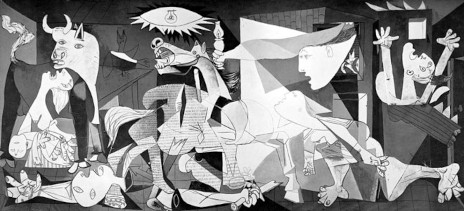
  1. Guernica
  2. Therefore, war is wrong.

Does it make sense to simply incorporate a work of art as a premise to an argument. One problem—and this may be the reason for the apparent Islamic privileging of verbal arguments—is that arguments that incorporate a work of art as a premise are hard to criticize. I am not a pacifist. So I accept that the above argument is unsound. But it is really hard to see what I deny. Do I deny premise (1), i.e., deny Guernica? That seems to be a category mistake. Or do I deny that (2) follows from (1)? So there is something unfair about the use of art in argument—one is putting oneself beyond criticism, except maybe by a competing work of art.

Difficulties with this notwithstanding, I do think the idea that a work of art can express an otherwise ineffable proposition is defensible. Perhaps Guernica expresses the proposition that war is like this (isn't it fun to use hyperlinks to indicate referrents of demonstratives?). If so, then while denying Guernica is a category mistake, denying the proposition expressed by Guernica is no category mistake.

If so, then poems, songs, novels, etc. can express propositions that have truth value. This might be relevant to an account of Biblical inerrancy that includes the full range of genres found in Scripture.

Final note: I think the Bach and Guernica arguments may have different logical forms. It may not be that the music of Bach itself expresses something that implies the existence of God, so that the music is not a premise, but only a part of a premise—the premise that there is this [mp3 download is from here].

Tuesday, January 1, 2008

Individual duties in unjust wars

Apparently, a predominant view is that the ordinary soldier who follows decent military orders (ones that do not transgress jus in bello) in an unjust war does not do wrong.

This view seems quite clearly mistaken, though. First of all, it is always wrong to formally cooperate with an evildoer, where to "formally cooperate" is to share an intention in virtue of which the evildoer counts as an evildoer. But in an unjust war, the leaders of one's country are evildoers (perhaps non-culpable ones, but that doesn't matter), and they are evildoers in part because they intend the deaths of enemy soldiers. Thus the ordinary soldier in intentionally killing enemy soldiers is formally cooperating with evil. Moreover, even if the cooperation were not formal but material (i.e., the cooperator did not share any of the evil intentions of the evildoers, but nonetheless materially contributed to the evil), given the fact that few evils on the face of the earth are as bad as an unjust war, the presumption against such cooperation would still be almost indefeasibly strong.

Second, the state lacks the authority to permit one to intentionally kill those who are doing nothing wrong. That is simply an invalid exercise of the state's authority. This is particularly clear when the unjust military action takes place on the territory of the victim state, since except in cases like lawful self-defense or of embassies, one is bound by the laws of the state that one is in the territory of, but it is also true when the action takes place within the territory of the unjustly warring state. To kill those who are doing nothing wrong is, simply, wrong. So it is wrong to kill in an unjust war when the other side is acting justly (there are wars that are bilaterally unjust--this argument does not apply to those), since then one is killing soldiers who are acting in a morally permissible manner, viz., by engaging in a just war.

But suppose that it is objected that while the state waging the unjust war acts impermissibly in authorizing the killing of the enemy, the authorization nonetheless "succeeds", i.e., the individual soldiers on the unjust side do become authorized. This seems mistaken, but suppose it. Then we get a third argument. If it were not wrong to engage in combat on the unjust side, there would be no such thing as a just war. For in a just war, the state permissibly authorizes the killing of enemy soldiers. But it is wrong for the state to authorize the killing of people who are doing nothing wrong. Hence if the soldiers on the unjust side are doing nothing wrong, it is wrong for a state with justice on its side to authorize killing them. And that is absurd.

Objection: One can defend oneself lethally against someone who is doing nothing wrong. Response: That seems mistaken. If I have broken legs and can't move, and a toddler with a deadly communicable disease is running towards me, I do not have the right to shoot the toddler before he gets to me.

Note that it seems that what I said is compatible with the claim that the soldiers on the unjust side are, frequently, not culpable for their wrongful actions. It seems to me--and I could very well be wrong--that lethal state-authorized self-defense is concerned with stopping evildoers, rather than with stopping culpable evildoers. Culpability requires an individual judgment that is not practicable. Alternately, one might here make the move that Cardinal Ratzinger does in an essay on conscience, which is that even those who are ignorant of the moral law are guilty of having blinded themselves to the moral law. However, in some cases, the enemy soldiers are not ignorant of the moral law, but of the relevant facts of the situation (e.g., some German soldiers may have falsely believed that Poland invaded Germany).