Showing posts with label size. Show all posts

Friday, March 1, 2024

Comparing sizes of infinite sets

Some people want to be able to compare the sizes of infinite sets while preserving the proper subset principle that holds for finite sets:

  1. If A is a proper subset of B, then A < B.

We also want to make sure that our comparison agrees with how we compare finite sets:

  1. If A and B are finite, then A ≤ B if and only if A has no more elements than B.

For simplicity, let’s just work with sets of natural numbers. Then there is a total preorder (total, reflexive and transitive relation) ≤ on the sets of natural numbers (or on subsets of any other set) that satisfies (1) and (2). Moreover, we can require the following plausible weak translation invariance principle in addition to (1) and (2):

  1. A ≤ B if and only if 1 + A ≤ 1 + B,

where 1 + C is the set C translated one unit to the right: 1 + C = {1 + n : n ∈ C}. (See the Appendix for the existence proofs.) So far things are sounding pretty good.

But here is another plausible principle, which we can call discreteness:

  1. If A and C differ by a single element, then there is no B such that A < B < C.

(I write A < B provided that A ≤ B but not B ≤ A.) When two sets differ by a single element, intuitively their sizes should differ by one, and sizes should be multiples of one.

Fun fact: There is no total preorder on the subsets of the natural numbers that satisfies the proper subset principle (1), the weak translation invariance principle (3) and the discreteness principle (4).

The proof will be given in a bit.

One way to try to compare sets that respects the subset principle (1) would be to use hypernatural numbers (which are the extension of the natural numbers to the context of hyperreals).

Corollary 1: There is no way to assign a hypernatural number s(A) to every set A of natural numbers such that (a) s(A) < s(B) whenever A ⊂ B, (b) s(A) − s(B) = s(1+A) − s(1+B), and (c) if A and B differ by one element, then |s(A)−s(B)| = 1.

For if we had such an assignment, we could define A ≤ B if and only if s(A) ≤ s(B), and we would have (1), (3) and (4).

Corollary 2: There is no way to assign a hyperreal probability P for a lottery with tickets labeled with the natural numbers such that (a) each individual ticket has equal non-zero probability of winning α, (b) P(A) − P(B) and P(1+A) − P(1+B) are always either both negative, both zero, or both positive, and (c) no two distinct probabilities of events differ by less than α.

Again, if we had such an assignment, we could define A ≤ B if and only if P(A) ≤ P(B), and we would have (1), (3) and (4).

I will now prove the fun fact. The proof won’t be the simplest possible one, but is designed to highlight how wacky a total preorder that satisfies (1) and (4) must be. Suppose we have such a total preorder ≤. Let An be the set {n, 100 + n, 200 + n, 300 + n, ...}. Observe that A100 = {100, 200, 300, 400, ...} $ is a proper subset of A0 = {0, 100, 200, 300, ...}, and differs from it by a single element. Now let’s consider how the elegant sequence of shifted sets A0, A1, ..., A100 behaves with respect to the preorder ≤. Because An + 1 = 1 + An, if we had (3), the order relationship between successive sets in the series would always be the same. Thus we would have exactly one of these three options:

  1. A0 ≈ A1 ≈ ... ≈ A100

  2. A0 < A1 < ... < A100

  3. A0 > A1 > ... > A100,

where A ≈ B means that A ≤ B and B ≤ A. But (i) and (ii) each contradict (1), since A100 is a proper subset of A0, while (iii) contradicts (4) since A0 and A100 differ by one element.

This completes the proof. But we can now think a little about what the ordering would look like if we didn’t require (3). The argument in the previous paragraph would still show that (i), (ii) and (iii) are impossible. Similarly, A0 ≥ A1 ≥ ... ≥ A100 is impossible, since A100 < A0 by (1). That means we have two possibilities.

First, we might have A0 ≤ A1 ≤ ... ≤ A100. But because A0 and A100 differ by one element, by (4) it follows that exactly one of these is actually strict. Thus, in the sequence A0, A1, ..., A100 suddenly there is exactly one point at which the size of the set goes up by one. This is really counterintuitive. We are generating our sequence of sets by starting with A0 and then shifting the set over to the right by one (since $A_{n+1}=1+A_n), and suddenly the size jumps.

The second option is we don’t have monotonicity at all. This means that at some point in the sequence we go up and at some other point we go down: there are m and n between 0 and 99 such that Am < Am + 1 and An > An + 1. This again is really counterintuitive. All these sets look alike: they consist in an infinite sequence of points 100 units apart, just with a different starting point. But yet the sizes wobble up and and down. This is weird!

This suggests to me that the problem lies with the subset principle (1) or possibly with discreteness (4), not with the details of how to formulate the translation invariance principle (3). If we have (1) and (4) things are just too weird. I think discreteness is hard to give up on: counting should be discrete—two sets can’t differ in size by, say, 1/100 or 1/2. And so we are pressed to give up the subset principle (1).

Appendix: Existence proofs

Let U be any set. Let be the equivalence relation on subsets of U defined by A ∼ B if and only if either A = B or A and B are finite and of the same cardinality. The subset relation yields a partial order on the -equivalence classes, and by the Szpilrajn extension theorem extends to a total order. We can use this total order on the equivalence classes of subsets to define a total preorder on the subsets, and this will satisfy (1) and (2).

If we want (3), let U be the integers, and instead of the Szpilrajn extension theorem, use Theorem 2 of this paper.

The proof of the “Fun Fact” is really easy. Suppose we have such a total preorder ≤. Let A = {2, 4, 6, ...}, B = {1, 2, 3, 4, ...} and C = {0, 2, 4, 6, 8, ...}. By (1), we have A < C. Suppose first that B ≤ A. Then C = 1 + B ≤ 1 + A = B by (3). Hence C ≤ A by transitivity, contradicting A < C. So A < B by totality. Thus B < C by (3). Since A and C differ by one element, this contradicts (4).

Wednesday, September 14, 2016

Does the size of an organism matter morally?

One might with pull a small plant from one's garden with little thought. But one wouldn't do that to a full grown tree. Of course it's harder to pull out a tree, but that doesn't seem to be all that's going on. The tree seems more significant.

Part of that is that the tree has been growing for a longer time. Temporal size definitely seems to matter. We would think a lot harder about cutting down a tree that hundreds of years old rather than one that's five years old. (Interestingly, we tend to have the opposite judgment in the case of people: it is perfectly understandable when an older person lays down their life for a child. Maybe this is because people have an irreplaceability that plants do not.)

But what about pure spatial size? Does that matter? I once thought about this case. We kill insects for minor reasons. But would we do that if the insects were our size? I thought at the time that we would have more hesitation to kill the large insects for minor reasons (we might not hesitate on self defense), but that this was an irrational bias.

But I now think there might be a justification to thinking of spatially larger organisms as having more value. The larger organisms have more cells, and that makes for a complex system, just like a castle made of ten thousand Legos is more complex, other things being equal, than one made of a thousand.

In the case of people, I guess we will have a duty of justice to bracket reasons arising from the number of cells. So we shouldn't save the fatter person just because he has more cells.

But what about dogs, say. Is it really the case that if a Chihuahua and a Great Dane are drowning, other things being equal we should try to save the Great Dane?

Maybe the differences due to the number of cells are on a logarithmic scale, and hence are only significant given an order of magnitude difference? But a Great Dane is an order of magnitude heavier than a Chihuahua, and so I'd guess it has an order of magnitude more cells.

Maybe the moral difference requires several orders of magnitude? Or maybe it runs on a loglog scale?

Or maybe I'm barking up the wrong tree and spatial size doesn't matter morally at all.

If size doesn't matter morally at all, we have a nice argument that the parts of a substance are never substances. For if the parts of a substance are ever substances, the cells of a multicellular organism will surely qualify. But if the cells are substances, then they are living substances. But surely an order of magnitude difference in the number of living substances destroyed makes a moral difference.

Tuesday, May 3, 2016

Determinates vs. values

Spot has a mass of 10kg, while Felix has a mass of 8kg. The standard Platonic way to model the facts expressed by this is to say that Spot and Felix both have the determinable property of mass and they also have the determinate properties mass-of-10kg and mass-of-8kg, respectively. But there is another Platonic way to model these facts. Rephrase the beginning statement as: "Spot masses 10kg while Felix masses 8kg." The natural First Order Logic rendering of the English is now: Masses(spot, 10kg) and Masses(felix, 8kg). In other words, there is a relation between Spot and Felix, on the one hand, and the two respective values of 10kg and 8kg, on the other.

The determinate property approach multiplies properties: for each possible mass value, it requires a property of having mass of that value. The value approach, on the other hand, introduces a new class of entities, mass-values. So far, it looks like Ockham's razor favors the standard determinate property approach, since we don't want to multiply classes of entities.

However, the determinate property approach has some further ideology. It requires a determinable-determinate relation, which holds between having mass and having mass m. The mass-value approach doesn't require that. We can define having mass in terms of quantification: to have mass is to mass something (∃x Masses(spot, x)). Moreover, the value approach might be able to greatly reduce the number of values it posits. For instance, mass, length and charge values could all simply be real numbers in a natural unit system like Planck units. If one thinks that the Platonist needs mathematical objects like numbers anyway, the additional commitment to values comes for free. Further, the determinate property approach requires positing either a privileged bijection relation (or set of bijection relations) between mass values and non-negative real numbers or enough mathematical-type relations between mass determinates (e.g., a relation of one mass determinate being the sum of two or more mass determinates) to make sense of the mathematics in laws of physics like F=Gmm'/r2.

There is also a potential major epistemological bonus for the value approach if the values are real numbers. Standing in a mass relation to a particular real number will be causally relevant. Thus, real numbers lose the inertness, the lack of connection to concrete beings like us, that is at the heart of the epistemological problems for mathematical Platonism.

All that said, I'm not enough of a Platonist to like the story. Is there a non-Platonic version of the story? Maybe. Here's one wacky possibility after all: Values are non-spatiotemporal contingent and concrete beings. They may even be numbers, contingent and concrete nonetheless.

Friday, April 24, 2009

The smallness of the universe

[I am now thinking that the following line of argument is probably deeply spiritually mistaken. Or, maybe, the issue is this: It is the universe conceived of naturalistically that is small. But the universe that we in fact inhabit lacks that kind of smallness for it images the glory of God. So perhaps there is still an ad hominem against naturalism in the line of thought.]

Suppose I and a few other people were born and lived on the inner surface of a sphere that was a kilometer in diameter. Walk 3.14 km, and you're back where you started. And that was all. As far as I could tell, things had always been in the sphere more or less the same as far back as one could tell, with a small stable population and a simple, self-contained ecosystem. There is nothing particularly mysterious in this ecosystem, and there even is a little library containing books written by my ancestors which give complete systmes of physics, chemistry and biology that fit with all the data.

I think there is an intuition one might have after one had surveyed this meager habitat: there has to be more to reality than this. This intuition could be bolstered by arguments from design or causation, but I think it could also be a self-standing intuition: this can't be all there is.

Now our universe is bigger than that sphere. But I do not think that sheer size is what makes a difference. When I reflect on my stargazing, instead of thinking of the vastness and mystery of the physical world, I have lately been thinking about a certain kind of smallness that it has. Sure, there are untold numbers of stars arranged in untold numbers of galaxies. But even that one kilometer sphere had untold numbers of grains of dust, and that didn't make it all that large. The universe is physically large relative to us, but it exhibits a lawlike unity, and while there are many stars, they can mostly be classified into a limited number of types and subtypes. And this vast universe is, nonetheless, one that is small enough that we can have all-encompassing cosmological theories—that we can hold it all in our mind. It is true that our present theories are not good enough. But we seem to be making progress.

If this is right, then I think it is possible to have a similar kind of smallness intuition about the universe as a whole: this can't be all there is to reality. Reflecting on the universe as a whole—a whole made up of physical parts, indeed largely made up of parts like electrons, neutrinos and/or electromagnetic fields that are pretty familiar to us—can make the universe seem small to the mind's eye. Not small physically, of course. The relevant kind of conceptual smallness is compatible with the universe having infinite spatial extent. Rather, it is small in some deeper sense, despite all its wonder and glory.

I think this may be a way in which the physical universe proclaims to us that it is not all there is, that it is not self-sufficient, that while great and full of splendor, it is, after all, but an image. And unless it is seen expressly as an image, it will pale to us. For a while one might enjoy looking at the calligraphy in a manuscript. But eventually, unless one starts reading what the text says, the manuscript will probably stop being all that interesting. But once seen as pointing to something greater, indeed something infinite (and not just in the uninteresting spatial sense), then it takes on a new, and deeper splendor, one that shines through that natural splendor that was in danger of fading.

Friday, January 2, 2009

Size

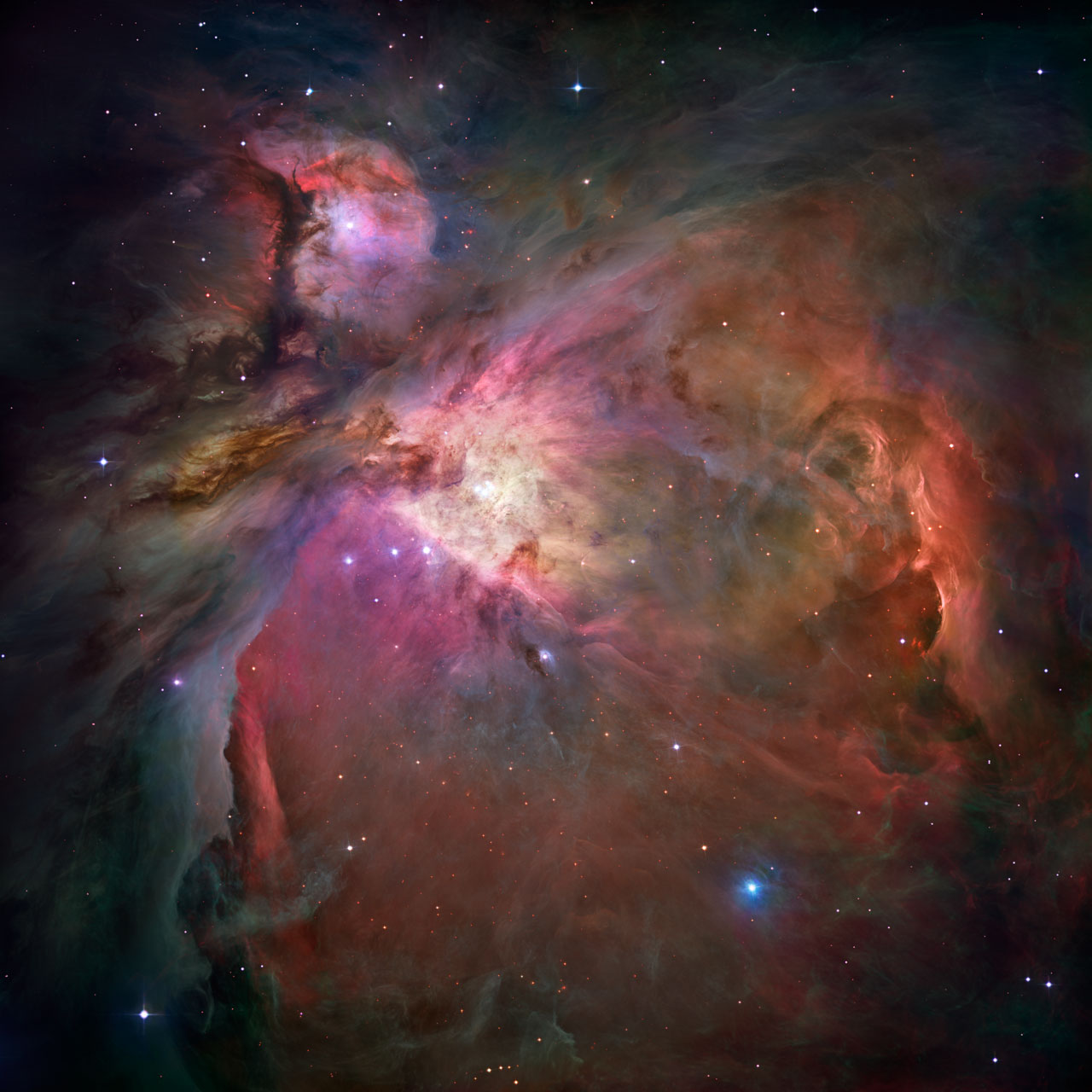
There is something particularly impressive about astronomical objects, such as nebulae and galaxies. Take the Orion Nebula, a stellar nursery, 25 light years across. Yet, a nebula is, as the name indicates, just a big cloud. It is hard to say that it is necessarily much more beautiful than cloud formations in earth's sky lit up by the setting sun. But the astronomic object is more impressive.

Are we wrong to take astronomical objects as particularly impressive? Or is size something objective? (Would the universe bet at all different if everything got a million times bigger, with the laws of nature changing in a compensatory way?) Or is it, perhaps, the impressiveness has a relational component, and things that have much more mass-energy and spatial extent than ourselves are appropriately seen as more impressive? But if so, then when we are impressed by an astronomical object, we are impressed not just by how the object is in itself, but how it is in relation to us. The latter seems phenomenologically somewhat wrong: being impressed by something takes us outside of ourselves, and hence should not be a way of seeing things in relation to ourselves.

Or perhaps astronomical objects are no more impressive than terrestrial ones, but the mistake in our perceptions is not in our finding the astronomical objects more impressive than they are as much as in our failure to find the terrestrial objects impressive. Perhaps we should find the earthly clouds in many ways as impressive as we find nebulae, and grain of sand in many ways as wondrous as a planet? (In many ways, but not in all. For, after all, a planet has much more complexity than a grain of sand, if only because it is made up many more atoms.)

I generally suspect we don't love and appreciate the things around us enough.