There is something particularly impressive about astronomical objects, such as nebulae and galaxies. Take the Orion Nebula, a stellar nursery, 25 light years across.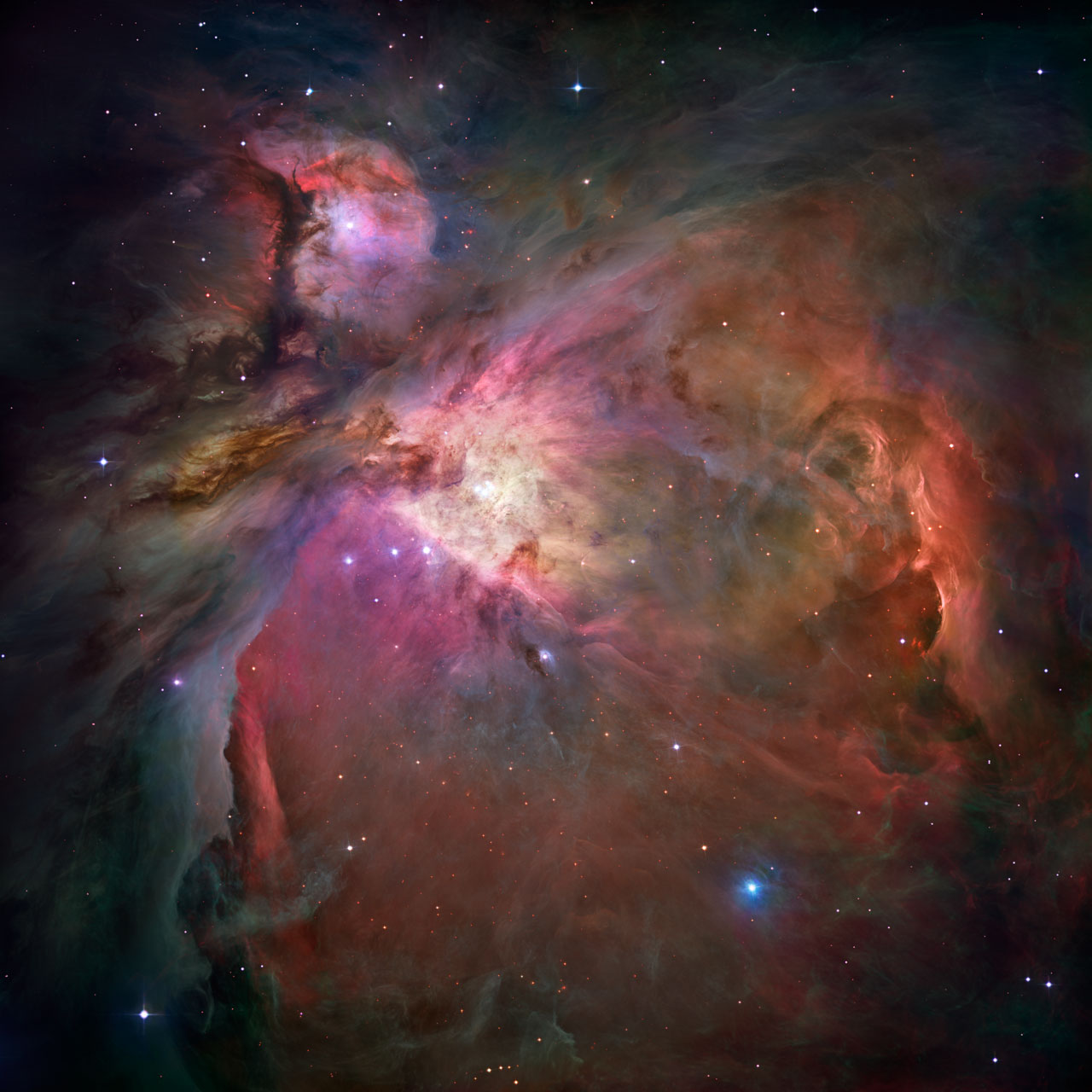 Yet, a nebula is, as the name indicates, just a big cloud. It is hard to say that it is necessarily much more beautiful than cloud formations in earth's sky lit up by the setting sun. But the astronomic object is more impressive.
Are we wrong to take astronomical objects as particularly impressive? Or is size something objective? (Would the universe bet at all different if everything got a million times bigger, with the laws of nature changing in a compensatory way?) Or is it, perhaps, the impressiveness has a relational component, and things that have much more mass-energy and spatial extent than ourselves are appropriately seen as more impressive? But if so, then when we are impressed by an astronomical object, we are impressed not just by how the object is in itself, but how it is in relation to us. The latter seems phenomenologically somewhat wrong: being impressed by something takes us outside of ourselves, and hence should not be a way of seeing things in relation to ourselves.
Or perhaps astronomical objects are no more impressive than terrestrial ones, but the mistake in our perceptions is not in our finding the astronomical objects more impressive than they are as much as in our failure to find the terrestrial objects impressive. Perhaps we should find the earthly clouds in many ways as impressive as we find nebulae, and grain of sand in many ways as wondrous as a planet? (In many ways, but not in all. For, after all, a planet has much more complexity than a grain of sand, if only because it is made up many more atoms.)
I generally suspect we don't love and appreciate the things around us enough.

