Showing posts with label imitation. Show all posts

Monday, May 17, 2021

Being a (counter)example

Consider a case where there is a spectrum of behaviors such that without considering influence on others A is bad, B is moderately good and C is the best. It seems likely (by analogies to the studies on political opinions hardening in the face of opposition) that sometimes when people see someone engaging in behavior radically different from theirs, this strengthens their commitment to their own behavior. Thus, someone who does A upon seeing someone do C might be hardened in doing A. One might easily think about the person doing C: “That behavior is really out there, and so only crazy people don’t do A”. On the other hand, seeing someone do B might actually shift one’s behavior away from A.

And so we can imagine a case where although C is best when one doesn’t consider influence on others, the difference between B and C is sufficiently narrow, that overall it is better to do B, because one is more likely to influence others for good by doing B rather than the “crazy” C.

On the other hand, no doubt there are cases where seeing the radicality of another’s behavior, and the contrast between that radicality and one’s behavior, could shake one up. Thus, when I was a teenager, I was converted from some of my sins upon reading Augustine’s Confessions and seeing the contrast between my sinful ways and the radical holiness that Augustine strove for. Had Augustine only striven for B in contrast to my A, I perhaps wouldn’t have been converted. But he strove for C, and that impressed me.

What’s the lesson? I don’t know. Maybe just this: Absent specific data about the likely influence of one’s actions in a particular case, maybe we do best to do what’s best without considering the influence.

Wednesday, May 12, 2021

Theism and Natural Law

One occasionally wonders what theism adds to Natural Law ethics. Here is one example.

  • Q1: Why are artistic endeavors good?

Here, Natural Law answers by itself, without any help from theism:

  • A1: Because they fulfill the human nature.

We can ask another question:

  • Q2: Why do artistic endeavors fulfill the human nature?

Again, Natural Law answers by itself in a not very informative way:

  • A2: Because necessarily the human nature teleologically directs its possessors to artistic endeavors.

But we can now ask a different question:

  • Q3: Why are there beings with a nature that teleologically directs its possessors to artistic endeavors?

Natural Law by itself has no answer. Theism can go on to answer Q3:

  • A3: God created beings with such a nature because artistic endeavors imitate God, who is the Good Itself.

One might say that Q3 is an etiological rather than normative question, and hence lies beyond the scope of value theory. But A3 also answers a value-theoretic variant of Q3:

  • Q3a: What is it about artistic endeavors that makes them apt for being intrinsically good for a being, apt for being the telos of a nature?

To see the force of Q3a, imagine that we meet aliens and they spend a lot of time and energy on some activity that does not seem to conduce to or constitute any biological end of theirs, and does not seem to promote any end that we can understand. We ask the aliens about why they do this activity, and they say: “It’s good for us in and of itself, and our observation of your culture shows that you have no concept of this type of good.” They are otherwise smart and morally sensitive, so we trust that the activity is good for them, that it is a telos of their nature.

But even after we have learned that the activity is a telos of their nature and hence intrinsically good for them, we would be puzzled by the activity, and what makes it apt for being a good for them. A theistic story about how this good imitates God provides an answer to this kind of a question.

The question suggests, too, that not everything is apt for being good for a being, that not everything is apt for being the telos of a nature. And that, too, seems right. It does not seem that one could have a being for which the production of ugliness or the promotion of the suffering of others is intrinsically good. But I think only a theist can say something like that.

Indeed, this last point suggests another way in which theism helps Natural Law. Consider this objection to Natural Law:

  • Cruelty would be wrong even for beings whose nature it was to be cruel, but according to Natural Law, if a being’s nature were to be cruel, cruelty would be right for that being.

But the theist can do something to help with this: cruelty is just not the sort of thing that a nature could aim at, since it is counterimitative of God. So the conditional about beings whose nature is to be cruel is a per impossibile one. And it is not surprising if strange results follow from impossible suppositions.

Thursday, December 22, 2011

Speculations on imitation, reflection, symmetry, truth, justice and value

Beartooth Butte / USDA/Forest Service
Imitation is a kind of reflection, and reflection seems to introduce a new symmetry into the world.  Symmetry has value, aesthetic value.  Therefore imitation seems to introduce value.

Wikipedia
Plato thought that the value of an imitation was derivative from the value of what was imitated.  That may be true if one considers the imitation in and of itself.  If the water is perfectly still, an ugly building will have an ugly reflection (if the water is not perfectly still, the natural beauty of the water may improve on the building).  But when one considers the imitation together with the imitated, the resultant symmetry can produce new, additional beauty.  The kaleidoscope is the most obvious example, where beauty arises by reflection from a jumble of shapes.
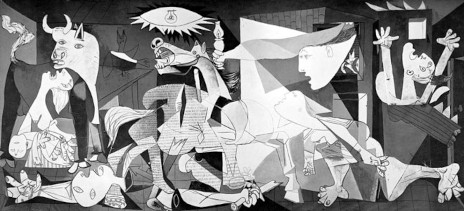

Thus the revelation of ugliness, as in Picasso's Guernica, when taken together with the horror that it reflects is a greater whole with a kind of grim beauty of symmetry.  This kind of symmetry is a case of truth.  It is aesthetically crucial for Guernica that the horrors it reflects are real.  Truth can have a beauty to it when it is a form of symmetry.  Thus at least sometimes we should take truth to correspond to reality.  

Symmetry, thus, is one way in which the bad and the ugly can become a constituent part of a good, a good that defeats the ugly and moves in the direction of defeating the bad.  Justice, in fitting reward and punishment, provides a further symmetry, a symmetry that also exhibits the aesthetic value of symmetry--we admire this aesthetic value when enjoy works of literature and film that exhibit poetic justice.  But justice has a value going beyond the aesthetic, as surely does truth.

The above show how one can derive an aesthetic value in imitation from the value of symmetry.  One could try to run the derivation in the opposite direction.  Could symmetry just be a form of imitation, and hence take its value from imitation?  First of all, only non-naturalists like theists and Platonists can say this, because a "chance" arrangement of pebbles can exhibit a genuinely beautiful symmetry without there being any imitation there.  The theist can say that Providence is behind the chance arrangement, and hence each symmetric segment of the arrangement can be imitating God in an infinitely imperfect way, while the Platonist can say that both symmetric segments reflect some Form.  But this would put the imitation in the wrong place.  For in the "chance" symmetric arrangement, what is beautiful is not just that each symmetric segment imitates God or the Forms, but that they are symmetric to one another.  This symmetry is not just a mirroring, because mirroring has an essential distinction between the mirror image and reality, with the reality being explanatorily prior, while the segments of an artistically planned symmetric arrangement do not need to have one of them be explanatorily prior to the others.

But, nonetheless, the theist needs to affirm that there is a value in imitation that does not come from the value of symmetry and, further, that there can be cases where imitation has no value of symmetry.  For all creation imitates God, but it does not thereby produce a greater God-and-creation whole (even an ontologically innocent) that exhibits the value of symmetry.  For nothing can add anything to God.  There is no holistic value of which God is component.  God perfectly exhibits the symmetry of three Persons with precisely one essence, and creation's imperfect imitation adds nothing to this perfection.  There is no new valuable symmetry of "God and creation".  Thus while symmetry is valuable in and of itself, imitation can have a value over and beyond the value of symmetry: the imitation of God only highlights the infinite gulf between God and creation rather than creating symmetry.

And so we come back to seeing that Plato may have been right.  The value (aesthetic and otherwise) of the imitation qua imitation, rather than of the imitation qua producer of symmetry, depends on the value of what is being imitated.  Creation as imitation of God exhibits that value, but does not as imitation of God exhibit the value of symmetry.  On the other hand, Guernica has no additional value of imitation qua imitation beyond symmetry, since the horrors of war that are being imitated are ugly and evil.  But at the same time, revelatory imitation of evil can have an additional value qua revelatory, namely the value of truth.

Thus, while there is a tie between imitation and symmetry, and within creation imitation produces a kind of symmetry, we should not derive the value of imitation from that of symmetry nor that of symmetry from that of imitation.  Likewise, truth and retributive justice have values independent of symmetry, though truth about creatures and retribution, whether positive or negative, to creatures seems to always exhibit the value of symmetry as well.