Showing posts with label astronomy. Show all posts

Tuesday, April 9, 2024

Absolute reference frame

Some philosophers think that notwithstanding Special Relativity, there is a True Absolute Reference Frame. Suppose this is so. This reference frame, surely, is not our reference frame. We are on a spinning planet rotating around a sun orbiting the center of our galaxy. It seems pretty likely that if there is an absolute reference frame, then we are moving with respect to it at least at the speed of the flow of the Local Group of galaxies due to the mass of the Laniakea Supercluster of galaxies, i.e., at around 600 km/s.

Given this, our measurements of distance and time are actually going to be a little bit objectively off the true values, which are the ones that we would measure if we were in the absolute reference frame. The things we actually measure here in our solar system will be objectively off due to time dilation and space contraction by about two parts per million, if my calculations are right. That means that our best possible clocks will be objectively about a minute(!) off per year, and our best meter sticks will be about two microns off. Not that we would notice these things, since the absolute reference frame is not observable, so we can’t compare our measurements to it.

As a result, we have a choice between two counterintuitive claims. Either we say that duration and distance are relative, or we have to say that our best machining and time measuring is necessarily off, and we don’t know by how much, since we don’t know what the True Absolute Reference Frame is.

Monday, April 8, 2024

Eclipse

The day started off all cloudy, but the clouds got less dense, and then when the eclipse in our front yard reached totality, we had a big break in the clouds.


The first picture has a sunspot in the middle. In the totality picture, slightly to the right of the bottom of the sun in the totality picture there is a hint of a reddish prominence which in my 8" telescope had lovely structure. A quick measurement from the photo shows that the prominence is about seven times the size of the earth.

Tuesday, March 26, 2024

Today's sunspots

Today I was testing the solar filter I got for the eclipse. (300mm f/5.6, cropped).

Sunday, October 15, 2023

Partial eclipse

Handheld, through welder's glass


Hanheld, through eclipse glasses, with a whiff of sunspots (I'll have to get proper solar film for total eclipse photography this spring)

Thursday, May 4, 2017

What Galileo should have said

The big theological problem that Galileo's opponents had for Galileo wasn't the (not very convincing) biblical arguments that the sun moves and the earth stands still, but a theological objection to Galileo's inference from (a) the greater simplicity of the Copernican hypothesis over its competitors and (b) the fact that the hypothesis fits the data to (c) the truth of the Copernican hypothesis. The theological objection, as I understand it, was that Galileo was endangering the doctrine of divine omnipotence, since if there is an omnipotent God, he can just as easily have made true one of the less simple hypotheses that fit the data. (And, indeed, an earth-centered system can be made to fit the data just as well as a sun-centered one if one has enough epicycles.)

What Galileo should have said is that his argument does not, of course, establish the Copernican hypothesis with certainty, but only as highly probable, and that his argument had the form of the well-established theological argument ex convenientia, or from fittingness: "It was fitting for God to do it, God was able to do it, so (likely) God did it." Such arguments were widely given in the Middle Ages for theological views such as the immaculate conception of Mary. The application is that it is fitting for God to do things in the more elegant Copernican fashion, an omnipotent God was able to do things in such wise, and so (likely) God did it. Not only would the argument form have been one that Galileo's interlocutors would have been familiar with and friendly towards, but Galileo would have the dialectical advantage that he could not be reasonably said to be challenging divine omnipotence if his own argument depended on it. (Maybe Galileo did say something like this. I've seen the use of the argumentum ex convenientia in astronomy attributed to Kepler. Maybe Kepler got it from Galileo.)

And, to be honest, I think that all science is essentially founded on arguments ex convenientia. Which are good arguments.

Saturday, March 5, 2016

I can see that the sun exists and shines

  1. On a sunny day, I can see that the sun exists.
  2. If presentism is true, even on a sunny day I can't see that the sun exists.
  3. So presentism is false.
Premise (1) is obvious. Premise (2) is true for the following reasons. I see that the sun existing only if I see the event of the sun's existing. In order to see an event, that event needs to cause my perception. But if presentism is true, then the event of the sun's existing does not cause my perception, since the sun's existing coincides with the sun's presently existing according to presentism. Rather, the cause of my perception is the event of the sun's having existed eight minutes ago, since that's how long it took the light to travel. So on presentism, I see the sun's having existed, but misinterpret it as seeing the sun's existing. Worse yet, I don't ever see that anything exists, except perhaps myself and my mental states.

The eternalist isn't completely off the hook, either. For surely it is not just a part of the content of my experience that the sun exists simpliciter, but also that the sun exists now. But by the above argument, I don't see that the sun exists now. The eternalist is, however, in slightly better shape than the presentist, as the eternalist can say that some of the content of my perception is correct: I veridically see the sun's existing, but misperceive that existing as being present as well.

The formulation above in terms of existence is a bit awkward verbally. I think I can probably run the same argument with the sun's shining. On a sunny day, I can see the sun's shining. Not so if presentism is true. For the event of the sun's shining that I see, assuming I do see it, would be an event that occurred eight minutes ago, and hence a nonexistent event according to presentism. No one sees the nonexistent (they only apparently see it). So if presentism is true, I can't see the sun's shining.

Again, the eternalist isn't entirely off the hook. For intuitively I not only see the sun's shining, but I also see the sun's present shining. So I have to say that there is some illusion here: I do see the sun's shining, but my experience mistakenly attributes presentness to that event.

Monday, October 12, 2015

Exploring the moon with Minetest

I had a really good time at the ACPA over the weekend, but I also had some spare time at the airport, on the plane and in the hotel, so I entertained myself by finishing off a lunar mod for Minetest (a free Minecraft-like game, which works a lot better than Minecraft on old hardware) that uses real-world data from NASA's LRO spacecraft to generate lunar terrain. To make this more Minetest-y, I flatten the moon out into two pancakes. And I added some sky background textures from SpaceEngine. (The Enterprise isn't a part of this mod, but is generated with the render.py script for RaspberryJamMod).

Monday, October 13, 2014

Not a finetuning argument

In The Impiety... (1624), as part of the 6th argument for the existence of God, Mersenne writes:

The proportion found between all the bodies of the world also shows that there is a God who has made all the universe in weight, in number and in measure: for the earth has no other ratio with the sun than 1:140, with the moon than 40:1, ... (pp. 98-99)
(I don't know off hand what the ratios are exactly meant to be; if they are ratios of volume, the moon is within 25% of the truth but the sun is off several orders of magnitude; if they are ratios of diameter, the sun is within an order of magnitude of the truth but the moon is an order of magnitude off.)

Mersenne's argument is full of such numerical (claimed) facts (the sun goes around the earth in 365.241 days, the moon traverses the Zodiac in 27 days, etc., etc.) and claims that God is needed to explain these facts. Now, I'm right now teaching on the fine-tuning argument, so I am sensitized to seeing such numbers in an argument for the existence of God. But it's striking that nowhere can I see Mersenne saying why these numbers are at all better than others, especially since surely some tuning facts seem very close at hand--surely, for instance, if the sun were much bigger or much smaller than it is, it would be too hot or too cold for life.

Mersenne explicitly insists that the numbers aren't explained by the essential natures of the objects, just before the above quote:

For the sun wouldn't be any the less the sun if it were closer or further from the earth, just as the stars could still be stars if they absented themselves from us by more than 14,000 earth radii.
Mersenne's argument seems to be a pure application of the idea that all contingent facts need explanation, and the arbitrariness of the numbers in the numerical statements seems to be cited precisely in order to show the contingency of the numerical statements. The argument suggests a strikingly strong commitment to a Principle of Sufficient Reason for contingent facts: all he needs to argue for a cosmic cause is to argue that there are contingent cosmic facts. Mersenne is confident that God has "many reasons" (as he says in the case of one of the numerical claims) for making the numbers be what they are, but these are reasons "which we aren't going to know except in Paradise" (101-102).

Mersenne's argument isn't a design argument--it doesn't advert to value-laden features that a God would have good reason to actualize. I think it's a kind of cosmological argument, but an eccentric one. Rather than arguing from generic features like motion or causation as Aquinas did, it focuses on very particular features.

The focus on these very particular features seems to have two benefits. The first is that it makes any appeal to necessity as the explanation implausible. Maybe it's necessary that there is motion, but it is incredible that it be necessary that the ratio of the diameter of the earth to that of the moon have to be 3.665:1 (to use modern numbers). So we get contingency very easily. The second feature is one I didn't notice right away. The astronomical features cited by Mersenne are ones that would reasonably be thought to be permanent features. They are thus prime candidates to be dismissed by it is so, as it has always been so. Mersenne's focus on the seeming arbitrariness of these features makes it very clear that would be no explanation. Thus Mersenne's cosmological argument works whether or not the past is finite. It is not disturbed by an infinite regress but does not need one either.

Of course, we no longer think that these particular features are permanent in the same way--the earth and sun changed in size in the formation of the solar system. But impermanent features are no better explained by an infinite regress than permanent ones--the permanence of the features in Mersenne's argument is only heuristic (and I don't see him explicitly drawing the reader's attention to the permanence). Plus we could run the argument on the basis of the apparently permanent but seemingly arbitrary elements in the laws of nature, such as precise values of constants.

The downside of Mersenne's argument, however, is that unless it is explained why the features are desirable, it is difficult to show that the cause of these features of the universe must be intelligent.

Wednesday, July 3, 2013

Snapping photos of the sky

I took my Panasonic DMC-G1 camera, set it on the widest setting, focused on something lit up in the distance, set it on manual, maximal aperture, 14mm F/3.5 setting on the 14-45mm lens, 30 second exposure, and put it upside down a table on our balcony.  I was surprised how much more you see than with the naked eye.  Here's the result (with the slightest bit of editing to crop and to darken the sky).


That's Lyra at the bottom and Hercules in the middle. If you look really closely, you should be able to see M13:


At 30 seconds, even at this low, low magnification, star trails start.

And here's the Baylor Science Building with Venus setting over it:

Tuesday, June 5, 2012

Transit of Venus

Here are some photos over the first 45 minutes or so. They are in sequence, but not evenly spaced in time.

This is from my 8" F/4.5 scope, stopped down to about 3", with photo taken hand-held with my Canon G7 camera off the projection funnel.


Here is the last photo in a larger size.  The sunspots were very nicely visible in the funnel (I counted about 15), and I could even see two without a telescope in the #14 welder's glass.  The photo doesn't do justice to the sunspots, especially the nice bright area that was just barely visible at the bottom of the disc.


Sunday, May 20, 2012

Eclipse

Here in central Texas, the sun set before the eclipse hit maximum.  But we had some lovely views of the moon gobbling up sunspots as the sun was setting over the lake.  Photos are taken by a Canon G7 camera, using a modified version of the sun funnel for projection.  The scope is an 8" F/4.5.  For the first photo it was stopped down to about 3".  The second photo I think used the full aperture.


And for reference, here's the sun in the afternoon, before the eclipse:

Friday, March 25, 2011

Hunting for micrometeorites

Inspired by stuff on the web (e.g., here), I went hunting for micrometeorites. I wrapped a magnet with plastic wrap, and ran it through the dirt under one of our house's downspouts. Apparently meteorites have high iron content so magnets capture them. There was some magnetic dust. I then transfered a couple of pieces of it to a microscope slide and had a look. I saw black chunks of stuff with transmitted light, unsurprisingly, but they became pretty and shiny when I shone a flashlight on them. The two largest ones had rough edges. Micrometeorites are supposed to be smoother due to their hot passage through the atmosphere. But moving the slide around, I cam on a smaller piece with smoother edges and interesting texture that matched what one would expect a meteorite to look like. There was some shiny bumpiness, some small pit-like spots and some interesting rod/wave like areas.

I tried to save the tiny piece for future observations. I tried to stick it to some sticky tape, but the goo made it very hard to observe under the microscope. So I ended up dissolving the goo with acetone to recover the piece. As a side-effect, the piece became cleaner and was brightly metallic under the microscope. Unfortunately, I eventually lost it. It was very small, about four or five times longer than wide, and the width was about that of a hair or maybe a touch more. I lost it when I tried to transfer it with the tip of a needle from a dirtier cover glass to a cleaner one, but somehow it just disappeared--I used a powerful loupe to try to find it, but couldn't. Oh well.

At least the kids got to see it. I don't know it was a meteorite, of course. Too bad I lost it before taking a picture.

Tuesday, December 21, 2010

Lunar eclipse


I stayed up to watch the lunar eclipse.  It was quite nice.  I took the kids out for the grand finale.

I also took a whole bunch of photos.  I'll be editing them a bit more and trying to write some script to align the frames better (and maybe even de-rotating?), but for now, here is the set.  The animation jumpy because I wasn't taking pictures all the time--some of the time I was indoors watching Starship Exeter.  I used a perl script and ImageMagick to animate the photos, using the exif time stamps and speeding up by a factor of 400.  Some of the shadows are odd--I've had trouble with shadows of clouds, branches and internal telescope structures.  I'll eventually try to clean up the photos and remove the bad ones.


I suppose one of the remarkable things about an eclipse is that one is used to astronomical views changing much more slowly.  The video covers a period of about an hour.

Monday, July 19, 2010

Seeing dark nebulae and silhouettes

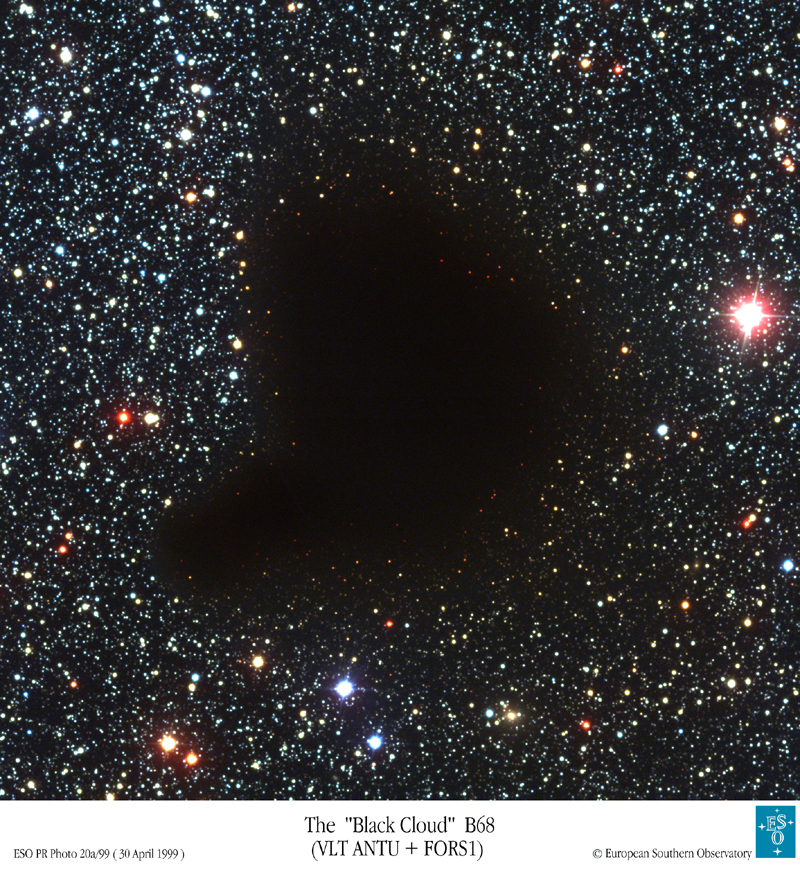
B68We can see shadows, even though surely shadows don't exist—there is nothing to them, but lack. Dark nebulae can also be seen, as the photo shows. However, a dark nebula isn't a complete nonentity like a shadow. It is a molecular cloud of particles that obscure the stars behind it. Those who believe in unrestricted compositionality will even think that they are really existing objects. But seeing a dark nebula is rather different from seeing a shadow. The shadow's shadowy being is constituted by the absence of light. The absence of light in the case of the dark nebula does nothing to constitute the nebula—it is simply that the dark nebula has absorbed the light from the stars and other objects behind it.
Here is an argument that we see dark nebulae. Two nights ago, I tried to see Barnard 91. I thought I saw it, but I was looking at the wrong thing. So, I tried to see it, and failed. But this suggests that there is a distinction between seeing and not seeing it.
There may seem to be something paradoxical here. Isn't seeing supposed to be a causal process, where patterns of light are seen and caused by the object seen? But in the case of the dark nebula—or a human silhouette in the dark, outlined against a light—it is precisely a matter of the absence of light caused by the object seen. However, patterns can be constituted by absence as well as presence. When I look at a sheet of transparent red plastic, the redness of the plastic comes from the plastic's selective transmission characteristics: it lets red light through, and holds back much of the rest of the visible spectrum. The case of the dark nebula and silhouette are just limiting cases of this.
But what the above helps show is that the "in the right way" causal condition for seeing is going to be very complicated. Does this matter? Maybe: it does make life harder for reductionist accounts of perception.

Friday, July 9, 2010

Collimating a collimator

Collimating a Newtonian telescope basically means aligning the optical axis of the primary mirror with the optical axis of the eyepiece.  An easy way to do this is to use a collimator, e.g., a laser collimator.  The collimator is basically a tube that contains a laser that you put in place of the eyepiece.  You adjust the angle of the secondary mirror in the telescope so the beam hits the center of the primary mirror, and then you adjust the angle of the primary mirror so that the beam comes back on itself.  But it is crucial for this procedure with a laser collimator that the collimator be itself collimated, i.e., that the laser's axis be aligned with the tubing that the laser is in.

Now, if we were writing a philosophy paper, at this point it would be very tempting to say: "And a vicious infinite regress ensues."  But that would too quick.  For a laser-collimator collimator is very simple: a block of wood with two pairs of nails, where each pair makes an approximate vee shape.  You then lay the laser collimator on the two vees, aim it at a fairly distant wall, and spin it.  Then you adjust the adjustments screws on the laser collimator until the beam doesn't move as you spin the collimator on its axis, at which point the laser is collimated to its housing.  Moreover, because of how the geometry works, the vees don't need to be very exactly parallel--all the work is done by spinning.  So, it seems, the regress is arrested: the laser-collimator collimator does not itself need collimation.

Potential lesson: Perhaps sometimes we philosophers are too quick after one or two steps in a regress to say that the regress is vicious and infinite.  For sometimes after two steps, the regress may be stopped with a bit of cleverness.

Well, actually, that's not quite right.  For the double-vee collimator depends on the laser collimator's housing being a cylinder.  And one might argue that manufacturing an exact cylinder requires a procedure like collimation.  For suppose that we manufacture the cylinder by taking a block of aluminum, spinning it in a lathe and applying a lathe tool.  But to get an exact cylinder, the lathe tool needs to remain, at the end, at an equal distance to the lathe's rotational axis.  So that's another alignment procedure that's needed.  I don't know how that's done, being foggy on the subject of lathes, but I bet it involves aligning some sort of a guide parallel to the lathe's rotational axis or by moving the workpiece parallel to the rotational axis.  So another collimation step will then be needed when manufacturing the lathe.

And so the regress does continue.  But still only finitely.  At some point, parallelism can be achieved, within desired tolerance, by comparing distances, e.g., with calipers.  There is still a collimation issue for the calipers, but while previous collimations involved the spatial dimensions, the collimation of calipers uses spatial and temporal dimensions: in other words, the calipers must keep their geometrical properties over time.  For instance, if one sets the calipers to one distance, and then compares another, the caliper spacing had better not change over the amount of time it takes the calipers to move from one place to another.  So calipers allow one to transfer uniformity over time into uniformity over space.

But how do we ensure uniformity over time?  By using a rigid material, like hardened steel.  And how do we ensure the rigidity of a material?  This line of questioning pretty quickly leads to something that we don't ensure: laws of nature, uniform over space and time, that make the existence of fairly rigid materials possible.  And if we then ask about the source of these laws and their uniformity, the only plausible answer is God.  So, we may add to God's list of attributes: ultimate collimator.

There are, of course, other ways of manufacturing cylinders than by using a lathe.  One might cast a cylinder in a cylindrical mould--but that just adds an extra step in the regress, since the mould has to be manufactured.  Or one might extrude a cylinder by pushing or pulling the material for it through a circular die.  In the latter case, one still has to make a circular die, perhaps with a spinning cutter at right angles to a flat piece, and one has to ensure that the material is moved at right angles to the die.  So one has changed the problem of parallelism into the very similar problem of aligning at right angles.  And I suspect we eventually get back to something like rigid materials anyway.

So the lesson that sometimes regresses stop after one or two steps is not aptly illustrated with the case of the collimator.  That regress is still, perhaps, finite--but it goes further back, and eventually to God.

Wednesday, June 2, 2010

Feeling at home in the universe

When I was a kid, and early in my amateur astronomy hobby, I found the night sky spooky. But now I feel relaxed and at home in the starry dark, with a telescope and (electronic) charts. There is a pleasant familiarity (though I still don't know the constellations by name very well; I often just see the shape on the chart and think of them as "the one that has such-and-such a squiggle"). I wonder if the feeling of at-homeness in the universe isn't some evidence that the universe is created for humans. On the other hand, we are made for heavenly life and exiles here. So maybe the feeling is pernicious. But the "here" where we are exiles, maybe that is not a spatial here. Perhaps the new earth and the new heavens will include--as in the last Narnia book--all the best features of the present earth and the present heavens. (For the report of the observing session that led to this reflection, see here.)

Thursday, April 29, 2010

Where are the ugly galaxies?

Carina NebulaI have yet to see a technically well-done astronomical photograph which is ugly. I have seen ones that are ugly because they have been technically poorly done—indeed, most of my own photographs other than of the moon have ranged from ugly to boring, but this is a function of technical inaccuracy (out of focus, not long enough exposure, lack of tracking, etc.) rather than of any ugliness in the subject. It appears that astronomical objects range from neutral to beautiful.

Astronomical objects are not alone in this. In fact, there are very few if any natural, inorganic objects (crystals, mountains, clouds, waves, etc.) that are ugly, and many that are beautiful. It is only within the realm of man-made, biological or formerly biological objects that we find ugliness. Buildings, paintings, musical compositions, bugs, body parts, and corpses can all appear ugly to us. But even there, we might want to make a few distinctions. It is not clear that any normally functioning biological organism, or even a part thereof, is properly seen as ugly. There is some plausibility to the idea that if I were to devote my life to study of the world's ugliest sea creatures, I would cease to see them as ugly, and I would be right so to cease. So it could, in fact, be the case that in the biological arena, it is only the abnormal biological organisms, their current parts and former parts, and their corpses that should be seen as ugly.

It is plausible, then, that beauty by far predominates over ugliness in the universe, and indeed I do not know of anything ugly outside of the earth and things originating from the earth (maybe there is an ugly painting on board the ISS). This is an interesting aesthetic asymmetry. Moreover, it calls out for an explanation. (It will not surprise anyone that I would hope for a theistic one here.)

An interesting topic for discussion would be classes of objects that appear to have no ugly instances. I am not sure I've seen an ugly healthy tree, or an ugly healthy flower (though some have an ugly smell).

Tuesday, January 19, 2010

Seeing versus looking

This discussion thread on an amateur astronomy site seems to me to be rather relevant to philosophical accounts of perception.

Monday, January 18, 2010

M33

Saturday night, at the Central Texas Astronomical Society's dark site, M 33 looked to me both like a spiral galaxy and like it was created by God. Therefore, probably, it was a spiral galaxy and created by God. I think this is a perfectly good argument, and it would be a nightmare to try to discredit the "spiral galaxy" part of the argument without discrediting the "created by God" part, or vice versa.

That it might not look to everyone like it was created by God is no more impressive than the fact that it might not look to everyone like a spiral galaxy (it is well known that some observers see more than others, under the same conditions).

Monday, December 21, 2009

Light pollution

When out observing at my sort-of dark location, I realized that when Scripture says that the heavens declare the glory of God, Scripture is not talking of the few pretty sparkles in a light-polluted modern city sky. The image presupposes a sky aglow with stars, with a glorious Milky Way stretching across it. My observing location is only an approximation to that, but is still pretty glorious. It's interesting how understanding certain texts requires that one know what certain created things look like, and first-person experience (or a really good simulation, like a good planetarium) is needed.

It was indeed a good night for naked-eye viewing. Two or three open clusters in Auriga were naked-eye, the Double Cluster was really obvious, and I might have even caught a glimpse of M 33 with averted vision, but I am not sure. I also got to try out my home-made travel telescope under decent skies. It nicely framed the M 31/M 32/M 110 galaxies in an about 1.7 degree field of view. And the Orion Nebula was really wonderfully detailed through my 13".