For a long time I have thought that the identification of God as the Alpha and the Omega in the Book of Revelation is very Aristotelian: God is the efficient and final cause of all. Indeed, Revelation 22:13 explicitly glosses as he arche kai ho telos. This may initially seem an over-metaphysicalization of Scripture, but I think it is a very Scriptural idea that particular aspects of God’s involvement in the world—us being comforted (in a way) that God is the arche and the telos of the upheavals in the Book of Revelation—are mirrors of God’s innate nature.
Showing posts with label Scripture. Show all posts
Showing posts with label Scripture. Show all posts
Wednesday, August 23, 2023


Tuesday, January 17, 2012
Literalism and inerrantism
In the popular imagination, the doctrines of literalism and inerrantism about Scripture go hand-in-hand. And there may well be a positive correlation between adherence to these doctrines.
But isn't this a strange marriage? Inerrantism is basically the doctrine that every proposition asserted by Scripture is true (perhaps with an "oeconomic necessity" operator applied). On the other hand, literalism is something like the doctrine that narrative sentences in Scripture, with the exception of those that the Bible marks otherwise and those that sufficiently closely stylistically and/or contextually resemble those so market, are to be understood pretty much the way they would be understood if their vocabulary were mildly modernized and they were embedded in a present-day work of history. (It's clear that literalism is much harder to define then inerrancy—it's a slippery doctrine. It has some charateristic marks, though, such as thinking that Genesis 1 and 2 are meant to be, basically, history.)
An obvious difference is that it would be hard to both be an atheist and accept inerrance (one would have to have a really wacky interpretation of Scripture), but it is quite possible (and it actually happens, perhaps quite often) for an atheist to be a literalist.
In fact one would expect a negative correlation between adherence to literalism and adherence to inerrantism. If one is an inerrantist, then one of the exegetical tools available to one is an inference from "p is false" to "Scripture does not assert p", and this exegetical tool, together with modern science, should result in the rejection of literalism.
Monday, January 16, 2012
Aliens and the Bible
My nine-year-old daughter suggested that the fact that aliens aren't mentioned in the Bible gave us good reason to think there aren't any aliens. I countered that dolphins aren't mentioned in the Bible either. My daughter noted that kangaroos aren't either, but she thought that aliens were the sort of thing that, if they existed, the Bible would mention them. I thought there was something to that idea, but perhaps only a weaker claim can be made: the fact that the Bible doesn't mention aliens gives us a good reason to think that humans aren't going to meet up with them in this life. For if we are going to meet up with them, we would need the sort of ethical guidance that we expect from Scripture.
I don't think this is a very powerful argument against the claim that there will be human-alien contact. After all, as long as the aliens appear to be rational beings subject to moral constraints we have good reason to think that they are in the image and likeness of God just as much as we are, and we can apply Scriptural principles. But I do think, nonetheless, that the silence of Scripture is some evidence against humans meeting up with aliens in this life.
Note added later: I definitely should have included Tradition alongside Scripture. See the comments.
Sunday, May 23, 2010
Aquinas on the senses of Scripture
The Tradition holds that Scripture has many senses. I found really striking what St Thomas does with this: "The author of Holy Writ is God, in whose power it is to signify His meaning, not by words only (as man also can do), but also by things themselves." In other words, it seems that the Angelic Doctor thinks that the words of Scripture directly only have a literal meaning (which of course isn't the "literalistic meaning"; the literal meaning of an assertoric text is that proposition which is asserted in the text; as Aquinas says, "When Scripture speaks of God's arm, the literal sense is not that God has such a member"). The non-literal meaning is not a meaning of the words of Scripture, but it is a meaning of the realities signified with the words understood in their literal meaning. Thus, the description of the Israelites' crossing of the sea in the Book of Exodus has as its meaning that the Israelites cross the sea. This text signifies a historical event—the Israelites' crossing of the sea. And the further meanings, such as a future baptism in Christ, are had not by the text, but by the historical event itself. The events of salvation history are thus a text, and the non-literal meaning of Scripture is thus not a meaning of the text of Scripture, but a meaning of salvation history itself.
I really like this. If the non-literal meanings of the text were really meanings of the text as such, it is hard to see what would distinguish them from the literal meaning. One alternative is to say that the non-literal meanings are intended by God but not by the human author. But if so, then that makes the human author less fully the author of the text, and it makes God an embedder of secret messages in the text. On Aquinas' view, the human author gets to be fully the author of the text, even if the human author does not grasp any of the non-literal meanings. For the non-literal meanings aren't really meanings of the text. (And there is nothing unusual about the events described by a historian having a meaning going far beyond that which the historian sees in them. But these meanings are of the events, not of the history book.) Moreover, this shifts us from being unduly book-centered. Those who experienced the Sinai event were not in principle worse off than the readers reading about the event. But if the additional meanings were meanings of the text and not of the event itself, then those who experienced the Sinai event were in principle worse off than those who read about it.
All this gives a strong sense to the idea that the non-literal meanings of Scripture depend on the literal meaning. For if the Israelites did not in fact cross the sea, then there is no historical event of the crossing of the sea to bear any of the non-literal meanings. The words of Scripture don't signify a future baptism—they signify a crossing of the sea. The crossing of the sea would signify a future baptism, but since the crossing didn't take place on this hypothesis, that is irrelevant.
Moreover, if Aquinas' idea is right—and I think it is right as the notion that God writes not just in words but in historical events is deeply embedded in the Christian tradition—then the theologian who denies the various miracle stories but hopes to save a non-literal meaning is in even greater trouble. For while we assert by speech and not by silence (unless we set up a special convention—"If I say nothing, assume I agree"), we implicate both by speech and by silence. If the Israelites did not in fact cross the sea, not only is the crossing of the sea not there to bear a non-literal meaning, but the non-existence of the crossing of the sea—i.e., God's refraining from causing a crossing of the sea—carries an implicature that we should be cognizant of. But the implicature carried by refraining from an utterance s is typically (though not always, but a special case would need to be made out that the present case is such an exception) opposed to the meaning that s would have had. So the theologian who reads the miracle stories ahistorically, if Aquinas is right, may well make God out to be implicating something opposed to the non-literal meaning that the theologian hopes to find there.
Friday, March 5, 2010
Exegesis of Scripture
It is standard in interpreting Scripture to ask questions like: "What did the Paul hope to accomplish by this passage?" or "What motivated the prophet to write this verse?" or "What must the p been thinking given that he wrote this?" These questions are interesting to ask and the answers seem to illuminate our understanding of Scripture. We investigate secular texts in exactly the same way. It potentially illuminates our understanding of Aristotle's thought to ask why he waited until Met. H.6 to give a solution to the problems of Met. Z.
But there is a crucial difference between the secular case and Scripture: Scripture is authoritative. But, I think, what is authoritative is the text that the human author wrote, rather than the human author's motivations and thinking behind that text. The inferred motivations and thinking of the human author give us insight into what the text means (more strongly, I think that speaker-meaning is the relevant kind of meaning for Scripture, but the point remains even if one denies this), and hence help us know what is being taught. But the human author's motivations and thinking, in and of themselves, are quite fallible, while, in the words of the Vatican II ecumenical council, "everything asserted by the inspired authors or sacred writers must be held to be asserted by the Holy Spirit" (Dei Verbum 11, emphasis added) and hence is true.
Let me argue for the claim that the author's motivations and thinking are not in and of themselves authoritative, though I may need to qualify it. Suppose we infer from internal and external evidence that an author wrote the text to a particular audience with the confident belief that the text would convince the audience of some proposition. Can we conclude that it is authoritatively taught that the audience was in fact convinced of that proposition? Surely not. We gain an insight into the intentions of the author, and this helps us understand what the text means, but the author's motivating belief is not authoritative. Or for an even more obvious example, from the fact that a sacred author writes a sentence s we can typically infer that he thought s was orthographically and grammatically correct and stylistically good Hebrew, Aramaic or Greek. But this claim about grammar and spelling is not authoritative. Scripture is not to be taken as an authoritative examplar of style—that would be like the confusion of apostle and genius that Kierkegaard inveighs against (this is probably a point at which Christian attitudes to Scripture differ from Islamic ones).
It is sometimes possible to infer from the fact that the author wrote a sentence s that asserts the proposition p that there is some other proposition, q, which he also believed. For instance, suppose the author writes with great emphasis that anyone who does A will be doomed for eternity. We might be able infer from the emphasis that the author believes that some people do A, or at least that it is quite possible to do A. This belief, however, is not asserted by the author and need not be authoritative. However, the belief does help us with the interpretation of what the author meant. For instance, suppose we have two ways of interpreting "A": A1 and A2. Suppose, further, that internal and/or external evidence shows that the author probably would not have believed that anybody does A1 but would have thought that some people do A2. This now gives us strong evidence for the claim that the author meant A2 by "A". Thus, probably, we are being authoritatively taught that those who do A2 are doomed for eternity. But it does not follow from this that we are being authoritatively taught that anybody actually does A2, even though our exegesis depended on attributing that belief to the author.
However, the above needs to be qualified. We must avoid the serious theological mistake of limiting the inspiration of Scripture to the inerrance of its assertions—the inerrance of assertions is a consequence of inspiration, but does not exhaust inspiration. There are large chunks of Scripture—much of the Psalms, for instance—where the illocutionary act is not assertion, but, say, prayer. Those parts are inspired as well, but the doctrine of the inerrance of Scriptural assertions says nothing about them. Similarly, even in the parts where assertion is the (primary?) illocutionary act, we should be open to the idea that something more is going on than inerrance. (Besides, inerrance is something basically negative—a preventing of error—while inspiration is a positive thing.) Thus, while what should be open to the idea that it does not exhaust the authority of an assertion of Scripture to say that we need to believe its content.
In particular, this raises the question of whether what is implicated by a text of Scripture is also authoritative. Here I will be entirely speculative. I think we need to distinguish between two kinds of implicatures. The first kind is where we can infer from some hypotheses about the text, such as that it tends to obeys Gricean maxims, that the author believed something, but the author does not intend for us to make that inference. The second is where the author intends for us to make some such inference. In the case where the author does not intend the inference, but we can make it nonetheless because we're clever, the inferred belief is not authoritative. In the case where the author intends for us to make the inference, we still need to distinguish between cases. The author may just want us to infer an autobiographical fact about him, that he happens to believe p. (For instance, maybe by a particular way of phrasing a question, the author wants to indicate to the reader which theological faction in Jerusalem he belongs to, and membership in the theological faction may be defined by believing p.) In that case, p need not be authoritatively taught. But the author may intend for us to learn that p from the text. In that case, p is authoritatively taught. Though maybe then p was in fact asserted?
In any case, in untangling these issues there is material for someone who is both interested in Biblical exegesis and philosophy of language for years of fruitful research. I am hoping that these reflections also show the necessity of a deep familiarity (greater than my passing acquaintance) with contemporary analytic philosophy of language to serious work on the theology of biblical inspiration.
Monday, March 23, 2009
Inspiration and inerrance
Some people prefer to talk of divine inspiration of Scripture instead of Scriptural inerrance, because they think this way they can avoid affirming inerrance and hence being subject to the apparent counterexamples to inerrance. However, I think the right concept of divine inspiration will make God a full author of the text (so is the human author, of course; I am not here addressing the interaction of the two authorships). Sometimes it happens to an author that the text asserts something that the author did not assert. I doubt this can happen in the case of an omniscient and omnipotent author. If it cannot, then anything that the text asserts is asserted by God. Moreover, it seems central to Christianity and Judaism that God does not lie. Hence, the text only asserts propositions that God believes to be true. But the only propositions that God believes to be true are propositions that in fact are true. Hence, anything the Biblical text asserts is true. If we add some plausible counterfactual robustness to this story (a hard question exactly how to do this—cf. this post), we get inerrance. So inspiration, understood the way I want to understand it, entails inerrance.
I don't mean for the above argument that inspiration entails inerrance (which is basically an expansion of the enthymematic argument for inerrance in Vatican II's Dei Verbum, section 11) to convince those who don't believe inerrance. Rather, I am here interested in a different point. Even if we believe in inerrance, as indeed the Christian Tradition does, nonetheless we have at least two good reasons to focus on inspiration as the basic concept.
First, if we can argue from inspiration to inerrance, but not from inerrance to inspiration, then inspiration is likely to be the more basic concept. If something like the strategy in the first paragraph of this post goes through, we can argue from inspiration to inerrance. But we cannot argue in the opposite direction. Inerrance is a negative doctrine, namely that a text does not contain any false assertions, plus a bit of counterfactual robustness. Such a doctrine could be made true by all kinds of positive realities, of which inspiration is only one. For instance, an uninspired text would be inerrant if, say, God resolves to paralyze the person at the first sign of writing a false. For a more extreme case, God could make a text be inerrant simply by resolving to preventing the human author of the text from setting down any assertions (thus, the text might contain questions, commands, nonsensical rhymes, etc.)
Second, inspiration is a doctrine about all of Scripture. Inerrance is only a doctrine about the truth of assertions in Scripture. An assertion can be true, and intentionally both deeply misleading and spiritually harmful. And there are important portions of Scripture, of varying length, where the main business is is not the making of assertions—but the offering of prayers (especially in the Psalms), the making of commands, the giving of advice ("Go to the ant, O sluggard, and consider her ways, and learn wisdom" is not an assertion), and so on. Inerrance says nothing about those portions. Inspiration does.
Presumably, there is some analogue to inerrance in the case of those portions of Scripture (perhaps, the analogue to inerrance in the giving of proverbial advice is that the advice is helpful when appropriately applied by a phronimos). But these are analogues to inerrance, not inerrance itself, and it is to the doctrine of inspiration that we turn to find out what these analogues would be.
Friday, February 13, 2009
Inerrance
Occasionally, the rhetorical question is asked of inerrantists: "What's the use of having an inerrant text, if your interpretation of the text is fallible?" Sometimes this question is asked by opponents of inerrance, and sometimes by those who think that those who accept inerrance don't go far enough—they should also accept an infallible exegetical authority. I've done this myself, as an argument for Catholicism.
But the argument implicit in the question is not a good argument without further work. It would be silly to ask: "Why do you care about having a calculator that makes no mistakes, given that you can punch the wrong numbers into it and read the answer off wrongly?" When using a fallible calculator, there are three sources of errors: the calculator, the data input, and the reading of the output. Surely it is a good thing to be able to eliminate one of the three, even if the other two remain.
Furthermore, there is the following advantage to having an inerrant text: progress in interpreting the text is apt to get us closer to the truth of the matter in the subject the text is about. But if the text is wrong on some point, it might be that the better we interpret it, the further from the truth we find ourselves (if we take the text to be authoritative). It is worth having this feature. We might be currently unable to tell what Scripture requires of us in some matter, but it is not unreasonable to devote significant effort into trying to figure it out—because it is likely true.
But let's go back to the rhetorical question and see if we can make it into any argument that can be defended. First of all, it's not clear how "What's the use of p?" even when met with no answer gives us reason to deny p. What's the use of the moon? I don't know, but my not knowing the use for it doesn't seem to significantly affect my confidence that it's there.
However, inerrance isn't like the moon. Inerrance is very unlikely without a miracle. And we might think that God doesn't work miracles except with good reason. So perhaps we could argue that if inerrance is of no use, God wouldn't bother with it. But that's going to be weak. How could we rule out all uses of inerrance? And in fact, surely there are some. The belief that Scripture is inerrant has inspired many people to obey various good commands in Scripture. Moreover, it is better be inspired by a true rather than false belief. So there is surely some use of inerrance. One might worry that the miracle is too great and the benefit disproportionately small. But I don't see why an omnipotent being can't do a great miracle for a small benefit (God helps me find lost objects sometimes—for all I know, he may even be miraculously transporting the lost objects to me, though somehow it seems more likely that he is simply directing my attention to the objects), nor do I see the benefit as small.
Still, there is, I think, some force in the argument of the rhetorical question. There are four sources of errors in information obtained from a text: errors in the original, errors in copying, errors in reading (decoding of words), and errors in interpretation. If it turns out that there are likely so many errors in interpretation that the benefit of lack of errors in the original is quite small, then there is something to be said for asking why God would have ensured a lack of errors in the original without ensuring an infallible method of interpretation. (If a measurement has two sources of error, one of the order of magnitude 0.001 units and the other of the order of magnitude of 0.020 units, a scientist would be unlikely to try to minimize the first error without trying to minimize the second.) But this would require a further argument that fallible interpretation would be quite unreliable—we couldn't just base the argument on the mere fact that interpretation is fallible. Moreover, I think this wouldn't so much an argument against inerrance, as an argument for an infallible method of interpretation (such as a magisterium or tradition or both).
Is it the case that errors in the interpretation of the Bible are so very common that there is something to the argument? I think it might be. Granted, there may be wide exegetical agreement on certain basic points. But if the point of inerrance is simply to preserve agreement on these basic points, we would not need full inerrance, but a more limited doctrine of preserving the truth in the basics (this point was made by one of our grad students in discussion today). So we might still argue: If we think God valued truth in such a way as to give us full inerrance in Scripture, we have good reason to think that he would also have ensured an infallible interpretative method, since that would serve the same value. This is an argumentum ex convenientia, an argument form well loved by medieval theologians.
So, yes, there is something to the argument in the original rhetorical question, but it would take significant effort to defend it carefully. I haven't put in that sort of effort in this post.
Friday, July 25, 2008
Sola Scriptura and ecumenism
I am Catholic and I don't believe Sola Scriptura. But here I want to engage in some friendly theologizing, trying to figure out what would be the best thing for me to say about Sola Scriptura were I evangelical. The main difficulty for Sola Scriptura is the standard self-defeat argument. Evangelicals typically take Sola Scriptura to be an important Christian doctrine, important enough that one can base theological arguments on it (e.g., arguing against some Catholic or Orthodox belief on the grounds that that belief is not found in Scripture). But let us take Sola Scriptura to be the claim that all true, Christian doctrines are found explicitly or implicitly in Scripture. Then, we have a self-defeat argument against Sola Scriptura: it is proposed as a true, Christian doctrine, but it is nowhere found explicitly or implicitly in Scripture, and hence by its own claim is not a true, Christian doctrine.
The fact that Sola Scriptura is not found in Scripture might be disputed. A standard proof-text for Sola Scriptura is 2 Timothy 3:16-17 which says that Scripture is inspired by God and has as its purpose that one might be "thoroughly equipped for every good work" (NIV; one may also query points in the translation). But of course the opponent of Sola Scriptura does not need to deny that all Scripture is inspired by God. Moreover, the claim that Scripture exists to equip us for every good work does not entail that Scripture is all that is needed to equip us thoroughly for every good work. After all, plainly, lots of other things are needed—air, food, water, intellectual skills, and, above all, God's grace. And even if Scripture were sufficient to equip us for every good work, it would not follow that Scripture contains all true, Christian doctrine. Finally, it is very unlikely that 2 Timothy 3:16-17 contains Sola Scriptura, since the "Scriptures" referred to are the ones Timothy learned "from infancy" (v. 15), and hence are the Old Testament. And the Old Testament surely does not contain all true, Christian doctrines. In fact, when this text was penned, Scripture was not yet completed, and there were surely Christian doctrines not yet in Scripture (such as the Christian doctrines taught in the next chapter of 2 Timothy!).
Nor is it likely that Sola Scriptura would be found in Scripture, since at the points at which most of the New Testament was being written, there was much reliance on apostolic preaching, or on reports of apostolic preaching.
So, what can an evangelical say in defense of Sola Scriptura given the self-defeat argument? One suggestion is to limit the scope of what is claimed. Thus, instead of claiming that Scripture contains all Christian doctrine, one instead claims that Scripture contains all the Christian doctrine that is necessary for salvation. A problem with this more limited claim is that it makes Sola Scriptura a not very interesting doctrine on standard evangelical views of what is necessary for salvation, namely faith that Jesus Christ is Lord. On such views, one can seemingly replace the claim that Scripture is sufficient for salvation with the stronger claim that some collection of three or four verses is sufficient for salvation. And surely one doesn't want Sola Scriptura to simply follow from the sufficiency of three or four verses.
I want to suggest that a better answer to the self-defeat argument is to say that the argument does not show that Sola Scriptura is false. Rather, the self-defeat argument only shows that Sola Scriptura is not a true, Christian doctrine, i.e., that it is either not true, or not a Christian doctrine, or neither. The evangelical can opt for saying that while Sola Scriptura is true, it is not a Christian doctrine. After all, many true claims, even claims about Scripture, are not Christian doctrine. For instance, it is true that Scripture has been translated into Swahili, or that most Bibles are printed in mostly black ink, but these facts are not Christian doctrines. This solution is not original to me—I heard it from a Protestant friend, I think.
Now this way of taking Sola Scriptura has a pleasant ecumenical consequence. It is not appropriate for an evangelical to consider a Catholic or Orthodox Christian to be unorthodox for denying Sola Scriptura. For only the denial of a Christian doctrine can make a Christian unorthodox, and Sola Scriptura is not a Christian doctrine. This reduces the division between evangelicals and Catholics and the Orthodox, though division remains on the other side (Catholics believe that the denial of Sola Scripture is a true, Christian doctrine, and there is no parallel self-defeat argument against their belief here).
Moreover, one might query the epistemological basis of affirming Sola Scriptura once one no longer takes it to be a Christian doctrine. After all, if it is not a Christian doctrine, then one cannot know it one the basis of public divine revelation. One might claim to believe Sola Scriptura on the basis of a private revelation (an angel whispering the doctrine to one), but that is unlikely to convince many others. Could one, perhaps, know Sola Scriptura empirically or maybe by a careful application of a priori reason? I doubt it. Surely one cannot know it empirically. Nor does it seem at all a candidate for a priori knowledge. Maybe one might think there is some way to combine empirical and a priori reasoning with divine revelation to get Sola Scriptura, but I doubt this.
If Sola Scriptura is not a matter of faith (since it's not a Christian doctrine), and cannot be known to be true, I think what would be most reasonable for an evangelical, short of chucking Sola Scriptura altogether, would be to take Sola Scriptura to either be a negative first person claim—"I am not aware of any source of true, Christian doctrine other than Scripture"—or as a working hypothesis.
What is interesting is that in both cases there should be an in-principle openness to the possibility of other loci of divine revelation, such as the Tradition that Catholics and the Orthodox refer to. Adopting either the "negative first person claim" or the "working hypothesis" view of Sola Scriptura would, thus, move ecumenical dialog forward. One might, of course, think this is a minus, but I don't.
Saturday, June 7, 2008
Homosexuality in Leviticus 18
[The main two arguments in this post have been refuted by the first commenter, and so I no longer endorse this post, though I still accept the category A view on other grounds. I was thinking of deleting the post, but thought it better to stay, as an embarrassing testimony to my slip up. I had simply missed Lev. 18:19. So Lev. 18 as a whole is not just about morality, but also about ritual purity (given the incest prohibitions, it is clear that some of the purity rules are closely tied to moral rules). My inductive argument fails, thus. Moreover, on reflection there are alternate readings of Lev. 18:24-25, which verses have now become problematic. First, one might read verse 24 as saying that the nations that are being driven out defiled themselves by their practice of all the prohibited items, some of which (well, I still think all but one) clearly are a matter of morality. Second, we might suppose that the menstruation rule violated a purity rule that members of the relevant nations themselves accepted, and hence was a violation of conscience or something like that.]
The Old Testament prohibits homosexual activity. One of the challenges in regard to Old Testament prohibitions is to separate (A) those that are universally applicable, for instance because they are a matter of Natural Law, from (B) those that were only literally applicable to the Jewish people (and even there, only until such time as one should die with Christ in baptism), such as the prohibition on pork. In an earlier post, I argued that the God of Love would only give a complete prohibition on homosexual acts if these acts were always immoral, so the prohibitions on homosexual acts were in category A.
I was reading Leviticus 18 tonight. This contains prohibitions on incest, the sacrificing of children to Moloch, male homosexual activity and bestiality. Two items struck me (not in the order in which I list them). First, all the prohibitions other than of male homosexual activity can be easily read as having universal, or near-universal applicability (perhaps God made special provisions with respect to incest for the first humans; the duty of exogamy can perhaps be relative to the size of the gene pool). There is, thus, an inductive argument that the prohibition on male homosexual activity has universal or near-universal applicability as well. Second, we have the following text in verses 24-25 (in the JPS translation), after all the prohibitions have been given:
Do not defile yourselves in any of those ways, for it is by such that the nations that I am casting out before you defiled themselves. Thus the land became defiled; and I called it to account for its iniquity, and the land spewed out its inhabitants.It is clear contextually that "those ways" include all the prohibitions of Leviticus 18. It appears, thus, that God held non-Jews responsible for violations of all the rules in Leviticus 18, and this would put the rules in Leviticus 18, including the prohibition on male homosexual activity, in category A.
It may be that I am missing something here.
Monday, June 2, 2008
Christian Revelation
Catholics and the Orthodox see the primary repository of divine revelation (in the sense which Protestants call "special revelation", i.e., as distinguished from the revelation embodied in nature) as the Church. The inerrant and inspired Scriptures are the written tradition of the Church (the Church is the New Israel, so this includes the Old Testament), but the Church also expresses divine revelation in liturgy, oral tradition, the Councils and the Magisterium.[note 1] Protestants, on the other hand, tend to find divine revelation primarily in Scripture, though there are some Protestants who think that the Church is the primary respository of revelation, but that this revelation is only found infallibly in the Church's Scriptures.
It is often argued that seeing the Church as primary here makes much sense in light of the fact that the canon of Scripture is defined by the Church.
Here I want to suggest a different argument. The primary object of our faithful trust is Jesus Christ. But the Church is the mystical body of Christ. In trusting the Church, we are trusting Christ. Seeing revelation as embodied primarily in the Church fits well with the christological focus of our faith. While, of course, the Holy Spirit who inspires the Scriptures is perfectly trustworthy, New Testament faith is primarily a trust in Jesus Christ. Trust is an interpersonal relation, so it makes sense to distinguish the persons of the Trinity in respect of it. Seeing the Church, the mystical body of Christ, united as such by the Holy Spirit, as the primary respository of revelation fits particularly well with the christological nature of our Christian faith.
Tuesday, April 8, 2008
Art as argument
I once ran a panel discussion between an Islamic theologian and a philosopher of art. The Islamic theologian was defending what she claimed was traditional Islamic jurisprudence, that for the sake of freedom of inquiry it is legally permitted to write anything in the context of intellectual verbal argument (even really nasty things about the founder of Islam, as long as long as they were supported by argumentation), but that there are restrictions on, say, what is permitted in art. The idea was that in intellectual inquiry, verbal expressions have a privileged status.
It seems to me that this account of inquiry is somewhat impoverished. While argument can be made in words, it can also be made in other ways. In their fun Handbook of Christian Apologetics Kreeft and Tacelli give this argument for the existence of God:
There is the music of Johann Sebastian Bach.I may not see it, because my own appreciation of music is most deficient[note 1], but I see the kind of argument that is made here, and it is not an argument in words—simply asserting that there is the music of J. S. Bach doesn't do the job. The music is an essential part of the argument itself.
Therefore there must be a God.
You either see this one or you don't.
Or consider the following argument:
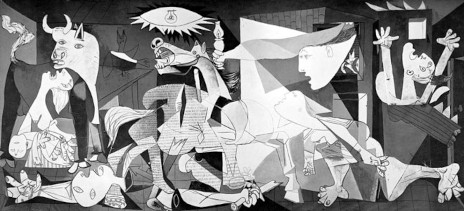
- Therefore, war is wrong.
Does it make sense to simply incorporate a work of art as a premise to an argument. One problem—and this may be the reason for the apparent Islamic privileging of verbal arguments—is that arguments that incorporate a work of art as a premise are hard to criticize. I am not a pacifist. So I accept that the above argument is unsound. But it is really hard to see what I deny. Do I deny premise (1), i.e., deny Guernica? That seems to be a category mistake. Or do I deny that (2) follows from (1)? So there is something unfair about the use of art in argument—one is putting oneself beyond criticism, except maybe by a competing work of art.
Difficulties with this notwithstanding, I do think the idea that a work of art can express an otherwise ineffable proposition is defensible. Perhaps Guernica expresses the proposition that war is like this (isn't it fun to use hyperlinks to indicate referrents of demonstratives?). If so, then while denying Guernica is a category mistake, denying the proposition expressed by Guernica is no category mistake.
If so, then poems, songs, novels, etc. can express propositions that have truth value. This might be relevant to an account of Biblical inerrancy that includes the full range of genres found in Scripture.
Final note: I think the Bach and Guernica arguments may have different logical forms. It may not be that the music of Bach itself expresses something that implies the existence of God, so that the music is not a premise, but only a part of a premise—the premise that there is this [mp3 download is from here].
Wednesday, January 9, 2008
Liberal theology
Consider a revealed religion, say Christianity. I will use "the Sources" for the locus or loci where revelation is believed to be discursively embodied. In the case of Catholic Christianity, the Sources are Scripture and Tradition, in the case of Protestant Christianity, the Sources might be just Scripture, and in the case of Islam, the Sources will be the Qur'an and various traditions. The liberal theologian does not believe that any part of the Sources is infallible in matters of faith or morals. I will take this to be part of the definition of a liberal theologian, and will argue that liberal theology is untenable.
As an adherent of a revealed religion, the liberal theologian has to accord some authority to the Sources. And so she has to decide when to follow the Sources and when not to. Since no part of the Sources is taken by her to be infallible, she has to make that decision by the light of her reason.
Thus we get our first conclusion: The liberal theologian, to be consistent, must have a high view of reason. I suspect that some liberal theologians, in the thrall of postmodern thought, do not have a high view of reason. But then they are inconsistent. For there to be any hope of a liberal theology, reason has to be capable of trumping the Sources.
Let us, then, suppose that our liberal theologian has a high view of reason. She rejects claims from the Sources when she takes them to conflict with reason. But what does it mean to conflict with reason? There are two kinds of deliverances of reason: (1) apodeictic ones are justified by a logically impeccable argument from self-evidently true premises, and (2) plausibilistic fall short of that, either by employing inductive or probabilistic argumentation, or by relying on premises that are not self-evidently true. Now I am not planning to offer any argument against in this post against being a liberal theologian in whose theological practice only the apodeictic deliverances of reason trump the Sources. But I just don't think there are any liberal theologians like that. The typical disagreements with the Sources rely on plausibilistic arguments. There are, for instance, no available apodeictic arguments for claims like:
- salvation apart from Christ is possible
- any non-reproductive role that a man can appropriately play, a woman can appropriately play as well
- same-sex sexual relations are permissible
- marital contraception is permissible
- miracles do not happen
- we are the product of a random, unguided, natural process
- everyone achieves salvation
- all the major religions tell us the same truth about God
So our liberal theologian now not only has a high view of reason, but also believes that some merely plausibilistic arguments trump the Sources. But now we have a problem. Merely plausibilistic arguments can be wrong, no matter how strong they are. That is what distinguishes them from apodeictic ones. Now, if the Sources have some authority, it cannot be that every merely plausibilistic argument trumps the Sources.[note 1]
Thus, we get our second conclusion: The liberal theologian needs to distinguish between those plausibilistic arguments that are strong enough to trump the Sources and those that are not strong enough. (The degree of strength required may depend on which part of the Sources is contradicted by the argument.)
From this it follows: The liberal theologian's methodology closes the door to the possibility that we be corrected by divine revelation when there is a sufficiently strong plausibilistic argument for a false conclusion. After all, no matter how great a degree of strength we require in a plausibilistic argument, an argument could have that strength and still lead to a false conclusion. That is because it is plausibilistic and not apodeictic. And if the argument is strong enough, it will trump anything in the Sources. This is an unfortunate conclusion, and one that should worry the liberal theologian, given the possibility of very strong plausibilistic arguments for false conclusions.
On the other hand, revelation often concerns things beyond our experience and beyond the powers of our reason. If one takes somewhat seriously the authority of the Sources and the fallibility of reason, one will be very cautious about the idea of reason trumping the Sources. Thus: The liberal theologian needs to accept that the Sources trump reason in many of the areas of revelation, because these areas go beyond reason's competence. Thus a liberal theologian with a realistic view of reason's limitations cannot be too liberal. And, in fact, I think a realistic view of reason's limitations in regard to plausibilistic arguments makes the project of liberal theology implausible.
Let me end with what I think is one of the most serious in-practice objections to certain moral aspects of liberal theology. Many of the plausibilistic arguments in the liberal theologian's repertoire at most establish a presumption in favor of the conclusion, and thus have the form: "In light of such-and-such facts, there is a presumption in favor of claim p, absent considerations to the contrary." But surely arguments of that form should not trump the Sources--the Sources, after all, are a consideration to the contrary. Let me explain what I mean here by way of example, using an idea from this old post of mine. Take, for instance, a liberal Christian theologian who wants to argue that some form of sexual activity (e.g., same-sex sexual relations) that the Sources say is wrong is in fact acceptable. But in fact there really aren't any very strong positive arguments for the permissibility of a form of sexual activity apart from a presumption of permission, i.e., a view that if we can't find an argument against A, then we should assume A to be permissible. Granted, there might be some arguments based on considerations of autonomy, but Christians who believe that God is in charge of us--and it is hard not to believe that even if one is a liberal theologian--are surely going to be suspicious of that. Nor are there any very strong positive arguments against the claim that God in his omniscience might see some bad consequences of an activity that we do not see--this happens quite often. The most reason can say in favor of the form of activity is something like: "As far as we can tell by reason, there are no strong considerations to the contrary." Yes, but a judgment like that will certainly be trumped by the Sources, unless one has such a low view of the Sources that one is not really considering them to be Sources anymore.
This post is inspired by discussions with Trent Dougherty, but he should not be thought of as endorsing anything here.
Tuesday, October 23, 2007
The deposit of faith
Consider the following objection to the Catholic faith (this is based on something I got by email): Catholicism includes a large number of detailed and substantive doctrines that do not seem to be derivable from God's revelation as completed by around the time of death of the Apostles, even though the Catholic Church herself claims that revelation was completed by around the time of death of the Apostles.
Consider, after all, something like the doctrine that Mary was free of original sin from the first moment of her conception. This is a detailed and substantive doctrine that seems to go far beyond the information given in Scripture and what we know about the faith of the first century Church from non-Scriptural sources. The objection is an incredulous stare at the possibility that such doctrines could be derived from revelation as completed by around the time of death of the Apostles. But:
1. Twenty simple axioms of Euclidean geometry generate an infinity of detailed and substantive theorems. These theorems are such that there is no prima facie way to see that they would follow from the axioms. It can take centuries and centuries for humankind to discover that they can be derived. It should, thus, be no surprise at all that we can derive from a set S of propositions new propositions that are details and substantive, and that seem to go far beyond S. This is particularly true when S is not a list of twenty axioms, but includes about 27,570 verses of the Old Testament, about 7956 verses of the New Testament, as well as decades of Apostolic preaching which Catholics think became embedded in the tradition of the Church, particularly in her liturgy.
2. Furthermore, unlike the development of geometry which is as far as we know is typically done by the unaided human intellect, the development of Catholic doctrine is claimed to be done by the human intellect guided by Holy Spirit.
3. Moreover, the Scriptures and the Tradition of the Church not only contain particular doctrinal axioms from which we can derive further propositions, but contain ways of reasoning or rules of inference that embody an understanding of how God deals with the world. Prominent among these is typology. In the New Testament and the Church's liturgy, we learn that God works through parallels. The people of Israel pass through the sea; Christians pass through baptism. Adam sins and from his sin comes death; Christ conquers sin and from his conquering sin comes life. The New Testament (Luke 24:27) says that all of the Old Testament scriptures tell us about Christ. Thus there may be substantive ways of reasoning embodied in Scripture, liturgy and theological practice, ways of reasoning that include typological reasoning. These ways of reasoning are, plainly, more than just formal rules of logic. They are based, rather, on an understanding of God as acting in certain ways (maybe with certain motives), as producing a certain kind of deeply interconnected history.
And new insights might well come from this. Christ corresponds in an important way to Adam; but Mary in the Church's understanding corresponds in an important way to Eve. Just as Eve was created without sin, so, too, Mary was created without original sin. Now it is true that prima facie one might have tried different typological correspondences--one might, for instance, make Mary's being conceived in sin be parallel-by-contrast to Eve's being sinless (as Christ's raising us is parallel-by-contrast to Adam's bringing death on us). Working out a deep understanding of the typology here, and connecting it with many other aspects of Christian doctrine, is going to be difficult. It may take centuries, thus, for the Church to settle on a particular understanding, e.g., to see that the parallel between the new creation in Christ and the old creation in Adam does in fact call not just for Christ the new Adam to be without original sin, but Mary the new Eve as well, but of course with her freedom from the weight of original sin flowing from Christ's redemption, just as our Church's freedom from the weight of original sin does.
Conclusion: It should be no surprise if from a very large body of axioms, which includes substantive rules of inference, one could derive many doctrines that one is individually surprised by.
Subscribe to:
Comments (Atom)