Showing posts with label Plato. Show all posts

Thursday, March 27, 2025

Plato and teaching philosophy to the young

In the Republic, Plato says philosophy education shouldn’t start until age 30. I’ve long worried about Plato’s concern about providing young people with tools that, absent intellectual and moral maturity, can just as well be used for sophistry.

Exegetically, however, I think I was missing an important point: Plato is talking about his utopian society, where one can (supposedly) count on society raising the young person to practice the virtues and live by the truth (except for the noble lie). We do not live in such a society. It could well be the case that in our society, young people need the tools.

We might make a judgment like this. Absent the tools of a philosophical education, an intelligent young person set afloat on the currents of our society maybe is 50% likely to be led astray by these currents. The tools are unreliable especially in the hands of the young: perhaps the tools have a 65% chance of leading to the right and 35% of leading to ill. That’s still better than letting the young person navigate society without the tools. But if our society were better—as Plato thinks is the case in his Republic—then the unreliable tools might be worse than just letting society form one.

Thursday, January 23, 2025

Recollection and two types of "Aha!" experiences

On some argumentatively central occasions, Plato refers to an intellectual “aha!” experience of seeing some point (say, something philosophical or mathematical). This is supposed to be evidence for the theory of recollection, because the experience is similar to remembering a nearly forgotten thing.

After insightful comments from students in my philosophy of mathematics seminar today, I think “aha!” experiencess come in two varieties. We might express paradigm instances of the two varieties like this:

  1. Aha! I’ve always thought this, but never quite put it into words!

  2. Aha! Now that I think about this, I see it’s got to be true!

An example of the first variety might be someone who hears about the Golden Rule, and realizes that whenever they were at their best, they were acting in accordance with it. I had a case of the second variety when I was introduced to the distributive law in arithmetic in grade three: I had never thought about whether a ⋅ (b+c) = a ⋅ b + a ⋅ c, but as soon as the question came up, with some sort of an illustrating mental picture, it was clear that it was true.

The two experiences are phenomenologically quite distinct. Type (i) experiences fit better with the Platonic picture of innate knowledge, since type (ii) experiences feel like a new acquisition rather than the recovery of something one already had. Another difference between type (i) and type (ii) experiences is that in type (ii) experiences, we not only take ourselves to have evidence for the thing being true, but the thing becomes quite unmysterious: we see how it has to be true. But type (i) experiences need not have this explanatory feature. When I have the vision of the truth of the distributive law of arithmetic, I see why it’s got to be true though I may not be able to put it into words. Not so with the Golden Rule. I can continue to be mystified by the incumbent obligations, but cannot deny them.

Literal remembering of a forgotten thing seems less like (ii) than like (i). When I remember a forgotten phone number by some prompt, I don’t have an experience of seeing why it’s got to be that.

Plato’s theory of recollection does not account for the phenomenology of type (ii) experiences. And perhaps Plato would admit that. In the Republic, he talks of “the eye of the soul”. The context there is the abilities of this life, rather than recollection. Perhaps type (ii) experiences fit more with the activity of the eye of the soul than with recollection.

At the same time, while (i) is a bit more like remembering, it’s not exactly like it, either. Remembering need not have any “I’ve thought this all along” aspect to it, which type (i) experiences tend to have. So I think neither of our “Aha!” experiences is quite like the theory of recollection leads us to. Is there a third “Aha!” experience that does? I doubt it, but maybe.

Thursday, February 23, 2023

Morality and the gods

In the Meno, we get a solution to the puzzle of why it is that virtue does not seem, as an empirical matter of fact, to be teachable. The solution is that instead of involving knowledge, virtue involves true belief, and true belief is not teachable in the way knowledge is.

The distinction between knowledge and true belief seems to be that knowledge is true opinion made firm by explanatory account (aitias logismoi, 98a).

This may seem to the modern philosophical reader to confuse explanation and justification. It is justification, not explanation, that is needed for knowledge. One can know that sunflowers turn to the sun without anyone knowing why or how they do so. But what Plato seems to be after here is not merely justified true belief, but something like the scientia of the Aristotelians, an explanatorily structured understanding.

But not every area seems like the case of sunflowers. There would be something very odd in a tribe knowing Fermat’s Last Theorem to be true, but without anybody in the tribe, or anybody in contact with the tribe, having anything like an explanation or proof. Mathematical knowledge of non-axiomatic claims typically involves something explanation-like: a derivation from first principles. We can, of course, rely on an expert, but eventually we must come to something proof-like.

I think ethics is in a way similar. There is something very odd about having justified true belief—knowledge in the modern sense—of ethical truths but not knowing why they are true. Yet it seems humans are often in this position. They know the ethical truths but not why they are true. Yet they have correct, and maybe even justified, moral judgments about many things. What explains this?

Socrates’ answer in the Meno is that it is the gods. The gods instill true moral opinion in people (especially the poets).

This is not a bad answer.

Thursday, February 2, 2023

Socrates and thinking for yourself

There is a popular picture of Socrates as someone inviting us to think for ourselves. I was just re-reading the Euthyphro, and realizing that the popular picture is severely incomplete.

Recall the setting. Euthyphro is prosecuting a murder case against his father. The case is fraught with complexity and which a typical Greek would think should not be brought for multiple reasons, the main one being that the accused is the prosecutor’s father and we have very strong duties towards parents, and a secondary one being that the killing was unintentional and by neglect. Socrates then says:

most men would not know how they could do this and be right. It is not the part of anyone to do this, but of one who is far advanced in wisdom. (4b)

We learn in the rest of the dialogue that Euthyphro is pompous, full of himself, needs simple distinctions to be explained, and, to understate the point, is far from “advanced in wisdom”. And he thinks for himself, doing that which the ordinary Greek thinks to be a quite bad idea.

The message we get seems to be that you should abide by cultural norms, unless you are “far advanced in wisdom”. And when we add the critiques of cultural elites and ordinary competent craftsmen from the Apology, we see that almost no one is “advanced in wisdom”. The consequence is that we should not depart significantly from cultural norms.

This reading fits well with the general message we get about the poets: they don’t know how to live well, but they have some kind of a connection with the gods, so presumably we should live by their message. Perhaps there is an exception for those sufficiently wise to figure things out for themselves, but those are extremely rare, while those who think themselves wise are extremely common. There is a great risk in significantly departing from the cultural norms enshrined in the poets—for one is much more likely to be one of those who think themselves wise than one of those who are genuinely wise.

I am not endorsing this kind of complacency. For one, those of us who are religious have two rich sets of cultural norms to draw on, a secular set and a religious one, and in our present Western setting the two tend to have sufficient disagreement that complacency is not possible—one must make a choice in many cases. And then there is grace.

Wednesday, September 29, 2021

The Fourth Way, remixed

I’m playing with a reading—or perhaps remix—of Aquinas’ Fourth and Fifth Ways as giving a theistic solution to a problem that non-theistic Aristotelianism has no solution to. In this post, I will discuss the Fourth Way, and in the next, the Fifth.

The Fourth Way starts with the principle that degreed predicates, predicates where it makes sense to talk of “more” and “less”, are predicated in comparison to a maximal case. Infamously, however, given modern science, Aquinas’ down-to-earth illustration of that principle, namely that heat is predicated in comparison to the maximal case—allegedly, fire—is not not an example of the principle, but is actually a counterexample to it. There just is no such thing as maximum heat.

But nevermind heat. Aquinas wants to apply the Fourth Way to goodness. Now, the Aristotelian system that he has adopted already has an account of the good: a thing is good to the extent that it fulfills its proper function, a proper function that is defined by the thing’s form. Note that this account, too, does not match Aquinas’ gradation principle: unlike in Plato, forms are not self-predicating, so rather than the Form of the Sheep being the most ovine thing possible, the Aristotelian form of the sheep is immanent in each sheep, directing each sheep to an ovine perfection that no object actually meets.

But the Aristotelian account of the good is incomplete. While it allows us to compare the goodness of things within a kind—the four-legged sheep better fulfills its form than a three-legged one—there are also meaningful value comparisons between kinds. When Jesus says that we are “worth more than many sparrows” (Mt. 10:31), what he is saying is entirely commonsense. The human has much more good than the sparrow. The sparrow has more good than the worm. And the worm has more good than a mushroom. There really is a something like a great chain of being in reality. These comparisons, however, are not simply grounded in the immanent forms of things. The form of the worm need make no reference to mushrooms, nor that of a mushroom to worms.

Note that these interspecies value comparisons not only cannot be read off from the immanent forms, but sometimes they are in a kind of tension with the immanent forms. An earthworm’s form limits the neural development of the worm. Were the worm to grow a brain as big as a dog’s, it wouldn’t be able to burrow as well. And a mushroom that walked around would fail to be properly rooted as a mushroom ought.

Interspecies value comparison is a genuine problem that Aristotelianism faces, though some Aristotelians are willing to bite the bullet and deny the meaningfulness of such comparisons. Platonism did not face this problem—it could just talk of varying degrees of participation in the Form fo the Good—but Platonism lacked a satisfactory solution to the problem of intraspecies comparisons (Platonism’s solution would be to posit a self-exemplified Form for each species, which would involve the absurd idea that there is a perfect Sheep, which somehow manages to be both a sheep and immaterial, and we have all sorts of silly questions about whether it is male or female, what color it is, whether it has an even or an odd number of hairs, etc.)

A theistic Aristotelianism, however, has a solution to the problem of interspecies value comparison, in addition to non-theistic Aristotelianism’s solution to the intraspecies’ problem. There is a great chain of being defined by the ways in which the various species participate in the being that has all perfections. The human exemplifies intellection, the sparrow approximates omnipresence through rapid movement and exemplifies a significant degree of intelligence, the worm approximates omnipresence less well and has a lower degree of intelligence, while the mushroom at least exemplifies life. What grounds the goodness of these qualities independently of the forms of the things they are found in, and what makes for their axiological directionality (more intelligence is better than less), is then comparison to the maximal case, namely God.

Note that while this gives something like a great chain of being, it need not exactly be a great chain of being. We should not seek after a strictly total ordering—a partial ordering matches intuition better.

I don’t have a knock-down argument that theistic Aristotelianism is the only good Aristotelian solution to the problem of interspecies comparison. But it is a very good solution, and so once we have accepted basic Aristotelianism, it gives us significant reason to adopt the theistic version.

An earlier, more compact, version of this argument is here.

Friday, January 26, 2018

The Euthyphro

I’ve realized today that I read the Euthyphro dilemma differently from how some other people do. I think some people read it as meant to be a real dilemma—a real philosophical question—whether the gods love the holy because it’s holy or whether things are holy because the gods love them.

Maybe it is a real philosophical question, but I don’t think that’s how the text intends it. I suspect that Plato (along, I expect, with Socrates) just straightforwardly thinks:

  1. The gods love the holy because it is holy.

  2. If the holy were defined as what is loved by the gods, then the holy would be the holy because the gods love it.

  3. There is no circularity in explanation. (Implicit premise)

  4. So, the holy is not defined as what is loved by the gods. QED

Friday, June 30, 2017

The variety of beauty

A crucial part of Diotima’s ladder is the progress from sensible beauty to the non-sensible beauty of mind, law and mathematics. From time to time I’m struck by how very strange it is that such very different things as paintings, faces, poems, minds and theorems have beauty in common.

If one has a view of beauty as that which gives a certain “aesthetic pleasure”, it’s easy to explain this: it is not that surprising that different inputs could give rise to the same kind of pleasure. But that view of beauty is false. (We would not make my preschool scribbles more beautiful than Monet’s mature paintings by brainwashing people into taking more aesthetic pleasure in the former than in the latter.)

Plato’s famous explanation is that all these different things participate in the same form. But that leaves mysterious why it is that a painting that exhibits a certain harmonious play of colors and a theorem that is illuminating and unifying in a certain way both end up necessarily participating in the form of beauty. There needs to be a connection between the configurations that give rise to beauty and the participation in the form of beauty. The historical Plato seems to have thought that there was a common mathematical structure in all these configurations, but this seems quite implausible given the great variability of them.

Perhaps a theistic explanation can make some progress. All beauty is a participation in God. But God is infinitely beyond all else, so this participation is from an infinite distance, and it is not so surprising that the infinite richness of God can be participated in in infinitely many different ways.

The difficulty with this explanation is that beauty is not the only property that’s a participation in God. Every positive property is a participation in God. And some positive properties—say, knowledge—are much more unified than beauty. Perhaps it helps, though, to have the medieval view that beauty, goodness and being are all in some sense interchangeable. So perhaps every participation in God constitutes beauty, and so the great variety of participations in God gives rise to the great variety of types of beauty.

Friday, December 16, 2016

The sharpness of the Platonic realm

I feel an intellectual pull to a view that also repels me. The view is that all contingent vague truths are grounded in contingent definite truths and necessary vague truths. For instance, that Jim is bald might be grounded in a contingent definite truth about the areal density of hair on his scalp and a necessary vague truth that anyone with that areal density of hair is bald.

On this view, any vague differences between possible worlds are grounded in definite differences between possible worlds.

But the view also repels me. I have the Platonic intuition that the realm of necessary truth should be clean, unchanging, sharp and definite. Plato would be very surprised to think that fuzziness in the physical world is grounded in fuzziness in the Platonic realm.

Epistemicism, of course, nicely reconciles the Platonic intuition about necessary truths with the intellectual pull of the grounding claim. For it is no surprise that there be things in the Platonic realm that are not accessible to us. If vagueness is merely epistemic, then there is no difficulty about vagueness in the Platonic realm.

Friday, September 20, 2013

Two thoughts on theologians who say "God does not exist"

Some theologians like to say that God does not exist. They say this to mark the radical difference between God and creatures.

1. If one is going to say such things, a more helpful way to speak would be: "God exists but we don't." For that would still get across the radical difference between God and creatures, but get right the fact that God is the one who is the more real. Compared to God's reality, we are but shadows. It is said that God said to St Catherine of Siena: "I am who I am, and you are she who is not." This poetically conveys a deep truth. We are but shadows, and "shadow" is often an overstatement.

2. There are many metaphysicians who like to say that complex artifacts like tables, chairs and blowguns don't exist. But many of them say this only in philosophical contexts and not in "ordinary" contexts, or they qualify the "don't exist" with a "really". They may or may not be misguided in the form of their odd denial, but what they (we!) are getting at is plausible: There is a deep difference between the kind of being that a table, chair or blowgun has, and the kind of being that a horse or a photon have (some of these philosophers will class the horse with the chair; that's mistaken, but the basic point I am making isn't affected). The ordinary language sentences "The pig exists" and "The car exists" have very different (nonpropositional) grounds: the former is grounded in a single thing while the latter is grounded in the arrangement of many things. Well, these theologians, like these metaphysicians, are also impressed by a deep ontological difference (a deeper one, perhaps). But like the metaphysician who is willing to speak with nonphilosophers in ordinary ways, these theologians should be willing to say "God exists" in contexts of ordinary worship. Or like the metaphysician who says that computers don't really exist, she could simply make a qualification: "God doesn't exist in the shadowy way." Or, more perspicuously?, she could say: "We don't really exist, but God does." (Though I think that if one does that, one should also distinguish us from artifacts. Perhaps the distinction could be marked with "really" and "really really"!)

Tuesday, February 7, 2012

Inferring an "is" from an "ought"

You tell me that you saw a beautiful sunset last night. I conclude that you saw a beautiful sunset last night. You are talking about Mother Teresa. I conclude that you won't say that she was a sneaky politician. You promise to bake a pie for the party tomorrow. I conclude that you will bake a pie for the party tomorrow or you will have a good reason for not doing so. I tell a graduate student to read a page of Kant for next class. I conclude that she will read a page of Kant for next class or will have a good reason for not doing so.

All of these are inferences of an "is" from an "ought". You ought to refrain from telling me you saw a beautiful sunset last night, unless of course you did see one. You ought not say that Mother Teresa was a sneaky politician, as she was not. You ought not fail to bake the promised cake, unless you have good reason. The student ought not fail to read the Kant, unless she has good reason.

All of these are of a piece. We have prima facie reason to conclude from the fact that something ought to be so that it is so. In particular, belief on testimony is a special case of the is-from-ought inference.

In a fallen world, all of these inferences are highly defeasible. But defeasible or not, they carry weight. And there is a virtue—both moral and intellectual—that is exercised in giving these inferences their due weight. We might call this virtue (natural) faith or appropriate trust. We also use the term "charity" to cover many of the cases of the exercise of this virtue: To interpret others' actions in such ways as make them not be counterinstances to the is-from-ought inference is to charitably interpret them, and we have defeasible reason to do so.

The inference may generalize outside the sphere of human behavior. A sheep ought to have four legs. Sally is a sheep. So (defeasibly) Sally has four legs.

I used to think that testimony was epistemically irreducible. I am now inclined to think it is reducible to the is-from-ought inference. Seeing it as of a piece with other is-from-ought inferences is helpful in handling testimonial-like evidence that is not quite testimony. For instance, hints are not testimony strictly speaking, but an inference from a hint is relevantly like an inference from testimony. We can say that an inference from a hint is a case of an is-from-ought inference, but a weaker one because the "ought" in the case of a hint is ceteris paribus weaker than the "ought" in the case of assertion. Likewise, inference from an endorsement of a person to the person's worthiness of the endorsement is like inference from testimony, but endorsement of a person is not the same as testimony (I can testify that a person is wonderful without endorsing the person, and I can endorse a person without any further testimony). Again, inference from endorsement is a special case of is-from-ought: one ought not endorse those who are not worthy of endorsement.

If is-from-ought is a good form of inference, the contraposition may-from-is will also be a good form of inference. If someone is doing something, we have reason to think she is permitted to do it. Of course, there are many, many defeaters.

It is an interesting question whether the is-from-ought inference is at all plausible apart from a view like theism or Plato's Platonism on which the world is ultimately explanatorily governed by values. There may be an argument for theism (or Plato's Platonism!) here.

Thursday, December 22, 2011

Speculations on imitation, reflection, symmetry, truth, justice and value

Beartooth Butte / USDA/Forest Service
Imitation is a kind of reflection, and reflection seems to introduce a new symmetry into the world.  Symmetry has value, aesthetic value.  Therefore imitation seems to introduce value.

Wikipedia
Plato thought that the value of an imitation was derivative from the value of what was imitated.  That may be true if one considers the imitation in and of itself.  If the water is perfectly still, an ugly building will have an ugly reflection (if the water is not perfectly still, the natural beauty of the water may improve on the building).  But when one considers the imitation together with the imitated, the resultant symmetry can produce new, additional beauty.  The kaleidoscope is the most obvious example, where beauty arises by reflection from a jumble of shapes.
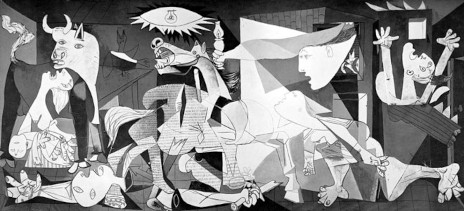

Thus the revelation of ugliness, as in Picasso's Guernica, when taken together with the horror that it reflects is a greater whole with a kind of grim beauty of symmetry.  This kind of symmetry is a case of truth.  It is aesthetically crucial for Guernica that the horrors it reflects are real.  Truth can have a beauty to it when it is a form of symmetry.  Thus at least sometimes we should take truth to correspond to reality.  

Symmetry, thus, is one way in which the bad and the ugly can become a constituent part of a good, a good that defeats the ugly and moves in the direction of defeating the bad.  Justice, in fitting reward and punishment, provides a further symmetry, a symmetry that also exhibits the aesthetic value of symmetry--we admire this aesthetic value when enjoy works of literature and film that exhibit poetic justice.  But justice has a value going beyond the aesthetic, as surely does truth.

The above show how one can derive an aesthetic value in imitation from the value of symmetry.  One could try to run the derivation in the opposite direction.  Could symmetry just be a form of imitation, and hence take its value from imitation?  First of all, only non-naturalists like theists and Platonists can say this, because a "chance" arrangement of pebbles can exhibit a genuinely beautiful symmetry without there being any imitation there.  The theist can say that Providence is behind the chance arrangement, and hence each symmetric segment of the arrangement can be imitating God in an infinitely imperfect way, while the Platonist can say that both symmetric segments reflect some Form.  But this would put the imitation in the wrong place.  For in the "chance" symmetric arrangement, what is beautiful is not just that each symmetric segment imitates God or the Forms, but that they are symmetric to one another.  This symmetry is not just a mirroring, because mirroring has an essential distinction between the mirror image and reality, with the reality being explanatorily prior, while the segments of an artistically planned symmetric arrangement do not need to have one of them be explanatorily prior to the others.

But, nonetheless, the theist needs to affirm that there is a value in imitation that does not come from the value of symmetry and, further, that there can be cases where imitation has no value of symmetry.  For all creation imitates God, but it does not thereby produce a greater God-and-creation whole (even an ontologically innocent) that exhibits the value of symmetry.  For nothing can add anything to God.  There is no holistic value of which God is component.  God perfectly exhibits the symmetry of three Persons with precisely one essence, and creation's imperfect imitation adds nothing to this perfection.  There is no new valuable symmetry of "God and creation".  Thus while symmetry is valuable in and of itself, imitation can have a value over and beyond the value of symmetry: the imitation of God only highlights the infinite gulf between God and creation rather than creating symmetry.

And so we come back to seeing that Plato may have been right.  The value (aesthetic and otherwise) of the imitation qua imitation, rather than of the imitation qua producer of symmetry, depends on the value of what is being imitated.  Creation as imitation of God exhibits that value, but does not as imitation of God exhibit the value of symmetry.  On the other hand, Guernica has no additional value of imitation qua imitation beyond symmetry, since the horrors of war that are being imitated are ugly and evil.  But at the same time, revelatory imitation of evil can have an additional value qua revelatory, namely the value of truth.

Thus, while there is a tie between imitation and symmetry, and within creation imitation produces a kind of symmetry, we should not derive the value of imitation from that of symmetry nor that of symmetry from that of imitation.  Likewise, truth and retributive justice have values independent of symmetry, though truth about creatures and retribution, whether positive or negative, to creatures seems to always exhibit the value of symmetry as well.

Wednesday, October 19, 2011

Plato might have been a "nominalist"

I was reading the SEP entry on nominalism by Rodriguez-Pereyra. Rodriguez-Pereyra sees nominalism as basically the rejection of causally inert non-spatiotemporal entities. If so, then Plato might have been a nominalist. It seems that Plato did not think the Form of the Good was causally inert--it caused the good arrangement of things in the universe. I don't know if Plato generalized from that case, but he might well have--he might have taken all of the Forms to be capable of causing things to be like them. So, for all I know, Plato was a nominalist.

And Leibniz might have been was a nominalist despite going on and on about abstract objects, because he thought of them as ideas guiding God's deliberation, and hence perhaps we should say that on his view they had a causal role in creation.

This isn't a big deal. Rodriguez-Pereyra's account nicely captures a rejection of modern forms of Platonist.

I wonder, too, whether a belief in Newtonian space is compatible with nominalism by this definition. Newtonian space seems to be causally inert (perhaps unlike the Riemannian manifold of General Relativity). And it may be a category mistake to say that space is spatiotemporal. Though maybe it's fine to say that space is spatiotemporal in some trivial sense.

Wednesday, March 9, 2011

Healing and harming

Plato was impressed with the idea that he who can best heal is he who can best kill. I doubt it. The big brawny person with the nail-studded club can kill as well as a physician. But a weaker claim seems plausible: those who are competent to make one well are competent to make one unwell. The reverse is false. Competence with clubs and poisons does not imply competence in surgery and healing drugs. Similarly, it is easy to completely destroy a car and hard to be a mechanic. The asymmetry is interesting. It suggests an important asymmetry between good and evil.

Wednesday, January 5, 2011

Friendship and friendly love

Thesis 1: There is no special form of love that falls under the label "friendly love" or "the love characteristic of friendship". Every love is a friendly love.

To love someone involves appreciating the beloved, pursuing her good, and seeking some sort of union of common pursuit with her. If we have only one out of three then we do not have love, but something else, respectively like disinterested appreciation, benevolence or lust. Nor are two out of three enough. But if one has all three, one has friendly love. For friendship is multiform, and any common pursuit providing a genuine union can be made the object of a friendship.

One might try to distinguish "friendly love", however, by its mutuality. While one can have unrequited romantic love, one cannot have unrequited friendship. Friendship is essentially mutual. But this argument is invalid, since friendship is not the same as friendly love. Friendly love is the love characteristic of friendship. But it can exist without a friendship. If I am your false friend, but am a very good actor, we can have what from your point of view looks just like friendship. And your love does not fall short of friendly love—it is my love that does so. So, you have a friendly love, even though there is no friendship. Or consider cases where the friendship has been lost, because one party has slid into vice, but the other retains a friendly love, striving to rescue the backslider.

The distinction between friendly love and friendship is essential to Plato's Lysis. The Lysis begins by attempting to define a friend (philos--the noun) in terms of friendly loving (philein--the verbal form; I am suspecting that philia is ambiguous in the Greek between friendly love and friendship). We begin by rejecting the definition of a friend as someone whom one loves with friendly love or someone who loves one with friendly love, on the grounds that if the friendly love is reciprocated with hatred, we do not have a case of a friend. This argument requires that it be possible to have a friendly love that is reciprocated with hatred, and hence that it is possible to have a friendly love without friendship.

Thesis 2: Friendship is the right kind of mutuality in friendly love, i.e., in love.

I do not know how exactly to characterize this mutuality, though. Minimally, it requires that each should know of the other's friendly love, but more than that is needed.

A consequence of this is that appropriately mutual romantic love is a kind of friendship.

Saturday, September 19, 2009

Caring and fundamentality

One of my basic driving intuitions is that the things we should most care about are the ones that are most fundamental ontologically. This intuition drives me away from micro-reductionism (facts about people, animals and the like reducing to properties of microscopic stuff) and towards macro-reductionism (facts about particles, at least sometimes, reduce to facts about the macroscopic things they are "part" of).

Tuesday, August 18, 2009

The liar paradox and desire

The standard desire version of the liar paradox is to consider a person whose only desire is to have no satisfied desires. But that's a weird enough desire that one might wonder if it's possible to have it. Here is a version of the liar paradox using desires that are more imaginable.

Malefa has only one desire: That none of Bonnie's desires be satisfied. Bonnie has only one desire: That all of Malefa's desires be satisfied. Whose desire is satisfied? If Malefa's is, then Bonnie's isn't, and Malefa's isn't. If Malefa's isn't, then Bonnie's is, and Malefa's is, too.

What assumptions does this paradox depend on?

  1. It is possible that Malefa and Bonnie both have the above desires.
  2. The following disquotational schema for desire satisfaction is correct: A desire that p is satisfied iff I(p) (where I(p) is p rewritten with the subjunctive mood replaced by the indicative; thus, I("he eat ice cream") is "he eats ice cream"; to be more precise in the schema, I need to put in quotation marks of the right sort, but I'm not going to bother);
  3. Classical logic.

In regard to (1), one might worry that it's not possible to have only one desire. But that's easily handled by modifying the cases. Maybe Malefa's strongest (or most intense or latest acquired) desire is that Bonnie's strongest (or most intense or latest acquired) desire not be satisfied, and Bonnie's strongest (or ...) desire is that Malefa's strongest (or ...) desire be satisfied.

Moreover, there is nothing absurd about having desires that someone else's desires be or not be satisfied.

One could do what I did in my Monday post and argue that whether Malefa actually manages to have the indicated desires depends on what Bonnie desires (or vice versa or both). Somehow, I find this less plausible in the case of desire—I guess I feel a pull of a certain internalism about desire.

A different move would be based on the Gorgias. In the Gorgias, Socrates argues at length that the tyrant, though he is able to put enemies to death and all that, gets less and less of what he wants the more powerful he is. The reason for that is that he does not really desire to put enemies to death and all that—what he really wants is happiness. There are a couple of ways of taking Socrates' point. One way is to say that there are no instrumental desires. If the tyrant had a desire to have enemies put to death, that would be merely instrumental. Another way (I think Heda Segvic took this view) is to make desire have a normative dimension, such that to desire is to desire appropriately, so that the tyrant does not desire the deaths of his enemies.

Both of these two readings undercut the view that everything that can be put in a (subjunctified) "that clause" can be an object of desire. Moreover, they in particular make questionable the possibility of one person desiring that another's desires not be satisfied: that desire seems too much akin to the tyrant's desire that so-and-so die.

The paradox gives support for the thesis of the Gorgias. But there is something uncomfortable in using a paradox to give support to a substantive philosophical position.

Moreover, one might think that the solution in the case of the desire-satisfaction form of the paradox should be the same as in the case of the truth form. I am not completely sure. (Here is a consideration to back up my uncertainty: the complements of desires are subjunctified that-clauses, while the complements of beliefs and assertions are indicative that-clauses. This observation weakens—ever so slightly—the standard view that the object of a desire is a proposition. But the object of belief and assertion is a proposition. (I say this without committing to a realism about propositions.))

Thursday, March 26, 2009

The Phaedo equality argument

I've never quite got the Phaedo 75 "equality" argument. The point is made that whenever we have two equal things in the physical world, they are never simply equal, but are always only equal in some respect. From this we are supposed to infer that we do not get the concept of equality from the two things. Here are two readings that build arguments out of the text. Whether they're faithful to what Plato is saying is a different question.

Reading 1: Take two sticks. They are related in many respects. In one respect, they are equal. In another, they are not. Their may be equal length, but not in their width. Moreover, the length of the one is certainly not equal to the width of the other. (I include that remark in case one is tempted to say: "Why not just consider the same stick twice over, and then it'll surely be equal to itself?" But no, it, too, will only be equal to itself secundum quid—its length will be equal to its length, but not to its width, say.) The two sticks are related in all kinds of ways other than equality. Among these many relations that they stand in (such as inequality in width, difference in color, similarity in value, etc.), there is equality, in repect of length. To recognize the equality, in respect of length, among the many relations that they stand in, requires that we already have the concept of equality so that seeing it in the crowd of relations will pick it out from that crowd.

Objection: We can't do it just with two sticks, but if we have enough items, we can abstract equality from them. For it might be that a1 and b1 stand in a multitudinous set M1 of relations including equality, and a2 and b2 stand in a multitudinous set M2 of relations, and so on. But maybe the intersection of M1,M2,...,Mn contains only equality.

Response: There are so many relations that things stand in, that it is very unlikely that the intersection will be a mere singleton.

Objection: We can get to equality as long as we specify "in respect of length". So we do get the concept of equality from the sticks—"the relation in which their lengths stand to one another."

Response: First, the lengths of the sticks stand in infinitely many relations, equality being but one of those relations. (To give a non-Platonic example, the two lengths stand in the relation of being equal or the same color. Or the two lengths stand in the relation of being observed by the same observer.) So the problem reappears. Second, "length" must be defined in some respect—from which exact point on one end of the stick do we measure to which exact point on the other end do we measure? And, note, that almost surely we cannot really exactly specify points—the Cartesian coordinates are triples of real numbers, and almost no real numbers can be exactly specified (there are uncountably many real numbers, but only countably many can be exactly specified by us), so almost surely the ones here cannot be.

Reading 2: The two sticks are only equal in some respect R. But even the claim "the two sticks are equal in respect R" only holds in some further respect. And so on. Hence, we never get to equality itself. Concretely, let's start with: they are equal in respect of length. But that only holds in respect of one time—at some later time, one of the sticks will slightly oscillate and they won't be equal. So, they're equal in respect of length in respect of some time. But now, their length has one value in respect of one way of defining lengths, and another value in respect of another way of defining lengths. (There are probably little whiskers of wood fiber sticking out both ends. Do we measure them, or not? Which ones do we measure? Where in the atoms do we start measuring? And of course we have the uncertainty principles to contend with.) Moreover, in what way do we compare the lengths? Do we take a measuring stick to the one, and then to the other? But equality then only holds in respect of measuring sticks that don't change their lengths. And how do we define the measurement with the measuring sticks? Let's say they have tick marks. Where in the tick mark is the relevant point? It is not impossible that these questions go on ad infinitum. But even if they don't, they go further than we can answer them—and so we didn't get the concept of equality from the sticks.

Monday, December 1, 2008

Spiritual sickness and spiritual death

There is a temptation for Catholics—also present for non-Catholic Christians but with different terminology—to settle for avoiding mortal sin. After all, if one has living faith and does not reject Christ's salvific grace through mortal sin, one will be saved. So why should one worry about venial sin?

Leaving aside the question of purgatory—for that is not the heart of the issue, but something more in the way of an effect of it—here is one thing that is wrong with this. In a state of mortal sin, one is bereft of living faith, of charity and of Christian hope. One is spiritually dead. If one is not a state of mortal sin, then one is spiritually alive. But surely we are not merely satisfied with being alive.

It would be silly to say: "I shall not go to the doctor. Yes, I have a great big ulcer, but after all, I am alive, and that is all that matters." While there may be contexts where it is appropriate to shout with joy "I am alive!" as if that was all that mattered—for instance, right after one's life (spiritual or physical) has just been saved. But as regards the body, we do not just want life. We want a life of health. One can be alive, but very ill, close to death. There is still reason to have the joy of life—there is a qualitative difference between that life and death—but that is not what we aspire to. (Here, of course, one recalls what Socrates says about how happiness is thought to require health of body and in fact requires health of soul.)

But there is a disanalogy between the physical illness of those who are physically alive and the spiritual illness of those who are spiritually alive. For while this particular physical illness may not win out, our mortal body is after all heading for the grave—perhaps unless the eschaton intervenes.[note 1] But while spiritually ill though in a state of grace, there is reason to hope—not just hope to overcome that particular illness, but to overcome them all, by the grace of Christ living in us. Thus we do have more reason to rejoice over being spiritually alive than over physically alive—but this rejoicing cannot lead to idleness, since after all, how much do we want to prolong our ill health?

Tuesday, April 29, 2008

Plato on knowledge and teaching

For a long time, based largely on the Meno, I've been under the impression that Plato interdefines knowledge and teaching. Here is the idea:

  1. Teaching is the imparting of knowledge.
  2. Knowledge is what can be taught to every one who is willing and has sufficient learning abilities.
If this is right, then Platonic knowledge is never essentially private. It cannot be essentially indexical, since you cannot believe the same thing I do when I believe that I am six feet tall, arguably. Nor can it be of something essentially temporal: I cannot teach you that I am presently writing this post, because by the time you learn it, it may no be longer true, and hence it may not be knowledge. Neither can knowledge be of culturally relative facts. That this piece of jewelry is beautiful is something I may simply be unable to teach a Spartan, and she may be unable to teach me that that amphora is elegant.

Platonic knowledge thus must be of a non-indexical, atemporal, non-relative reality. And all this follows from Plato's understanding of teaching.

Moreover, teaching is not indoctrination. It is not the mere transmission of opinion or even the turning of knowledge into opinion. It is the imparting of knowledge, so that she who is taught can herself in turn teach. The evidence that the teacher has must itself be evidence that can be imparted to the student. Thus, the evidence, too, must be non-indexical, atemporal and non-relative, accessible to people of all times, cultures and social classes (think of the slave boy) who have sufficient ability. This does not require the theory of recollection--a divinely implanted faculty or knowledge that we receive by illumination at conception will do the trick, too--but does seem to require something special and universal like it.

Furthermore, a part of what it is to teach is to show how the knowledge withstands Socratic questioning--this questioning, thus, is a part of the teaching process, and the knowledge must be something that can survive this.

Or so, on this reading, Plato thinks. Whether it is all true is another question.

Saturday, November 3, 2007

Participation in divine goodness

According to St. Thomas, we only have properties like goodness, wisdom and being by participation in divine goodness, divine wisdom and divine being, respectively. Divine goodness, divine wisdom and divine being are the focal cases of goodness, wisdom and being, respectively. We have these qualities only insofar as we are dependent on God's having their focal cases. Our goodness, our wisdom and our being are mere shadows, as Plato would say, which is why Jesus said that only God is good (Mark 10:18), and St. Catherine of Siena reports God as having told her: "I am he who is and you are she who is not."

I suspect that if we reflect on this, we will find an answer to the question of why it is that we add nothing to the value of God--the world, given that God exists, is in an overall sense no better for having us in it. God's moral goodness is no greater if he creates us than if he does not. This had better be true--what God has chosen to do for us is pure grace, and is in no way necessitated. (And if one thinks that to be truly good, one needs some kind of generation of good, the a-causal timeless begetting of the consubstantial Son by the Father, and the a-causal timeless procession of the consubstantial Holy Spirit from the Father through the Son, should help.)

All this should provide ample ammunition against Rowe's argument that God doesn't exist, because if he did, then for any world he created, he could have created a better, and hence he could be morally outdone. For God's moral worth is not dependent on what he creates; this worth is, simply, infinite, no matter what.