I once ran a panel discussion between an Islamic theologian and a philosopher of art. The Islamic theologian was defending what she claimed was traditional Islamic jurisprudence, that for the sake of freedom of inquiry it is legally permitted to write anything in the context of intellectual verbal argument (even really nasty things about the founder of Islam, as long as long as they were supported by argumentation), but that there are restrictions on, say, what is permitted in art. The idea was that in intellectual inquiry, verbal expressions have a privileged status.
It seems to me that this account of inquiry is somewhat impoverished. While argument can be made in words, it can also be made in other ways. In their fun Handbook of Christian Apologetics Kreeft and Tacelli give this argument for the existence of God:
There is the music of Johann Sebastian Bach.I may not see it, because my own appreciation of music is most deficient[note 1], but I see the kind of argument that is made here, and it is not an argument in words—simply asserting that there is the music of J. S. Bach doesn't do the job. The music is an essential part of the argument itself.
Therefore there must be a God.
You either see this one or you don't.
Or consider the following argument:
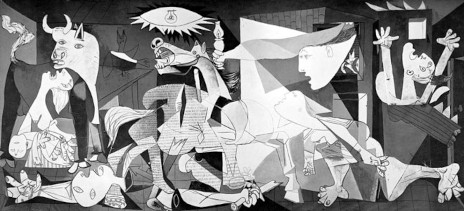
- Therefore, war is wrong.
Does it make sense to simply incorporate a work of art as a premise to an argument. One problem—and this may be the reason for the apparent Islamic privileging of verbal arguments—is that arguments that incorporate a work of art as a premise are hard to criticize. I am not a pacifist. So I accept that the above argument is unsound. But it is really hard to see what I deny. Do I deny premise (1), i.e., deny Guernica? That seems to be a category mistake. Or do I deny that (2) follows from (1)? So there is something unfair about the use of art in argument—one is putting oneself beyond criticism, except maybe by a competing work of art.
Difficulties with this notwithstanding, I do think the idea that a work of art can express an otherwise ineffable proposition is defensible. Perhaps Guernica expresses the proposition that war is like this (isn't it fun to use hyperlinks to indicate referrents of demonstratives?). If so, then while denying Guernica is a category mistake, denying the proposition expressed by Guernica is no category mistake.
If so, then poems, songs, novels, etc. can express propositions that have truth value. This might be relevant to an account of Biblical inerrancy that includes the full range of genres found in Scripture.
Final note: I think the Bach and Guernica arguments may have different logical forms. It may not be that the music of Bach itself expresses something that implies the existence of God, so that the music is not a premise, but only a part of a premise—the premise that there is this [mp3 download is from here].

